Tag Archives: Four Levels

The Nations, and Me

“With each of the thirteen bulls offer a grain offering of three-tenths of an ephah of the finest flour mixed with oil; with each of the two rams, two-tenths.
Numbers 29:14 (NIV)

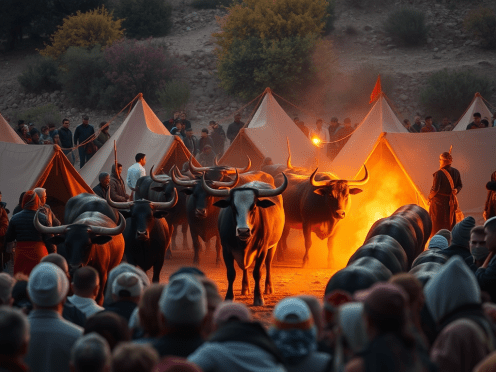
In today’s chapter, God continues to remind the people through Moses of the annual festivals He requires as part of the spiritual rhythm of the community. The final festival described is the “Festival of Tabernacles.” It was a one-week harvest festival held in the autumn. Families gathered and camped out in their own tent for the week, remembering how their ancestors camped out through the wilderness on the way to the Promised Land.

In the detail requirements for the festival, there were 13 bulls sacrificed on day one. The number of bulls sacrificed decreased by one each day until the seventh and final day of the festival in which seven bulls were sacrificed. Whenever I see a pattern like this, I know something is up. This is, after all, the book of Numbers and numbers are important in the Great Story, especially to the ancients.

If I add the total number of sacrifices for the week, it equals 70. Remember, everything in the Great Story is connected and this number 70 connects back to Genesis 10 which lists all the nations of the world. There were 70 nations listed. In our chapter-a-day treks through both Genesis and Leviticus, I observed that God promised Abraham that all the nations of the world would be blessed through him and his offspring. Then God tells the Hebrews at Mt. Sinai that the purpose of them following His ways and His priestly guidebook are so that they would be a light to the nations, showing them His ways.

How fascinating then to think that at the harvest festival, which carries all the metaphorical meaning of gathering in the fruit that has sprung from scattered seed, God asks for a daily series of sacrifices that represent what He is doing on a cosmic spiritual level throughout the Great Story. God wants the whole world to know Him, to learn His ways, and to follow. Jesus wasn’t making something new when He said,

“All authority in heaven and on earth has been given to me. Therefore go and make disciples of all nations, baptizing them in the name of the Father and of the Son and of the Holy Spirit, and teaching them to obey everything I have commanded you. And surely I am with you always, to the very end of the age.”
Matthew 28:18-20 (NIV)

Jesus was perpetuating the game plan that had been established with Abraham and clarified through Moses.

Yet as I meditated on this, there was more. The bull sacrifices during the week of the festival start with the large broad number of 13. That’s one more than the 12 representing the Hebrew tribes. It’s like saying we’re going to start with the all the nations. It’s Hebrews-Plus, the one metaphorically referencing “and everyone else.” As the week goes on, it is whittled down to the intimate and important number of seven, God’s number of “completion.” It’s like God starts with sacrifices for all the nations and then ends by bringing it back to the intimate, complete covenant He made with His people, with Abraham.

Over the past several years I’ve unpacked how God’s plan can be envisioned metaphorically like life on four levels. Level 1 is just me and God. Level 2 is me in relationship with others. Level 3 is me in relationship to the kingdoms of this world. Level 4 is me in relationship with God’s Kingdom. This too is echoed in the receding sacrifices of the Festival of Tabernacles. It begins with sacrifices for Level 3 and all the kingdoms/nations of the world. It tapers down to the final day of the festival when I’m reminded of God’s intimate and personal covenant with me on Level 1.

In the quiet this morning, I’m reminded that God’s ultimate plan for humanity in the Great Story is rooted in the individual. It started with one person in Abraham. Jesus taught His disciples that God’s Kingdom starts with each individual heart. Jesus transforms my heart and my individual life, which transforms my relationship with other individuals in my circles of influence, which then begins to transform my community, my cultures, and even nations.

“But remember,” God whispers in the Feast of Tabernacles and Jesus is saying in the Great Commission, “It all begins with Me in you.”

A good reminder for this Monday morning as I lace ‘em up and head into another work week. Have a good one, my friend.

If you know anyone who might be encouraged by today’s post, please share.

Promotional graphic for Tom Vander Well's Wayfarer blog and podcast, featuring icons of various podcast platforms with a photo of Tom Vander Well.
These chapter-a-day blog posts are also available via podcast on all major podcast platforms including Apple, Google, and Spotify! Simply go to your podcast platform and search for “Wayfarer Tom Vander Well.” If it’s not on your platform, please let me know!
An illustration depicting the significance of the Festival of Tabernacles, featuring a depiction of tents and people gathered in celebration, reflecting the biblical themes of community, sacrifice, and spiritual connection.

The Way of Jesus Exemplified

Perhaps the reason he was separated from you for a little while was that you might have him back forever— no longer as a slave, but better than a slave, as a dear brother. He is very dear to me but even dearer to you, both as a fellow man and as a brother in the Lord.
Philemon 1:15-16 (NIV)

Along this chapter-a-day journey I have gained a love and appreciation for the chapters in this Great Story that no one talks about. When was the last time you hear any one reference Philemon? And yet, the story of Philemon is one of the most beautifully powerful human dramas in the Great Story.

Philemon was a member of the local gathering of of Jesus’ followers in the city of Colossae in Greece. He became a follower of Jesus when Paul visited, shared Jesus’ love and message there, and established the local gathering. Philemon was a man of means, with a household large enough to host the church in his home. His means and his large household included slaves.

Among the slaves in Philemon’s household was a man named Onesimus. Reading between the lines Paul’s very short, intimate letter, Onesimus stole money from Philemon and ran away. Eventually, Onesimus made his way to Rome. In Rome, the runaway slave runs into none other than his former master’s friend Paul who is now under house arrest awaiting trial before Caesar.

We don’t know the details, but the bottom line is that Paul shared Jesus’ love and message with Onesimus, and the runaway slave became a sincere believer. Now, Paul tells Onesimus that he must make things right with Philemon, not as slave and slave-master but as brothers in Christ. He sends the runaway slave back to his master with this letter in hand in order to reconcile the relationship and make things right.

Over the last several years, I have shared with my own local gathering a graphic and a concept that depicts the way of Jesus and how different it is from the way the world operates. The world operates through the force of top-down power and authority. From the childhood game of “king of the mountain” to the power structures of politics, business, commerce, and crime. Whoever has the wealth, influence, and power dictates how things are going to work in this world whether it’s through law, rules, regulations, coercion, domination, leverage, or threat.

Jesus, however, did the opposite. He left the power of heaven itself, came to earth to live as a human being. Through faith, obedience, and sacrificial love He changed the hearts of individuals. He then tasked those of us who are His followers to utilize that same faith, obedience, and sacrificial love to carry His message so that it might change the lives of individuals in our circles of influence. As more and more lives are changed and more and more individuals are operating out of faith, obedience, and sacrificial love, the world itself is impacted.

It’s not top-down power and domination but bottom-up love and generosity.

“For my thoughts are not your thoughts,
    neither are your ways my ways,”
declares the Lord.

Isaiah 55:8 (NIV)

Here’s how I’ve depicted it graphically:

The thing that I love about the story of Philemon is that it perfectly illustrates this entire paradigm.

Level 1: Jesus changes Paul’s life from the inside out.

Level 2: Paul shares Jesus’ love and message with people in Colossae.

Level 1: Jesus changes Philemon’s life from the inside out.

Level 2: Philemon’s community is changed as members of his household and community become believers and meet in his home.

Level 2: Onesimus the runaway slave from Philemon’s household stumbles into Paul, his former master’s friend and member of his former master’s circle of influence, in Rome of all places.

Level 1: Onesimus becomes a believer and Jesus changes him from the inside out.

Level 2: Changed by the love of Jesus, Onesimus returns to Philemon to be reconciled and make things right, their relationship now transformed by the love of Jesus that has transformed each of them.

Level 3: The world is still being impacted by their lives and story. This very blog post and podcast are living proof.

What is beautiful about the letter is the fact that it is all about transformation. The transformation of Philemon and his household into a center of God’s love in their community. The transformation of Onesimus from thief and runaway slave to brother in Christ. The transformation of the relationship between Philemon and Onesimus in which the love and power of Jesus tears down the socio-economic power structure of the world’s paradigm of slavery and replaces it with the love, joy, and peace of spiritual family.

In the quiet this morning, I find myself moved spiritually and emotionally as I imagine the moment when Onesimus arrives to face his master. I imagine the mixture of emotions that each of them were feeling in that moment. I imagine the runaway slave handing Philemon Paul’s letter. The shock and surprise as Philemon reads it. The conflicting emotions in Philemon’s heart as anger gives way to forgiveness, resentment yields to kindness, and the world’s paradigms crumble to the transformational, life-changing power of Jesus’ love.

Jesus, I pray that your love continues to change me today from the inside out, so that your love through me might change those around me, that your love through us might positively impact the world for your Kingdom.

If you know anyone who might be encouraged by today’s post, please share.

These chapter-a-day blog posts are also available via podcast on all major podcast platforms including Apple, Google, and Spotify! Simply go to your podcast platform and search for “Wayfarer Tom Vander Well.” If it’s not on your platform, please let me know!

Lent & the Four Levels