Tag Archives: Nations

The Nations, and Me

“With each of the thirteen bulls offer a grain offering of three-tenths of an ephah of the finest flour mixed with oil; with each of the two rams, two-tenths.
Numbers 29:14 (NIV)

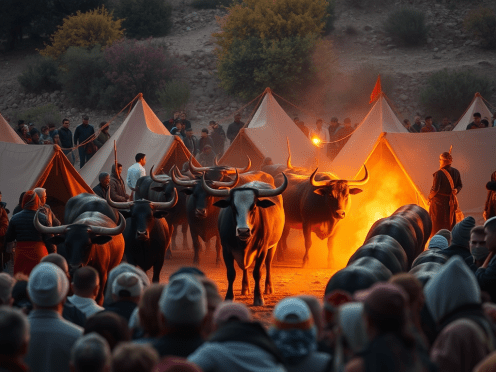
In today’s chapter, God continues to remind the people through Moses of the annual festivals He requires as part of the spiritual rhythm of the community. The final festival described is the “Festival of Tabernacles.” It was a one-week harvest festival held in the autumn. Families gathered and camped out in their own tent for the week, remembering how their ancestors camped out through the wilderness on the way to the Promised Land.

In the detail requirements for the festival, there were 13 bulls sacrificed on day one. The number of bulls sacrificed decreased by one each day until the seventh and final day of the festival in which seven bulls were sacrificed. Whenever I see a pattern like this, I know something is up. This is, after all, the book of Numbers and numbers are important in the Great Story, especially to the ancients.

If I add the total number of sacrifices for the week, it equals 70. Remember, everything in the Great Story is connected and this number 70 connects back to Genesis 10 which lists all the nations of the world. There were 70 nations listed. In our chapter-a-day treks through both Genesis and Leviticus, I observed that God promised Abraham that all the nations of the world would be blessed through him and his offspring. Then God tells the Hebrews at Mt. Sinai that the purpose of them following His ways and His priestly guidebook are so that they would be a light to the nations, showing them His ways.

How fascinating then to think that at the harvest festival, which carries all the metaphorical meaning of gathering in the fruit that has sprung from scattered seed, God asks for a daily series of sacrifices that represent what He is doing on a cosmic spiritual level throughout the Great Story. God wants the whole world to know Him, to learn His ways, and to follow. Jesus wasn’t making something new when He said,

“All authority in heaven and on earth has been given to me. Therefore go and make disciples of all nations, baptizing them in the name of the Father and of the Son and of the Holy Spirit, and teaching them to obey everything I have commanded you. And surely I am with you always, to the very end of the age.”
Matthew 28:18-20 (NIV)

Jesus was perpetuating the game plan that had been established with Abraham and clarified through Moses.

Yet as I meditated on this, there was more. The bull sacrifices during the week of the festival start with the large broad number of 13. That’s one more than the 12 representing the Hebrew tribes. It’s like saying we’re going to start with the all the nations. It’s Hebrews-Plus, the one metaphorically referencing “and everyone else.” As the week goes on, it is whittled down to the intimate and important number of seven, God’s number of “completion.” It’s like God starts with sacrifices for all the nations and then ends by bringing it back to the intimate, complete covenant He made with His people, with Abraham.

Over the past several years I’ve unpacked how God’s plan can be envisioned metaphorically like life on four levels. Level 1 is just me and God. Level 2 is me in relationship with others. Level 3 is me in relationship to the kingdoms of this world. Level 4 is me in relationship with God’s Kingdom. This too is echoed in the receding sacrifices of the Festival of Tabernacles. It begins with sacrifices for Level 3 and all the kingdoms/nations of the world. It tapers down to the final day of the festival when I’m reminded of God’s intimate and personal covenant with me on Level 1.

In the quiet this morning, I’m reminded that God’s ultimate plan for humanity in the Great Story is rooted in the individual. It started with one person in Abraham. Jesus taught His disciples that God’s Kingdom starts with each individual heart. Jesus transforms my heart and my individual life, which transforms my relationship with other individuals in my circles of influence, which then begins to transform my community, my cultures, and even nations.

“But remember,” God whispers in the Feast of Tabernacles and Jesus is saying in the Great Commission, “It all begins with Me in you.”

A good reminder for this Monday morning as I lace ‘em up and head into another work week. Have a good one, my friend.

If you know anyone who might be encouraged by today’s post, please share.

Promotional graphic for Tom Vander Well's Wayfarer blog and podcast, featuring icons of various podcast platforms with a photo of Tom Vander Well.
These chapter-a-day blog posts are also available via podcast on all major podcast platforms including Apple, Google, and Spotify! Simply go to your podcast platform and search for “Wayfarer Tom Vander Well.” If it’s not on your platform, please let me know!
An illustration depicting the significance of the Festival of Tabernacles, featuring a depiction of tents and people gathered in celebration, reflecting the biblical themes of community, sacrifice, and spiritual connection.

Connected

Connected (CaD Gen 36) Wayfarer

This is the account of the family line of Esau (that is, Edom).
Genesis 36:1 (NIV)

A few years ago, Wendy and I participated in a cemetery walk for our local historical society. We have, for many years, portrayed our community’s founding couple (Hendrick Peter and Maria Scholte) at the town’s annual Tulip Festival, and so we were asked to participate in the cemetery walk. Basically, we stood by the gravestones of the couple we were portraying and when people walked by we would share a brief, scripted story about individuals we were portraying. There were other actors in different costumes stationed by gravestones around the cemetery.

While we were waiting between visitors, I began investigating the gravestones within the Scholte family plot. I was shocked to see a name I thought I recognized. When we got home that afternoon I looked it up. Sure enough, a woman buried in the Scholte family plot, Harriett Yeater Vander Linden (see featured photo on this post), was a relative of mine. Why she was buried with the Scholte family is a bit of a mystery. Especially since she wasn’t Dutch, but came from my mother’s side of the family whose ancestors all came from the British Isles. Never in a million years would I have thought I would end up living in this town portraying its founder. Never in a billion years would I have expected to find my own relative buried with his family.

It’s a small world.

Let’s face it, today’s chapter is one of those that is easily skipped over. It’s one of the genealogical records that everyone hates. All the descendants of Esau are seemingly irrelevant to my life. As an amateur historian and genealogist, however, I spent some time this morning thinking about the bigger picture of Esau’s descendants, who became a small nation called Edom.

It begins with twin brothers, Esau and Jacob. Despite Jacob’s deceit, Esau appears to have prospered on his own. In today’s chapter, they seem to have amicably separated. Esau went to an area east and south of the Dead Sea to settle. The descendants of each brother would grow to become their own tribes which, in turn, would eventually become their own nations, Edom and Israel. Later in the Great Story, the two nations will become enemies. They will war with one another. The prophet Obadiah, for example, wrote his prophetic poem specifically against Edom, predicting its destruction as he recalls that the two nations were rooted in a fraternal relationship.

As time went by and the descendants expanded, the connection was lost. Families became enemies.

One thing that has always appealed to me about history and genealogy is that it is about making connections. It’s kind of the opposite of the Israel/Edom effect I just described. As I make connections to people and the past, I learn things and grow in appreciation for others.

Genetic science has proven that we all descended from one woman referred to as “genetic Eve.” The truth is that we are all connected. Feuds, wars, prejudice, and hatred are the fruit of disconnection. When Jesus calls me to bless my enemies and to pray for those who persecute me, I believe He is calling me to make a reconnection. My enemy is my family. Jesus loves and died for my enemy just as He did for me. While the Kingdoms of this world continue to divide, disconnect, separate, and antagonize, Jesus calls me to be an Ambassador of God’s Kingdom where the goal is to be one Body, connected, unified, and loving.

I may not be able to make a difference on a national level, but I can make a difference in my circles of influence each day. The grave of my great-great-aunt Harriett Yeater Vander Linden reminds me: The connections are closer than I imagine.

If you know anyone who might be encouraged by today’s post, please share.

Of Voices & Family

Of Voices and Family (CaD Ps 117) Wayfarer

Praise the Lord, all you nations;
    extol him, all you peoples.

Psalm 117:1 (NIV)

Wendy and I read a fascinating interview in the last week of an expert in race and culture. In the loud cacophony of voices lecturing about race and culture with stark in-group and out-group labels and distinctions, this academic stands as a proverbial “voice in the wilderness.” He has been studying trends for 50 years and pointed out facts that no one else is talking about or acknowledging.

The number of bi-racial and bi-cultural couples getting married and having children has increased significantly in the last 50 years and continues to rise. Both Wendy’s and my family are classic examples. Between our siblings, nieces, nephews, their spouses and children, we have the following races and cultures represented in just two generations: Dutch-American, Anglo-American, African-American, Korean-American, Korean, Japanese, Chinese, and Mexican.

In other words, the simple, binary labels on the census list are increasingly obsolete. For this, I am increasingly joyful.

Today’s chapter, Psalm 117, is most known for being the answer to trivial pursuit questions. As just two verses long, it is the shortest psalm and the shortest chapter in the Bible. (If anyone is starting this chapter-a-day journey with me today, you’re getting off to an easy start. Just a warning, the longest psalm is just two chapters away, so you might want to get a head-start! 🙂

In its brief content, however, this ancient Hebrew song of praise has a significant purpose in the Great Story. This short song, traditionally sung each year as part of the Hebrew Passover, calls all nations and all peoples to worship and praise. This fits in context with the calling of Abraham, father of the Hebrew people when God promises Abraham that through his descendants all nations and peoples will be blessed.

If we fast forward to the Jesus story, we find Jesus breaking down the racial and cultural walls that His tribe had erected to keep those they considered spiritual and racial riff-raff out. Jesus followers went even further to take the message of Jesus to the Greek, African, and Roman worlds and beyond. This created upheaval and conflict among Jesus followers of strictly Hebrew descent. It was Paul (who called himself “a Hebrew of Hebrews”) who used today’s “trivial” psalm when writing to the followers of Jesus in Rome to argue that from the very beginning the Great Story has been about all nations, all races, all cultures, and all peoples.

When John was given a glimpse of heaven’s throne room, this is what he saw and heard:

And when [the Lamb who had been slain] had taken [the scroll], the four living creatures and the twenty-four elders fell down before the Lamb. Each one had a harp and they were holding golden bowls full of incense, which are the prayers of God’s people. And they sang a new song, saying:

“You are worthy to take the scroll
    and to open its seals,
because you were slain,
    and with your blood you purchased for God
    persons from every tribe and language and people and nation
.
You have made them to be a kingdom and priests to serve our God, and they will reign on the earth.”

Revelation 5:8-10 (NIV) emphasis added

In the quiet this morning, I am reminded of texting our daughters of Suzanna’s engagement to Chino in Mexico a couple of years ago. The response to the news was, “Yay for more beautiful brown babies in the family!” (by the way, the first of those arrives this summer and we can’t wait to meet our newest nephew).

Along my life journey, I have observed that we humans like to reduce very complex questions into simple binary boxes and choices. As a follower of Jesus, I found that the journey seemingly began that way. I could choose to follow, or not (though my theologian friends will be happy to turn that into a very complex question for you). After that, things get exponentially personal and complex. Just yesterday, I gave a message among our local gathering of Jesus’ followers and I made the same argument about the season of Lent. Religious institutions want to make things top-down prescriptive when Jesus was always about things being intimately and spiritually bottom-up personal.

I find myself this morning meditating on the contrast between the voices of culture and the experiences of family. There are such complex questions we face today of race, gender, and culture. I don’t want to diminish or dismiss them. At the same time, I find myself encouraged by a profound truth simply stated in today’s chapter.

Praise the Lord, all you nations;
    extol him, all you peoples.

Personal AND Universal

“Sit in silence, go into darkness,
    queen city of the Babylonians;
no more will you be called
    queen of kingdoms.”
Isaiah 47:5 (NIV)

The Great Story told throughout God’s Message weaves multiple storylines together throughout history. There is the storyline about God’s relationship with humanity on an individual, interpersonal level, but there is also the storyline of God’s relationship with the nations. As I journey through God’s Message I believe that it’s important to recognize and distinguish between the two in understanding the Story.

In today’s chapter, God speaks through the prophet Isaiah to the nation (you might also say Kingdom or Empire) of Babylon. Earlier in the Isaiah’s prophetic writings God said that He would raise up that nation of Babylon in order to deal with the rebellious Kingdom of Judah.

When we read the story of Daniel and his friends, who had been taken into exile by the Babylonians, we find that God is at work in the life of the Babylonian King Nebuchadnezzar. Once again we see God at work in storylines on the national level and on the personal level.

Now Isaiah’s prophetic pen targets this nation of Babylon whom God will bring low just as He had raised her up. God was at work in the storylines of Daniel, Nebuchadnezzar, Isaiah, Jeremiah, while at the same moment being at work in the storylines of Babylon, Israel, Judah and Persia.

This morning I’m thinking about my belief that God cares about me and my story in intimate and detailed ways, AND that God cares about the nations and the larger storyline being told in the rise and fall of nations and kingdoms. I have heard some argue that God has bigger issues to deal with than their own personal troubles. I don’t believe that God is limited in power, knowledge or presence so that either storyline be excluded for the other. I’m thinking this morning about the tension of being grateful for God’s care and involvement in my own personal story, without being deluded into thinking that it’s any more important than all the billions and trillions of storylines woven into the Great Story God is telling.

All You Nations

pillow globePraise the Lord, all you nations;
    extol him, all you peoples.
Psalm 117:1 (NIV)

I am not what I would consider to be “well traveled” from an international perspective. I’ve done just enough travel to other nations and cultures to have a taste of life in other places. I am proud of my daughters. Even in their youth, they have travelled far more extensively than me and have experienced many other cultures on other continents. I have watched them approach life with a larger perspective on life than I see in most of their peers. Through their experiences I have gained a much bigger appreciation for our global village.

I am constantly aware that for my brothers and sisters around the globe, following Jesus comes with a much higher personal price tag:

  • In North Korea, being caught with a Bible or worshipping God will get you and your entire family thrown into the gulag. It is estimated that between 50,000-70,000 Jesus followers have been imprisoned. North Korea tops Open Door’s list of the 60 most dangerous countries for followers of Jesus. (OpenDoors.org)
  • In Syria in 2013, there were 2,123 documented killings of Jesus followers because of their faith (CBS News)
  • On New Year’s Eve in Cairo, a Jesus follower was shot leaving worship. He was turned away by three hospitals and died a short time later. (MideastChristianNews)
  • On January 3rd in Lebanon a Greek Orthodox priest, whose personal library of books and resources had been used by the whole community, had his entire library torched and an employee shot. An interview with the priest, published years ago, had been deemed blasphemous to Islam. (WorldWatchNews)

This morning I am thinking about how easy it is to follow Jesus in this place where I live. While grateful for this, I confess how susceptible I am to giving undue daily emotional concern and mental energy to what my daughter Taylor labels “Midwest white girl problems.” When I read the lyric in the psalmist’s short, ancient ditty calling on praise for all nations this morning, it reminded me of my penchant for living an insular life and my need to widen my perspective. In the quiet of this dark, Iowa morning I muse that ease and affluence may be more eternally detrimental to my spiritual well-being than the daily suffering and persecution faced by my brothers and sisters around the globe.

Enhanced by Zemanta