Tag Archives: Business

Chapter-a-Day Numbers 23

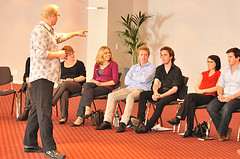
Business Plan Presentation at FSG 2009
Image via Wikipedia

Balaam answered, “Don’t I have to be careful to say what God gives me to say?” Numbers 23:12 (MSG)

In my vocation, I’ve had the experience of presenting the results of surveys, resesarch projects, and assessments to many different clients and every level of an organization. It’s always fun when the results show satisfied customers, improvements in service performance, and strong overall results. When the news is not so good, however, it can be rather stressful. o one likes to hear bad news. But when the data reveals an outcome that the client will not be happy with, there’s not much I can do.

I identify with Balaam as he presents the results of his conversation with God to his client, Balak. What’s funny is that Balak’s response is the same as I get when I present data the client doesn’t like.

  • “Somethings got to be flawed in your methods.”
  • “Go and check it again. You have to have missed something.”
  • “Redo the survey. Call more customers. This can’t be right.”
  • “Kill the messenger!” (thankfully, I’ve never actually heard this one spoken, I’ve just sensed that my client was thinking it a few times)

I’m sure you can pay people to say what you want to hear, but the truth is a precious gift. When you know exactly where you stand you have an opportunity to make tactical decisions based on reality. Balaam was doing right by Balak to tell him the truth about God’s Message.

Speaking truthfully and honestly about what we know and/or feel can be difficult. However, when it’s done consistently and done well it may reap huge rewards for both the presenter and an audience who is open and receptive.

Enhanced by Zemanta

Chapter-a-Day Matthew 15

organically grown vegetables
Image by cafemama via Flickr

He then called the crowd together and said, “Listen, and take this to heart. It’s not what you swallow that pollutes your life, but what you vomit up.” Matthew 15:10-11 (MSG)

I’ve watched with interest the growing craze for natural, organic, and healthy foods. Even companies who make relatively unhealthy foods have their marketing departments working overtime to find ways to tout what little health benefit their product has in it. The cereal aisle, in particular, always makes me chuckle. All of these sugary, chemically infused breakfast foods touting how much Niacin you get in every box.

I think that eating healthy is a good thing. Nevertheless, I thought Jesus’ admonition in today’s chapter was an interesting one. You can eat all of the healthiest, most organically grown natural foods that you can find – but it won’t change a spotted soul. The true test of our soul’s health is not what we put into our mouths and bodies, but what comes out of our mouths and lives.

If what comes out of our mouths is anger, malice, selfishness, jealousy, slander, profanity, criticism, and judgement – then perhaps we should worry less about the health of our bodies and worry more about the health of our souls.

Enhanced by Zemanta

Chapter-a-Day 2 Chronicles 36

The evil mindset spread to the leaders and priests and filtered down to the people—it kicked off an epidemic of evil, repeating the abominations of the pagans and polluting The Temple of God so recently consecrated in Jerusalem. 2 Chronicles 36:14 (MSG)

In my profession, I have the opportunity to visit and work in many different places of business. I am astounded at how unique the culture can be from one company to the next. I have worked with clients who maintain exemplary levels of professional and ethical standards at every level of the organization. I’ve also had the experience of being in workplaces that are cut-throat and fear-filled. The one common thread I’ve witnessed over the past 16 years is that the environment I observe among the business’ front lines is generally a reflection of the person or persons in that company’s executive suite.

As we’ve journied through the historical books of God’s Message, I see the same pattern over and over again. The author of Chronicles described it so well in today’s chapter. King Zedekiah’s stubborn, evil, rebellious, self-centered leadership trickled down and spread out through his officials, and then filtered down through the religious leaders and local leaders.

What a huge lesson for any of us who are in leadership, whether that leadership is over family, small group, church, organization, or business. Today, I’m reminded to mind my business and to guard my heart. My leadership affects many people in ways I have likely not even considered.

Creative Commons photo courtesy of Flickr and us embassy newzealand

Chapter-a-Day Daniel 5

The handwriting on the wall.  "God sent the hand that wrote on the wall, and this is what is written: mene, teqel, and peres. This is what the words mean:

Mene: God has numbered the days of your rule and they don't add up.
Teqel: You have been weighed on the scales and you don't weigh much.
Peres: Your kingdom has been divided up and handed over to the Medes and Persians." 

Daniel 4:24-26 (MSG)

There once was a man who built a business from ground up. He worked from dawn to dusk and often into the night. Through the blood, sweat, and toil of his efforts the business yielded a tidy fortune. After many years, the man died suddenly and the business was handed over to his children, who had grown up in the ease of their father's fortune. In their privileged upbringing, the children refused to learn or appreciate the principles of hard work, faithful stewardship and shrewd business practices on which their father built his business. Under their leadership the business quickly failed and their fortunes were squandered.

This parable is actually a common tale, and we see it again in today's chapter. Nebuchadnezzar was a great king who learned his lessons the hard way, but did learn his lessons. His son, Belshazzar, was a spoiled brat who did not learn from the lessons of his father. The "handwriting was on the wall," and it cost him the kingdom.

Living wisely and living well requires us to learn, not only from our own mistakes, but also the mistakes and successes of others. Seeing the patterns and principles of success and failure at work all around us, and adopting the lessons learned in our own lives is crucial. By doing so, God provides us with insights and wisdom we might not otherwise learn if we remain singularly focused on ourselves.

Creative Commons photo courtesy of Flickr and silent e

Chapter-a-Day Daniel 1

Sign on the dotted line.  But Daniel appealed to a steward who had been assigned by the head of the palace staff to be in charge of Daniel, Hananiah, Mishael, and Azariah: "Try us out for ten days on a simple diet of vegetables and water. Then compare us with the young men who eat from the royal menu. Make your decision on the basis of what you see." Daniel 1:11-13 (MSG)

The consulting group I work with was founded with a stated mission of applying Biblical principles in our work. We're certainly not perfect, but we do make an honest and sincere effort to apply God's word to what we do. For example, many businesses and firms who operate on a contractual basis will try to sign long-term contracts clients. The idea is that the longer the contract you can convince your client to sign, the greater security you have. However, our group does not believe that our security lies in contracts or clients. So, we have never agreed to a contract longer than twelve months. The underlying idea is that we must be good stewards of the annual contractual opportunities our clients give us and continually prove our worth if we hope to have our contract renewed.

That principle is expanded in the way our group approaches potential new clients. We typically ask a new client only to sign up for a "pilot project" that may last 60-90 days. We ask them to give us an opportunity to show them what we can do. If they find measurable value in that project, we'll ask them to commit to a broader annual offering. It's the same thing that Daniel did when he asked the king's steward to give his diet a chance and make his judgement based on the result. Give it a chance. Put it to the test. Then make the decision.

Many people will only make decisions based on the results they see, not just onthe pitch they hear.

Creative Commons photo courtesy of Flickr and macroberts