Tag Archives: 1 Kings 17

Elijah: a Pivotal Character

Elijah: a Pivotal Character (CaD 1 Ki 17) Wayfarer

Now Elijah the Tishbite, from Tishbe in Gilead, said to Ahab, “As the Lord, the God of Israel, lives, whom I serve, there will be neither dew nor rain in the next few years except at my word.”

Then the word of the Lord came to Elijah: “Leave here, turn eastward and hide in the Kerith Ravine, east of the Jordan. You will drink from the brook, and I have directed the ravens to supply you with food there.”

1 Kings 17:1-2 (NIV)

One of the things that constantly amazes me in my ongoing journey through the Great Story is how events separated by hundreds and thousands of years and recorded by different authors are so interconnected.

Today’s chapter launches one of the most exciting and action-packed episodes in all of the Great Story. King Ahab is on the throne in the northern Kingdom of Israel. The Kingdom of Israel has abandoned Yahweh, the God of Moses and David, and has embraced one of the most popular regional deities, a fertility/storm god named Baal. This had been largely a business strategy for Israel which desired lucrative trade alliances with their neighboring Kingdoms (who all worshipped Baal). Ahab marries a Phoenician princess named Jezebel, who is a faithful advocate for the worship of Baal and other regional deities. The marriage was also a strategic trade alliance.

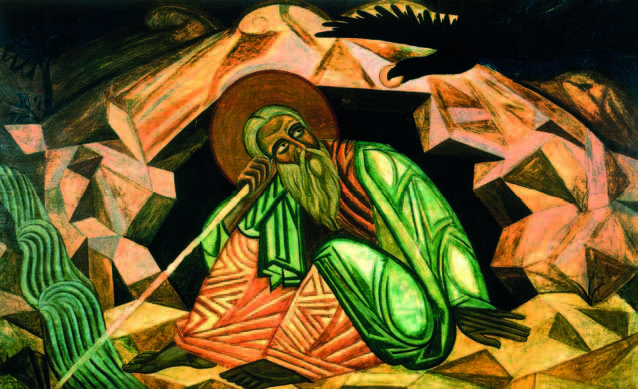
Out of nowhere there arrives a lone stranger, a prophet of God named Elijah. Elijah proclaims that there will be no rain, nor dew, except by his word. A catastrophic drought and famine begin.

What was fascinating for me in the rest of the chapter was the way that the events point back in time to earlier events and foreshadow future events of Jesus and His followers.

First, there’s the drought, which is a powerful metaphor for spiritual decline and need. Jesus said that He was “living water.” Water is a repetitive metaphorical theme God uses throughout the Great Story to communicate spiritual nourishment, abundance, and life. In the Garden of Eden at the beginning of Genesis and the new heaven at the end of Revelation I find the “river of life” watering the Tree of Life. Drought and the subsequent famine were, therefore, living word pictures of the spiritual consequences (lack, need, thirst, starvation, decline, death) that the Kingdom of Israel faced in giving themselves over to Baal worship.

God tells Elijah to go “east” beyond the Jordan River. East is the direction God told Adam and Eve to go out of the Garden of Eden. East is the direction of exile that the people of God at the hands of Assyria and Babylon. Elijah is also going into exile, into the wilderness across the Jordan where Moses and the Hebrew tribes wandered while seeking the Promised Land. For the Israelites of Elijah’s day, this was a stinging rebuke that the man of God was metaphorically separating from God’s people in the Promised Land and returning to the wilderness. I couldn’t help but also see this as a foreshadowing of Jesus, His followers, and the early Jesus Movement. When the Hebrew religious institution rejects, executes, and persecutes Jesus and His followers, their ministry expands to the non-Jewish Gentiles.

Elijah is fed by Ravens in the wilderness. They bring him bread and meat every morning and every night. This points back to God providing manna (bread) and quail (meat) to His people during their wilderness wanderings in Exodus. Ravens, however, were “unclean” for the Hebrew people as would be any food that came out of their mouths. This also foreshadows events of the early Jesus Movement when God tells Peter and the rest of Jesus’ followers that every food is “clean.”

Meat was a luxury in the diet of common people of Elijah’s day. Kings were among the only ones who could afford this luxury. And, there was a famine in the land. This meant that the King of Israel was likely going hungry in his palace while Elijah feasted on meat twice a day at Yahweh’s table.

Elijah is led to go to a Gentile widow’s house in Zarephath, foreshadowing the early Jesus movement being led to take Jesus’ message to the Gentiles like Peter being led to a Roman Centurian’s house in Acts.

There is a drought and famine going on, and Elijah has the audacity to ask a Gentile widow for water and bread. This foreshadows both Jesus asking a Gentile woman from Samaria for a drink of water and the audacity of Jesus telling his disciples to feed a crowd of thousands with a couple of loaves and a few fish. Elijah goes on to tell the woman to make bread from her flour and oil jars, explaining that the jars will miraculously never be empty just like the baskets of bread and fish that Jesus’ disciples passed around the crowds.

Elijah then raises the widow’s son from the dead, foreshadowing the same miracle that Jesus would perform on multiple occasions.

The prophet Elijah himself is a pivotal figure in the Great Story, and today’s chapter is a great example of this. Elijah hearkens back to earlier chapters of the Great Story, he is a lead character in the chapter of history in which he lived, and he foreshadows John the Baptist, Jesus’ earthly ministry, and where God will ultimately lead the story in future chapters. Elijah’s life and experiences metaphorically point to what God has done, is doing, and will do later in the story.

In the quiet this morning, I’m once again amazed at how the Great Story ties together across multiple sources and across time. I’m also once again reminded that the story is still being told, and that I have a role to play.

And with that thought, I enter my day.

If you know anyone who might be encouraged by today’s post, please share.

The Intriguing Person of the Prophet Elijah

The upper part of The Transfiguration (1520) b...
The upper part of The Transfiguration (1520) by Raphael, depicting Christ miraculously discoursing with Moses and Elijah. (Photo credit: Wikipedia)

So [Elijah] did what the Lord had told him. He went to the Kerith Ravine, east of the Jordan, and stayed there. The ravens brought him bread and meat in the morning and bread and meat in the evening, and he drank from the brook. 1 Kings 17:5-6 (NIV)

The prophet Elijah is one of the most intriguing characters in the entirety of God’s Message. He appears out of nowhere, has a brief ministry marked by miraculous events, confronts the evil and powerful King Ahab and Queen Jezebel of Israel, and then disappears in a whirlwind.

Most people don’t realize it, but Elijah also figures into Jesus’ life and teachings. When asked who people that Jesus was, his followers respond that Elijah was a trending vote getter. Jesus told His followers that John the Baptist was the person of Elijah returned to restore all things. On the mount of transfiguration when Jesus was revealed in His glory, Elijah appeared with Him. Jesus referred to Elijah in His teaching on multiple occasions. While hanging on the cross, witnesses thought Jesus was calling out to Elijah.

As I read today’s chapter, I found it interesting that the miracles of Elijah seemed to strongly parallel the miracles of Jesus. The widows flour and oil never ran dry, much like the baskets filled with bread and fish when Jesus fed the crowds with His all you can eat fish fry by the Sea of Galilee. When Elijah takes the dead widow’s son into an upper room and bring’s the boy back to life, it is eerily reminiscent of Jesus going into the room of Jairus’ dead daughter bringing her back to life.

One of the things I have come to appreciate more and more in my sojourn through God’s Message is the connections, parallels, foreshadowing, and recurring themes that stretch across the entirety of the story that God has told and is still telling. I love that God is both an artist and an author. He is telling a story. It is His-story.

Chapter-a-Day 1 Kings 17

Running on empty. This is the word of the God of Israel: 'The jar of flour will not run out and the bottle of oil will not become empty before God sends rain on the land and ends this drought. 1 Kings 17:14 (MSG)

It's been a long week and I'm tired. The physical and emotional batteries are on empty.

As I read the chapter today, I was struck by God's promise to the woman of Zarephath to replenish the oil and flour in her home each day so that she, and her son, and Elijah could eat.

Just as Jesus would replenish the loaves and fish until everyone had their fill of fish sandwiches.

Just as Jesus taught us to pray "Give us this day, our daily bread."

God is in the business of replenishment. He provides what we need when we need it. And, that's a good thought as I head out the door this morning.