Tag Archives: Acting

Preparing for a Role: Digging Into the Character

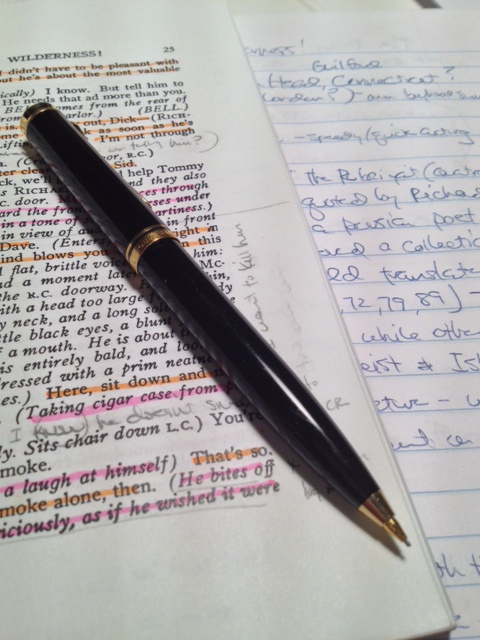
scriptworkAs an actor, I want an audience to willingly suspend their disbelief for a couple of hours and really believe that I am the character I’m portraying. When I step on stage in Ah, Wilderness! I want those who know me to forget that they’re watching Tom Vander Well and get sucked into the life and times of Nat Miller. The better I understand the character of Nat Miller, the more likely I am to succeed, and understanding the character takes work. It means being researcher, detective, historian, psychologist, artist, and writer.

Character work is one of the most enjoyable parts of the acting process for me. Here is a brief description of some of the steps I go through as I’m digging into a character:

  • What does the playwright say about the character? Eugene O’Neill does a nice job of describing his characters. Nat Miller is described: “in his late fifties, a tall, dark, spare man, a little stoop-shouldered, more than a little bald. Nat’s face has large, irregular, undistinguished features, but he has fine, shrewd, humorous gray eyes.” I may not look exactly like O’Neill describes, but I get a sense of Nat from words like “spare,” “stoop shouldered,” “humorous,” and “shrewd.”
  • What do other characters in the play say about my character? In one scene my character is off stage, my wife and the other adults talk about the fact that Nat always talks about being allergic to a certain kind of fish even thought my wife has served it to me for years without me knowing it. So, I like to repeat myself and have certain strong beliefs that might not always be accurate. It hints at a playfulness between Nat and his wife. In another scene, a salesman and bartender speak about my characters ability to make life difficult for them, hinting at Nat’s prominence and clout in the community.
  • What do I learn about my character from his own words and actions? Nat uses “hm” a lot, which is very interesting. We all have vocal idiosyncrasies, and that’s one of his along with repeating phrases: “Couldn’t help it. Just couldn’t help it!” Nat puts on a strong, authoritative role when his children are around, but when it comes to actually having an intimate discussion with his son he’s reduced to babbling.
  • In what time and culture does my character live? How would that make him different than me? What was life like then in that place? 1906 was a more proper time. Proper in the way people dress, talk, and the manners they use around the house. The Millers have a servant and an automobile, hinting at the fact that they are well off in that time. How would that change the way I act and relate to others compared to being lower class at that time? How does that effect my expectations of the children in their lives, words, actions, and how they are viewed by the community?
  • What is my characters age and occupation? What was that like? Nat owns a newspaper. Some internet research about what the newspaper business was like in 1906, specifically in Connecticut yielded some interesting results. Yellow journalism was rampant in that day. Newspapers not only reported the news but helped rise and destroy people and their careers. Most newspapers were backed by political parties and were the vehicle of how a political party got their views out. What party was Nat Miller affiliated with? What were his political connections? How did he use his paper to get ahead or influence his community?
  • What is my characters life story? One of the exciting things about acting is the fact that you get some creative control. I will often take my character journal and spend some time doing free writing in a stream-of-consciousness style. I’ll invent an entire back story. What were Nat’s parents like? When did his family come to America? What was his childhood like? Where did he go to school? How did he meet his wife? What dreams did he have as a child? How did he come to own the newspaper? It can be challenging to take hints and clues you find in the script and fill in gaps. The more completely you flesh out the character, the easier it becomes to step into character when you’re on stage. Your lines and the relationships with other characters on stage take on new depth and layers of meaning.
  • What is my relationship with the other characters on stage? Nat has four children in the show and two who do not appear in the play. What does he think of each of his children? Does he have a favorite? His sister is visiting. What was their relationship like growing up? Again, a character journal and some free writing can yield interesting thoughts and discoveries that may turn into interesting choices for how to play a line or react to another character.

Of course, this is all work that takes place outside of rehearsal. It is the homework of an actor’s preparation. Just like school, the more work you do outside of class the more prepared you are when it comes to the discussion in class and the eventual test. It is no different when it comes to the stage. A little work outside of rehearsal can make a big difference in both the rehearsal and in the eventual performance.

[Ah, Wilderness! is being produced by the Theatre Department of Central College under the direction of Ann Wilkinson. It will be performed on the campus of Central College in Pella, Iowa Feb 27 through March 3, 2013.]

Preparing for a Role: Digging Into the Script

2013 01 11 Wilderness Journal_Snapseed

[This is part of a series of posts in which I’m documenting the steps I go through when I’m preparing for a role on stage. I thought it might be interesting to someone, somewhere, at some point. For what it’s worth.]

Having done a little background into the playwright and the play. My next step in preparing for a role is to dig into the script itself. I find that a cheap notebook or journal is generally handy to keep throughout the process. I typically grab one of those marbled composition notebooks you can get at any discount store for a buck. With pen and notebook handy, I start reading through the script and get ready to jot down notes, questions that come to mind, and references I want to look up.

Since a lot of classic plays were written decades or centuries ago and many of them refer to a specific period of history, scripts regularly contain references that are lost on an actor living in 2010. If I’m going to give an authentic portrayal of a small town newspaper man in 1906, then I better know exactly who/what I mean when I make references on stage – even if they will be largely lost on the audience. The believability in an actors portrayal hinges on that actor internalizing and knowing what his or her line is talking about.

As I read through the script the first time, I make notes about things that I need to investigate or references I don’t understand. I’m not too concerned with my character yet, though I will jot down thoughts and questions about my character as they come to me. I’m mostly concerned with the setting and references to persons, places, or things with which I’m not intimately familiar. This is particularly true of a period piece like Ah, Wilderness! which is set on a specific date in a specific year (July 4, 1906). O’Neill filled the script with a ton of literary and period references. I’m kind of a nerd when it comes to trivial knowledge, but there were a ton of things I needed to look up and investigate.

Here’s are some examples:

  • 1906: The year the play was set. What was happening in the world at that time? What were the big political issues? Nat Miller is a newspaper man. What stories were big and what stories had he been following and writing about?
  • July 4: What day of the week was it? What were typical celebrations like in 1906?
  • Newspaper Editor: What were the issues for editors in that day? What was the business like? How much could  you make?
  • Sachem Club: Reference to senior members of Tammany Hall – an Irish social/political club dedicated to the political advancement and power of the Irish in America. Nat is a member. How did this influence his past/position? How do his Irish roots affect who he is and his world-view?
  • Buick: Nat owns a Buick. Considering automobiles were relatively new, this is really interesting. What would it have looked like? How much did it cost? How did he afford it? See previous reference of Sachem Club…does he have connections?
  • W.C.T.U.: Women’s Christian Temperance Union (they led the fight for prohibition)
  • Waterwagon: abstaining from alcohol
  • Emma Goldman: Russian born anarchist, political activist and speech writer
  • Carlyle’s French Revolution: Popular victorian history of the Revolution by a Scottish Calvinist who lost his faith but retained his Calvinist values.
  • Tumbril: an open cart used to carry condemned victims to the guillotine.
  • “The Ballad of Reading Gaol” – poem by Oscar Wilde written from his experience in prison.
  • Play by Bernard Shaw banned from Broadway: “Mrs. Warren’s Profession” was initially not allowed to be produced on Broadway because Mrs. Warren ran a brothel.
  • Old Cap Collier & Nick Carter: serial Detective stories popular with young readers and sold for a nickel/dime.
  • “Poems and Ballads of Swinburne”: British poet. Contemporary of Oscar Wilde.
  • The Rubaiyat of Omar Khayyam – a series of quatrain poems by Persian mathematician, astronomer, and philosopher. The title of the play comes from one of his famous quatrains. “Here with a loaf of bread beneath the bough, A flask of wine, a book of verse – and thou; Beside me singing in the wilderness; And Wilderness is paradise enough.”

As I dig into references, read the poetry, and learn more about the period in which the piece is set, I’m building an understanding of the broader context in which my character lives, thinks, moves, and relates. I  begin to gain a deeper appreciation for what O’Neill was trying to say through the characters and the things that the characters thought about, read, and how they viewed the world.

I’m not even thinking too much about the actual lines yet, but doing this background work will an invaluable help to me as I begin to internalize and interpret them.

Next step: Digging into the Character

[Ah, Wilderness! is being produced by the Theatre Department of Central College under the direction of Ann Wilkinson. It will be performed on the campus of Central College in Pella, Iowa Feb 27 through March 3, 2013.]

What “Bullet Point” Legacy Will You Leave Behind?

Daniel & Fanny Bloem

After the birth of Methuselah, Enoch lived in close fellowship with God for another 300 years, and he had other sons and daughters. Genesis 5:22 (NLT)

As a lover of history, I’ve always been interested in genealogy. I think my love of acting has something to do with it, as well. When I learned how to do character studies of those I portrayed on stage, I naturally migrated to doing an on-going character study of myself. “Who am I, and how did I get here?” are natural questions. There are a lot of clues to be found in family history.

I’ve traced the branches of my family tree back a relatively long way. As I pour over the names and dates there is so much that I don’t know. There’s just a name and maybe a birth date or death date. As I get nearer to the present generations, there are names that conjure up scraps of knowledge handed down through the family. I have pictures of my great-grandfather, Daniel Bloem. The one thing the jumps to mind when I see his picture is that he had a drinking problem. There’s a great uncle, James Hendrickson. I know he was a Methodist circuit preacher in Illinois. Family legend holds that he was a good man and had a huge influence on my grandfather. That’s about all I’ve got.

Scraps. Tidbits. Legacy. The vital questions aren’t just “Who am I?” and “How did I get here?” but also “How will I be remembered?” and “What impact will I have on those around me?” What is the bullet point that future generations will remember and repeat about me when they see my name or my picture…

  • He had a temper. Everyone was afraid of him.
  • She was really mean. Nobody in the family liked her.
  • He was known to be the laziest of that generation. He went bankrupt a couple of times.
  • She was married six times.
  • He built a successful business, but his children all hated him.
  • She got married, but her first child was born six months later. Do the math.

As we read through the long list of Adam’s descendants, we are given little information. We have names, life spans and the name of the first born son. Then we get to Enoch and this tidbit of information is passed down to us: “he lived in close fellowship with God.” That’s not a bad legacy considering we’re still talking about it many millennia later.

Each day our words, actions, and relationships are etching the legacy we will leave. What’s the one thing you think people will remember about you? What’s the one thing you want people to remember about you? What will make the difference?

Preparing for a Role: Digging Into the Past

Poster for presentation of "" at the...
(Photo credit: Wikipedia)

Speaking of being an artist, over the next seven weeks I’m going to be involved in a fun creative challenge. I’ve been asked by Director Ann Wilkinson and Theatre Central to be a guest artist and perform a role for their production of Eugene O’Neill’s Ah, Wilderness! which will be performed February 27th through March 3rd at Central College.

I thought I might chronicle my experiences in a series of posts here. I get the feeling that many people fail to understand the work and the process that goes into a role they see performed on stage. People go to a play and it looks like the actor simply memorized some lines, put on a costume and just sort of pretended.

Work on my part actually began over the past four weeks as I familiarized myself with the script. The first thing I want to do as an actor is to understand the background of the play, what the playwright was expressing, and what can be learned from past productions of the script. [Thank God for the internet. It makes the process so much easier.]

Eugene O’Neill is known for long, brooding plays like (the five hour long) The Iceman Cometh and A Long Day’s Journey into Night. O’Neill, who wrote from the beginning to middle of the 20th century, was known for plays that were dark, pessimistic and tragic. There was one comic exception: Ah, Wilderness! The comedy, in which O’Neill tapped into autobiographical elements of his childhood, is a coming of age play in a traditional family setting. It is set in 1906 Connecticut on the Fourth of July holiday. It is sweet and sentimental. It is a precursor to Leave It to Beaver, The Brady Bunch, and The Cosby Show.

I’ve been cast in the role of the family Patriarch, Nat Miller. Miller is a small town newspaper man. The role was once played by legendary American humorist Will Rogers. Like the television fathers we’ve come to know and love, Miller is loving and wise but also a bit bumbling and humorously flawed even as he holds the family together.

O’Neill had a lot of issues with his own family growing up. He was the son of an actor (a hard Irish Catholic disciplinarian) and grew up on the road. During his young adult years he spent summers in Connecticut. He had a girlfriend whose father made a huge impression on him. It is believed that O’Neill fashioned the character of Nat Miller based on this man whom he appreciated.

Understanding the background of the play and the larger picture of its history helps me as an actor as I approach the script. It’s not that I have to be limited to what everyone else has done with it in the past or how others have interpreted it, but knowing the context can help me embrace the spirit of the whole as I carve out my own interpretation of it. History isn’t a set of shackles. It is a springboard.

Having done a little bit of background I read through the script. Knowing that the show was first staged in 1933, my mind was sort of in a black and white Hollywood frame of mind. As I read Nat Miller’s lines and pictured the scenes in my head, the voices of different great actors of that era entered my head. I didn’t mean for this to happen. It just sort of did. There was Henry Ford, Cary Grant, and Jimmy Stewart to name a few. My brain catalogued different visions of what these great actors might have brought to the role with different scenes and lines. I don’t want my portrayal to be an impersonation of Jimmy Stewart playing Nat Miller, but envisioning the humor that Stewart might bring to a particular moment fuels ideas of what I might want to try as I communicate as I enter the rehearsal process.

Next step…. digging into the script.

Chapter-a-Day John 7

“Look beneath the surface so you can judge correctly.” John 7:24 (NLT)

One of the things Wendy and I have learned about acting over the years is that we enjoy the character work as much as we do the actual performance. Building a character means doing the ground work, investigating the character’s history and relationships, and peeling back the layers of who a person really is below the lines of the script and the movement of the director’s blocking. The character work an actor does brings depth to the character on stage.

One of the life lessons that doing character work has taught me is that people are complex, multi-faceted creatures. If I simply memorize the lines and move from point A to point B like a trained dog I do a great disservice to the complex creature I am portraying. Plumb the depths of a character’s heart and mind and you begin to empathize with who he is and why he does the things that he does. Only then can my acting begin to serve the character and the story well.

As I read today’s chapter I could almost feel the chaos of public opinion swirling around Jesus. The religious leaders were saying one thing about Him, some of the crowd another, His family were saying something different, while within His own inner circle of followers there was an on-going debate about Him. Like all who find themselves in the public spotlight, Jesus was finding Himself judged, labeled, and branded. He knew that people were misjudging Him because they had not taken the time to look below the surface of what they saw and heard, to plumb the depths, and to understand who He really was.

Whenever we brush over another person with a swash of generalization, we diminish them so as to justify our simplistic judgement of them. I have done the same thing. I do it all the time. We would all do well to obey Jesus’ command to look below the surface so we can judge correctly. We would all do well to do a little character work for those creatures and characters we dismiss, diminish, hate, or simply avoid. If we do so, we might find there’s more to their story than we ever imagined. We might just treat them with a little more love and understanding. We might just become better creatures ourselves for having done so.

Talk About a Bunch of Characters

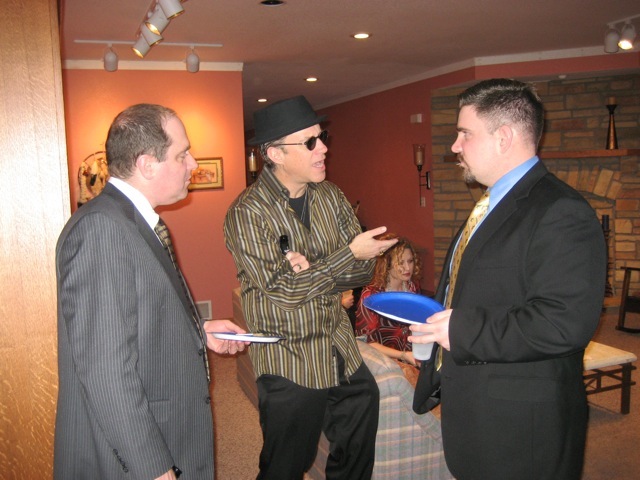
Me (center) as "Guts" Regan chatting at the party with ADA Flint (Doug DeWolf) and Police Detective Elmer Sweeney (Mark Schaeffer).

Wendy and I are currently rehearsing for Union Street Players’ production of Night of January 16th penned by acclaimed author Ayn Rand (Atlas Shrugged, The Fountainhead). It’s a Law & Order-esque courtroom drama about a sensational New York City trial in the mid-1930s. A Donald Trump type business mogul with no scruples and many enemies is found dead. His secretary and jilted lover is accused of the murder. The fun thing about the play is that the jury is seated with 12 members of the audience and they decide the ending of the play with their verdict.

Because it is a courtroom drama, most of the characters in the play do not interact with one another on stage. So, to have a little fun the show’s director threw a party on Friday night. Each of us were to dress for the party as our characters might dress in today’s fashion. For the first hour or two of the party, we interacted with one another in character and mingled, trying to learn more about each other. After a while the director called us together to take a little quiz with prizes going to those who could identify certain facts about the most characters.

Wendy as terpsichorean Roberta Van Rensselaar.

It was a fun evening. Wendy plays an exotic dancer and I play an Irish gangster and crime boss. We had a fun time hanging out and chatting with our fellow cast and crew members, both in character and as ourselves.

The show is Thursday, March 29th through Sunday April 1st. Tickets can be purchased on-line at www.unionstreetplayers.com.


Roles I’d Love to Play: Matt Friedman

Mermaid Dramabook Series published by Hill and...
Image via Wikipedia

As I’ve contemplated the list of roles I’d love to play for this series of posts, I realize more than ever how influenced we are by plays and roles we either did/studied earlier in our lives or roles that we would have loved to have played but didn’t get the part.

So it is with the role of Matt Friedman in Lanford Wilson‘s play Talley’s Folly. The show takes place in a broken down family boathouse in Missouri in 1944. It is the 4th of July and Sally Talley has returned home from her job as a nurse in St. Louis. She met Matt Friedman, a young Jewish man, while on vacation. Matt has written Sally a letter every day since they first met and only received one (not encouraging) reply. He shows up at the family homestead to confront Sally. She meets him in the boathouse, angry that he has shown up uninvited. The show reveals their conversation, their history, and their hearts.

My college produced the show, and the role of Matt went to my roommate, Kirk. Kirk played the role with his usual display of talent and excellence. Kirk could always find humor in the most amazing ways. And, as Craig S. continues to remind me to this day, Kirk also got to kiss Tara. Nevertheless, as I helped Kirk with his lines and helped produce the show I fell in love with the role of Matt. I have always wished that one day I could sink my teeth into portraying Matt on stage. I love the depth of his character and would love the challenge of finding his voice and physicality. Plus, the intricacies of the conversation between he and Sally is like a chess game. Finding the complexities would be a blast.

Wendy had never read the show, so a few years ago on a cold Saturday morning we cuddled together on the couch with one script and read the play together. By the end of the play we were both wiping our eyes (as one audience member put it – “It’s a two-hanky show”).

Chapter-a-Day Proverbs 28

By Justified Sinner via Flickr

In the end, people appreciate honest criticism 
      far more than flattery.
Proverbs 28:23 (NLT)

While studying theatre in college, my professor worked hard to teach us the value of honest criticism and temptation of listening to empty flattery. After a show you’ll have a throng of people tell you “good job,” but that hollow compliment does nothing for you. When someone tells you “good job,” my professor said, your response should be “What was good about it?” A specific praise about a moment, an action, or a decision you made on stage that struck them positively is something from which you can learn and build on. A simple “good job,” profits you nothing.

Better still is when someone gives you the gift of an honest piece of criticism. A character in the script I’m polishing up is given a very specific age to play. After reading the play, one of the readers commented that the lines and stage directions seemed too young for the age described. When she said that it was like a cloud parted and I saw it for the first time. She hit the nail on the head. I completely rewrote a bunch of dialogue and action to fix it.

I don’t understand people who think criticism is a bad thing, inherently negative, and something not to be tolerated. I may not like some of what I hear, but if I understand what’s not working for people I can fix it or at least I can better communicate why I’m doing or saying or acting the way I do so that others can have a better understanding of the decisions I’ve made.

Today, I’m grateful for those in my life who are willing to be honestly critical with me.

Roles I’d Love to Play: John Proctor

Cover of "The Crucible (Penguin Plays)"
Cover of The Crucible (Penguin Plays)

I have a love/hate relationship with The Crucible. Along with Death of a Salesman, it seems that this play was required reading in every high school and college English, Literature, or theatre class. When I was in high school and college during the 1980s (yes, I had a mullet), it seems that Arthur Miller was the only American playwright the textbook companies knew. I got to know the play really well. I love the way Miller explores the themes of humanity and legalistic religion out of control, but the play is so long, so heavy, and has so many characters. It’s a tough one to stage, and it’s tough on audiences..

Nevertheless, because The Crucible seemed to be required in so many classes, I got to do multiple character studies of John Proctor, and played the character in a lot of scene work for class. I came to love his humanity, his honesty and his willingness to stand up to the falsehood around him even at the cost of his life. The further I get in life’s journey, the more I identify with his failings and his courage.

It’s somehow tragic to put so much work into a character, fall in love with portraying him, and then never have the opportunity to play out the entirety of the script. It’s like that long, lost love you almost had, but life never allowed the two of you to get together. You always look back with longing and wonder “What if?”

While I would love to play the role, I know that my age is now against me. Like a number of great roles, that window of opportunity has likely passed. John Proctor will always be one of my “what ifs?”

Roles I’d Love to Play: Willy Loman

1st edition cover (Viking Press)
Image via Wikipedia

The other day Wendy and I were talking in the car on our way back from Des Moines. I don’t even remember the context of our conversation. Our conversations tend to ebb and flow all over the map. Somewhere in the midst of our conversation I mentioned that I would love the challenge someday of playing Willy Loman, the iconic, tragic centerpiece of Arthur Miller‘s Death of a Salesman.

“That would make a great blogging challenge,” Wendy said all of a sudden. “Do a series of blog posts on roles you’d love to play.”

She’s so smart (and sexy).

The truth is that I’m not that fond of Miller’s play itself. I got sick of reading it, and re-reading it in every English and Lit class only to have to read it again in theatre classes. It is depressing, and I can understand the legends of how it drove Lee J. Cobb (the great actor who famously made the role his own) crazy with despair.

Still, I’ve reached the age when you start to look back, think about where you envisioned your life going, and compare it to where you stand. I’ve travelled hundreds of thousands of air miles with salesmen slogging through life shuttling their wares from customer to potential customer. I’ve seen, and shared, the vacant look in their eyes. I’ve eaten alone with them together at another restaurant that’s the same as the one before. I’ve slept alone with them in the adjacent hotel room just like the one we were both in the night before. I get it now.

And so, I think it would be a challenge to play the iconic role, slip into Loman’s scuffed up wing-tips, and hoist his valises onto the stage. It would be fascinating and I think it would stretch me in interesting ways.