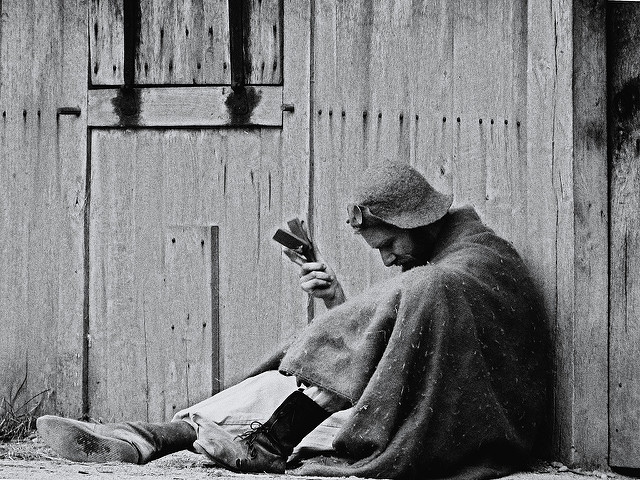
“Anyone with such a defiling disease must wear torn clothes, let their hair be unkempt, cover the lower part of their face and cry out, ‘Unclean! Unclean!’ As long as they have the disease they remain unclean. They must live alone; they must live outside the camp.” Leviticus 13:45-46 (NIV)
We live in the most ridiculously healthy era of human history. Never has have so many human beings on the face of the earth had access to medical care. Never has humanity, on the whole, been as healthy and wealthy. I encourage you to take four minutes and watch Dr. Hans Rosling show you the animated data from the past 200 years. When I saw how poor and unhealthy the people of the world were in 1800, it gave me some perspective to imagine how much worse it must have been around 1500 B.C. when the Hebrew tribes were wandering in the desert becoming a nation.
Today’s chapter is strange, repetitive, and more than a bit boring for modern readers. It is all about skin diseases and mold. To get at the heart of what’s going on in today’s chapter I have to put my feet in the sandals of the Hebrews. There is no healthcare. There are no doctors. There’s no pharmacy. And yet, there is an understanding that disease can quickly wipe out an entire population. God through Moses is setting up a triage system as it relates to skin diseases, infection, and substances that can create health problems for their community as a whole. There’s even a system of quarantine for those who might have something that could be contagious. This is a giant leap forward for these people who will be protected from untold health and medical issues going forward through the priests examining, diagnosing, and prescribing quarantine when needed.
But there’s a spiritual element to this as well. According to the Creation story in Genesis the consequence of sin was that our bodies became subject to death and illness. Despite the fact that I will live 50-60 years longer than the average American in 1800 and have access to the greatest healthcare in human history, I can’t escape the eventual physical decline that aging will bring. I am doing to die. “All have sinned and fallen short of the glory of God,” Paul writes to the believers in Rome. He goes on to remind them, “The wages of sin is death.”
I am spiritually “unclean.”
How tragic for the person with incurable leprosy. Forever banished to live outside the camp, to wear torn clothes, look like a beggar, and cry out “Unclean!” whenever a “healthy” person was near to warn them off. It was necessary for the health and safety of the community, but what must it have done to the soul of the person? Never to be hugged or touched by your loved ones ever again. To have people shun you, children fear you, and still be condemned to proclaiming “Unclean!” knowing that it will forever perpetuate the bitter isolation and public scorn.
Which reminds me of an often overlooked episode of Jesus’ story. I picture what I have just described, a man condemned to this life as a leper. His clothes are torn. His hair is unkempt. He has a mask covering his face. His is a life of bitter isolation and public scorn. People literally “avoid him like the plague.” Day and night he shouts “Unclean!” if anyone draws near. Lord only knows how long it had been since he’d experienced a human touch, a kind word, or an ounce of kindness. He approaches Jesus on his knees and asks, “If you want to, you can make me clean.”
Mark is careful to describe that Jesus reached out and touched the man.
“I want to,” Jesus replied.
The man’s leprosy was healed.
Suddenly, this episode takes on a whole new beauty and meaning for me. I may not have leprosy, but I am a sinner stuck in this body subject to sin, sickness, and death. I am unclean. Who will save me from this state?
“Jesus? If you want to…”
If you know anyone who might be encouraged by today’s post, please share.
These chapter-a-day blog posts are also available via podcast on all major podcast platforms including Apple, Google, and Spotify! Simply go to your podcast platform and search for “Wayfarer Tom Vander Well.” If it’s not on your platform, please let me know!
More than "Boy Meets Girl" (CaD Ruth 2) –
Wayfarer
So [Ruth] went out, entered a field and began to glean behind the harvesters. As it turned out, she was working in a field belonging to Boaz, who was from the clan of Elimelek. Just then Boaz arrived from Bethlehem and greeted the harvesters, “The Lord be with you!” Ruth 2:3-4 (NIV)
When I told Wendy yesterday that I’d begun the story of Ruth, her response was, “Oh good! I love the story of Ruth!” I was not surprised by this. In fact, I mentioned it because I knew she would be pleased. When Wendy and I were married, we wrote our own vows. Her vows to me included Ruth’s vow to Naomi:
“Where you go I will go, and where you stay I will stay. Your people will be my people and your God my God.”
The story of Ruth often resonates deeply with women. It’s a boy meets girls story, and it is basically an ancient version of the film Pretty Woman. Destitute young woman who is a societal outcast and pariah meets older man of means. As I’m fond of saying: “All good stories are reflections of the Great Story.”
But there’s more going on under the surface of the boy meets girl romance in the story of Ruth. Ruth is a story of redemption, and it’s important for 21st century readers to understand a bit of context.
The early chapters of the Great Story are about God calling one man, Abraham, and growing his descendants into a nation. That doesn’t happen overnight, but over centuries as Abraham’s grandson has twelve male sons/grandsons who become leaders of tribes (the story of Abraham through Jacob and his sons is told in Genesis). Those tribes then become slaves in Egypt for 400 years before Moses led their deliverance. Then God has the difficult task of turning slaves who have had zero autonomy, freedom, or education for generations into a fully functioning nation. To facilitate this, God give them His law through Moses (this story is told in the books of Exodus and Leviticus). What’s utterly fascinating about the law of Moses is that it is an ancient blueprint for how a nation and society should function lawfully and it prescribes ways for managing common societal ills including immigration, incurable and infectious diseases, and poverty. Those issues sound familiar?
Having a blueprint is one thing. Actually convincing a couple of million former slaves in the brutal world of the ancient near east to actually implement it is another. The time of the Judges, in which this Pretty Woman story of Ruth takes place, is a time when the implementation is failing miserably. This new nation remains a tribal system with no central leadership, violent wars and feuds within and without, and little adherence to the laws and blueprint God had given them.
In today’s chapter, we’re introduced the prototype of Richard Gere’s character in Pretty Woman. We learn that Boaz is a “guardian-redeemer” or “kinsman-redeemer.” This was part of the societal blueprint God gave through Moses. Men in each family clan within each tribe were appointed as “redeemers” to care for those in their clan who’d been dealt a bad hand. The law required leaving part of your field unharvested so the poor in your clan could glean food for themselves. It required the redeemer to buy-back (e.g. “redeem”) clan members who, because of poverty, had been sold into slavery. It required them to help widows of child-bearing years to bear heirs who would then be responsible to care for them so they wouldn’t become a drain on the nation at large. Only, men in the time of the Judges were not known for living up to their responsibility or following the blueprint.
Boaz is far more than just a dashing figure with salt-and-pepper hair who looks good in an Armani suit and Julia Roberts on his arm. The first thing we hear from Boaz is his greeting to his own servants: “The Lord be with you.” Boaz is, first-and-foremost, God’s man, and that lays the foundation for the rest of the story. At a time when not following God and His blueprint led the nation into repeated chaos, violence, war, and tragedy, Boaz represents how when those with status, wealth, and power within the system trust God and faithfully follow the blueprint, they become agents of redemption and the entire society benefits.
In the quiet this morning, I can’t help but think about a larger conversation going on right now within our culture in which the Christian church is accused of not following Jesus’ blueprint of caring for “the least of these.” I won’t deny that this is true, though I believe that it is a broad-brush, black-and-white generalization that completely paints over the tremendous work of sincere followers of Jesus, throughout history, who fulfill Jesus’ mission of caring for the marginalized and improving life and humanity on earth.
I also can’t help but think about Boaz. He’s simply one faithful believer who is obedient within his clan. He may not be altering the course of the entire nation in those dark times, but he is altering the course of Ruth, Naomi, his clan, and his community. Boaz is an agent of redemption within his circles of influence. Imagine if there was one Boaz in every clan in every tribe in that day?
I often read the headlines over coffee with Wendy in the morning and enter my day feeling impotent to make a difference in the national and global problems plaguing the world. This morning, I’m reminded that I have the power and ability to be a Boaz.
“Be a Boaz.” That’s the cry of my heart as I enter this day.
If you know anyone who might be encouraged by today’s post, please share.
Earlier this sumer my dad found himself in the hospital for five days after suffering what was eventually diagnosed as a (thankfully) minor stroke. Being in the hospital meant that I had the honor of spending five days and four nights with my mother, who is in the middle stages of Alzheimer’s Disease. It was the most uninterrupted time I’ve spent alone with my mother since childhood. I found it a fascinating opportunity to observe her life at this point in her journey through dementia, and to interact with her in her daily realities.
Let me begin by confessing that I am no expert in Alzheimers. Our daughter, Taylor, has had far more experience with, and education in, the tragic disease. I am, however, deeply versed in life with my mother. I began noticing the changes long before her diagnosis. Conversations with her, which have always been pleasant, meandering journeys slowly became stilted and repetitious. I began to realize that there were certain subjects that she clung to like a child hanging safely on to homebase in a neighborhood game. In retrospect, I wish I had forced the issue with her and our family long before it all came to light, as we learned that medications can successfully slow the disease’s progression. C’est la vie.
I also know that Alzheimer’s and Dementia experiences can vary widely depending the patient and his or her own unique circumstances. I am in no way implying that my observations are somehow applicable to every person who suffers from these terrible diseases. For what it is worth, I am merely recording some of the observations and lessons that came from my personal time with my own mother in her current stage of this tragic disease.
First, a few general observations about my mother’s current waypoint in the descent to the cognitive darkness of Alzheimer’s. She has yet to forget any of our family members, though the names and faces of life-long friends have begun to escape her. When talking to me, she now refers to my father as “my husband” as though her relationship with him and her relationship with me have been separated from the mental compartment of “family” into separately labled relationship compartments in her brain. Nevertheless, I am still able to enjoy her recognizing me when she sees me. She has yet to fail in greeting me with the pet name she’s had for me since childhood (“Hello, Tommy Jameses“) and extending her arms for an embrace.
I have heard it said that those with ALZ can sometimes become more childlike, and many become bitter, angry and even violent. Mom has occasionally had momentary flashes of uncharacteristic anger, though more often I’ve experienced that she now lets fly with a blunt honesty about people and things that she’s never exhibited before. To be honest, I tend to find it refreshing. I am thankful that she has mostly exhibited a sweet, childlike humor I’d never seen in her before.
Watching mom now often feels like peering into the little girl she must have been. She is playful and joyous in an almost exhibitionistic way. The woman who who raised me and my siblings was sweet and fun-loving, but she carefully guarded herself, her looks, her words, and her actions. For most of my childhood she wore a partial set of dentures. I can remember her never wanting anyone, even her children, seeing her without her partial in her mouth. The mom I spent five days with this summer could not only care less, but I expect she’d be happy to pull out her dentures and make a funny face to make me laugh. My mother has always been apropriately reserved and “mature” around a camera. Now if I pull out my phone to take a picture she starts hamming it up and making faces. A part of me asks, “Who is this woman who looks like my mother?” Then I realize that I’m probably seeing an entire side of my mother that has always been there. I just never saw it.
I spent my time with mom in quiet observation. Our days together had a certain cadence. We would rise and have breakfast together. We would ready ourselves and drive to the hospital where we sat with dad in his hospital room. Each day I would take mom out for lunch before returning to the hospital to spend the afternoon with dad. In the late afternoon we would return to their apartment at the retirement community, enjoy a bite together, and spend the evening watching television until mom was ready to retire.
I made a conscious effort not to intervene with mom in the time I spent with her. I’ve observed that her flashes of temper often come when she feels as though someone is telling her what to do or treating her like she’s incompetent. It’s much like a child who barks at a nagging parent and exclaims, “I can do it myself!” So, I never told her what to do or tried to control her in any way. I just let her do her thing and quietly paid close attention. I was pleasantly surprised to find that it was only occasionally necessary to “suggest” that she might want to see if she’d taken her pills or double-check this-or-that. As long as I kept my voice tone pleasant and helpful, she always responded positively.
I discovered that she had a very specific routine each morning:
Turn on the coffee pot. This is always prepared before bed the night before, another part of her daily ritual.
Sit on the couch and turn on the television. Any morning news channel will do. It seemed to be randomly different each morning.
Drink one cup of coffee while watching television. She doesn’t really watch television or take anything in, but she likes to have it on. I think it allows her the illusion (for others) that she’s doing something while her mind struggles to make sense of her moment. Interestingly, when she watched baseball with me she would regularly comment on things that happened in the moment (e.g. “Boy, hit that ball a long way.”) which is something she didn’t really do with any other kind of program. One night I took her to Buffalo Wild Wings for dinner. Surprisingly, she wanted to sit at the bar. She actually found all the television screens interesting. There was so much to look at and steal her attention.
Set the table for breakfast. This included placemats, spoons, and plates. The east and south sides of the table were where the settings went. This seemed important. If I was working on my laptop where the placemat was supposed to be set then I could tell this threw her off a wee bit, but didn’t rattle her.
Eat one yogurt with her second cup of coffee at the table. In the evening her meal was a Boost protein drink and another yogurt.
Wash her cup and spoon along with the coffee maker.
Go into the master bedroom/bathroom to get ready. Putting on make-up and “fixing herself” in front of the mirror is one of the things she gets lost in. One morning I finally had to “suggest” that we get going to the hospital in order to get her out of being lost in her endless loop of putting on and fixing her make-up.
I was pleased to observe that there were things that her routine helped her to remember and how much she still did without me prompting her. I watched her, at times, silently straining her mind to organize her world even if she quickly got lost in the process. If dad’s doctor started to give instructions she would get out a pen and note pad. She knew that she was supposed to do that. She might even pretend to pay attention and write “Dean’s Instructions” at the top of the page. Nothing else would be written as she would then get lost in another moment.
The mother I grew up with would NEVER have allowed this picture to be taken. 🙂
Much of my time spent with mom was me experimenting with, and even catering to, this playful, child-like spirit that has emerged in her as the Alzheimer’s has progressed.
Take chocolate malts for example. Mom’s appetite at this point is almost non-existent. A year-or-so ago her doctor said that she was, medically, at the point of starvation. Her weight was just under 90 lbs. Props to my dad and sister who have worked tirelessly to get her to eat. She’s gained weight and has been doing much better. Nevertheless, she is never hungry and will, like a child, refuse to eat almost anything you put in front of her. The one exception is chocolate malts.
Mom has developed an insatiable appetite for chocolate malts. When I asked her, “What sounds good to you?” it was the only answer she ever gave and she gave it every time. And, if I got her one she would actually eat the whole thing. So, I joyfully indulged her appetite. I mean, the woman’s almost starving and, in the near future, she’s going to forget the joy of tasting anything! Good nutrition, be damned! I decided that I would buy her chocolate malts as often as she’ll eat them. I soon learned that three chocolate malts a day was perfect.
Three times a day I would ask her “How about a chocolate malt?”
Every time I asked she’d look at me wide-eyed like a little little girl and responded, excitedly, “Oh, that sounds good!”
I started going to different places (DQ, Culvers, Bauders, Smokey Row, etc.) to see if she liked certain chocolate malts better than others. Smokey Row was clearly the winner, so that became our usual stop. It was during our thrice daily chocolate malt runs that I had another epiphany.
Mom’s ALZ has a certain repetition to it, but there’s also a routine to the repetition. Driving down I-235 always brought about the observation “I wouldn’t want to live in any of these houses along here.” Driving through the neighborhood around the hospital always brought out the comment, “I just love these big, old houses.” Pulling into a restaurant’s parking lot always brought out the comment, “Oh, I haven’t been to this place in a long time!” This statement was made the first time we pulled into the drive-through at Smokey Row even though I knew my mother had never been there before. And, it came out again four hours later when we returned for the chocolate malt she loved so well.
Two, make that three, observations sitting in the drive-through with mom at Smokey Row.
First, we often wax poetic in our culture about living in the moment:
“Forget the past.”
“YOLO.”
“Tomorrow is never promised.”
“Enjoy the moment.”
But, I find that we rarely do any of these things. We allow ourselves to be haunted by the past or refuse to deal with resentments, injuries, and relational baggage. We worry incessantly about tomorrow. We crank through our days with little or no introspection, observation, or enjoyment.
Our dinner date sitting at the bar of Buffalo Wild Wings. Mom actually found all of the television screens fun to watch.
For my mother, the present moment is her only constant reality. The past is a fog. The future is cognitively unreachable. There is only this moment. Certain stimuli bring out the same reaction time and time again. I can’t will my mother to remember. I can’t correct her brainwaves to help her conceive of the future. I can only be her companion right now, in this very moment. My brain is the one that functions “normally.” When my mother’s “moment” repeats itself in intervals of five minutes or five hours I am the one who must compassionately choose to forget the last time it happened, let go of the annoyance I feel in the knowledge it will happen again (and again, and again, and again…), and simply be fully present with her in this moment.
There is also, I realized, compassion to be had for my father who is my mother’s constant companion on this journey. That was my second take-away from the moment.
I believe that my father’s Dutch sensibility long-ago convinced him that there is a black-and-white, right-and-wrong aspect to everything in life. Add to this a touch of perfectionism and he’s always been a bit OCD, and vocal, about the correct way to approach everything. My dad was a great accountant. The books always balanced perfectly. He was also a master craftsman with anything he built or made by hand.
Of course, living with a person who forgets almost everything means you’re living with a person who gets almost everything wrong. My father’s compulsion for everything to be right means that whatever is wrong must be corrected just like an incorrect number on the spreadsheet. Alas, correcting a person with ALZ is a fruitless, even counter-productive, exercise. Here I cross-reference the culturally popular definition of crazy: Doing the same thing over and over and expecting a different result. You can correct my mother all you want, she’s going to make the same mistake when she repeats herself in five minutes. I’ve watched my dad struggle to adapt to these difficult new realities. He’s done remarkably well, considering.
Once again, I found child-like-ness to be a good vehicle to understand that I needed to surrender any compulsion I felt to correct my mother. Life for her, much like a child, is a never-ending game of pretend. Sometimes she doesn’t remember and I watch her make up an answer just like our daughters did when they were toddlers and you asked them a question that was just beyond their comprehension. Sometimes her brain is permanently confused about a fact or a memory, and nothing is going to change that.
Because she can’t remember the past, however, I began to notice that each moment can be a bit of an adventure, a new revelation, and an exploration. When I decided to play pretend with her and to even encourage it, I suddenly found it easier to give up any need I felt for anything she did or said to be right. It’s not about right or wrong. It’s a game, and I am simply playing along. And, I sometimes found it to actually be fun.
Btw, our daughter Taylor wrote a great piece in which she observed that a conversation with a person who has dementia is a lot like a playful theatre exercise. I highly recommend it. It’s a quick read: https://storiicare.com/blog/carer-amusement-absurd-conversations/
Which brings me to my third observation sitting in the Smokey Row drive-through. During our first visit that day I noticed a cemetery across the street. Mom was, as usual, staring out the passenger window trying to make sense of her moment.
“Look at that cemetery over there,” I said.
“Yeah,” she answered as she looked to where I pointed.
“They say people are just dying to get in there,” I dead-panned.
She laughed, and laughed, and laughed. “Oh, Tommy Jameses, you’re so funny!” she giggled.
When we returned a few hours later for her third chocolate malt of the day she experienced her routine “I haven’t been here for a long time” moment. It was then that I realized: If she forgot that she’d been there a few hours ago, then she also forgot my joke. So, like a stand-up comedian working a different audience at a different club on a different night, I used my cemetery joke again just as I had before. She thought it was hilarious again! She thought it was hilarious every time I used it (and, I used it a lot).
Yes, the repetition of my mother’s dementia can be really, really annoying, but it also affords me the opportunity of repeatedly giving her a laugh or a happy moment over and over again with minimal effort. As the old saying goes, “If you can’t beat ’em, join ’em.”
As I began to embrace the fun of playing with my mom in her moments, I had other discoveries. I’d read that the Church of England has started to conduct services in which they’ve consciously returned to the hymns and liturgy of 60-80 years ago. They did this because church members with dementia remember and connect with the hymns and ritual in the compartments of long-term memory they could still access. This gave me an idea.
I know some of my mother’s favorite songs from her childhood. She used to tell me stories about playing the song Sh’ Boom by the Crew Cuts so many times that her father yelled at her. So, as we left the apartment to head to the hospital I pulled up Spotify and played Sh’ Boom. My mother came to life. She knew almost every word to the song and began dancing in her seat. I then queued up Frank Sinatra, Nat King Cole, and Doris Day. We sang together and danced in our seats together all the way to the hospital.
Then, we did it again the next day and the day after that. The moment was new to her every morning, and I had the joy of singing and dancing and sharing a special moment with my mother each time. I realized that these moments are all I have left with her in this life. Alzheimer’s will eventually steal them, too.
My father and my sister are my mother’s constant care-givers. I recognize that my time with mom is grossly minimal in comparison, and I honor their love and perseverance.
“Thank you for helping take care of me,” my mom, nevertheless, said repeatedly to me in the days I spent with her.
Each time she said it I repeated the same answer. “Are you kidding me? Mom, you gave me life. You and dad have given me so much over the years. Helping you out right now doesn’t even compare. I am so deep in your debt.”
Repeating that answer was somehow therapeutic for me, as was the realization that doing so brought to mind. I’d learned some important life lessons in those five days that I will always carry with me. I also enjoyed some precious moments of laughter and joy with my mother that I will always cherish. Even with Alzheimer’s, she was still giving.
The Lord said to Moses,“Say to the Israelites: ‘Any man or woman who wrongs another in any way and so is unfaithful to the Lord is guiltyand must confess the sin they have committed. They must make full restitution for the wrong they have done….'” Numbers 5:5-7 (NIV)
Many of the client offices in which I’ve worked over the years are cramped quarters. Numerous people work in confined spaces with little barrier between desks. During the winter months it is quite common to hear stories of entire departments decimated by the flu or other viruses that spread quickly with little or no warning. Over the years when I’ve found myself with a nasty bug I have felt compelled to call clients and explain, “You don’t want me visiting you right now.” I can’t remember a single client who wasn’t grateful for me being considerate of their operation and team members.
When reading through the ancient marching orders for the Hebrew nation in the book of Numbers it’s easy to for me to find myself perplexed in the simple reading of the text. It is so easy to read it from a 21st century American perspective and scratch my head. There is little connection between me (the modern, western technological age reader) and a nomadic nation of semitic people in Arabia around 3500 years ago.
Stepping back and looking at today’s chapter as a whole, the rules prescribed through Moses had to do with things that were threats to their community, starting with that which was physical and easy to see and ending with that which was relational and much harder to judge.
It begins with that which was physical and quite easy to diagnose. In that time period infectious disease could wipe out an entire people in little or no time. While my cold virus might wreak havoc on my client’s workforce and productivity, in the days of Moses a nasty virus could bring death and plague to the entire nation. So, those who showed clear physical sign of what might be a disease were to be quarantined outside the camp. Next came the broad category of “wronging” another member of the community. I think of this as the type of neighborly disputes that might end up in small claims court at my local courthouse. Finally, the bulk of the chapter deals with the most intimate and difficult things to know or to judge: marital infidelity.
It’s easy as a modern reader to get mired in the struggle to understand rules made for an ancient, middle-eastern culture. Wendy and I had a fascinating discussion over coffee last week about the historical and cultural contexts of these rules. Still, I walk away from today’s chapter reminded that all cultures need laws, rules, and regulations that protect the good of the community. Infectious disease, personal disputes, and the breakdown of marriage all have consequences that radiate throughout the community. God through Moses prescribed very specific ways to determine and deal with them for the good of the whole.
This morning I’m thankful to live in a community with a strong system of law that protects our community, state, and nation as a whole. I’m also reminded this morning of my individual responsibility to be considerate of my community as a whole. In fact, I report for jury duty in two weeks.
The person who has the leprous disease shall wear torn clothes and let the hair of his head be disheveled; and he shall cover his upper lip and cry out, “Unclean, unclean.” He shall remain unclean as long as he has the disease; he is unclean. He shall live alone; his dwelling shall be outside the camp. Leviticus 13:45-46 (NRSV)
“I have a nasty cold. You don’t want to shake my hand.”
It’s not uncommon to hear that phrase when greeting someone during cold and flu season. With all we know about germs, bacteria, and viruses, it’s considered courteous and a socially appropriate way to show concern for, and protect the health of, another person. We don’t even think that much about it.
Today’s lengthy chapter is fascinating when I consider what scant medical knowledge must have existed when these laws about visible infections were given thousands of years ago. The prescribed actions in today’s chapter describe a systematic diagnosis of symptoms, the quarantine of infected individuals, the destruction of infected clothing, and the public communication of such infections so as to protect the larger community from transmittal.
What was considered necessary for the health and welfare of the society could also be incredibly shaming for the infected person. You were expected to make yourself look sick and disheveled so others could spot you and would want to avoid you. You were to proclaim loudly and repeatedly “Unclean!” so that others could stay away. How awful for those who lived their entire lives in such a way. I can’t imagine what it would do to my soul to live life always on the periphery of “normal” society, continually repelling people with my appearance and forever announcing to people who I was “unclean.” Talk about tragic.
It brings to mind this morning one of my favorite stories about Jesus. It happens so quickly that it is often forgotten among the wondrous things Jesus did on his miraculous mystery tour:
Then a leper appeared and went to his knees before Jesus, praying, “Master, if you want to, you can heal my body.”
Jesus reached out and touched him, saying, “I want to. Be clean.”
I think about this leper in terms of today’s chapter with its rigid legal and religious societal prescription. This is a person who has been alienated from family and society, perhaps their whole lives. This is a person who has had people perpetually avoid them, look at them in disgust, and treat them with contempt. This is a person who may very well have not felt the touch of another human being for as long as they could remember. No warm hugs, no human intimacy, no loving caress of a mother or spouse. This is a person who, in word and action, has been repeatedly fed a message by society: “I don’t want to see you. I don’t want to touch you. I don’t want you near me or my loved ones.”
Imagine this wounded soul coming to Jesus at the height of Jesus’ popularity. The crowds were enormous.
“Unclean!” the person shouts hoarsely as the crowds part. Mothers protect their children and hurry them away. People look away in disgust. Shouts and insults erupt as the “normal” people urge this person to leave and get away from them. Perhaps a few even picked up stones to throw in order to physically drive the leper away from them.
But Jesus watches quietly as the leper kneels and proclaims a simple statement of faith. “If you want to, you can make me clean.”
Then Jesus reaches out and touches the leper. “I want to,” Jesus says.
This morning I am thinking about my leprous soul that no one sees. I am thinking about the many ways I am “unclean” and infected with envy, hatred, prejudice, and pride. I am thinking of the ways I secretly identify with the leper, and all the ways I don’t have a flipping’ clue.
Set me free from my prison, that I may praise your name. Psalm 142:7 (NIV)
The key to understanding David’s “prison” is by reading the liner notes to this particular song’s lyrics: “A maskil of David. When he was in the cave. A prayer.” The fact that the note is specific in mentioning “the” cave means that it refers to the Cave of Adullam which was a secret fortress and a bandits hideout. David was on the run from King Saul who unjustly wanted to wipe him out. There was a price on his head. For David, as time passed, the cave transformed itself from a place of refuge into a personal prison.
One of the definitions of “prison” is “any place of confinement or involuntary restraint.” Our prison can be any number of places that have nothing to do with steel bars and razor wire. Our prison can be a house or a room within a house. For a weary traveller, an airport, airplane or auto can become a prison. Relationships can become tortuous places of confinement. For those struggling with addictions, disorders, disease or handicap, our very own bodies can become our prison cell. Any who have struggled with the weight of guilt and shame know that our very soul can become our personal penitentiary.
David’s song is a wailing blues number and a desperate cry for salvation from his intensely personal problems. Each of us experience our own places of confinement. Sometimes we have been placed there involuntarily. Other times we find, like David, that a place we once ran for refuge has become a source of torment. Crazier still, we sometimes choose to stay in our personal prison because the torment we know seems less fearful than the freedom that is available to us.
I am reminded this morning of the quote from the prophet Isaiah which became the core of Jesus’ first public teaching:
“The Spirit of the Lord is on me, because he has anointed me to proclaim good news to the poor. He has sent me to proclaim freedom for the prisoners and recovery of sight for the blind, to set the oppressed free, to proclaim the year of the Lord’s favor.” [emphasis added]
Today, I am praying for myself and all those who know the pain of captivity in all of its diverse and personal manifestations. My prayer is rooted in Jesus’ words: “If you hold to my teaching, you are really my disciples. Then you will know the truth, and the truth will set you free.”
“Any person with a serious skin disease must wear torn clothes, leave his hair loose and unbrushed, cover his upper lip, and cry out, ‘Unclean! Unclean!’ As long as anyone has the sores, that one continues to be ritually unclean. That person must live alone; he or she must live outside the camp.”Leviticus 13:45-46 (MSG)
The reason for all of the designations of sores, rashes, boils and fungus in today’s chapter is pretty clear. The people of Israel, millions of them, were wandering through the desert, pitching their tents as they went. They had no formal system of government or organization. Anyone who has watched the aftermath of disasters on television knows that large groups of people in precarious situations are in need of provision and health considerations. By setting out some basic health regulations around infectious disease, the law of Leviticus was protecting the people from getting killed off in a preventable epidemic.
But, consider the poor individuals with an infection. No penicillin. No anti-biotics. They were cast from the society to live on their own. Not only scarred by their physical ailments, they now had the scarring of their souls which came from being cursed and separated from family and friends. No more warm embraces from loved ones. No more intimacy with a spouse. Wherever they went they had to scream “UNCLEAN!” Imagine the psychological effect of having to scream that word all day, declaring to the world your own curse and shame.
I can’t read Leviticus 13 without thinking about the time a man with leprosy came to Jesus. Imagine the outcast described in today’s chapter: torn clothes, face covered, body covered with the ugly white scars of leprosy. Imagine the man who has cried “unlean” for years and watched people, including his own loved ones, flee from him in horror. Imagine the man who can’t remember feeling the touch of another human being.
A leper came to [Jesus], begging on his knees, “If you want to, you can cleanse me.”
Deeply moved, Jesus put out his hand, touched him, and said, “I want to. Be clean.” Then and there the leprosy was gone, his skin smooth and healthy.
And that’s the whole of God’s message in a nutshell. We are all unclean, separated from God and made outcast by this infectious spiritual condition of sin. But Jesus comes to us, and we fall on our knees before him uttering “If you want to, you can make me clean.”
And he touches us. In that touch is healing. In that touch is life.
“I want to,” he says. “Be clean.”
Creative Commons photo courtesy of Flickr and archeon