Tag Archives: Matthew 17

Mountains of Meaning

Mountains of Meaning (CaD Matt 17) Wayfarer

After six days Jesus took with him Peter, James and John the brother of James, and led them up a high mountain by themselves.
Matthew 17:1 (NIV)

I have recently been slowly making my way through a series of podcasts by The Bible Project on the theme of mountains in the Great Story. It’s been a fascinating study, as it is yet another metaphorical theme that runs throughout in ways I’ve never seen or understood until now. In fact, the Garden of Eden in Genesis and the Holy City at the end of Revelation are both on mountains. Mountains are revealed as metaphorical thin places where heaven and earth meet. Mountains are full of meaning.

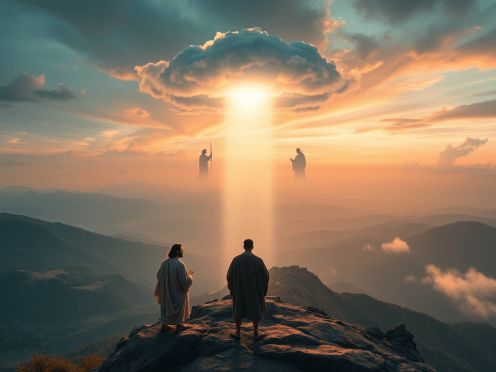
In today’s chapter we come across one of the most strange and mystical episodes of Jesus’ Story. He takes His inner circle of three disciples (Peter, James, and John) and goes us “a high mountain.” There, He is transfigured and the trinity of disciples are allowed to see Jesus revealed in His glory. A cloud descends and from the cloud the voice of God speaks. Moses and Elijah appear and have a conversation with Jesus.

If you have a moment, I urge you to quickly read Exodus 24. It is the story of Moses going up Mount Sinai to receive the Law from God. It has all the same elements. God descends in a cloud, and when Moses returns in chapter 34, his face is so radiant with God’s glory that he has to cover his face so that people can look at him.The two are connected. In Exodus, God is making a covenant with the Hebrew people. He is giving Moses His Law and to the same Hebrew people He will send His prophets. “The Law and Prophets” were how God spoke to His people. Now, Jesus stands on the high mountain. A new covenant is being born that Jesus even said is a “fulfillment” of everything that has come before a la the Law (represented by Moses) and the Prophets (represented by Elijah).

The mountain of transfiguration is Sinai 2.0. In our recent chapter-a-day trek through Leviticus I regularly made the point that the Law was God’s instruction manual for humanity in the toddler stages of civilization. Humanity is now at an age of accountability. The black-and-white paternal rules for which there was a reward-and-punishment paradigm that we use with toddlers is now evolved into the more mature understanding of spiritual principles (think Jesus’ Sermon on the Mount in Matthew 5-7) that a young adult is given as he or she leaves the nest and begins living independently as a responsible adult who must face the consequences of their own willful actions and decisions.

History has moved forward. Humanity has moved forward. The Great Story is moving into a new chapter. This new chapter, however, is not fully understood without the context of the mountain of Eden, mount Sinai, the Law, the Prophets, and the ultimate destination of the eternal Holy City on the “high mountain” in a new heaven and new Earth at the climactic end of the Great Story. It’s all connected. The strange and mystical story of the mountain of Transfiguration in today’s chapter is an important link in the metaphorical mountain chain tying the entire Story together.

So, in the quiet this morning, I find myself ending another work week meditating on my own story in context with the Great Story. Next week on Wednesday I’ll celebrate my 59th trip around the sun. I’ll enter my sixth decade on this life journey. A new chapter.

As I meditate on Elijah’s presence and conversation with Jesus on the mountain of Transfiguration, I can’t help but think about his story. He experienced an incredible victory on Mount Carmel, but then ended his journey in depression, defeat, and being dismissed by God on Mount Sinai, the very mountain that launched Moses into a successful new chapter of his life journey. I don’t know what this new chapter of my earthly journey looks like, but I know I would rather be launched like Moses into a powerful and purposeful new chapter than be depressed and dismissed like Elijah. I’m thinking that I have a role to play in how things ultimately pan out. That’s a good conversation for Wendy and me to have as we celebrate my birthday and the birthdays of friends this weekend.

Enjoy your weekend, my friend. Lord willing, I’ll see you back here on Monday.

If you know anyone who might be encouraged by today’s post, please share.

These chapter-a-day blog posts are also available via podcast on all major podcast platforms including Apple, Google, and Spotify! Simply go to your podcast platform and search for “Wayfarer Tom Vander Well.” If it’s not on your platform, please let me know!

Behind the Veil

Behind the Veil (CaD Matt 17) Wayfarer

After six days Jesus took with him Peter, James and John the brother of James, and led them up a high mountain by themselves. There he was transfigured before them. His face shone like the sun, and his clothes became as white as the light. Just then there appeared before them Moses and Elijah, talking with Jesus.
Matthew 17:1-3 (NIV)

I was never much of a science guy back in school. It just wasn’t my jam. The further I get in my life journey, however, the more fascinated I’ve become by it. In particular, I find it fascinating the mysteries being uncovered and discovered. I learned as a child that the atom was the smallest “building block” of matter, but physicists have discovered a number of subatomic particles, with even more of them theorized. What’s crazy is that they behave in strange ways we don’t understand. I find it fascinating that we are at once discovering the expanding universe and its mysteries at the same time we’re discovering newer layers of the building blocks of the universe and their mysteries. In either direction, macro or micro, we’re making mind-blowing discoveries beyond our current comprehension. Amazing.

I mention this because the further I get in my spiritual journey, the more aware I’ve become of the connectedness of the Great Story and the mysteries of eternity to which it points. Jesus was always making a distinction between earth-bound thinking and eternity-centric thinking. He continually contrasted the kingdoms of this world to the kingdom of God, earth as opposed to heaven, temporal as opposed to eternal. This is not confined to Jesus. In fact, it’s connected throughout the Great Story.

In today’s chapter, Matthew records one of the most mysterious episodes in Jesus’ story. Jesus takes His inner circle of followers and goes up a mountain. In an instant, Jesus is revealed in His eternal glory. Light brighter than you can imagine, a dense cloud, a voice from within the cloud, and then two beings appearing with Him: Moses and Elijah.

Jesus said in His message on the hill that He didn’t come to “abolish the Law and the Prophets, but to fulfill them.” The climactic event for the Hebrew people was their deliverance from slavery in Egypt and the God giving of the Law to Moses on a mountain. If you go back and read about that event in Exodus chapters 19 and 20, there are amazing parallels between that episode and the episode described in today’s chapter.

Both events happened on mountains. Jesus shines like the sun, just like Moses whose face was so bright after returning from the mountain that he had to wear a veil over his face (Ex 34:29-35). Both involved seemingly natural phenomena of clouds/smoke and God’s voice from the midst. The former event precipitated the giving of the Law, the latter precipitated the fulfillment of it. Why did Moses and Elijah appear with Jesus? Moses was the instrument of giving. Jesus was the instrument of fulfillment. Moses represented the Law, Elijah represented the Prophets, and Jesus was the fulfillment of both just as He said He came to do. The Transfiguration was a bookend event to Moses’ receiving the Law on Mt. Sinai.

What struck me as I read the episode again today was the instantaneous transfiguration from temporal normal to eternal glory and then the instantaneous transfiguration back from eternal glory to temporal normal, along with the disciples’ terror.

In the quiet this morning, I find myself contemplating the probability (based on evidence in the Great Story) that the veil between earth and glory is thinner than I’ve ever imagined. I live, move, and have my being in an earthbound, three-dimensional world which frames my thinking and perception. But physicists now theorize that there are actually 11 dimensions (or more). There’s more to it than I ever realized, which is exactly what Jesus continually tried to get His followers to understand.

“Truly I tell you, if you have faith as small as a mustard seed, you can say to this mountain, ‘Move from here to there,’ and it will move. Nothing will be impossible for you.”

In essence, Jesus is saying that there is an eternal reality that is more real than the earthy reality I experience in three dimensions with my five senses. He called it “the Kingdom of God” and He asked me as His follower to seek it, find it, see it, believe it, and allow it to transform the way I live, move, and have my being on this earthly journey.

Jesus chastised Peter in yesterday’s chapter for being so bound to his earthy perceptions that he couldn’t see heaven’s intentions. The further I get in my spiritual journey, the more convinced I am that every time Jesus tells His followers to expand their faith, He’s encouraging me to open my mind and spirit to see what is beyond my human senses yet just as real as physical matter. It is already woven into creation itself. I believe it’s right there behind the veil that is thinner than I imagine.

If you know anyone who might be encouraged by today’s post, please share.

Driving the Action

As they were coming down the mountain, Jesus instructed them, “Don’t tell anyone what you have seen, until the Son of Man has been raised from the dead.”

When they came together in Galilee, he said to them, “The Son of Man is going to be delivered into the hands of men. They will kill him, and on the third day he will be raised to life.” And the disciples were filled with grief.
Matthew 17:9, 22-23 (NIV)

Yesterday I had the privilege of presenting a message and the text was the raising of Lazarus in John 11. As we unpacked the story together, I made the point that Jesus was not a victim of the events around Him, rather Jesus was driving the action of the scene.

Whenever a writer crafts a story, play, or screenplay, he or she must be mindful of how to drive the action of the story and propel events forward. Sometimes action can be circumstantially driven when an event takes place which unleashes a subsequent series of events. In The Godfather, there is an unexpected attempt on Vito’s life and an attack on the Corleone family. [spoiler alert!] As a result of these events Vito’s son, Michael, who wanted nothing to do with his father’s illegal business will become just like his father.

Other times action is driven by a character in the story whose words and actions propel the story forward. In The Lord of the Rings, Gandalf makes a prophetic observation that even Gollum has some part to play in the events leading to the ending of the One Ring. Time and again Gollum’s mischief and machinations drive the action, even to the climactic moment of the epic.

One of the things that becomes very clear as we read the story of Jesus is that Jesus is driving the action. He is not a passive victim of others. He is not the victim of unexpected events that lead to execution. At every turn Jesus is driving the action which will lead to His arrest and even foreshadowing the events to come. In today’s chapter, Jesus twice refers to his death and resurrection. He knows what is coming because it was part of a larger narrative that He had storyboarded in the beginning, and had been prophetically envisioned for centuries (see Psalm 22 [c. 1000 B.C.] and Isaiah 53 [c. 700 B.C.]).

This morning I’m thinking that Jesus came with purpose. He was on a mission and He drove the action. What about me? What’s my mission? Do I act, think, speak with purpose, or am I passively awaiting for circumstances to drive the narrative of my life?

I’m reminded in the quiet this morning that Jesus told us to ask, to seek, and to knock. Those are not commands to be passive, but to participate with God in driving the action of our stories.

Featured image courtesy of bnorthern via Flickr

Chapter-a-Day Matthew 17

Spa Treatment at Le Telfair Golf & Spa Resort ...
Image by whl.travel via Flickr

His appearance changed from the inside out, right before their eyes. Sunlight poured from his face. His clothes were filled with light. Matthew 17:2 (MSG)

God’s glory is an inside out proposition. The change that God wants to make in us is not a cosmetic one. The beauty and light that God wants to emerge from us as a calling card of His grace begins as a change of heart and pours out as a change of countenance and a change of behavior.

Feeling ugly? There is only so much that make-up and new clothes can do – and it’s a temporary fix at best. Radiant beauty starts with God giving your heart and life a makeover. Gorgeousness eminates from a spiritual spa treatment of the soul.

In just over one week we will be celebrating Easter and Jesus’ resurrection. Many of us are, no doubt, contemplating Easter dresses, bonnets and looking good for Easter Sunday. Perhaps this year when I put on my “Sunday best” for Easter it should not be clothes I’m talking about, but the attitude of my heart, the purity of my thoughts, the love in my words and actions.

Enhanced by Zemanta