Tag Archives: Holy City

New Things Come

Now the main point of what we are saying is this: We do have such a high priest, who sat down at the right hand of the throne of the Majesty in heaven, and who serves in the sanctuary, the true tabernacle set up by the Lord, not by a mere human being.
Hebrews 8:1-2 (NIV)

He walked up to me after I’d given a message about Sabbath rest. He wasn’t mean or angry, but he was definitely not happy with me. I live amidst a culture that has traditionally been religiously rabid about Sabbath keeping. I have heard so many stories from adults who spent their Sundays growing up sitting in chairs in the living room. The entire family listening to the clock tick. Other stories recount hair-splitting legalism worthy of Jesus’ day. Tossing a football was okay, but organizing a game was work and that broke the Sabbath.

In my message, I taught that this kind of legalistic rule-keeping Sabbath worship was never the point, it was not what Jesus taught, nor does it resonate God’s intentions for us. Sabbath is about needing rest for our spiritual, mental, physical, relational, and communal health.

The man informed me that he held his family to strict Sabbath keeping and wanted me to know that I’d just thrown him under the bus in the minds of his children. I hope that the family conversation that afternoon was productive and healthy for all of them.

In today’s chapter, the author of Hebrews continues his discussion of Jesus as the cosmic, eternal High Priest of heaven. In fact, the author states that this is his main point. For the first-century Jewish believers to whom he is writing, this resonates deeply. It echoes their entire life experience. They intimately know the temple in Jerusalem, the priestly system of worship, offering, and sacrifice.

As a believer growing up in Protestant midwest Iowa, not so much.

And yet, this is part of a thread of the Great Story that is crucial to understanding all of it. If I miss this, it’s like watching the original Star Wars movie and thinking Luke and Darth Vader are unrelated antagonists. It’s like reading Harry Potter and the Sorcerer’s Stone and thinking Snape is a cookie cutter villain.

The metaphor of temple is woven into the tapestry of the Great Story itself:

  • In Eden, the whole world was God’s temple.
  • In Exodus, God compresses His presence into a tent tabernacle.
  • In Solomon’s day, that becomes a stone temple.
  • In the prophets, God promises a greater dwelling.
  • In Jesus, the temple becomes flesh.
  • At Pentecost, the temple becomes the people. You and me.
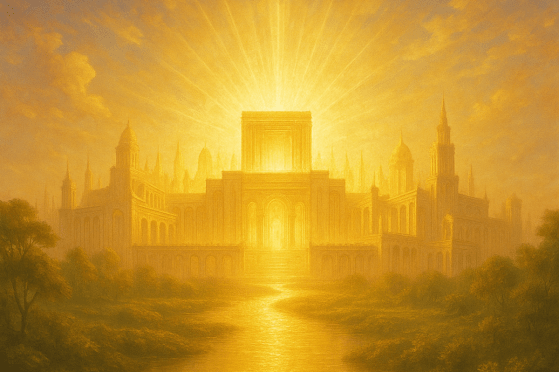
  • In Revelation, the temple becomes the entire renewed creation—
    a holy city that is a Holy of Holies, illuminated from within by the Lamb who is the sanctuary.

Everything is moving toward union, presence, intimacy…
and the erasure of every barrier between God and humanity.

Notice, however, the changes that come with the progression. My legalist Sabbath keeper brothers and sisters want to live in an Exodus paradigm, when Jesus changed all of that. The author of Hebrews says it plaining in the chapter. First in quoting the prophet Jeremiah:

“The days are coming, declares the Lord,
    when I will make a new covenant…


It will not be like the covenant
    I made with their ancestors
when I took them by the hand
    to lead them out of Egypt…


I will put my laws in their minds
    and write them on their hearts.”

No longer a legal written code to be kept like a rule book. The new covenant Jesus made put God’s Spirit into our very bodies, minds, and hearts. It’s not about behavior modification from adherence to an outside set rules, but life transformation from God’s holy presence within me.

The author ends the chapter writing:

By calling this covenant “new,” he has made the first one obsolete; and what is obsolete and outdated will soon disappear.

Old things pass away. New things come. The story of Scripture is not God demanding a temple and religious rule keeping.

It is God refusing to live without me.

It is God shrinking Himself from cosmos → tent → body → Spirit
so that He might enlarge me from dust → disciple → temple → bride → city of God.

Jesus said He was the temple. It was God saying:

“Where I dwell is not a building.
It is with you. It is in you.
And one day, my beloved,
it will be the whole world again.”

If you know anyone who might be encouraged by today’s post, please share.

Promotional graphic for Tom Vander Well's Wayfarer blog and podcast, featuring icons of various podcast platforms with a photo of Tom Vander Well.
These chapter-a-day blog posts are also available via podcast on all major podcast platforms including Apple, Google, and Spotify! Simply go to your podcast platform and search for “Wayfarer Tom Vander Well.” If it’s not on your platform, please let me know!
A logo featuring an open book icon with an orange background, representing a spiritual or religious theme.

Mountains of Meaning

Mountains of Meaning (CaD Matt 17) Wayfarer

After six days Jesus took with him Peter, James and John the brother of James, and led them up a high mountain by themselves.
Matthew 17:1 (NIV)

I have recently been slowly making my way through a series of podcasts by The Bible Project on the theme of mountains in the Great Story. It’s been a fascinating study, as it is yet another metaphorical theme that runs throughout in ways I’ve never seen or understood until now. In fact, the Garden of Eden in Genesis and the Holy City at the end of Revelation are both on mountains. Mountains are revealed as metaphorical thin places where heaven and earth meet. Mountains are full of meaning.

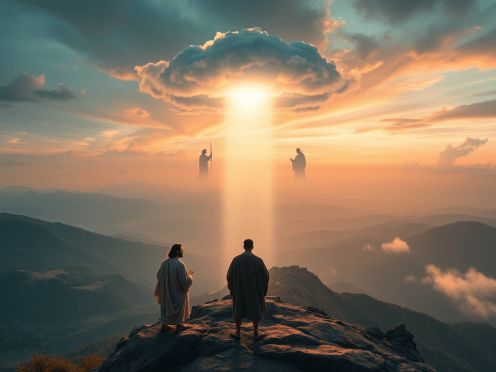
In today’s chapter we come across one of the most strange and mystical episodes of Jesus’ Story. He takes His inner circle of three disciples (Peter, James, and John) and goes us “a high mountain.” There, He is transfigured and the trinity of disciples are allowed to see Jesus revealed in His glory. A cloud descends and from the cloud the voice of God speaks. Moses and Elijah appear and have a conversation with Jesus.

If you have a moment, I urge you to quickly read Exodus 24. It is the story of Moses going up Mount Sinai to receive the Law from God. It has all the same elements. God descends in a cloud, and when Moses returns in chapter 34, his face is so radiant with God’s glory that he has to cover his face so that people can look at him.The two are connected. In Exodus, God is making a covenant with the Hebrew people. He is giving Moses His Law and to the same Hebrew people He will send His prophets. “The Law and Prophets” were how God spoke to His people. Now, Jesus stands on the high mountain. A new covenant is being born that Jesus even said is a “fulfillment” of everything that has come before a la the Law (represented by Moses) and the Prophets (represented by Elijah).

The mountain of transfiguration is Sinai 2.0. In our recent chapter-a-day trek through Leviticus I regularly made the point that the Law was God’s instruction manual for humanity in the toddler stages of civilization. Humanity is now at an age of accountability. The black-and-white paternal rules for which there was a reward-and-punishment paradigm that we use with toddlers is now evolved into the more mature understanding of spiritual principles (think Jesus’ Sermon on the Mount in Matthew 5-7) that a young adult is given as he or she leaves the nest and begins living independently as a responsible adult who must face the consequences of their own willful actions and decisions.

History has moved forward. Humanity has moved forward. The Great Story is moving into a new chapter. This new chapter, however, is not fully understood without the context of the mountain of Eden, mount Sinai, the Law, the Prophets, and the ultimate destination of the eternal Holy City on the “high mountain” in a new heaven and new Earth at the climactic end of the Great Story. It’s all connected. The strange and mystical story of the mountain of Transfiguration in today’s chapter is an important link in the metaphorical mountain chain tying the entire Story together.

So, in the quiet this morning, I find myself ending another work week meditating on my own story in context with the Great Story. Next week on Wednesday I’ll celebrate my 59th trip around the sun. I’ll enter my sixth decade on this life journey. A new chapter.

As I meditate on Elijah’s presence and conversation with Jesus on the mountain of Transfiguration, I can’t help but think about his story. He experienced an incredible victory on Mount Carmel, but then ended his journey in depression, defeat, and being dismissed by God on Mount Sinai, the very mountain that launched Moses into a successful new chapter of his life journey. I don’t know what this new chapter of my earthly journey looks like, but I know I would rather be launched like Moses into a powerful and purposeful new chapter than be depressed and dismissed like Elijah. I’m thinking that I have a role to play in how things ultimately pan out. That’s a good conversation for Wendy and me to have as we celebrate my birthday and the birthdays of friends this weekend.

Enjoy your weekend, my friend. Lord willing, I’ll see you back here on Monday.

If you know anyone who might be encouraged by today’s post, please share.

These chapter-a-day blog posts are also available via podcast on all major podcast platforms including Apple, Google, and Spotify! Simply go to your podcast platform and search for “Wayfarer Tom Vander Well.” If it’s not on your platform, please let me know!