Tag Archives: Eden

A Different Way

The devil led him up to a high place and showed him in an instant all the kingdoms of the world. And he said to him, “I will give you all their authority and splendor; it has been given to me, and I can give it to anyone I want to. If you worship me, it will all be yours.”
Luke 4:5-7 (NIV)

We forget evil.

Along my life journey I’ve observed that God gets a lot of the rap for all the misery in the world. Yet, at the very beginning of the story we learn that human beings chose to be their own gods—with a serpent whispering them on. They are forced to leave God’s Garden and enter… the world.

This world.

And in this world, the serpent holds dominion, power, and authority. Human beings continue to choose they’d rather be their own gods.

Chaos.

And when everything falls apart we blame… God.

The Great Story is a story of good and evil. The kingdoms of this world are ruled by the Prince of this World, that old snake. They operate by a well-worn playbook that doesn’t change much.

Look out for number one.
Be beautiful, powerful, popular, and rich.
The one with the most stuff wins.

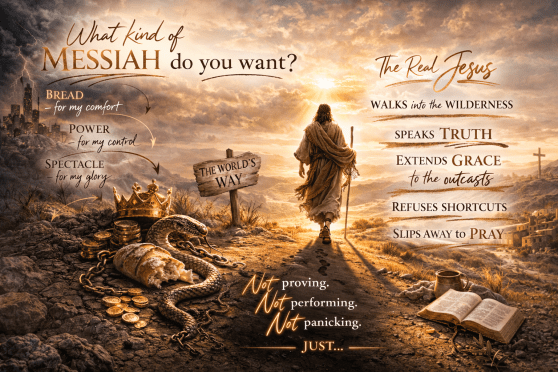
In today’s chapter, Luke shares the beginning of Jesus’ earthly ministry. Jesus begins His ministry by going into the wilderness by Himself. He fasts. He prays.

And then the snake shows up. This world is his dominion after all, and having God’s Son running around is a threat to that dominion. The temptations he offers Jesus are about identity.

These are not random sins—they are messianic shortcuts.

Each begins with a subtle seduction:

“If you are the Son of God…”

Not prove it—but define it on your own terms.

  • Bread = meet your own needs first
  • Power = take the crown without the cross
  • Spectacle = force God’s hand

In other words: be your own kind of Messiah. Do it the world’s way. It’s quick, it’s easy, and the snake has the power to make it happen.

Jesus resists each with Scripture. Not flexing divine muscle—but anchoring himself in trust.

What follows in the rest of the chapter is a study in how God’s ways differ from the ways of this world. Jesus does exactly the opposite of what the world’s playbook prescribes for fame, power, and fortune.

He speaks hard truths. He makes people angry. They reject Him.

He sets up His ministry in rural, blue-collar villages far from the halls of worldly power and influence.

When the crowds surge, He steps away.

And in the quiet this morning, Jesus example, in contrast to what the world has to offer, has me asking myself “What kind of Messiah do I want?”

Because the temptations offered Jesus are the same ones I often prefer:

  • A Jesus who makes my life easier (bread)
  • A Jesus who gives me control (power)
  • A Jesus who proves himself on demand — for my benefit (spectacle)

But the real Jesus?

He walks into wilderness.
He speaks uncomfortable truth.
He extends grace to people I’d rather exclude.
He slips away when I want him to perform.

Meanwhile, I find myself constantly tempted…

  • To grasp instead of trust
  • To impress instead of obey
  • To control instead of surrender

Because the enemy rarely shows up with fangs…

He shows up with reasonable alternatives.

So, I find myself at the beginning of another day with yet another opportunity to choose the ways of this world, or to follow in Jesus’ footsteps – the way He operated.

I want to walk into this day like Jesus walked into the wilderness:

Not proving.
Not performing.
Not panicking.

Just…

Spirit-filled.
Scripture-anchored.
Prayer-centered.

And when the crowd presses in—whether with praise or pressure—

I will slip away, even for a moment,
and find my center again.

If you know anyone who might be encouraged by today’s post, please share.

Promotional graphic for Tom Vander Well's Wayfarer blog and podcast, featuring icons of various podcast platforms with a photo of Tom Vander Well.
These chapter-a-day blog posts are also available via podcast on all major podcast platforms including Apple, Google, and Spotify! Simply go to your podcast platform and search for “Wayfarer Tom Vander Well.” If it’s not on your platform, please let me know!

Icon of an open book on an orange background.

New Things Come

Now the main point of what we are saying is this: We do have such a high priest, who sat down at the right hand of the throne of the Majesty in heaven, and who serves in the sanctuary, the true tabernacle set up by the Lord, not by a mere human being.
Hebrews 8:1-2 (NIV)

He walked up to me after I’d given a message about Sabbath rest. He wasn’t mean or angry, but he was definitely not happy with me. I live amidst a culture that has traditionally been religiously rabid about Sabbath keeping. I have heard so many stories from adults who spent their Sundays growing up sitting in chairs in the living room. The entire family listening to the clock tick. Other stories recount hair-splitting legalism worthy of Jesus’ day. Tossing a football was okay, but organizing a game was work and that broke the Sabbath.

In my message, I taught that this kind of legalistic rule-keeping Sabbath worship was never the point, it was not what Jesus taught, nor does it resonate God’s intentions for us. Sabbath is about needing rest for our spiritual, mental, physical, relational, and communal health.

The man informed me that he held his family to strict Sabbath keeping and wanted me to know that I’d just thrown him under the bus in the minds of his children. I hope that the family conversation that afternoon was productive and healthy for all of them.

In today’s chapter, the author of Hebrews continues his discussion of Jesus as the cosmic, eternal High Priest of heaven. In fact, the author states that this is his main point. For the first-century Jewish believers to whom he is writing, this resonates deeply. It echoes their entire life experience. They intimately know the temple in Jerusalem, the priestly system of worship, offering, and sacrifice.

As a believer growing up in Protestant midwest Iowa, not so much.

And yet, this is part of a thread of the Great Story that is crucial to understanding all of it. If I miss this, it’s like watching the original Star Wars movie and thinking Luke and Darth Vader are unrelated antagonists. It’s like reading Harry Potter and the Sorcerer’s Stone and thinking Snape is a cookie cutter villain.

The metaphor of temple is woven into the tapestry of the Great Story itself:

  • In Eden, the whole world was God’s temple.
  • In Exodus, God compresses His presence into a tent tabernacle.
  • In Solomon’s day, that becomes a stone temple.
  • In the prophets, God promises a greater dwelling.
  • In Jesus, the temple becomes flesh.
  • At Pentecost, the temple becomes the people. You and me.
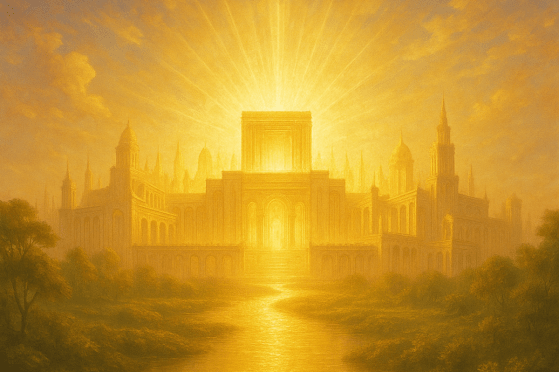
  • In Revelation, the temple becomes the entire renewed creation—
    a holy city that is a Holy of Holies, illuminated from within by the Lamb who is the sanctuary.

Everything is moving toward union, presence, intimacy…
and the erasure of every barrier between God and humanity.

Notice, however, the changes that come with the progression. My legalist Sabbath keeper brothers and sisters want to live in an Exodus paradigm, when Jesus changed all of that. The author of Hebrews says it plaining in the chapter. First in quoting the prophet Jeremiah:

“The days are coming, declares the Lord,
    when I will make a new covenant…


It will not be like the covenant
    I made with their ancestors
when I took them by the hand
    to lead them out of Egypt…


I will put my laws in their minds
    and write them on their hearts.”

No longer a legal written code to be kept like a rule book. The new covenant Jesus made put God’s Spirit into our very bodies, minds, and hearts. It’s not about behavior modification from adherence to an outside set rules, but life transformation from God’s holy presence within me.

The author ends the chapter writing:

By calling this covenant “new,” he has made the first one obsolete; and what is obsolete and outdated will soon disappear.

Old things pass away. New things come. The story of Scripture is not God demanding a temple and religious rule keeping.

It is God refusing to live without me.

It is God shrinking Himself from cosmos → tent → body → Spirit
so that He might enlarge me from dust → disciple → temple → bride → city of God.

Jesus said He was the temple. It was God saying:

“Where I dwell is not a building.
It is with you. It is in you.
And one day, my beloved,
it will be the whole world again.”

If you know anyone who might be encouraged by today’s post, please share.

Promotional graphic for Tom Vander Well's Wayfarer blog and podcast, featuring icons of various podcast platforms with a photo of Tom Vander Well.
These chapter-a-day blog posts are also available via podcast on all major podcast platforms including Apple, Google, and Spotify! Simply go to your podcast platform and search for “Wayfarer Tom Vander Well.” If it’s not on your platform, please let me know!
A logo featuring an open book icon with an orange background, representing a spiritual or religious theme.

Mountains of Meaning

Mountains of Meaning (CaD Matt 17) Wayfarer

After six days Jesus took with him Peter, James and John the brother of James, and led them up a high mountain by themselves.
Matthew 17:1 (NIV)

I have recently been slowly making my way through a series of podcasts by The Bible Project on the theme of mountains in the Great Story. It’s been a fascinating study, as it is yet another metaphorical theme that runs throughout in ways I’ve never seen or understood until now. In fact, the Garden of Eden in Genesis and the Holy City at the end of Revelation are both on mountains. Mountains are revealed as metaphorical thin places where heaven and earth meet. Mountains are full of meaning.

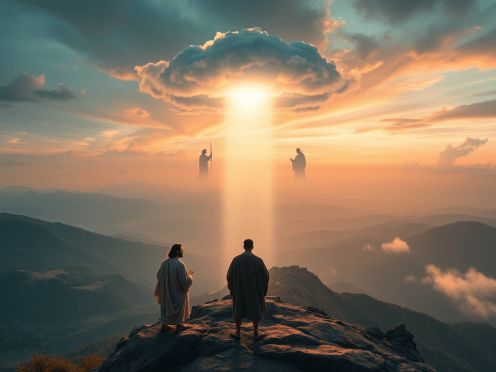
In today’s chapter we come across one of the most strange and mystical episodes of Jesus’ Story. He takes His inner circle of three disciples (Peter, James, and John) and goes us “a high mountain.” There, He is transfigured and the trinity of disciples are allowed to see Jesus revealed in His glory. A cloud descends and from the cloud the voice of God speaks. Moses and Elijah appear and have a conversation with Jesus.

If you have a moment, I urge you to quickly read Exodus 24. It is the story of Moses going up Mount Sinai to receive the Law from God. It has all the same elements. God descends in a cloud, and when Moses returns in chapter 34, his face is so radiant with God’s glory that he has to cover his face so that people can look at him.The two are connected. In Exodus, God is making a covenant with the Hebrew people. He is giving Moses His Law and to the same Hebrew people He will send His prophets. “The Law and Prophets” were how God spoke to His people. Now, Jesus stands on the high mountain. A new covenant is being born that Jesus even said is a “fulfillment” of everything that has come before a la the Law (represented by Moses) and the Prophets (represented by Elijah).

The mountain of transfiguration is Sinai 2.0. In our recent chapter-a-day trek through Leviticus I regularly made the point that the Law was God’s instruction manual for humanity in the toddler stages of civilization. Humanity is now at an age of accountability. The black-and-white paternal rules for which there was a reward-and-punishment paradigm that we use with toddlers is now evolved into the more mature understanding of spiritual principles (think Jesus’ Sermon on the Mount in Matthew 5-7) that a young adult is given as he or she leaves the nest and begins living independently as a responsible adult who must face the consequences of their own willful actions and decisions.

History has moved forward. Humanity has moved forward. The Great Story is moving into a new chapter. This new chapter, however, is not fully understood without the context of the mountain of Eden, mount Sinai, the Law, the Prophets, and the ultimate destination of the eternal Holy City on the “high mountain” in a new heaven and new Earth at the climactic end of the Great Story. It’s all connected. The strange and mystical story of the mountain of Transfiguration in today’s chapter is an important link in the metaphorical mountain chain tying the entire Story together.

So, in the quiet this morning, I find myself ending another work week meditating on my own story in context with the Great Story. Next week on Wednesday I’ll celebrate my 59th trip around the sun. I’ll enter my sixth decade on this life journey. A new chapter.

As I meditate on Elijah’s presence and conversation with Jesus on the mountain of Transfiguration, I can’t help but think about his story. He experienced an incredible victory on Mount Carmel, but then ended his journey in depression, defeat, and being dismissed by God on Mount Sinai, the very mountain that launched Moses into a successful new chapter of his life journey. I don’t know what this new chapter of my earthly journey looks like, but I know I would rather be launched like Moses into a powerful and purposeful new chapter than be depressed and dismissed like Elijah. I’m thinking that I have a role to play in how things ultimately pan out. That’s a good conversation for Wendy and me to have as we celebrate my birthday and the birthdays of friends this weekend.

Enjoy your weekend, my friend. Lord willing, I’ll see you back here on Monday.

If you know anyone who might be encouraged by today’s post, please share.

These chapter-a-day blog posts are also available via podcast on all major podcast platforms including Apple, Google, and Spotify! Simply go to your podcast platform and search for “Wayfarer Tom Vander Well.” If it’s not on your platform, please let me know!

I am Achan

And Achan answered Joshua, “It is true; I am the one who sinned against the Lord God of Israel. This is what I did: when I saw among the spoil a beautiful mantle from Shinar, and two hundred shekels of silver, and a bar of gold weighing fifty shekels, then I coveted them and took them. They now lie hidden in the ground inside my tent, with the silver underneath.”
Joshua 7:20-21 (NRSV)

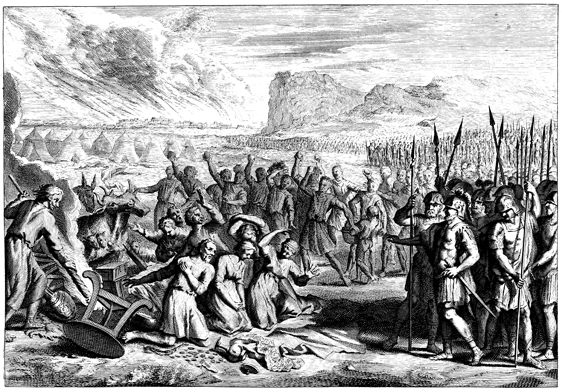
The story of Achan is fascinating. God miraculously delivers the city of Jericho to Joshua and his big band of trumpet players. The walls of the city come tumbling down and the nation of Israel plunders the city with one simple rule: don’t take any of the pagan idols or things used in the worship of the idols and false gods of the people of Jericho. Does this remind you of anything? (Hint: “You can eat of any tree of the garden except for that one in the middle.”)

Sure enough, a man name Achan takes some forbidden spoil for himself in direct disobedience to the order (that would be calls sin) and then hides it by burying it in his tent (that would be called shame). God clues Joshua in that someone has disobeyed and, eventually, Achan is confronted and confesses his sin. Achan and his entire family are stoned to death to rid the nation of sin (that would be called a “scapegoat”).

When I was younger, I always saw the story of Achan from the idealistic view of the majority. “Achan, how could you ruin it for the whole nation? Dude, you knew the rules! How simple was it just to do the right thing? What an idiot!

As I have progressed in my life journey I have increasingly come to terms with a simple fact: I am Achan. I am the child who, at the age of five, stole all the envelopes with money in them off my grandparent’s Christmas tree and buried them in my suitcase. I am the one who is guilty of lying, and cheating, and stealing, and breaking my word, and being disobedient to God and my loved ones. Not just once, mind you, but over and over and over again. If I point the finger at Achan, there are three pointing back at me.

In the context of the Great Story, Achan serves as a thematic waypoint. Achan hearkens us back to Eden and reminds us that the problem of sin has not been dealt with.  Achan reminds us, in the moment, of one of the meta-themes of God’s great story: one little sin taints the whole. As Jesus put it, one smidgen of yeast affects the whole loaf. Achan reflects our fallen human nature’s penchant to blame one for the failure of the whole, and a Cubs fan need only to hear the name Bartman to realize that human nature has not changed across time. Finally, the story of Achan is a foreshadow of the solution God will provide when He will send His one and only Son to be the One who will die the death that idol stealing and  Christmas money stealing criminals deserve. Jesus will be the sacrificial lamb and make atonement for the whole.

This morning I am once again humbled by an honest reflection of my own shortcomings. I am thinking about Achan and accepting that I am him. Throw the rocks, man. I deserve it. I am once again grateful for that which we have just celebrated: God becoming man to die for my sin, to take my shame on His shoulders, and then to rise from the grave to give grace, hope, forgiveness, and redemption to one such as me.


chapter a day banner 2015

A Hint of Paradise

wendy at als

Kiss me and kiss me again,
    for your love is sweeter than wine.
Song of Solomon 1:2 (NLT)


I sit in a hotel lobby as I write this. I have a couple of days in client meetings early this week, so Wendy and I left on Saturday morning to tack on a little weekend getaway to my business trip. We’ve had a lot of fun and it’s been one long date since we left on Saturday morning. As I write this post the elevator music in the lobby is playing “Babe” by Styx, the sappy late 70’s early 80’s power ballad that conjures up memories of school dances, teen romances and off the chart infatuations. I laughed to myself as I heard it and thought about it in context of a romantic getaway with my bride. For some strange reason, I thought it would be fun to start Song of Solomon this morning.

The lyrics of Solomon’s ancient, romantic power ballad bills itself as “more wonderful than any other.” The duet (with back up chorus) starts with the young woman saying that her lover’s kisses are “sweeter than wine.” The truth is that love is intoxicating. I feel it this morning. I’ve felt it all weekend. I’m feeling drunk and sappy with love for Wendy who is my wife, my lover, and my friend. And, I’m enjoying it thoroughly, thank you very much.

Conservative theologians like to point out that Song of Solomon is an ancient allegory of the relationship between Jesus (e.g. the king) and the church (e.g. his bride). I get that, but that’s where the stuffy legalists like to leave the conversation. God forbid we actually have a conversation about the healthy sexual relationship between a husband and wife. What a shame. God is an artist and great art communicates truth on a multitude of different levels. Song of Solomon is an incredible set of ancient lyrics full of sappy romance and strong sexual references both overt (e.g. “my lover is a sachet of myrrh lying between my breasts”) and subtle.

God, the artist, created us male and female. He created us naked. He told Adam and Eve to be fruitful and multiply. Love, intimacy and sex between husband and wife was part of the original ideal and when we are blessed to experience a moment of it here, East of Eden, it is allows us to capture, even for a brief moment, a hint of the original paradise.