Tag Archives: John 10

Shepherd and Sheep

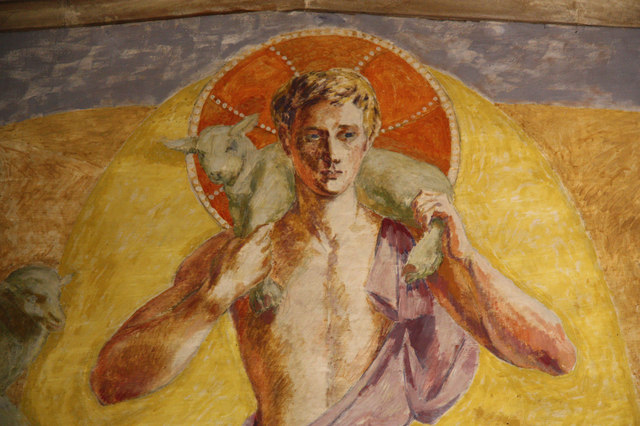
Shepherd and Sheep (CaD Jhn 10) Wayfarer

“I am the good shepherd; I know my sheep and my sheep know me…”
John 10:14 (NIV)

I mentioned in previous posts that John’s account of Jesus’ story is put together thematically, and John chooses seven miraculous signs of Jesus to introduce us, his audience, to Jesus. Seven is not an arbitrary number. Throughout the Great Story, the number seven is repeatedly used and indicates completeness. At the very beginning, in Genesis, God creates everything in seven days, calls it good, and establishes a complete week. In Revelation, the final judgments come in three sets of seven, where three represents the divinity of the judgments and seven indicates their completeness.

John also chooses to share seven metaphors and “I am” statements that Jesus used about Himself:

“I am the Bread of Life.”
“I am the Light of the World.”
“I am the Gate.”
“I am the Good Shepherd.”
“I am the Resurrection and the Life.”
“I am the Way, the Truth, and the Life.”
“I am the True Vine.”

These metaphors are not confined to Jesus’ declaration as each has deep connections throughout the Great Story.

The metaphor Jesus uses in today’s chapter is that of the Good Shepherd. Abraham, Isaac, and Jacob/Israel were shepherds and Israel referred to God as the Shepherd of their lives. Moses was a shepherd. David was a shepherd. The prophets repeatedly referred to the kings of Israel and Judah as the appointed shepherds of God’s people. Jesus repeatedly used the metaphor of the Shepherd and sheep in His parables. In Revelation, Jesus is referred to as the Shepherd who leads His sheep to springs of living water. In claiming to be the Good Shepherd, Jesus is channeling the metaphorical thread that God has woven throughout the Great Story itself from beginning to end.

As I meditate on the metaphor of Jesus being the Good Shepherd, I can’t help but focus on David’s famous lyrics in the 23rd Psalm. As a life-long follower of Jesus, the opening line is particularly poignant: “The Lord is my Shepherd, I shall not want.” There is a relationship and intimacy between the Good Shepherd and His sheep. The Shepherd is a provider, protector, and guide. The Shepherd knows and calls each sheep by name. The Shepherd will leave the flock to find one lost sheep. When predators attack, the Shepherd will lay down his life for them.

Having grown up on a small farm, Wendy loves to reminisce about the sheep and lambs they raised and cared for. “They’re so dumb,” she tells me. This fact also gets added to the mix as I meditate in the quiet this morning. It’s easy to observe people, recount my own poor choices in life, and conclude that people are “dumb” too. I present myself as Exhibit A. We wander aimlessly through life, afraid, threatened, and needy. “Like sheep without a Shepherd,” is what the ancient prophets liked to say.

In the quiet this morning, I find myself comforted as I think about the Lord being my Shepherd. I am currently in a season of life in which many things are uncertain. It’s easy to feel fear and anxiety. Then I look back at my entire life and can easily recount the many ways that God has always led, directed, provided, and protected me. He has been a Good Shepherd to this dumb sheep, and I can trust Him to continue being so. It’s who Jesus is. He said it Himself.

If you know anyone who might be encouraged by today’s post, please share.

Words and Works

Words and Works (CaD John 10) Wayfarer

The Jews who were there gathered around him, saying, “How long will you keep us in suspense? If you are the Messiah, tell us plainly.”

Jesus answered, “I did tell you, but you do not believe. The works I do in my Father’s name testify about me, but you do not believe because you are not my sheep.

John 10:24-26 (NIV)

Wendy and I have been regular readers of the Wall Street Journal forever. The New York based newspaper is one of a few newspapers to have had subscribers across the entire nation, even before the dawn of the digital age.

One of the things that we have noticed across the years is that you can take the Wall Street Journal out of New York, but you can’t take New York out of the Wall Street Journal. The content, from news to opinion to lifestyle are clearly New York City centric and cater to wealthy business professionals in Manhattan who have always been the key constituency in their subscriber base. What this means, however, is that Wendy and I often shake our heads over morning coffee here in small town Iowa. The Wall Street Journal clearly doesn’t get life in fly-over country (even when they visit every four years for the Iowa caucuses) where life and business are still largely centered around agriculture and people see life differently based on a very different daily life experience.

In the same way, it’s often challenging for a 21st century reader to understand the context of a first century story-teller, but it’s not impossible. Learning the context reveals often profound understanding.

God’s base language is metaphor, and in today’s chapter Jesus uses one metaphor in two different messages He presents in the Temple in Jerusalem: the Shepherd. Shepherds and sheep were understood by all of Jesus’ listeners back in the day. Sheep were a staple in their lives for both food, clothing, and the religious system. In fact, the metaphor of the Shepherd was not new to Jesus. It’s all over the place in the ancient Psalms and the messages of the prophets in which God revealed Himself as the “Shepherd of Israel,” the religious leaders were, likewise, to “shepherd” God’s people, and the coming Messiah was prophesied to be a true Shepherd to care for God’s people. Moses was a shepherd. David was a shepherd. Shepherd is an important metaphor in the Great Story.

In Jesus’ word picture, He is both a gate by which sheep go out to pasture and return to the safety of their home, and the Shepherd who lays down His life for the sheep because they are His sheep. He is not a thief, robber, or rustler who seeks to steal sheep for their own selfish aims.

John then moves the narrative to another time Jesus was teaching in the Temple in Jerusalem during another national religious festival in which he again uses the metaphor of Shepherd and sheep. There is still tremendous debate and division over Jesus true identity. He is asked plainly: “Are you the Messiah, or not?”

Jesus responds with an interesting statement: “I told you already, not with words, but by my actions, my works, and my signs. You didn’t get it because you’re not my sheep.”

Actions reveal identity.

Jesus says basically the same thing as He did in the previous chapter, but with a different metaphor:

I Am the Light of the World:
– There are blind who I make see
– There are those who see who I cause to go blind

I Am the Good Shepherd:
– My sheep know my voice and follow
– Those who don’t know my voice don’t follow; Not my sheep

What really stuck out to me, however, was that His true identity was revealed by words or claims but by works and deeds. It is the same thing Jesus told The Twelve later: They’ll know you’re mine, not by your claims, but by your love for one another. Jesus’ brother, James, would pick up on this in his letter to the exiled followers of Jesus scattered across the Roman empire: “Faith by itself, with no action, is dead. Show me your faith without deeds, and I will show you my faith by my deeds.”

In the quiet this morning, I am reminded that even when Jesus was walking the earth performing signs and wonders, there were many who remained blind and deaf to His message. Why should I think that it would be any different today? I’m also reminded that my claim to be a follower of the Good Shepherd is basically worthless. Jesus said so Himself. It is those acts of love, grace, mercy, generosity, and forgiveness that mark me as one of His sheep.

Time for this sheep to do my best to reveal my faith in action, and not just these words, on this another day of the journey.

If you know anyone who might be encouraged by today’s post, please share.

The Language of God

Jesus used this figure of speech with them, but they did not understand what he was saying to them.
John 10:6 (NRSV)

I taught a class a year ago called The Language of God,  and in the class I and my classmates walked through the Great Story, unpacking evidence that metaphor (something that represents something else) is the medium God incessantly uses to communicate Himself to us. God is Creator. God is an artist. God reveals Himself in creation and in word pictures.

John understood this better than Matthew, Mark, or Luke. In his biography of Jesus, John begins by revealing Jesus as “The Word.” Since then, John has communicated different metaphors that both John the Baptist and Jesus used to communicate who He was…

Lamb of God
Water of Life
Bread of Life
Light of the World
The Gate
The Good Shepherd

John isn’t done. There are more metaphors, more word pictures, to come in the remaining chapters.

I find it fascinating that John records that Jesus used “this figure of speech” or way of speaking, “but they didn’t understand what he was saying to them.” Later in the chapter the religious lawyers even make it more blunt, “If you are the Messiah, tell us plainly.” Jesus response: “I have told you.” And indeed, Jesus has been telling them all along. They were so myopically focused on the scribes’ ink on the papyrus of their precious scrolls that they couldn’t interpret the language of metaphor, the living Word, that was being communicated in front of their eyes and in their very own ears.

“Those who have the ears to hear,” Jesus said. Those who can interpret the word pictures Jesus is verbally painting, those who can understand the language of metaphor, they get what He is saying.

Understanding God’s Message is deeper than being able to read the ink on the page. You have to understand the language of metaphor our Creator/Artist God is using in His works of creation and the Great Story He authors.


chapter a day banner 2015

Chapter-a-Day John 10

by shefftim via Flickr

“The thief’s purpose is to steal and kill and destroy. My purpose is to give them a rich and satisfying life.” John 10:10 (NLT)

The further I get in the journey, the more keenly aware I am of both life and death. I want to be about things that are life giving and avoid those things that hint, or reek, or lead to death.

Each day I get to make a dizzying number of choices about what I think, say, and do as well as choices regarding things to which I watch, listen, and read.

More and more I find myself asking “is this life-giving, or does this hint of death?”

I choose life.