Tag Archives: Atonement

Contrition

Close up of an 17th-century depiction of the 2...
Close up of an 17th-century depiction of the 28 articles of the Augsburg Confession by Wenceslas Hollar. (Photo credit: Wikipedia)

When Ahab heard these words, he tore his clothes, put on sackcloth and fasted. He lay in sackcloth and went around meekly. 1 Kings 21:27 (NIV)

For over 20 years I have been training and coaching people in the art of delivering customer service. In that time, I have found that there is no more contentious and divisive service skill than the simple apology. I increasingly find that individuals struggle with saying a simple, “I’m sorry that happened,” even when saying it as a representative of a business and there is no interpersonal relationship between customer and representative. I also find it common for clients to exchange the word “unfortunately” for any form of “sorry” or “apologize.” I find this fascinating.

The root word of “unfortunately” is “fortune” which is synonymous with “luck.” When saying, “Unfortunately, you don’t have a receipt with you,” it’s like saying “It’s bad luck that you don’t have a receipt with you.” It acknowledges the other’s stinky situation, but does nothing to express any kind of personal empathy. It avoids having any personal skin in the game like the statement “I am sorry, but you don’t have a receipt,” or “I apologize, but without a receipt your options are limited.”

We don’t talk much, at least in the protestant circles in which I run, about contrition anymore. Contrition is the act of being sorrowful or remorseful about the ways you’ve blown it and the things you’ve done (or should have done but didn’t). In culture, and in media, it seems to me that we commonly find individuals who stonewall, obfuscate, deny, and deceive in order to escape taking responsibility for their inappropriate or damaging words or actions. As I write this, we are nearing an election day. One need only turn on the television to be bombarded by every politician with the same message: “I’m all good and am going to make your life rosy. My opponent is all bad and is going to ruin your life. Here are some gross misrepresentations of truth to deceive you into believing it.”

It’s interesting to note that when Jesus addressed potential followers, the call to following and believing were regularly predicated by an act of contrition. “Deny yourself,” “Take up your cross,” “Repent,” and “Sell all you have,” were prerequisites Jesus placed to faith and belief. Sincere contrition is a gateway to spiritual reconciliation, as we see in the example of Ahab in today’s chapter. By acknowledging our impotence, God’s power is loosened in our lives. By accepting our need, God’s sufficiency is quickened to provide. With the honest confession of our failures, God successfully showers us with grace through the blood of Jesus which was sacrificially poured out to atone for them.

Paying the Price (or Not)

But the king replied to Araunah, “No, I insist on paying you for it. I will not sacrifice to the Lord my God burnt offerings that cost me nothing.” 2 Samuel 24:24 (NIV)

It was almost cliche. It was the first weekend that my sister and I, as teenagers, had been left alone in the house. My parents headed to Le Mars to spend the weekend with Grandpa Vander Well. I was fourteen. My sister was sixteen. We were given the standard parental instructions not to have anyone over, to keep the house clean while they were gone, yada, yada, yada, blah, blah, blah.

We invited a few people over. I honestly remember it only being a few people. Nevertheless, word spread that there was a party at the Vander Wells, whose parents were out of town. Somehow, the kids kept coming that night. At one point I remember hiding in the laundry room because of the chaos outside. I’m not sure when I realized that things were out of hand. Perhaps it was when members of the football team began seeing who could successfully jump from the roof of our house onto the roof of the detached garage.

This, of course, was the pre-cell phone era. News took longer to travel. The parents got home on Sunday evening. The house was picked up and spotless. We thought we’d gotten away with it. I’m not sure which neighbor ratted us out, but on Monday morning Jody and I were quickly tried in the kitchen tribunal and found guilty as charged. I could have made a defense that it was Jody’s idea and the crowd was mostly older kids who Jody knew. I could have pled the defense of Tim and Terry never getting in trouble for the parties that they had when the rest of us were gone. Forget it. I knew it was useless.

We were grounded for a week. I didn’t argue. I didn’t complain. I didn’t whine. I was guilty and I knew it. I gladly paid the price for my sin.

I was struck by David’s response to Arauna, who offered to give David everything he needed to atone for his mistake. David understood the spiritual principle that the price has to be paid for your mistake. David had blown it and he deserved to pay the price of the sacrifice. I had blown it and knew I had to do a week in the 3107 Madison penitentiary as a price for my infraction.

I think most all of us know when we blow it, whether we wish to admit it or not. I think most all of us understand that we deserve to pay the price for our mistakes. What is difficult is to accept that Jesus paid the price for us. That’s what the cross is about. When we arrive at the metaphorical threshing floor seeking to make some sacrifice to atone for what we’ve done, Jesus says “I’ve already paid the price. I’ve already made the sacrifice, once and for all. The only thing you have to do is accept it.

For many of us, the spiritual economics of this make no sense. We want to pay the price for our sin. We need to pay the price for our sin. We can’t believe that our guilty conscience can be absolved in any other way that for us to personally pay the price and feel the pain. So, we self flagellate. We become Robert Di Nero in The Mission (watch move clip at the top of this post), dragging a heavy sack of armor up some rocky cliff because we simply cannot believe that forgiveness can be found by any other means than personally paying the price.

How ironic that, for some of us, the obstacle to believing in Jesus is simply accepting and allowing Him to have paid the price for us.

Today, I’m thinking about the things I do out of guilt for what I’ve done, rather than gratitude for what Jesus did for me when He paid the price and made the sacrifice I deserved to make.

Enhanced by Zemanta

Chapter-a-Day Mark 15

This is a diagram of the Biblical tabernacle o...
Image via Wikipedia

And the curtain in the sanctuary of the Temple was torn in two, from top to bottom. Mark 15:38 (NLT)

For those unfamiliar with the larger story of God’s Message, this obscure reference in the middle of today’s chapter makes little sense. When God gave Moses the blueprints for the Temple back in the book of Exodus, it included an inner room that was blocked off by a huge curtain. It was behind that curtain that God’s presence resided and it was considered so holy that only the high priest could go behind the curtain, and he could only do it once a year to make atonement for the sins of the people. The word picture was obvious and powerful. There was a separation between God and man and no man could stand before God in His holiness.

When Jesus died, that curtain was mysteriously and miraculously torn in two. Once again, the word picture is both obvious and powerful. With the death of Jesus, the sacrificial Lamb of God, the penalty for sin was paid once for all. There was no longer any separation between man and God – not because of anything man did to earn God’s favor, but because of what God did to pay the penalty of humanity’s flaws.

Today, as I look forward to Christmas, I’m thankful for God who sent his Son. A baby, born in the most humble of circumstances, who would eventually give Himself up to a cruel death to make a way for me to enter through the curtain of eternity.

Chapter-a-Day Numbers 16

Cover of "Harry Potter and the Philosophe...
Cover of Harry Potter and the Philosophers Stone

Aaron grabbed the censer, as directed by Moses, and ran into the midst of the congregation. The plague had already begun. He put burning incense into the censer and atoned for the people. He stood there between the living and the dead and stopped the plague. Numbers 16:47-48 (MSG)

The last Harry Potter movie comes out this weekend. Wendy and I are excited to see it and the last few days, while I’ve been on the road, I’ve been listening to the first Harry Potter book over again. It’s amazing to me as I listen again just how much of the story is foreshadowed in the early chapters, and how many key characters are subtly revealed. It’s part of what makes the series of stories so great. The fairly short and simple first installment is actually a brilliant foreshadowing of the much larger, complex story. I also happen to believe that all great stories are a shadow of the Great Story.

I admit, I don’t always get why God did things the way they happened in the ancient stories. I do know, however, that the circumstances and stories were the very early chapters of a much larger, epic story about the relationship between God and humankind. Like the early chapters of any great story, these ancient stories foreshadow and become a living word picture of God’s plan to redeem humanity. In today’s chapter, sin has brought about a plague on the people. Aaron, the high priest, runs to make atonement for the people. He “stood between the living and the dead and stopped the plague.” There is no better word picture of the role of a priest than this. A priest stands in-between and makes atonement.

A priest is a mediator, and in that moment Aaron foreshadows the much larger plan of God: that He would send His one and only Son, Jesus, to become the mediator, the priest, and the ultimate sacrifice to atone for the totality of sin of all humanity once, and for all.

“For there is one God and one mediator between God and mankind, the man, Christ Jesus.” 2 Timothy 2:5 (NIV)

We have this hope as an anchor for the soul, firm and secure. It enters the inner sanctuary behind the curtain, where our forerunner, Jesus, has entered on our behalf. He has become a high priest forever, in the order of Melchizedek. Hebrews 6:19-20 (NIV)

“Unlike the other high priests, [Jesus] does not need to offer sacrifices day after day, first for his own sins, and then for the sins of the people. He sacrificed for their sins once for all when he offered himself.” Hebrews 7:27 (NIV)

Jesus, as He hung on the cross, became the fulfillment of the word picture Aaron provided over a thousand years before: Jesus hung between the living and the dead and stopped sin’s plague.

Enhanced by Zemanta

Chapter-a-Day Leviticus 16

“This is the procedure for Aaron when he enters the Holy Place:” Leviticus 16:3 (MSG)

Okay, just so I get this straight, I’ve listed below the procedure for the high-priest to enter God’s presence and make atonement for the sins of the people:

  1. Take a bath.
  2. Put on the appropriate attire (the scared underwear, tunic, and sash). [You look MAHVELOUS!]
  3. Bring a bull, a ram and two goats to God’s tent.
  4. Offer the bull as a personal atonement for your sin.
  5. Draw straws over the two goats. Designate one for slaughter.
  6. Slaughter the bull.
  7. Bring hot coals and incense inside the tent and burn them by the ark of the covenant [cue: Indiana Jones Theme].
  8. Sprinkle blood from the bull over the ark (or Atonement Cover).
  9. Repeat the sprinkling of blood.
  10. Repeat the springling of blood.
  11. Repeat the springling of blood.
  12. Repeat the springling of blood.
  13. Repeat the springling of blood.
  14. Repeat the springling of blood.
  15. Repeat the springling of blood.
  16. Slaughter the goat and sprinkle the blood on or before the ark.
  17. Repeat the sprinkling of blood.
  18. Repeat the sprinkling of blood.
  19. Repeat the sprinkling of blood.
  20. Repeat the sprinkling of blood.
  21. Repeat the sprinkling of blood.
  22. Repeat the sprinkling of blood.
  23. Repeat the sprinkling of blood.
  24. Sprinkle blood from the bull and goat on the altar outside God’d tent.
  25. Repeat the sprinkling of blood.
  26. Repeat the sprinkling of blood.
  27. Repeat the sprinkling of blood.
  28. Repeat the sprinkling of blood.
  29. Repeat the sprinkling of blood.
  30. Repeat the sprinkling of blood.
  31. Repeat the sprinkling of blood.
  32. Take the goat that won the lottery, lay hands on it and confess all the sins of the people over it.
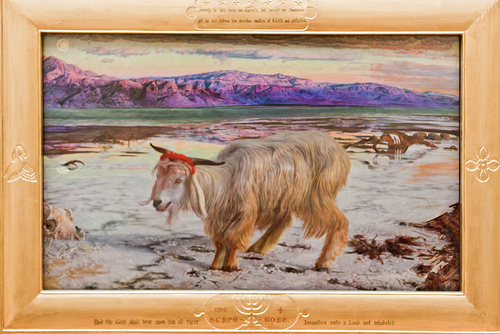
  33. Give the goat to a man standing by who will lead it into the wilderness(e.g. the scapegoat), metaphorically sending the sins of the people into the wasteland.
  34. Go into God’s tent, take off the sacred clothes, and bathe.
  35. Put on the priests uniform.
  36. Offer a whole burnt offering for yourself.
  37. Offer a whole burnt offering for the people.
  38. Burn the fat from the offering on the altar.
  39. Have the man who led the scapegoat into the wilderness take off his clothes and take a bath.
  40. Take the leftovers of the bull sacrifice and the goat sacrifice outside the camp and burn them.
  41. The man who burns the leftovers must wash his clothes and bathe.

Yikes. The crazy machinations of the sacrificial system became a living metaphor to help people understand how difficult [read: impossible] it is for a person to earn God’s forgiveness and favor. That’s why God sent His son, Jesus, as the ultimate sacrifice for our sins:

That’s why blood, the evidence of death, is used so much in our tradition, especially regarding forgiveness of sins.

That accounts for the prominence of blood and death in all these secondary practices that point to the realities of heaven. It also accounts for why, when the real thing takes place, these animal sacrifices aren’t needed anymore, having served their purpose. For Christ didn’t enter the earthly version of the Holy Place; he entered the Place Itself, and offered himself to God as the sacrifice for our sins. He doesn’t do this every year as the high priests did under the old plan with blood that was not their own; if that had been the case, he would have to sacrifice himself repeatedly throughout the course of history. But instead he sacrificed himself once and for all, summing up all the other sacrifices in this sacrifice of himself, the final solution of sin.

Everyone has to die once, then face the consequences. Christ’s death was also a one-time event, but it was a sacrifice that took care of sins forever. And so, when he next appears, the outcome for those eager to greet him is, precisely, salvation. Hebrews 9:22-28 (MSG)

Today, I’m grateful for Jesus making a sacrifice once and for all for my sins. I’m thankful that I don’t have to go through an impossible 41 point checklist to try and have my sins forgiven.

Creative Commons photo courtesy of Flickr and andy2580

Chapter-a-Day Leviticus 5

“When you are guilty, immediately confess the sin that you’ve committed and bring as your penalty to God for the sin you have committed a female lamb or goat from the flock for an Absolution-Offering.” Leviticus 5:5 (MSG)

A guilty conscience is a killer. It robs you of sleep. It ties your gut into knots. It gnaws at your thoughts. A person may be able to keep a lid on a guilty conscience for a time, but it will eat away at your soul until the guilt starts oozing out of your life in unexpected, often unhealthy ways.

When those burdened by addictions walk through the Twelve Steps, they are really walking through a systematic process of confession and atonement. The Twelve Steps are rooted in the understanding that our addictions are unhealthy ways we’ve habitually and ritualistically tried to medicate and cope with deeper guilt and pain. Through introspection, admission and making amends, we deal with the deeper issues which led us to our addictive behaviors.

The cool thing about the ancient law of Leviticus is that it presents and attempts to deal with core spiritual, relational, and personal issues with which we continue as human beings to struggle today. The prescription may look very different on this side of history, the sacrifice of Jesus, and the empty tomb, but the issues with which we silly humans grapple at the root of it are the same ones they were wrestling with 3500 years ago.

Creative Commons photo courtesy of Flickr and evilerin

Chapter-a-Day Leviticus 4

He is then to take some of the bull’s blood, bring it into the Tent of Meeting, dip his finger in the blood, and sprinkle some of it seven times before God, before the curtain of the Sanctuary. He is to smear some of the blood on the horns of the Altar of Fragrant Incense before God which is in the Tent of Meeting. He is to pour the rest of the bull’s blood out at the base of the Altar of Whole-Burnt-Offering at the entrance of the Tent of Meeting. Leviticus 4:5-7 (MSG)

Let’s face it, reading through all of the prescribed sacrifices in the book of Leviticus is a very bloody affair. I have to keep in mind that in all of this blood-letting there is a core spiritual teaching that is central to understanding who Jesus is, why Jesus came, and what Jesus did.

When Adam and Eve disobeyed God, God’s message tells us that sin entered the world. Every one of us, at one time or another, has willfully chosen to do what we knew was wrong. That’s sin. As we learned the other day, that willful disobedience is like yeast which taints the whole loaf. We may be good much of the time, but the fact that we sin at all (sometimes even without knowing it) seperates us from God, who is holy.

How do we, divorced from relationship with God by our own sin, get back into relationship with God? That is the ultimate question, and the ultimate story God authors in the Bible from beginning to end.

God’s message tells us that the penalty of sin is death. Therefore, the penalty must be paid in order for relationship between human beings and God to be reunited. Without the shedding of blood, there is no payment for sin. What we are reading in Leviticus is a methodical (and very burdensome) prescription for payment. The sacrificial lamb atones for the sins of the person sacrificing it. It is a brutal and bloody affair designed to address an eternally serious matter.

When Jesus came, He came on a mission. He was God’s son, sent to be the lamb without defect sacrificed for the sins of the entire human race. His death on a cross was a brutal, bloody affair designed to pay the ultimate penalty for sin once and for all:

The old plan was only a hint of the good things in the new plan. Since that old “law plan” wasn’t complete in itself, it couldn’t complete those who followed it. No matter how many sacrifices were offered year after year, they never added up to a complete solution. If they had, the worshipers would have gone merrily on their way, no longer dragged down by their sins. But instead of removing awareness of sin, when those animal sacrifices were repeated over and over they actually heightened awareness and guilt. The plain fact is that bull and goat blood can’t get rid of sin. That is what is meant by this prophecy, put in the mouth of Christ: You don’t want sacrifices and offerings year after year; you’ve prepared a body for me for a sacrifice. It’s not fragrance and smoke from the altar that whet your appetite. So I said, “I’m here to do it your way, O God, the way it’s described in your Book.” When he said, “You don’t want sacrifices and offerings,” he was referring to practices according to the old plan. When he added, “I’m here to do it your way,” he set aside the first in order to enact the new plan—God’s way—by which we are made fit for God by the once-for-all sacrifice of Jesus. Hebrews 10:1-10 (MSG)

All of these bloody sacrifices accomplish two things. First, they reminded us of how impossible it was, and is, to completely atone for sin by ourselves. Nothing we do, in and of ourselves, can atone for sin and please God. I can’t imagine trying to manage this web of offerings and sacrifices on an on going basis. Second, the sacrifices of Leviticus foreshadow the ultimate plan, which was for God to make the ultimate sacrifice for sin on our behalf.

Understanding the sacrificial system of Leviticus, I gain a much greater appreciation of what we celebrate on Good Friday.

Creative Commons photo courtesy of Flickr and joshuamellin

Chapter-a-Day Exodus 30

Half shekel. The rich are not to pay more nor the poor less than the half-shekel offering to God, the atonement-tax for your lives. Exodus 30:15 (MSG)

So much of our world is focused on economics and economic disparity. "The rich get richer," the saying goes. "The poor will always be with you," people utter, quoting Jesus. Taxes create strong reactions across all economic lines.

I find it interesting that God asked the people of Israel to pay this simple flat-tax called the "atonement tax." God is a God of metaphor, and this tax was a constant reminder that in the economy of God's Kingdom we all stand equal. Rich or poor, great or humble, the debt of sin is the great equalizer. We all fall short of God's glory, and we all owe a debt that is humanly impossible to pay.

Once again, the ancient system God instituted through Moses encompasses the great theme of human history and foreshadows God's plan to redeem all of us through the sacrifice of his very own Son.

Creative Commons photo courtesy of Flickr and tal_klinger