Tag Archives: 1 Corinthians 13

The Real Love Chapter

And now these three remain: faith, hope and love. But the greatest of these is love.
1 Corinthians 13:13 (NIV)

The followers of Jesus in Corinth were a classic dysfunctional human system. There were not only differences of opinion, pride and arrogance had escalated to the point there were factions in conflict with one another and people suing one another. There were not only humans making honest human mistakes, there were individuals flaunting and taking pride in their immorality. Conflict, anger, hatred, favoritism, envy, greed, and selfishness were in the driver’s seat. It’s the very reason for Paul writing his letter.

Which I think is important to remember when reading today’s chapter which is one of the greatest and most familiar passages ever penned. “The love chapter” is regularly read at weddings because of its beautiful and thorough description of love. I’ve actually always found this a bit ironic because the Corinthians believers were definitely not feeling the giddy love of newlyweds towards one another. They were in divorce court with one another, and that’s the context which inspires Paul’s famous words about love.

As a disciple of Jesus, I have learned two critically important lessons along my life journey.

The first lesson is that I don’t get to pick and choose who I love. Enemies, critics, people of other nations and cultures, people on the other side of the political aisle, sinners, and people who have wronged me, cheated me, persecuted me, judged me, spoken evil about me behind my back, and even injured me are all at the top of the priority list of people Jesus commands and expects me to love. It’s more important than going to church. It’s more important than my morality and purity. It’s more important than my spiritual disciplines. It’s more important than anything else. Jesus asks me to love Him so much that I’m compelled to love my enemies, haters, and those who’ve injured me the same way He did. This is my ultimate spiritual calling and priority.

\The second lesson is that there are no exemptions to lesson number one.

In the quiet this morning, I find that I’m not thinking about love in grand and glorious poetic ways. It’s too easy to do that when you read today’s chapter outside the context of the situation it was originally addressing. I’m meditating on love in the down-and-dirty realities of those people I don’t want to love, those I feel I shouldn’t have to love, and those my soul tends to justify hating, condemning, cursing, and generally wishing ill-will. As a disciple of Jesus, if I am unwilling to do that, then talking about love in grand and glorious poetic ways is both empty and meaningless.

If you know anyone who might be encouraged by today’s post, please share.

These chapter-a-day blog posts are also available via podcast on all major podcast platforms including Apple, Google, and Spotify! Simply go to your podcast platform and search for “Wayfarer Tom Vander Well.” If it’s not on your platform, please let me know!

The Activating Ingredient

If I speak in the tongues of men or of angels, but do not have love, I am only a resounding gong or a clanging cymbal.
1 Corinthian 13:1 (NIV)

As I’ve mentioned in recent months, I’m making my way chronologically through all of Paul’s letters. This is in conjunction with a year-long study my local gathering of Jesus’ followers is conducting of the book of Acts.

One of the patterns that is repeated over and over again in the book of Acts is an action or event that is followed by an opportunity to teach, testify or pray. The action always precedes the teaching or testimony. “Do” then “Teach.”

I thought about this as I read Paul’s famous discourse on love. He begins by acknowledging that religious actions void of love are empty, impotent, and useless. Love is the action. Love is the activating ingredient. Love is the “Do” that opens the way for meaningful conversation, interaction, and Life-giving moments.

In the quiet this morning I’m looking back over my entire spiritual journey. As I put on my 20-20 hindsight goggles, I confess that I’ve gotten a lot of things wrong. Oh my, have I missed some things. Simple things. Basic things. Things I should have seen long ago.

I was taught, and embraced the notion, that moral and doctrinal purity were “the most excellent way.” I and my Protestant tribes have been so worried about avoiding a doctrinally errant “gospel of works” (i.e. you earn your salvation by doing good deeds) that I believe I elevated the importance of belief and right-thinking. In so doing I diminished the activating ingredient: Love. And, without the activating ingredient, my faith is….

I’m reminded of James’ letter to believers (a letter Martin Luther hated and wanted struck from the canon of scripture). James is echoing the same sentiment as Paul. He just says it in a different way. If I say I have faith and I believe all the right doctrines, but I don’t have the activating agent of love motivating me to “Do” unto others, love my enemies, forgive those who’ve sinned against me, welcome the outcast, take up my cross, go the extra mile, turn the other cheek, give my coat as well, and et cetera, then my faith is void of Life. And, that which is void of Life is dead. I and my right doctrine are dead on arrival.

Lord, have mercy on me. I’ve still got so much to learn, and “Do.”

Spiritual Bankruptcy

If I speak with human eloquence and angelic ecstasy but don’t love, I’m nothing but the creaking of a rusty gate.

If I speak God’s Word with power, revealing all his mysteries and making everything plain as day, and if I have faith that says to a mountain, “Jump,” and it jumps, but I don’t love, I’m nothing.

If I give everything I own to the poor and even go to the stake to be burned as a martyr, but I don’t love, I’ve gotten nowhere. So, no matter what I say, what I believe, and what I do, I’m bankrupt without love.
1 Corinthians 13:1-7 (MSG)

It is possible to be religious, but not loving.
It is possible to be righteous, but not loving.
It is possible to be generous, but not loving.
It is possible to be doctrinally sound, but not loving.
It is possible to be right, but not loving.
It is possible to be politically correct, but not loving.
It is possible to be a defender of truth, but not love your enemy.
It is possible to know all scripture, but not love those who mock you.
It is possible to have spotless church attendance, but not love.
It is possible to have spiritual discipline, but not love.
It is possible to have success, but not love.
It is possible to have a million followers, but not love.
It is possible to have good intentions, but not love.

Jesus said there were two basic laws:
1) Love God with all your heart, soul, mind, and strength.
2) Love your neighbor as you love yourself.

When pressed to define who He meant by “neighbor,” Jesus told the story of the Good Samaritan. In the story, the person who had love was a foreigner and an immigrant. The person who had love carried scars from being the victim of racial prejudice, injustice and systemic social, political, and economic ostracization. The person who had love held heretical doctrinal beliefs. The person who had love stood condemned by the prevailing  institutional religion of which Jesus was a part. But, the hated, heretical, outcast foreigner had love, and Jesus’ story made clear that love was the one thing that mattered to God.

On this life journey I’ve taken a good  hard look at myself, and the prevailing institutional religion of which I am a part.

We still haven’t learned the simple and most basic lesson Jesus ever taught. All of my spirituality, righteousness, and religion is bankrupt without love.

Lord, help me love.

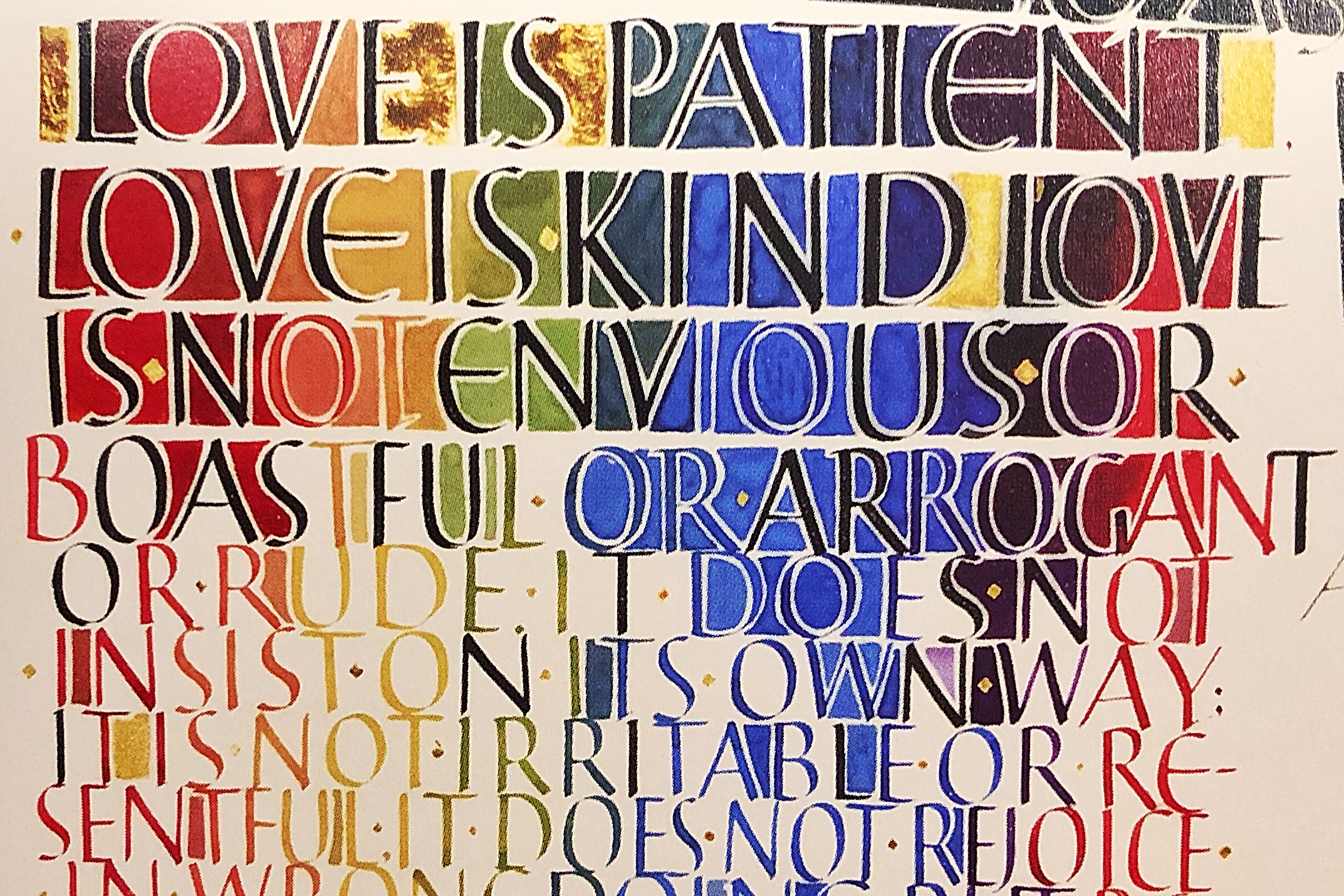
featured image is a detail from the St. John’s Bible

No Further Explanation Necessary

Nearly each week day I sit down to post my feeble thoughts on one chapter of God’s Message. In many cases, the daily chapter was written by a semitic prophet a long time ago in a land far, far away. Arcane metaphors and situational context sometimes require a little interpretation if a modern reader is going to find any applicable meaning in the text.

As I read today’s chapter, however, it strikes me that no further explanation is necessary. In the pre-dawn hour it seems silly of me to try and add anything to such a perfect passage. I’ll only get in the way. Many people confess to me that they rarely read the actual chapter I link to in my posts, but rather just read the verse I paste at the header and then read what I have written about it. That’s cool. I have no problem with that. Today, however, I want to step aside and I urge you to read this short chapter yourself:

If I speak in the tongues of men or of angels, but do not have love, I am only a resounding gong or a clanging cymbal. If I have the gift of prophecy and can fathom all mysteries and all knowledge, and if I have a faith that can move mountains, but do not have love, I am nothing. If I give all I possess to the poor and give over my body to hardship that I may boast, but do not have love, I gain nothing.

Love is patient, love is kind. It does not envy, it does not boast, it is not proud. It does not dishonor others, it is not self-seeking, it is not easily angered, it keeps no record of wrongs. Love does not delight in evil but rejoices with the truth. It always protects, always trusts, always hopes, always perseveres.

Love never fails. But where there are prophecies, they will cease; where there are tongues, they will be stilled; where there is knowledge, it will pass away. For we know in part and we prophesy in part, but when completeness comes, what is in part disappears. When I was a child, I talked like a child, I thought like a child, I reasoned like a child. When I became a man, I put the ways of childhood behind me. For now we see only a reflection as in a mirror; then we shall see face to face.Now I know in part; then I shall know fully, even as I am fully known.

And now these three remain: faith, hope and love. But the greatest of these is love.

That is all.