Tag Archives: Pagan

Awkward Moment at the Pub Part II

Awkward Moment at the Pub Part II (CaD 1 Cor 8) Wayfarer

Therefore, if what I eat causes my brother or sister to fall into sin, I will never eat meat again, so that I will not cause them to fall.
1 Corinthians 8:13 (NIV)

In the 18 years I’ve been writing this chapter-a-day blog, I’ve always found it fascinating which posts resonate with people. There are days that what I write something that I think a lot of people are going to want to read and no one does. Then there are days that I just sort of write a quick post and throw it out there and suddenly it’s getting unexpectedly read and shared all over the place.

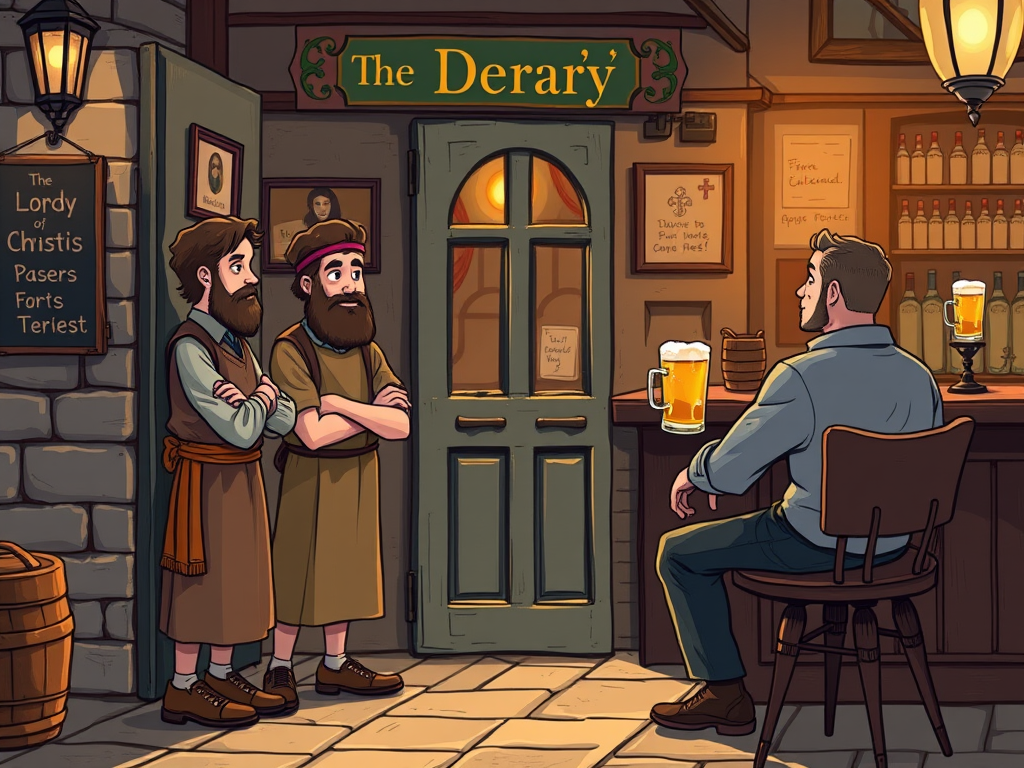
Last week I wrote about an awkward moment I had in the pub in which a Christian couple I know stopped to talk to me as I was sitting at the bar having a pint, but they refused to actually enter the pub. Instead, they stood and semi-shouted their conversation with me while making sure they didn’t cross the threshold. It was a popular post and even yesterday I had people stop me to ask if the story was true (it was).

Today’s chapter addresses an issue that was creating conflict with the Corinthian believers of Paul’s day. It is, however, not an issue that we deal with here in the 21st century. In the pagan religious culture of Greece and Rome, there were pagan temples everywhere, and people regularly sacrificed animals at these temples. The meat from the sacrifices found their way to the local market and were sold as food to anyone who would buy it. Among the followers of Jesus in Corinth there were those who felt that they could not, with a clear conscience, purchase and eat meat that had been sacrificed to a pagan god. Others among the Corinthian believers thought it was not a big deal. The two factions were at odds with one another and things were getting heated.

While meat being sacrificed to a pagan Roman god is not an issue today, I’d like to return to my friends who stood outside the doorway of the pub making sure their feet didn’t cross the threshold. It was obvious that my friends had been taught, and believed, that it was wrong to enter an establishment that serves alcohol. I’m equally sure that they are teetotalers. As silly as I might think they are being, it is certainly a matter of conscience for them and this is the point that Paul is making with the abstainers and eaters in Corinth.

I might disagree with my friends’ personal views on having a beer or entering a pub, but as a disciple of Jesus I am called to consider others ahead of myself.

“Do nothing out of selfish ambition or vain conceit.Rather, in humility value others above yourselves, not looking to your own interests but each of you to the interests of the others.
Philippians 2:3-4 (NIV)

Knowing their feelings about drinking, I’m going to be considerate of those feelings if I find myself having a meal with them or socializing with them. I’m not going to flaunt the freedom of conscience I have if it’s going to create tension with my friends. Rather, I’m going to humbly respect their feelings and choose not to drink around them. In fact, if the awkward conversation at the door were to ever happen again, I think the right thing for me to do is simply leave my pint at the bar for a minute and step out onto the sidewalk to have a chat.

In the quiet this morning, I’m reminded that Jesus calls me to be considerate and servant-hearted with others. Sometimes this means that I serve others by submitting to their customs or preferences even if I don’t share them.

If you know anyone who might be encouraged by today’s post, please share.

These chapter-a-day blog posts are also available via podcast on all major podcast platforms including Apple, Google, and Spotify! Simply go to your podcast platform and search for “Wayfarer Tom Vander Well.” If it’s not on your platform, please let me know!

The Perpetual Contrast

The Perpetual Contrast (CaD Ezk 22) Wayfarer

“‘‘This is what the Sovereign Lord says: You city that brings on herself doom by shedding blood in her midst and defiles herself by making idols…’”
Ezekiel 22:3 (NIV)

One of the repetitive messages of the prophets was the railing about idolatry. I have found as a modern reader that it is easy to get focused on the idolatry in the prophets’ messages and then mentally zone out because, let’s face it, the notion of worshipping strange little statues is such a foreign concept in a world that has predominantly monotheistic for centuries.

What is often missed in the prophets messages is that it was never really the idolatry alone that was the problem in God’s eyes. It was behaviors that went with it and the human outcomes. Pagan worship in those ancient times was often a pretense for all sorts of bad behavior from sexual immorality to selfish ambition to cursing and eliminating one’s enemies. Pagan culture promoted a self-centered mentality of selfishness, immorality, and violence.

In today’s chapter, Ezekiel lists the common behaviors that had resulted from Jerusalem’s being turned into a pagan carnival (see verses 6-12):

Corruption
Violence and murder
Contempt for family
Oppression of foreigners
Mistreatment of orphans and widows
Desecration of the holy and sacred
Slanderers
Dishonesty
Profiting off the poor
Extortion
Sexual immorality including:
Incest
Adultery
Rape

Now look at a list of what Paul describes as “the acts of the flesh” which stand in contrast to the “Fruit of the Spirit” in Galatians 5:

Sexual immorality
Impurity
Debauchery
Idolatry
Witchcraft
Hatred
Discord
Jealousy
Fits of rage
Selfish ambition
Dissensions
Factions
Envy
Drunkenness
Orgies

In the quiet this morning I am reminded that the prophets were never just about idolatry and bowing down to funny little statues. They were standing against the same things that God has always stood against, that God still stands against as He asks me and every other believer to, by the power of God’s Spirit, live daily lives of:

Love instead of hatred
Joy instead of criticism
Peace instead of anger and violence
Patience instead of selfish impatience
Kindness instead of meanness, prejudice, and harshness
Goodness instead of corruption
Faithfulness instead of falseness
Gentleness instead of violence
Self-control instead of immorality

Through Ezekiel and the other prophets of his day, God was crying out for His people to have a change of heart and life. Daily life looks much different than it did 2500 years ago, but human behavior is still given to the same contrasts. As a disciple of Jesus, I’m called to follow Jesus in moving against the world’s behavioral traffic flow.

Even Jesus acknowledged this contrast when He said:

“Enter through the narrow gate. For wide is the gate and broad is the road that leads to destruction, and many enter through it. But small is the gate and narrow the road that leads to life, and only a few find it.
Matthew 7:13-14 (NIV)

For the record, Jesus never mentions a middle road.

If you know anyone who might be encouraged by today’s post, please share.

God in (and Out of) a Box

God In (and Out of) a Box (CaD 1 Sam 5) Wayfarer

…the following morning when [the Philistines] rose, there was [their god] Dagon, fallen on his face on the ground before the ark of the Lord! His head and hands had been broken off and were lying on the threshold; only his body remained. That is why to this day neither the priests of Dagon nor any others who enter Dagon’s temple at Ashdod step on the threshold.
1 Samuel 5:4-5 (NIV)

For many years, I’ve had an idea for a book about the things the contemporary church continues to get wrong. If I ever do write this book, one of the chapters would be about church buildings themselves. From an early age, I was taught to treat a church building as a sacred space. The church building was and sometimes is, referred to as God’s house or the house of God.

In yesterday’s post/podcast I spoke of treating God like a good luck charm. I like to think of our perception of church buildings as God’s House as the notion of “God in a box.”

The problem with believing the church building is “God’s house” is, of course, that Jesus was very clear that He was changing the paradigm. In His conversation with the Samaritan woman at the well, Jesus addressed her question about the “right” place to worship God by saying, “…believe me, a time is coming when you will worship the Father neither on this mountain nor in Jerusalem...a time is coming and has now come when the true worshipers will worship the Father in the Spirit and in truth, for they are the kind of worshipers the Father seeks.

Jesus doubled down on this when He and the disciples were leaving the Temple in Jerusalem. His disciples commented on the magnificent Temple and Jesus replied that it was all going to be reduced to rubble, and it was just 40 years later.

Jesus’ taught that the “church” was not bricks and mortar but flesh and blood. When the Jesus Movement was changing the known world in the first two centuries, it had no churches or temples, no basilicas or cathedrals. The “church” was millions of followers who met, almost clandestinely, in people’s homes. It was only when the church became the Holy Roman Empire that the institution decided that God needed opulent cathedrals. The motivation wasn’t divine. It’s what human institutions do to centralize power and control masses of people. Jesus’ successful paradigm was that of Spirit-filled people loving, serving, and sharing in every home, neighborhood, and business. God was released from a box and carried by flesh-and-blood “temples” everywhere in the world. Jesus was wherever His followers happened to be. In Jesus’ paradigm “sacred space” was now the coffee shop, the office, the home, the pub, the park; It was wherever a believer, filled with Spirit and Truth was physically present in the moment. This is what Jesus meant when He said, “Wherever two or three of you are together, I’m there, too.”

The Holy Roman Empire put God back in a box. Then they made sure that only an institutionally educated and approved class of elites were qualified to be God’s representatives. Way too many people still believe that God is confined in the building on the corner and that only educated men in robes represent Him.

Today’s chapter is also about “God in a box.” The Ark of the Covenant was literally a box that represented God’s presence among the Hebrew people. The Hebrews reduced the notion of God’s holy presence to a good luck charm that would secure victory. They were defeated and the box was taken by the Philistines who put the Ark in the sacred space of their patron god, Dagon, underneath Dagon’s statue. Mesopotamian peoples routinely saw battles as not just contests between peoples, but contests between deities. The Hebrews’ God was now subject to Dagon.

But, God will never be contained inside a box of human design. The statue of Dagon fell, its head and hands breaking off. This was significant because heads, hands, and limbs were often cut-off and brought home by victorious armies as proof of victory and as a way of tallying up the body count. It was an omen the Philistines would have instantly understood. There was also a plague of tumors that broke out among the Philistines, which is ironically the outcome God warned His own people about in Deuteronomy 28, should they stray from His ways.

In the quiet this morning, I’m reminded that if I truly believe what Jesus taught, then my home office where I’m writing/recording these words is sacred space because God’s Spirit indwells me. I take Him with me everywhere I go today. God’s temple isn’t a building, it’s my body, and that should change my perspective on everything in my daily life.

If you know anyone who might be encouraged by today’s post, please share.

Love Trumps Freedom

No one should seek their own good, but the good of others.
1 Corinthians 10:24 (NIV)

Wendy and I have friends and family members who represent a broad spectrum of generations, backgrounds, beliefs and social customs. When we get together with people we are aware that others have very different thoughts and feelings about all sorts of human rituals and behaviors. From saying a prayer of thanks before a meal to whether it’s acceptable to consume alcohol to choice of appropriate words/topics to the appropriateness of a cigar after a great meal, there are many different considerations.

That’s the crucial word: consideration. When it comes social settings with others of very different beliefs, my behavior is determined largely by whether I consider my beliefs or others beliefs more important to me in that moment.

Paul was dealing with exactly the same situation among the followers of Jesus in the first century town of Corinth. Some of the community felt passionately that it was inappropriate to buy or consume meat that had been sacrificed to one of the many pagan temples there before it ended up in the market.  Others felt just as passionately that it was silly to worry about such things. The result was one of many conflicts that had come to full boil among the diverse community of believers.

For the past three chapters Paul has been addressing this controversy. Yes, he agreed, there is nothing wrong with eating the meat. Those who felt such freedom of conscience were not be convinced otherwise. At the same time, Paul urged those who experienced such freedom to be considerate of those who held different beliefs on the matter. In other words: relatively insignificant dietary rules or beliefs of religious/social propriety are subordinate to the great commandment Jesus gave: Love those who think differently than you do. When you are with them, Paul urged, consider their conscience more important than your freedom. Freedom of conscience is subordinate to the law of love.

As I ponder this principle, I am aware that at times I am admittedly guilty of putting my pride and freedom ahead of others whom I make uncomfortable. I am reminded this morning: Love trumps freedom. Consideration of others trumps the freedom of my conscience. A good thing for me to embrace and apply as I press on with my journey today.

Loving Well in the Midst of Differences

What's left of the meat market in Corinth (source: GloBible)
What’s left of the meat market in Corinth (source: GloBible)

Chapter-a-Day 1 Corinthians 8

And when you sin against other believers by encouraging them to do something they believe is wrong, you are sinning against Christ. 1 Corinthians 8:12 (NLT)

Keep in mind when reading books like 1 Corinthians that they were originally handwritten letters. In the case of Corinthians, it was a letter from Paul to the followers of Jesus in the Greek city of Corinth. Paul spent 18 months there sharing the Message about Jesus and building up a small but faithful group of believers. Paul moved on to other cities and regions. As with any group of humans, conflicts and differences arose among the new Corinthian believers. Word reached Paul about some of these conflicts and he wrote this letter to his friends to address these differences.

Back in the day when Paul was writing his letter the city of Corinth was largely pagan, and a person could visit any number of pagan temples in the city. They were mostly temples to the various Greek and Roman gods we all studied in English Lit and Western Civ classes. Corinth had two large temples, one to Apollo and one to Aphrodite. As part of the pagan worship rituals, animals would be sacrificed and the meat would be cooked up for a feast with the temple priests and wealthy patrons. Leftovers were taken to the local meat market and sold to the public.

A conflict rose up among the followers of Jesus in Corinth. Should you buy or eat meat that had been part of a pagan sacrifice? Some said it was no big deal and felt free to eat it. Others felt strongly that they were defiling themselves by eating it. While this is not a burning controversy in our American culture today, it doesn’t take me long to come up with a number of similar conflicts we have today about social behaviors and appropriateness.

I’m not a very legalistic person. At least, I’m not any more. I’ve become increasingly less so with age. Having meandered through God’s Message these past 30 years or so, it’s become clear to me that the people who ticked Jesus off the most were the religious legalists.  Note to self: Don’t be one of those guys. Put me in Corinth and I would likely be found hanging out with the pagans and enjoying a nice steak without thinking a thing of it.

But, there is danger inherent in freedom for ourselves and for others. Freedom can easily creep into destructive license. Also, followers of Jesus are called not only to look out for our own needs, but also the needs of others. This includes the needs of our fellow believers, some of whom have a distinctly religious legalist bent. Exercising my freedom can confuse, discourage and trip up another believer. I have a responsibility to be respectful of others and their beliefs, even when “other” refers to fellow believers with whom I disagree about the appropriateness of certain social behaviors. I am not to be led by my “right” to exercise my freedom, but by love for others. This may require me to circumstantially choose to curb my freedom in order to graciously love and respect a fellow believer.

Today, I’m reminded of how difficult it can be to navigate human relationships. When do you speak? When do you shut up? When do you prod? When do you pull back? When do you choose in? When do you choose out? It takes wisdom, humility, deference, and a lot of love in order to do it well. God, please give me these in abundant measure.