Tag Archives: Luke 22

The Look

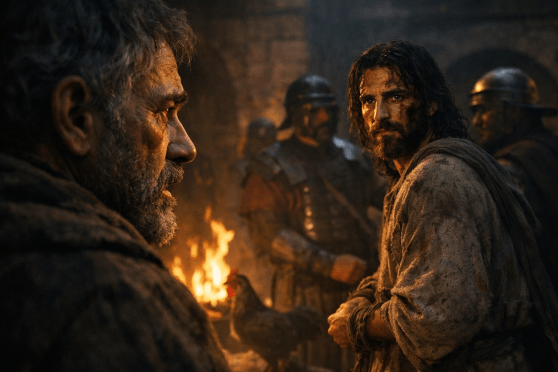
The Lord turned and looked straight at Peter…
Luke 22:61 (NIV)

One of the great themes woven through the entire Story is the tension between chaos and order.

Genesis opens with the chaos of the deep.
God speaks—and order is born.

The serpent enters the garden.
Deception takes root.
Sin fractures the world.

And from that moment on, the Story becomes a slow, relentless restoration.

Order… reclaimed from chaos.

Luke 22 is one of those moments where everything feels like it’s falling apart.

From the disciples’ perspective—boots on the ground—the world is unraveling.

What began as a night of celebration collapses into fear.

A friend—Judas—becomes a traitor.
Jesus, the one they’ve followed for three years…

Healing the sick.
Casting out demons.
Commanding storms.
Feeding thousands.
Raising the dead.

…is led away in chains like a lamb to slaughter.

The disciples scatter into the night.

And suddenly, the questions come rushing in:

Are we next?
Who will protect us?
What do we do now?

Earlier that evening, Jesus had led them—as usual—to a garden.

A place of peace.
Of prayer.
Of presence.

But another presence slithered in.

The ancient serpent.
Already coiled within Judas.

God.
Garden.
Order.

And then—

Chaos.

Peter, to his credit, doesn’t run far.

He follows… at a distance.

Close enough to see.
Far enough to stay safe.

Until he’s recognized.

“You’re one of them.”

He denies it.

Again.
And again.

Then Luke gives us this haunting detail—

As Peter speaks his third denial, Jesus is being led past him.

And in that moment…

Jesus turns.

And looks straight at Peter.

Not a glance.
Not a passing flicker.

A look.

And suddenly, the words from earlier that night come rushing back:

“Before the rooster crows today, you will deny me three times.”

The rooster crows.

Peter breaks.

For most of my life, I’ve stood in that moment with Peter.

And I’ve felt what he felt:

Shame.
Guilt.
Self-loathing.

But in the quiet this morning… I saw something different.

I saw control.

In the middle of chaos, Jesus is not surprised.
Not overwhelmed.
Not scrambling.

He is fully aware.

I saw compassion.

Though He is the one suffering—though the weight of what is coming is already pressing in—His eyes are not on Himself.

They are on Peter.

I saw purpose.

This moment didn’t derail the plan.

It was the plan.

Jesus knew.
Jesus said it would happen.
And still… He chose Peter.

Above the chaos the disciples would eventually see and understand that something deeper was unfolding:

Sin being atoned for.
Death being undone.
Creation being made new.

Order… rising again from chaos.

And somewhere in that storm…

Jesus looks at Peter.

And He looks at me.

Because I know that moment.

When fear floods in.
When anxiety tightens its grip.
When doubt whispers louder than truth.

When I fail in ways I swore I never would.

And in that place…

Jesus gives me the look.

Not the look of condemnation.

But the look that says—

I’m still in control.
I still love you—yes, even here.
And there is purpose… even in this.

The Creator is still at work.

Still speaking.
Still restoring.
Still bringing order… out of chaos.

If you know anyone who might be encouraged by today’s post, please share.

Promotional graphic for Tom Vander Well's Wayfarer blog and podcast, featuring icons of various podcast platforms with a photo of Tom Vander Well.
These chapter-a-day blog posts are also available via podcast on all major podcast platforms including Apple, Google, and Spotify! Simply go to your podcast platform and search for “Wayfarer Tom Vander Well.” If it’s not on your platform, please let me know!
Logo featuring an open book icon on an orange background.

How the Real World Works

How the Real World Works (CaD Lk 22) Wayfarer

“Every day I was with you in the temple courts, and you did not lay a hand on me. But this is your hour—when darkness reigns.”
Luke 22:53 (NIV)

I once knew a good man and follower of Jesus who worked for our local rural county on the road crew. As I was asking him about his job he told me hated it. I found this fascinating as it seemed like the kind of work he would enjoy. As I continued to question him, it became clear that the hatred of his job had nothing to do with the nature of the work but the nature of the workplace.

“The whole system is corrupt,” he told me. “This week I was sent out with a co-worker to fix a stretch of gravel road. It was a two-man job, however, and my co-worker refused to work. He just sat there and refused. So, I was stuck sitting there all day, too.” He went on to explain that the county government was controlled by a union that protected and perpetuated corruption and behavior like that of his co-worker. If my friend complained he would be threatened and punished. It was better to just keep your head down and your mouth shut.

Welcome to how things work in the “real world.”

A few years ago, I did a major study on the final hours of Jesus’ earthly journey. What I discovered in my study was that Jesus was tried and condemned by a fascinating combination of “real world” systems that included the earthly kingdoms of government, religion, and commerce.

The chief priests who arrested Jesus sat atop a political machine and cash cow in the Temple system. They were rich and powerful and they would not sit idly by and let anyone mess with the system that they controlled. As Luke points out again in today’s chapter, they were afraid of the crowds Jesus was drawing, and Jesus’ public criticism of them. They needed to get rid of the threat quickly and quietly.

The arrest of Jesus happens in the middle of the night in a garden on the Mount of Olives. It was illegal to hold a trial or condemn someone to death in the darkness of night. When Jesus points out that they could have arrested him any day that week as He taught in the Temple courts, He was making a legal point-of-order to the Temple officials arresting Him. This clandestine arrest and the series of kangaroo court trials they are about to put Him through are illegal. Jesus ironically points out that it is the “reign of darkness” that has arrived in the dead of night to arrest the Light of the World.

Along my earthly journey, I’ve learned from experience how things work in the “real world.” While not every system is corrupt, I’ve observed that the larger a system is, the more power it has in society, and the more money that’s involved, the more given to corruption it becomes. I’ve personally encountered corruption in the same systems of government, religion, and commerce that Jesus faced in his six trials. Like my friend who worked for the country road department, it’s easy to feel stuck in a corrupt system when there’s seemingly no way to fight it.

Luke wrote back in the fourth chapter that the evil one led Jesus up to a high place and showed him in an instant all the kingdoms of the world. And he said to Jesus, “I will give you all their authority and splendor; it has been given to me, and I can give it to anyone I want to. If you worship me, it will all be yours.” (Luke 4)

Jesus passed on the offer, and now those kingdoms of this world under the evil one’s dominion have come for Jesus. Jesus finds himself stuck in a corrupt worldly system with no earthly way to fight it.

In the quiet this morning, I find myself reminded that sometimes being a disciple of Jesus is very simple. I observe how the “real world” works and I choose to do the opposite.

If you know anyone who might be encouraged by today’s post, please share.

The Look

The Lord turned and looked straight at Peter. Then Peter remembered the word the Lord had spoken to him: “Before the rooster crows today, you will disown me three times.” And he went outside and wept bitterly.
Luke 22:61-62 (NIV)

As a child, I had a healthy conscience. If I had done something wrong, it weighed on my heart like the proverbial millstone Jesus referenced as just punishment for causing a little one to stumble. Looking back, it’s fascinating for me to think about the things that sent me into attacks of shame and the the things I could convince myself weren’t “that bad.”

It starts at such an early age, doesn’t it? The mental gymnastics of moral justice: What’s bad? What’s very bad? What’s not a big deal (if you can get away with it)? What sins weigh heavier on the scales of justice within the family system, the school system, the neighborhood system, and the peer group system?

It was fascinating for me to become a father and observe just how opposite two children with the same genes can be within the same family system. One daughter’s conscience was impregnable. She always pled “not guilty” no matter how red-handed she might have been caught. She remained stoically resolute, stuck with her plea, and quickly appealed any parental verdict as prosecutorial overreach and abuse of power. At times it was comical, at other times it was maddening.

With the other daughter, all it took was a look. A look of condemnation, or worse yet – a look of disappointment. Her little spirit wilted. Tears flowed. If nature helps to determine temperament, then I’m pretty certain she got that from me. Oh, that parenting could always be as easy as a look.

The look. That’s what struck me in today’s chapter. I find it fascinating that Luke included this little detail. Peter utters his third denial and immediately the rooster crows. With that audio cue, Jesus turns and looks directly at Peter. The denial, the rooster, the look. The weight of his denial, his sin, and the hollow emptiness of his emphatic assurance to be imprisoned and die with Jesus all come crashing down on Peter in a moment. He runs. He weeps bitterly.

As a child with a healthy conscience, it’s easy for me to feel that weight. I identify with Peter.

Me, too, dude,” my spirit whispers to the weeping, shamed, unworthy Simon. I totally identify with Peter at that moment; The seemingly ill-chosen ”Rock” and ”Keeper of the Keys.” By default, I ‘m ready to sit down with Peter and have a shame-induced pity party.

But, there’s something else I noticed in today’s chapter: Jesus knew. Jesus not only saw Peter’s impending denial and failure to follow-through on his assurances, but He also saw past the failure to the sorrow, repentance, and restoration. Jesus’ perceived that Peter’s fall would ultimately help mold him into a more solid, humble, and capable leader. Much in the same way that, as a father, I knew that one daughter’s tender spirit was going to develop into a heart of compassion that God would use in one way, and that God would use my other daughter’s strength of will and resolution for different but just as meaningful purposes.

In the quiet this morning I find the realization that I’m quick to sit and wallow with Peter in the failure and shame. This, however, means that I am slow to accept God’s perfect knowledge of me, my shortcomings, my failures, my heart of repentance, my restoration, and all that He is molding me to be for His Kingdom purposes. Embracing the former without embracing the latter is to accept an incomplete reality: Jesus remains very disappointed in me and I remain shamed and self-condemned. Within days, the resurrected Christ would stand on a beach graciously prompting from Peter three “I love you’s” to replace the three ”I don’t know Him’s.” Peter remains on course for the journey of love, faith, leadership, transformation and sacrifice to which he’d been called from the beginning.

It’s so easy for me to see “the look” of Jesus as one of a disappointment. But just as I could “look” at my daughters and see beyond their momentary infractions to the amazing individuals they would grow to be, “the look” of Jesus always sees beyond my failure to the fullness of all I am and will be in Him.

Pondering Betrayal

caravaggio-judas-kiss-taking-of-christ

And Judas went to the chief priests and the officers of the temple guard and discussed with them how he might betray Jesus. They were delighted and agreed to give him money. He consented, and watched for an opportunity to hand Jesus over to them when no crowd was present. Luke 22:4-5 (NIV)

This morning’s chapter is so full of intriguing details that I feel I could spend the entire day digging deeply into the text and the story. The tidbit that seemed to stir the most thought, however, was Judas’ betrayal.

The traitor is such an archetype in literature and film. I can think of several off the top of my head:

  • Iago (Othello)
  • Macbeth (Macbeth)
  • Saruman (Lord of the Rings)
  • Grima Wormtongue (Lord of the Rings)
  • Edmund (The Lion, the Witch, and the Wardrobe)
  • Peter Pettigrew a.k.a. Wormtail (Harry Potter)
  • Fredo (The Godfather II)
  • Lando Calrissian (Star Wars Episode V)
  • Cypher (The Matrix)

Betrayal is a part of life and I daresay every one of us has experienced some kind of personal betrayal whether it be on the schoolyard playground, our place of work, our family, our church, or the intimacies of courtship, love, and/or marriage. By the same token, I doubt any one of us can claim to be completely innocent of betrayal through the course of our entire life journeys. Human frailties are universal, relationships get messy, and we hurt one another.

There is a betrayal, however, that I believe goes deeper than mere human frailty and self-seeking. Evil exists, and that evil contrives, contorts and manipulates to upend that which is good and life giving in order to replace it with chaos and death. At times our human weaknesses serve darker powers.

Which leads me to thinking about Judas this morning. He had been present with Jesus and the boys for three years. He saw the lame walk, the blind see, and the hungry fed. He heard Jesus’ teaching the same as the rest. Judas watched Jesus loving sinners and speaking out against the hypocrisy and greed of the religious leaders. He witnessed Lazarus raised to life and shuffling out of his tomb still wrapped tightly in his grave clothes.

So what didn’t Judas get that the other eleven did?

The other eleven disciples would spend the rest of their lives bearing witness that Jesus’ was the resurrected Son of God. Ten of those eleven would die brutal deaths because of it (tradition holds that John was the only disciple to die of natural causes). But Judas could never see it. Not only did he not get it, but Judas wasn’t content to merely put in his notice and walk away. There was something deep inside Judas that drove him to betray Jesus to His death…for money. Was it anger? Envy? Spite? Greed? Judas makes for a fascinating character study.

This morning I am thinking about betrayal. I beg forgiveness for the many betrayals I have committed along my journey, and I am choosing to forgive those who have betrayed me. I also find in my heart this morning the desire to seek out all that is good and right and life giving that it might shine the Light into my soul and reveal any seed in me that might ultimately take root lead me down the dark path to further betrayal.

Chapter-a-Day Luke 22

Miniature from Chludov Psalter. Saint Peter an...
Image via Wikipedia

At that very moment, the last word hardly off [Peter’s] lips, a rooster crowed. Just then, the Master turned and looked at Peter. Luke 22:61 (MSG)

As a child you come to know “the look.” As a parent you naturally learn to give it. “The look” is the most powerful tool of silent and deserved verdict. No words are necessary; No pious lectures required. You are caught red handed and you know it. You stand naked and alone in your shame. You are guilty as charged yet no one need utter the word.

There is just the look, and the unspoken truth of my own actions inscribes itself on my soul.

“I’ve disappointed the ones I care about.”
“I blew it.”
“I failed God, myself, and others I loved.”
“Sinner. Liar. Oathbreaker.”
“Unworthy.”
“Untrusting.”
“Unbelieving.”
“Prodigal.”

A picture may paint a thousand words, but ‘the look’ pierces the heart with ten thousand in a second. I would much rather have the angry diatribe. Scream at me. Yell at me. Give me the lecture. Just stop looking at me like that.

With one look, I feel the entire weight of my guilt and shame.

With that look, I find myself at the crossroads.

Which way will I turn?

Enhanced by Zemanta