Tag Archives: Loaves

“Why Do We Pray Before Meals?”

“Why Do We Pray Before Meals?” (CaD Matt 14) Wayfarer

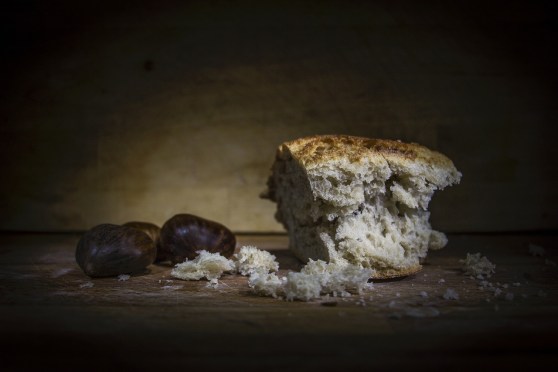
And he directed the people to sit down on the grass. Taking the five loaves and the two fish and looking up to heaven, he gave thanks and broke the loaves. Then he gave them to the disciples, and the disciples gave them to the people. They all ate and were satisfied, and the disciples picked up twelve basketfuls of broken pieces that were left over.
Matthew 14:19-20 (NIV)

“Why do we pray before meals?” Wendy asked me yesterday morning after I had prayed before breakfast.

It was a simple enough question. There are so many things in life that we do because they are habitual or traditional. We rarely stop to ask “Why?”

The question came back to mind as I read the chapter this morning. Jesus famously feeds a hungry crowd of 5,000 followers with just a handful of bread loaves and a couple of fish. Yet, there is so much more to this story than the surface event. It even addresses Wendy’s question.

We are blessed to live in the most affluent empire in human history during the most affluent age in human history. Never in the history of humanity has the simple human need for food been so abundantly satiated on our planet. I’m not saying that there aren’t places and people in the world who are struggling for their “daily bread,” but never in history has that number been so small. That is just the facts. Not only that, but here in America we have long struggled with the opposite problem. Food is so abundantly available that we have a problem with obesity.

Yet, for the crowds following Jesus to an isolated place to hear Him preach, and for God’s people leaving slavery in Egypt and wandering into the wilderness, the need for food simply to survive was critically real. And, this episode in today’s chapter is connected to the story of the Hebrews in the wilderness. It’s connected to the Lord’s Prayer that Jesus taught His followers to pray: “Give us this day our daily bread.”

For the Hebrews in the wilderness, God provided a miraculous bread from heaven called “manna.” Every morning when they woke up the manna covered the ground like dew. It was always just enough for that day, and if someone collected more than they needed for themselves and their family that day it would grow horribly rotten.

The spiritual lesson of manna, and of the loaves and fish, is profound in its simplicity: Trust God for what you need each and every day.

When I began work for our company, Intelligentics, back in 1994 it was unlike any job I’d ever held. No one in our company, including the founder and owner, has ever drawn a salary. Every person gets paid by the amount of time we charge clients within projects. Which means if we don’t have any clients or projects then no one gets paid. Our founder set up the business this way to mirror the spiritual principle of daily bread.

For over 30 years I have never had the simple assurance of next month’s paycheck or how much it would be.

God has always provided for our needs despite the fact that across the 30-plus years there have been months of proverbial feast and famine. Nevertheless, like the story of the loaves and fish in today’s chapter, there has always been “leftovers” in the end.

As I meditated on this simple life lesson in the quiet this morning, Holy Spirit raised within my memory one of my favorite verses in the entire Great Story. It comes from the time of the Hebrews in the wilderness as God is instructing them in their new way of life. The hard reality of slavery is that your Master has the responsibility of protecting and providing for his investment with housing and food, meager as it might be. Wandering in the wilderness is a very different reality. Freedom required faith that God would provide. And when God did provide, Moses instructed God’s people:

“When you have eaten and are satisfied, praise the Lord your God for the good land he has given you.
Deuteronomy 8:10 (NIV)

I love the fact that Jesus not only provided a filet-o-fish feast, but Matthew was careful to record that everyone “ate and was satisfied.” Matthew the Quirk was also careful to record the numbers like the math geek he was. Five loaves and two fish feed 5,000 with twelve baskets full of leftovers (that’s one basket for every one of the twelve tribes of Hebrews wandering in the wilderness back in Deuteronomy.

Matthew was also careful to record that Jesus “broke the bread,” giving us the colloquialism that we still use today for gathering together with friends or loved ones for a meal. Jesus also “gave thanks” in anticipation of God’s provision for the “daily bread” God was about to provide. While Matthew doesn’t say it specifically, I know for certain that everyone was obediently obeying Deuteronomy 8:10 and praising God after the fish feast was over that day.

So, there’s the answer to Wendy’s question. We pray before meals because it’s the spiritual pattern God wove into our daily lives. Trust God each and every day for my daily bread. Thank Him for His provision as I break my bread. Praise Him each time I am satiated and there are leftovers.

When I begin to trust and depend on myself for my daily bread, I’ve completely lost the plot.

If you know anyone who might be encouraged by today’s post, please share.

These chapter-a-day blog posts are also available via podcast on all major podcast platforms including Apple, Google, and Spotify! Simply go to your podcast platform and search for “Wayfarer Tom Vander Well.” If it’s not on your platform, please let me know!

Responsibility and Need

If any woman who is a believer has widows in her care, she should continue to help them and not let the church be burdened with them, so that the church can help those widows who are really in need.
1 Timothy 5:16 (NIV)

Early in my life journey I worked at a number of different churches and different denominations. One of the common struggles I observed was how each church handled those who would regularly come to the church asking for a handout. In every church I served there was a sincere and loving motivation to help those in need, but there was also the realization that responsible generosity also required  wisdom and discernment. While some individuals were people truly in need, others were not. There were individuals who were perfectly capable of getting a job and supporting themselves, but they were more than happy to avoid the work and simply make the rounds of every church in town seeing how much money they could talk the churches into giving them.

Along the way I’ve observed a simple reality of human nature. If you create a system of welfare there will be those who will try to take personal advantage of the system. Even Jesus encountered this when He fed the multitudes by turning a few loaves and fish into to a  miraculous Filet o’ Fish fest. He quickly recognized that many were following Him simply for the free lunch. John 6 describes Jesus confronting the crowd and questioning their motivation. He appears, at that point, to have shut down his miraculous fish sandwich program on the spot.

It’s so easy for me to get stuck thinking about “church” in context of what I have known and experienced “the church” to be in my lifetime. I default to thinking of buildings and denominational institutions with varying takes on theological issues.  It’s critical as a reader of Paul’s letter to Timothy for me to understand how different the circumstances were then. There was no institution, no denomination, and no church buildings. Small groups of Jesus’ followers were “the church.” It was a flesh and blood organism. Followers of Jesus gathered in homes where they ate together, worshipped together, and shared life together. They were loosely structured and yet they quickly gained a reputation for collectively caring for those in need who were marginalized and outcast by society of that day: widows, orphans, the sick, the diseased, and the disabled.

And, true to human nature, there were those more than willing to take personal advantage of the corporate generosity.

There is a theme woven throughout Paul’s life and letters that I rarely hear discussed today. It’s threaded through the entire chapter today. Until late in his life Paul always worked for his living and supported himself. His family were tentmakers by trade and no matter where he went he could pull out his tools and ply that trade. He expected Jesus’ followers to take personal responsibility for the needs of one’s self and one’s family so that generosity could be given to those “truly in need.”

In the quiet this morning I’m whispering a prayer of gratitude, as I recognize that I am blessed to have been raised in a culture and a family system that taught and modeled personal responsibility, hard work, and generosity. My gratitude extends to giving thanks for my job, my clients, and my colleagues. Finally, I’m thankful for the reality that, thus far in my entire life journey, I have never known what truly means to be what Paul described as “really in need.”

featured photo courtesy of IIP Photo Archive via Flickr

Enough

Elisha replied to her, “How can I help you? Tell me, what do you have in your house?”

“Your servant has nothing there at all,” she said, “except a small jar of olive oil.”
2 Kings 4:2 (NIV)

Many years ago I was pushing into my spiritual journey and trying hard to understand my feelings of shame, the deep, abiding sense that I was worth-less to the core. I have shared before about my friend and counselor who asked me to label my shame. He wanted me to give my shame a name tag; A moniker of my shame that would allow me to pick up my Sharpie and write on the my name tag at church: “Hello, My Name Is…” and write my shame right on there.

Not Enough” was the label I gave to my shame.

As I’ve continued on in my spiritual journey I’ve come to have more than a few head-slapping, eureka moments as I mull over my “Not Enough” shame moniker. Of course I feel “not enough” because it’s what culture and marketing have whispered and screamed to me so regularly since I was a toddler that I don’t even recognize it anymore.

You’re not athletic enough. Eat your Wheaties.
You’re not manly enough. Smoke a Marlboro.
You’re not beautiful enough. Wear brand “X”.
You’re not good enough. Work 24/7/365.
You’re not rich enough. Climb that ladder at all costs.
You’re not suave enough. Act like James Bond.
You’re not good enough. Stop sinning.
You’re not Christian enough. Only listen, read, and consume things labeled and marketed as “Christian” and sold by an acceptable, orthodox supplier.

You get the picture.

In today’s chapter the ancient prophet Elisha is approached by a widow who is in a desperate situation. Her husband died and was indebted to another man in the town. In ancient days, if you couldn’t pay your debts the creditor took whatever collateral the borrower had. Because the widow was left with nothing of real value her two sons were going to be taken from her to become the creditor’s slaves.

When Elisha asks the woman, “What have you got?” she replies that all she has is a small jar of oil. Elisha tells her to get all the empty jars she can find and borrow and pour the oil from her small jar into all the empty jars. Miraculously, the woman keeps pouring and the oil keeps flowing until her house is packed full of jars of oil. She is can now sell the oil and pay off the debts. And, there’s enough left over to provide for her and her sons.

What does this remind me of?

Oh yeah. Jesus fed the crowds (more than once) with just a few fish sandwiches that Peter and the boys could scrounge off a little kid whose mother packed him a sack lunch. The woman and her oil jars is kind of like that. In fact, it’s just like that.

I love it on my chapter-a-day journey when I begin to see patterns, themes and dots to be connected across the Great Story. This endless jar of oil is just like Jesus’ endless baskets of filet o’ fish sandwiches.

So, what is the point? What’s God trying to tell me?

In each case, God took the little that they already had and provided all that was needed. In fact, in both cases there were leftovers. The point is that what they already had was enough for God to work with. God can take what I am and what I have and it is enough for Him to work with to be all that I need, all that He needs, when it’s needed.

I don’t believe this means God is giving me an excuse to be complacent and slothful. It doesn’t mean that I have carte blanche to be foolish and stagnant. God wants me to keep progressing, keep pressing on, and keep pushing further up and further in. It’s important, however, to think about what I’m pursuing.

I’ve found that shame always calls me back. I constantly find my heart slipping off on paths that mindlessly pursue unreachable destinations. The more money I make the more I realize that there’s always someone richer, and I’ll never stop chasing after “just a little bit more.” No matter how skinny, ripped and ruggedly handsome I can make myself with wardrobe, workouts and organic male beauty products, I will still look in the mirror and fail to see Daniel Craig.

This morning I’m reminded that when I stick to the path in pursuit of God and God’s wisdom I find that what I already have is enough. It’s enough even if God has to, once in a while, miraculously stretch my enough to cover what’s needed in the moment.