“Why Do We Pray Before Meals?” (CaD Matt 14) – Wayfarer
And he directed the people to sit down on the grass. Taking the five loaves and the two fish and looking up to heaven, he gave thanks and broke the loaves. Then he gave them to the disciples, and the disciples gave them to the people. They all ate and were satisfied, and the disciples picked up twelve basketfuls of broken pieces that were left over.
Matthew 14:19-20 (NIV)
“Why do we pray before meals?” Wendy asked me yesterday morning after I had prayed before breakfast.
It was a simple enough question. There are so many things in life that we do because they are habitual or traditional. We rarely stop to ask “Why?”
The question came back to mind as I read the chapter this morning. Jesus famously feeds a hungry crowd of 5,000 followers with just a handful of bread loaves and a couple of fish. Yet, there is so much more to this story than the surface event. It even addresses Wendy’s question.
We are blessed to live in the most affluent empire in human history during the most affluent age in human history. Never in the history of humanity has the simple human need for food been so abundantly satiated on our planet. I’m not saying that there aren’t places and people in the world who are struggling for their “daily bread,” but never in history has that number been so small. That is just the facts. Not only that, but here in America we have long struggled with the opposite problem. Food is so abundantly available that we have a problem with obesity.
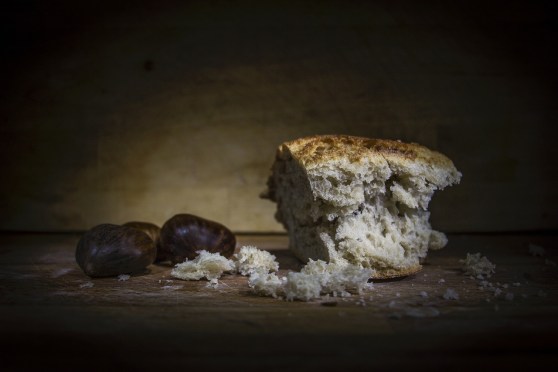
Yet, for the crowds following Jesus to an isolated place to hear Him preach, and for God’s people leaving slavery in Egypt and wandering into the wilderness, the need for food simply to survive was critically real. And, this episode in today’s chapter is connected to the story of the Hebrews in the wilderness. It’s connected to the Lord’s Prayer that Jesus taught His followers to pray: “Give us this day our daily bread.”
For the Hebrews in the wilderness, God provided a miraculous bread from heaven called “manna.” Every morning when they woke up the manna covered the ground like dew. It was always just enough for that day, and if someone collected more than they needed for themselves and their family that day it would grow horribly rotten.
The spiritual lesson of manna, and of the loaves and fish, is profound in its simplicity: Trust God for what you need each and every day.
When I began work for our company, Intelligentics, back in 1994 it was unlike any job I’d ever held. No one in our company, including the founder and owner, has ever drawn a salary. Every person gets paid by the amount of time we charge clients within projects. Which means if we don’t have any clients or projects then no one gets paid. Our founder set up the business this way to mirror the spiritual principle of daily bread.
For over 30 years I have never had the simple assurance of next month’s paycheck or how much it would be.
God has always provided for our needs despite the fact that across the 30-plus years there have been months of proverbial feast and famine. Nevertheless, like the story of the loaves and fish in today’s chapter, there has always been “leftovers” in the end.
As I meditated on this simple life lesson in the quiet this morning, Holy Spirit raised within my memory one of my favorite verses in the entire Great Story. It comes from the time of the Hebrews in the wilderness as God is instructing them in their new way of life. The hard reality of slavery is that your Master has the responsibility of protecting and providing for his investment with housing and food, meager as it might be. Wandering in the wilderness is a very different reality. Freedom required faith that God would provide. And when God did provide, Moses instructed God’s people:
“When you have eaten and are satisfied, praise the Lord your God for the good land he has given you.”
Deuteronomy 8:10 (NIV)
I love the fact that Jesus not only provided a filet-o-fish feast, but Matthew was careful to record that everyone “ate and was satisfied.” Matthew the Quirk was also careful to record the numbers like the math geek he was. Five loaves and two fish feed 5,000 with twelve baskets full of leftovers (that’s one basket for every one of the twelve tribes of Hebrews wandering in the wilderness back in Deuteronomy.
Matthew was also careful to record that Jesus “broke the bread,” giving us the colloquialism that we still use today for gathering together with friends or loved ones for a meal. Jesus also “gave thanks” in anticipation of God’s provision for the “daily bread” God was about to provide. While Matthew doesn’t say it specifically, I know for certain that everyone was obediently obeying Deuteronomy 8:10 and praising God after the fish feast was over that day.
So, there’s the answer to Wendy’s question. We pray before meals because it’s the spiritual pattern God wove into our daily lives. Trust God each and every day for my daily bread. Thank Him for His provision as I break my bread. Praise Him each time I am satiated and there are leftovers.
When I begin to trust and depend on myself for my daily bread, I’ve completely lost the plot.

If you know anyone who might be encouraged by today’s post, please share.