Tag Archives: Fig Tree

The Fig Tree Mystery

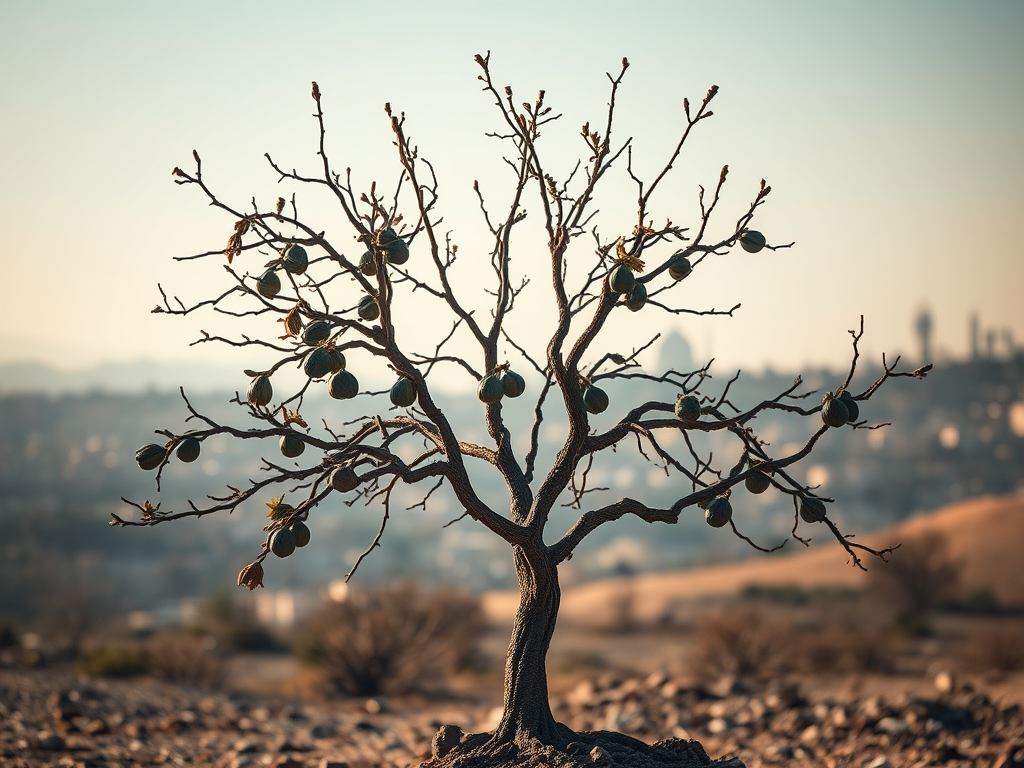
In the morning, as they went along, they saw the fig tree withered from the roots. Peter remembered and said to Jesus, “Rabbi, look! The fig tree you cursed has withered!”
Mark 11:21-22 (NIV)

This past summer, Wendy and I began avidly working at keeping a small little herb garden alive, along with some other house plants that include a Christmas cactus. I have joked on many occasions about having a brown thumb. Here I live on arguably the most productive farmland in the world, and all my life I’ve struggled to keep a simple houseplant growing and blooming.

Today’s chapter contains one of the strange, head-scratching episodes in the entire Jesus Story. It is the final week of Jesus’ earthly life. Jesus and His entourage are in Jerusalem along with thousands from all over the world to celebrate the Passover, a festival celebrating God’s deliverance of the Hebrews from slavery in Egypt back in the story of Exodus. Jesus and His followers are on their way to the Temple in the morning and Jesus checks out a fig tree to see if it has any figs on it, but it doesn’t, so He says, “May no one ever eat from you again.” He then goes to the Temple and famously drives out the money-changers, who were part of a extortion racket the Temple leaders had running. It was a money-making scheme that preyed on the poor and pilgrims visiting for the festival. On their way back to the Temple the next morning, Peter notices that the fig tree Jesus had cursed had withered.

Why on earth would Jesus curse and kill a fig tree? It seems so random and out of character for Jesus.

As we’ve made this chapter-a-day trek through Mark, I’ve talked a lot about God’s base language of metaphor. With today’s chapter, we have another opportunity to see how metaphor helps unlock some of the mysteries of the Great Story.

Fruit is a theme throughout the Great Story. In Eden, God provides the fruit of the entire Garden for Adam and Eve, but forbids them from eating just one kind. We all know what happens. As the end of the Great Story, as John describes his vision of the eternal city God is preparing, there is a river flowing from God’s throne and on each side of the river stands the Tree of Life which bears a new crop of fruit every month. So the Story begins and ends with fruit. In between, there are countless references to fruitfulness. Jesus Himself spoke about being able to determine what’s going on in a person’s soul by looking at the fruit of their lives.

And, this is the key to understanding the mysterious episode of the fig tree. The tree, wasn’t bearing fruit, so Jesus cursed it. He then goes to the center of Hebrew worship, God’s people who God had faithfully delivered from slavery, and exile. But the leaders who were supposed to be fruitfully serving God and the people had turned into money-grubbing elites padding their pockets and clinging to power by turning God’s Temple and its system of worship into a racket. The leaders of God’s own people were, once again, not being fruitful in the ways God had always said He desired of them.

Notice how the story of the fig tree is wrapped around this episode of Jesus driving the money-changers out of the Temple. They are connected. The Temple system and the unfruitful old ways will wither and die, as they crucify God’s Son. As Jesus is crucified and resurrected, a new covenant will be put in place. Old things pass away, and new things come. And God’s desire remains the same: that I become one with Jesus, that I remain in Jesus, and that I bear the fruit that God desires in my life.

In just three nights from the events of today’s chapter, Jesus will be with His closest followers in a garden on the night before his crucifixion. He will say to them:

“I am the vine; you are the branches. If you remain in me and I in you, you will bear much fruit; apart from me you can do nothing. If you do not remain in me, you are like a branch that is thrown away and withers; such branches are picked up, thrown into the fire and burned. If you remain in me and my words remain in you, ask whatever you wish, and it will be done for you. This is to my Father’s glory, that you bear much fruit, showing yourselves to be my disciples.
John 15:5-8 (NIV)

Along my life journey, I’ve observed that people often misunderstand what being a disciple of Jesus is all about. It’s not about rules, regulations, judgement and condemnation – though some people twist it into that. Jesus is about experiencing life in a way that produces the fruit of God’s Spirit in my daily thoughts, words, relationships, and actions. It’s evidenced by an increasing yield of love, joy, peace, patience, kindness, goodness, faithfulness, and self-control in my life.

By the way, our Christmas cactus has tiny blooms sprouting, and I just culled some fresh Basil and Rosemary this past week. Maybe I’m finally getting this growing and bearing fruit thing on a whole new level!

If you know anyone who might be encouraged by today’s post, please share.

These chapter-a-day blog posts are also available via podcast on all major podcast platforms including Apple, Google, and Spotify! Simply go to your podcast platform and search for “Wayfarer Tom Vander Well.” If it’s not on your platform, please let me know!

Spiritual Horticulture

Then [Jesus] said to the tree, “May no one ever eat fruit from you again.” And his disciples heard him say it.

In the morning, as they went along, they saw the fig tree withered from the roots.
Mark 11:14, 20 (NIV)

Over the past three or four years, Wendy and I have worked on a phased landscaping plan for our yard. I’m glad to say that this past year was the final phase (for now). I have never been very good with plants and often joke that I have a brown thumb. Nevertheless, I have been growing in my proficiency as I try to keep the lawn, bushes, trees, flowers, grasses, and shrubs alive.

One of the fascinating things for me to watch is what happens when we plant multiples of certain plants. They may look exactly the same when I planted them, and while they are in the same bed and treated to the same amounts of light and water, one of them will die. I’m sure there are very good reasons why this happened (that I don’t care to spend time figuring out), but it always leaves me scratching my head a bit.

In today’s chapter, Mark tells a curious episode of Jesus and a fig tree. He and His followers were walking from the temple in Jerusalem back to where they were staying. Jesus sees a fig tree and looks for a fig to eat. Finding none, He curses the tree and says, “May no one eat fruit from you again.” The next morning on their walk back to the temple, the disciples find the fig tree withered.

I found myself pondering this rather curious episode this morning just as I would scratch my head wondering why in the world that one arborvitae on the north side of our lawn didn’t make it.

As I am fond of saying, God’s base language is metaphor. Jesus rarely did anything that was not intended to be a metaphorical lesson, so there is little doubt in my mind that the cursing of the fig tree was not just a moment of hunger-induced rage. So, what was that all about?

Jesus and the disciples have arrived at the epicenter of Jewish worship and power. In Jesus’ day, the temple consumed about 25% of Jerusalem area-wise and first-hand accounts say that as many as two million spiritual pilgrims would visit to celebrate the Passover. Passover was the festival which annually memorialized the Hebrews miraculously being freed from enslavement in Egypt (e.g. The Ten Commandments with Charlton Heston and Yul Brenner). Being at the temple would have been a huge deal for Jesus’ followers. Think Times Square on New Year’s Eve, New Orleans on Mardi Gras, or Washington D.C. on the 4th of July.

As Jesus passes the fig tree they have just left the temple. They arrived late in the day and Mark records that they only had time to “look around” at the temple, the crowds, the courts, and the merchants. For Jesus and the disciples, who were from the simple, backwater region Galilee, I have to believe the sights, sounds, and smells of the awe-inspiring location would have been what was on everyone’s minds as they walked.

As I mulled this over, I was reminded of another episode from Matthew’s version of Jesus’ story. This happened during the very same visit to Jerusalem:

Jesus left the temple and was walking away when his disciples came up to him to call his attention to its buildings. “Do you see all these things?” he asked. “Truly I tell you, not one stone here will be left on another; every one will be thrown down.”

Matthew 24:1-2 (NIV)

Then there’s the metaphor of “fruit” which Jesus repeatedly used in His teaching, especially when talking about the religious leaders who ran the very temple they’d just exited:

Likewise, every good tree bears good fruit, but a bad tree bears bad fruit. A good tree cannot bear bad fruit, and a bad tree cannot bear good fruit. Every tree that does not bear good fruit is cut down and thrown into the fire.

Matthew 7:17-19 (NIV)

As I connected the dots, the metaphorical meaning of Jesus’ actions with the fig tree came into focus. The temple and the Law of Moses had been intended to bear good, spiritual fruit in the lives of God’s people, their community, and the world. Instead, it had become a corrupt, institutional religious system centered on power, prejudice, and greed. It was a religious tree bearing bad spiritual fruit. In the cursing of the fig tree, Jesus was providing a prophetic word picture to His followers consistent with what He had been teaching them all along.

Forty years after the events described in today’s chapter, the Roman Empire would tear down the temple and reduce it to rubble. They would also destroy the genealogical records necessary for determining who was able to perform priestly duties, sacrifices, and care for the temple according to the Law of Moses. In essence, the temple “tree” had been cut down for good.

In the quiet this morning, I find myself reminded that the same metaphor of “fruit” would continue to be central to the teaching of Jesus’ followers:

But what happens when we live God’s way? He brings gifts into our lives, much the same way that fruit appears in an orchard—things like affection for others, exuberance about life, serenity. We develop a willingness to stick with things, a sense of compassion in the heart, and a conviction that a basic holiness permeates things and people. We find ourselves involved in loyal commitments, not needing to force our way in life, able to marshal and direct our energies wisely.

Paul’s Letter to Jesus’ followers in Galatia 5:22-23 (MSG)

As I enter this post-Easter week in a world turned upside-down, I’m reminded that Jesus was never about being a religious rule-keeper. He was about being a cultivator of the spiritual fruit of love in life and relationships. And, I desire to have a green thumb when it comes to spiritual horticulture.

Now, if I could just figure out what the heck happened to those Pencil-Point Junipers by the patio. Oh well. Not as important.