Tag Archives: John 18

Empire v. Kingdom

Empire v. Kingdom (CaD Jhn 18) Wayfarer

Jesus said, “My kingdom is not of this world. If it were, my servants would fight to prevent my arrest by the Jewish leaders. But now my kingdom is from another place.”
John 18:36

Along my life journey, I’ve personally observed corruption at different times and in different venues of various organizations. When money, power, and status are added to the mix of any human system, humans act to control and wield that money, power, and status. It’s easy to quickly think of government and business as cradles of corruption, but it happens all the time in religious systems, as well.

As John recounts the story of Jesus’ arrest and trials, he carefully sets up some of the interesting contrasts. First, there is the plot line of Peter, whom Jesus prophesied would deny he knew Jesus three times before the rooster crowed. At the arrest, John mentions Jesus’ stating “I am He” three times, then recounts Peter’s three denials, two of which are direct opposites of Jesus’ admission as Peter says, “I am not.” John is also careful to state that Peter drew a sword to protect Jesus and even cut off the ear of the High Priest’s servant. Jesus then states to Pilate that if His kingdom were of this world “my servants would fight to prevent my arrest.” However, Peter did just that. I find Jesus making two points in his statement to the Roman Governor:

First, Peter still does not understand that Jesus’ kingdom is not of this world. Coupled with Peter’s denials, Peter has dug a pretty deep hole for himself. Jesus is also making the point that He has freely and willingly submitted to a set of trials that are both illegal and illicit. He has submitted precisely because His kingdom is not like the kingdoms of this world, especially the human empires that are currently judging Him.

The religious ruling council is one of those kingdoms. They wield power and control over the people of their nation. Through the temple’s sacrificial and financial systems, they generate tremendous wealth, and they enjoy the status of being on the highest rungs of status on their socio-economic ladder. Back in chapter 11, John quotes the high priest regarding their desire to get rid of Jesus: “If we let [Jesus] go on like this, everyone will believe in him, and then the Romans will come and take away our temple and our nation.” The high priest and his cronies didn’t care about Jesus’ teaching or miracles. They cared about their hold on status, power, and money.

This brings us to the Roman Empire, arguably the greatest and longest-lasting human empire in history. They were an occupying force and ultimately held sway. In order to execute Jesus, the religious council needed the Roman Governor to make it happen.

Corrupt human empire vs. the eternal Kingdom of God.

What a contrast.

And in the quiet this morning, I’m reminded that all along this is what Jesus has been teaching and exemplifying to His disciples and followers. At some level, we have all observed and/or experienced corruption, scandal, power games, and the game of thrones. When Jesus prayed, “Your kingdom come, your will be done on earth as it is in heaven,” I believe He was praying for me and every other believer to live our lives as Kingdom people in a world of human empires both small and large.

Like Peter, I don’t think I truly got this for many years. The further I get on this earthly journey, the more I see it and understand it. Like Peter, I’ve made my own mistakes and have failed miserably as a disciple. But, Peter’s journey isn’t over in John’s account, and neither is my earthly journey. I woke up this morning, so I at least have this day to live like a citizen of God’s Kingdom in a world of human empires. The Serenity Prayer is rising in my spirit as I write this:

If you know anyone who might be encouraged by today’s post, please share.

Contrasting Identity

Contrasting Identity (CaD John 18) Wayfarer

“You aren’t one of this man’s disciples too, are you?” [a servant girl] asked Peter.
He replied, “I am not.”

John 18:17 (NIV)

One of the themes I’ve been watching in John’s biography of Jesus is that of identity. John’s entire biography is thematically told around seven metaphorical “I am” statements that Jesus made paralleled by seven major miracles. These are not casual choices on John’s part.

When God revealed Himself to Moses, Moses asked God to identify Himself. God identified himself as “I Am.” Jesus’ seven “I am…” statements with their metaphors are a subtle proclamation John is making as to the complete divinity of Jesus as the Christ, while the miracles form a complete witness to divine power Jesus displayed in that claim of divinity. The number seven in the Great Story is the number of “completeness” (e.g. seven days of creation).

The seven “I am” statements:

  • “I am the Bread of Life” (6:35, 48)
  • “I am the Light of the World” (8:12; 9:5)
  • “I am the Gate” (10:7)
  • “I am the Good Shepherd” (10:11, 14)
  • “I am the Resurrection and the Life” (11:25)
  • “I am the Way, the Truth, the Life” (14:6)
  • “I am the True Vine” (15:1)

The seven miracles (before His death & resurrection):

  • Changing water to wine (2:1-11)
  • Healing the official’s son (4:43-54)
  • Healing the disabled man by the Bethesda pool (5:1-15)
  • Feeding the 5,000 (6:1-14)
  • Walking on water (6:16-21)
  • Healing the man born blind (9:1-12)
  • Raising Lazarus from the dead (11:1-14)

But the theme of identity is not confined to the identity of Jesus. John is careful to choose stories that point to the identity of the religious leaders, the identity of those whom Jesus spoke to, the identity of those whom Jesus healed, and the identity of those who followed Jesus.

In today’s chapter, what struck me was how Peter’s denials stood out in stark contrast to Jesus’ claims. I couldn’t help but reflect on the fact that Peter was not only the appointed leader of The Twelve, but his given name was Simon and Jesus gave Him a new name and a new identity: No longer the fisherman from Capernaum, Jesus gave Simon the identity of Peter, “the rockon which I will build my church.”

Yet as Jesus, the “I Am,” is arrested and tried, the “rock” crumbles with three contrasting claims: “I am…not.”

I find something beautiful in the human fragility of Peter’s trinity of “I am not“s. As a follower of Jesus, it echoes the fragility of my own faith, the cracks in my own witness, and my own major failures that stand in stark contrast to the proclamation “I am a follower of Jesus.”

As Jesus fulfills His mission to suffer for the sins of the world, I find “the Rock” there as my representative. How apt that the Divinely appointed human “leader” of Jesus’ followers becomes the designated representative of human weakness.

In the quiet this morning, I find myself sitting in humility of my own humanity. A lyric from Bob Dylan’s song Every Grain of Sand comes to mind:

Don’t have the inclination to look back on any mistake,
Like Cain, I now behold this chain of events that I must break.

Peter’s story has the same ebb-and-flow as any follower of Jesus. A new direction and a new identity followed by a long life journey that include both miraculous highs and humiliating set-backs. It’s not just Peter’s story. It’s my story. It’s the story of every human being who sincerely answers Jesus’ offer to take up your own cross and follow. As the murderer and persecutor of Jesus’ followers Saul, given the new identity of Paul, follower of Jesus whom he persecuted, said:

“That is why, for Christ’s sake, I delight in weaknesses, in insults, in hardships, in persecutions, in difficulties. For when I am weak, then I am strong.”

If you know anyone who might be encouraged by today’s post, please share.

The Moment

Again Peter denied [he was with Jesus in the garden], and at that moment the cock crowed.
John 18:27 (NRSV)

Of the big four biographies of Jesus, John has always been my favorite. Each one has their own style. I can appreciate Matthew for his accounting of the events. I appreciate Mark for his ability to compact so much information into so concise a retelling. I love Dr. Luke for his thorough, methodical presentation of his investigation and the minute details he includes. I love John most of all because John has a flair for writing. John is right brained. John is an artist. He is thematic in his narrative, and he has a flair for the dramatic.

Four chapters ago, John foreshadowed the events in today’s chapter when he recounts Jesus telling Peter: “Very truly, I tell you, before the cock crows, you will have denied me three times.”

As John picks up the story line in today’s chapter I, as a reader, almost feel like I’m stealing alongside Peter and “the other disciple.” (many scholars think the “other” disciple was John himself) as they covertly infiltrate the courtyard and house of the High Priest where Jesus is being questioned. They are in enemy territory. The High Priest is the one who wants to kill Jesus and squash their uprising like Michael Corleone taking out one of the five families. It did not take a genius to know that this High Priest/Godfather would relish the opportunity to kill Jesus’ followers as well. Peter is on thin ice.

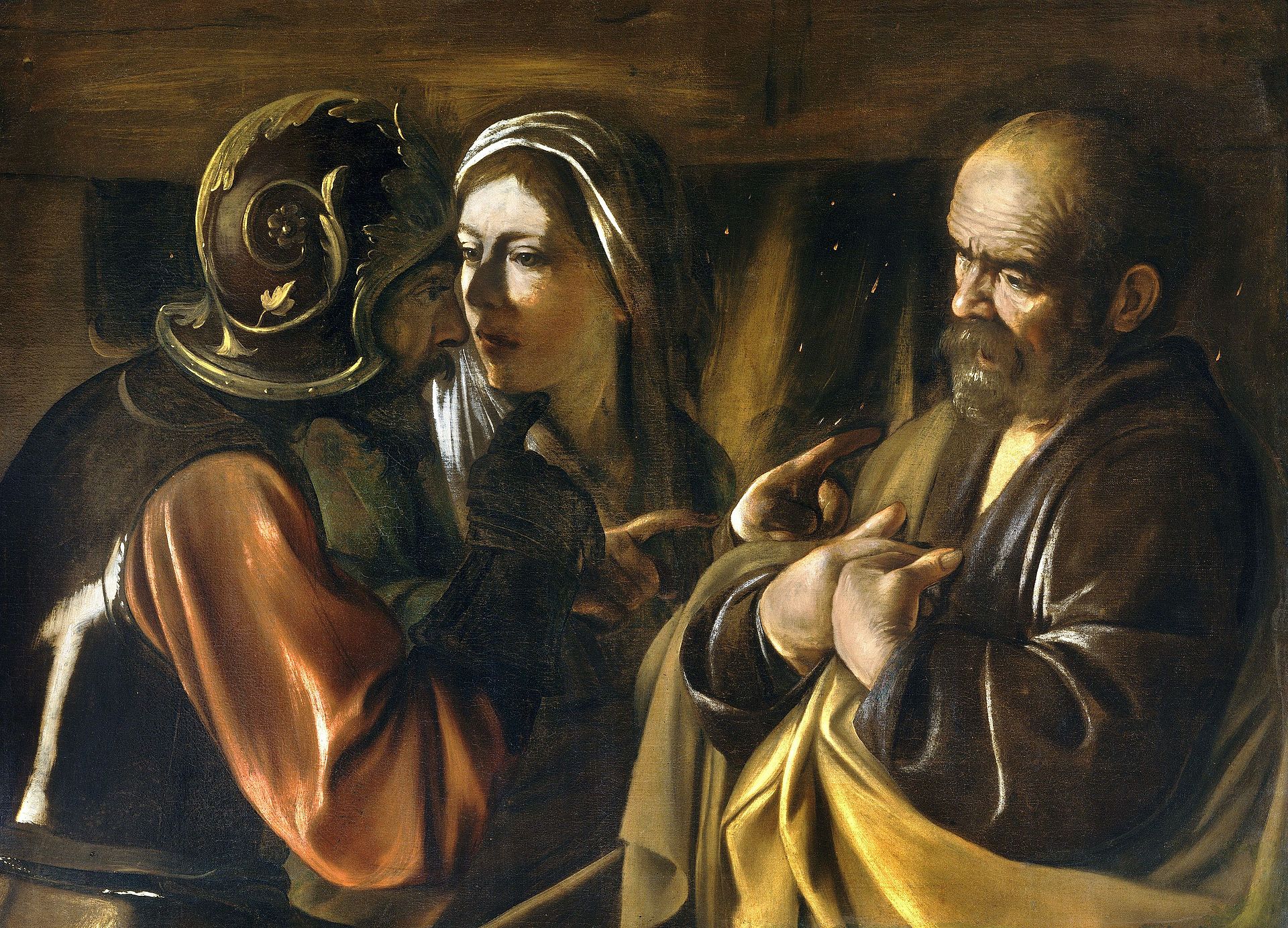
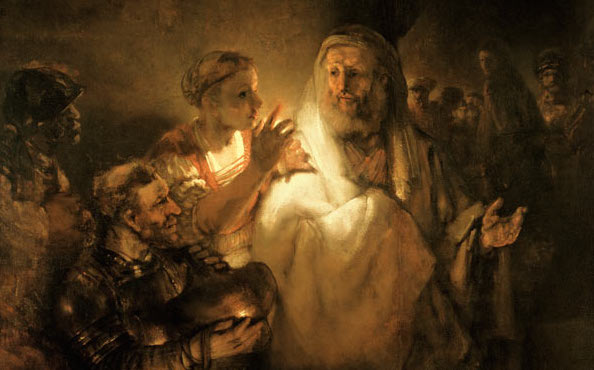
John is careful to describe each denial. We learn where he was and who did the questioning. The other biographers merely relay the facts as though Peter’s denials happened in one short burst of conversation. John lays out the story. It is on their way through the gate into the High Priest’s courtyard that the servant woman checking tickets first asks Peter a question and implies a negative answer. “You aren’t one of Jesus’ followers, are you?” The denial is easy and convenient. A little white lie to ensure we get into the courtyard.

John writes out the narrative like a movie script. The scene changes to the questioning of Jesus inside the house. Time is elapsing. Peter’s denial did not come in rapid succession. There was time and space between them.

When the scene shifts back we find ourselves inside the High Priest’s courtyard. We are there warming our hands on the charcoal fire. We feel the chill in the air in the deep watches of the night. There is a crowd around the fire. This is the High Priest’s house and the crowd is full of people who could easily finger us as followers. The situation is tense, to say the least.

A man, an anonymous stranger in the crowd, once again asks Peter if he is a follower of Jesus. Once again the question implies a negative response. “You aren’t one of Jesus’ disciples, are you?” Heads turn. It’s suddenly very quiet around the fire. This is not just a random question. This is a life and death moment. We are about to be found out. Peter, once again, provides a little white lie to shrug off the suspicion.

But, it just may be that the jig is up. Another member of the crowd takes a good look at Peter. This time it is not an anonymous stranger. This is a family member of the man Peter attacked earlier in the evening. When they came for Jesus in the garden, Peter hacked off the ear of this man’s cousin. Now, the question is not just about political loyalty to Jesus. This question is about blood oaths and family and vengeance. You can cut the silence like a knife. Tension hangs in the air before Peter’s denial comes swift and strong. He is preventing a riot. He is saving his own neck. He is making sure we all get out of here alive.

And then, at that very moment, we hear the cock crow.

There is a moment of realization. Peter hears it. We hear it. The words of Jesus come flooding back to mind. “Before the cock crows….” Shame and failure mix in a bitter cup.

What a moment. John is a good writer. He has a flair for the dramatic. This is Jack Nicholson’s “code red” moment in A Few Good Men. This is Michael Corleone’s “I do renounce him” moment in The Godfather. We are there in this moment. We are with Peter. We are Peter. We get it. We understand. There is not one of us who has not had a cock crowing moment in our lives. Our failure and shame crash down on our heads in an instant and we realize just how wretched we are.

Today, I am thinking about my own “cock crowing” moments along life’s journey. It’s not hard to bring them quickly to mind. There are more of them than I care to admit. I am also thinking about John and the way he weaves Peter’s personal story into the Great Story he pens. We are in the darkness before dawn. It will descend to greater darkness before its done. The story is not over, however, for Jesus, for Peter, for you or for me.

It’s Friday, but Sunday’s coming.

chapter a day banner 2015

Chapter-a-Day John 18

Pendulum clock conceived by Galileo Galilei ar...
Pendulum clock conceived by Galileo Galilei around 1637. The earliest known pendulum clock design, it was never completed. (Photo credit: Wikipedia)

So the soldiers, their commanding officer, and the Temple guards arrested Jesus and tied him up. First they took him to Annas, the father-in-law of Caiaphas, the high priest at that time. John 18:12-13 (NLT)

Along the journey I’ve become increasingly aware of how systems work in families, in businesses, in communities, organizations and even churches. Within each system there is  a power source that may, or may not, be clearly identified. Most systems have a labeled decision maker or decision makers, but those decision makers may often be influenced in one way or another by individuals who are power brokers within the system.

In today’s chapter I found it interesting to get a peek at the religious system of Jerusalem in Jesus’ day. The high priest, Caiaphas, was obviously the designated leader. So why was Jesus first taken to the house of Annas for questioning and roughing up?  There are a couple of answers to this question.

Annas had been the high priest before Caiaphas and he was Caiaphas’ father-in-law. I can only imagine the political and familial machinations in that family system. The mantel had been passed, but that doesn’t mean that Annas had given up the power behind it. In The Godfather: Part II, Frank Pentangeli may have run his own family and may have been living in the Corleone’s old house, but he still took orders from and answered to Michael. I think Jesus was taken to Annas first because Annas was the power broker and puppet master in the system.

The other reason was that Caiaphas was on a crucial errand while Annas conducted his own personal trial and dished out his own personal punishment with the young upstart Rabbi who had caused the system so much trouble and threatened their lucrative corner of the religious marketplace. Caiaphas was quickly trying to assemble a quorum of the system’s ruling body, the Sanhedrin. He wanted and needed their rubber stamp on the decision to send Jesus to Pilate for execution, and doing so in the middle of the night ensured that the quorum could be handpicked to avoid anyone sympathetic to Jesus’ teaching like Joseph of Arimathea. Of course, holding a trial in the middle of the night was itself against their own law, but power brokers within a system often believe that they are justified in breaking the system rules if they are sure they are protecting the system’s interests. Caiaphas himself said that it would be better to kill Jesus to protect the nation. Of course, killing Jesus and protecting the nation also meant protecting his money, power, and prestige. But, protecting the nation sounds much more altruistic.

As an actor, I often read a story or watch a film and wonder what part I would play. Alternatively, I look at the archetype and ask myself who am I in this scene? Am I the suffering servant or the self-protecting power broker? Am I the betrayer? The denier? The slave? The soldier just doing his job? Today, I’m doing a little soul searching and meditating on the part I play in the various systems in which I am a cog.