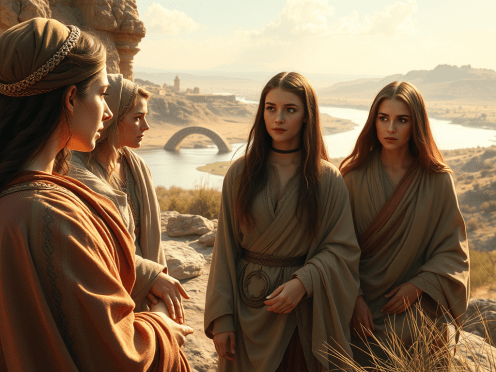
Tag Archives: Zelophehad

God’s Radical Decision for Women

So Moses brought [the case raised by Zelophehad’s daughters] before the Lord, and the Lord said to him, “What Zelophehad’s daughters are saying is right. You must certainly give them property as an inheritance among their father’s relatives and give their father’s inheritance to them.
Numbers 27: 5-7 (NIV)

The Hebrew tribes are camped on the Jordan River across from Jericho. On the other side of the Jordan lies the Promised Land. The time has come to take possession and everyone in the camp is talking about the land that their tribe and their families will eventually be given. The idea of land to farm and graze and a homestead for the family and future generations to live and flourish has been a common human dream throughout history.

This is a moment of promise for the Hebrews. At Mt. Sinai almost 40 years earlier God gave them a vision for this moment. He gave them his guidebook for life and community with God and others in Leviticus. God told the Hebrews that He was going to show them His ways and they would be an example to all the other nations, empires, and peoples of His ways. This included radical new ideas like a sabbath day of rest, the care for strangers, societal protection for the poor and vulnerable, and being a nation with no human king, pharaoh, or emperor.

Now, at this very moment of history on the edge of fulfilled promise of a land to call one’s own, one of the most amazing stories in the entirety of the Great Story takes place. It is a prime example of God wanting things to be different than human defaults. It is a tale no one taught or talked about in all my many years of sermons and Bible classes. It is the story of Zelophehad’s daughters.

At this moment when everyone is thinking about the land they will be given, the daughters realize they have a problem. Their father died and he had no sons. It’s just the sisters. The ancient near east, especially Mesopotamia, the nations and people groups were staunchly patriarchal. Women had no autonomy. They owned no land. They could inherit no land. Everything was legally channeled through the males in the family.

So, with divine chutzpah, the daughters approach Moses and the elders of the community. This in itself was a radical departure from cultural norm. Women didn’t participate in the meetings of the elders or the formal business affairs of the community. Nevertheless, the daughters broke protocol and they made their case before Moses. They had listened and embraced what God had said at Sinai and what Torah taught about God caring about the marginal, societal protection for the vulnerable, and justice. Why should another family get their family’s promised plot of the Promised Land simply because they had no brother?

Then something more amazing happens. Moses takes the daughters’ case before God. God quickly and unequivocally decides for the daughters. Women can inherit land and own it. God sides with women and demands that it become the law of His people. While there were other ancient cultures in which women had the right to own and inherit land (Egypt being prime among them) the right typically had certain patriarchal limits. Never before had there been a divine decree that simply and directly conferred upon women the right to inherit and own their family property. This was radical.

Remember, in the Great Story everything is connected. What God is doing with physical inheritance here in Numbers is the same thing He will do with spiritual inheritance through Christ:

“Now if we are children, then we are heirs—heirs of God and co-heirs with Christ…” Romans 8:17 (NIV)

“There is neither Jew nor Gentile, neither slave nor free, nor is there male and female, for you are all one in Christ Jesus.” Galatians 3:28 (NIV)

There are two main themes that flow out of my meditation on Zelophehad’s daugthers in the quiet this morning.

First, I love the holy audacity of the daughters to step-up at the right moment and stand for what was right. It echoes the same chutzpah I see in Wendy and in our daughters. I love it. I love their heart for what’s just for everyone. I love that God blessed their courage and that God divinely cut against what was entrenched human cultural tradition. I hear echoes of the prophet Isaiah: “Your ways are not my ways.”

Second, history has taught me that human defaults and entrenched human culture traditions never change easily. In just a few chapters, the men will find a way to use human legal means to hem in the radical rights God has just granted to women. Early Christian “fathers” made similar moves to hem in the spiritual equality Jesus brought to the table. The tension remains to this day. I don’t think the tension will ever abate this side of eternity because it is connected to the consequences of the Garden in just the third chapter of the Great Story.

But, I can embrace God’s heart. I can embrace and celebrate what He did for the daughters of Zelophehad thousands of years ago and all the women their precedent effected through the centuries. I can embrace and celebrate what Christ did in bringing women to the table as full and equal heirs of God’s Kingdom. And, where it is in my ability I can speak and act in supporting and encouraging that spiritual reality and all that it means.

If you know anyone who might be encouraged by today’s post, please share.

Promotional graphic for Tom Vander Well's Wayfarer blog and podcast, featuring icons of various podcast platforms with a photo of Tom Vander Well.
These chapter-a-day blog posts are also available via podcast on all major podcast platforms including Apple, Google, and Spotify! Simply go to your podcast platform and search for “Wayfarer Tom Vander Well.” If it’s not on your platform, please let me know!
Logo of Bible Gateway, featuring an open book icon and the name 'Bible Gateway' in bold font.

Building Silos

This is what the Lord commands for Zelophehad’s daughters: They may marry anyone they please as long as they marry within their father’s tribal clan.
Numbers 36:6 (NIV)

Almost every morning Wendy and I meet in our dining room for our requisite cups of coffee and tea. We read the newspaper together and start each day catching up on current events and solving the worlds problems. Over weeks and months and years we begin to see patterns that you can count on. For example, no matter what piece of legislation is presented by Congress here in America, all parties will get out their crystal balls and predict either blissful utopia or utter apocalypse depending on which side of the aisle they butter their womb-to-the-tomb pension and benefits package. The same clichés will be used like worn-out rags for the public while behind closed doors congressional staffers will be hammering out appeals and deals.

Along life’s journey I’ve observed that there are always unintended consequences to virtually any law. Laws may benefit the majority but will typically have unintended negative effect for others. Laws always get amended, altered and changed by additional legislation or by interpretations and clarifications from the judicial branch. It’s just the way the system works.

In today’s chapter we finish our journey through the ancient book of Numbers with a rather odd, anti-climactic story. A few chapters ago the unmarried daughters of a guy named Zelophehad approached Moses and argued that their father’s inheritance should pass to them, even though they were women. Women in near east cultures of that day could not own property and, in fact, were typically considered the property of their fathers or husbands. In a law that was incredibly progressive for the time, Moses agreed with the orphaned daughters and set up a new law granting unmarried daughters of a dead father the father’s inheritance. The inheritance would then pass to their husband if/when they eventually married.

Today we have an appeal to the original law. The ruling men in the tribe begin to ask themselves “What ifs.” It would not surprise me if multiple men from various tribes were lining up in an ancient version of The Bachelorette. Marrying Zelophehad’s daughters and getting your hands on Zelophehad’s inheritance would be a lucrative deal. “Mazel tov!”

The problem was that tribal inheritance in the promised land was to be set in stone and absolute. Land was not to pass back and forth from one tribe to another. The case of Zelophehad’s daughters created a problem. Their father’s land would go to their future husband. If they married outside the clan then their tribes land would be owned by another tribe. Moses quickly amends the original law stating that Zelophehad’s daughters must marry inside their own tribal clan.

Of course, when you follow the news long enough and acquaint yourself with human history you begin to see patterns. Today’s amendment will have its own unintended effect. When human tribes isolate and insulate themselves socially it creates “us versus them” mentalities. Eventually the tribes would turn against one another in a protracted civil war.

This morning I’m thinking about tribes and clans. In the business world we often speak of “Silos” in which departments and divisions of corporations operate within themselves and largely function in exclusion to the corporation as a whole. In the world of institutional Christianity we see this same paradigm in silos we call denominations. Across the U.S. I see silos in politics and in my own community I see silos culturally among groups with different ideas and interests. Silos we build with the best of intentions to shore up the identity and cohesion of certain groups become exclusionary protectorates that eventually contribute negatively to the whole.

The further I get in my life journey the more inclined I am to stop building silos and to start tearing them down.