Tag Archives: Royalty

“Everyone Has Their Shit”

"Everyone Has Their Shit" (CaD 1 Chr 3) Wayfarer

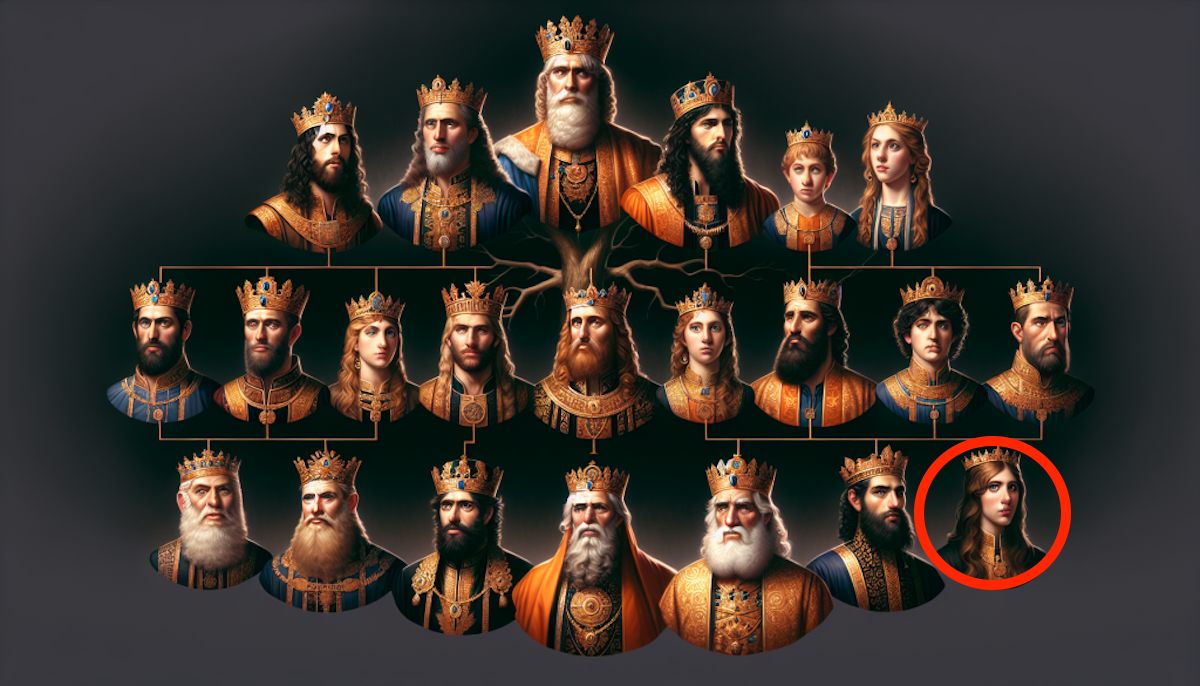
All these were the sons of David, besides his sons by his concubines. And Tamar was their sister.
1 Chronicles 3:9 (NIV)

Wendy and I created the lower level of our home with a British theme including a small bar that’s our homage to a British Pub. Add in all of the memorabilia from our years in theatre, and I’d like to imagine it would be at home in London’s West End. Next to the bar is a portrait of Scotland’s Robert the Bruce. In the adjoining guest room, you’ll find portraits of some of the more famous kings and queens of Britain. It’s something we’ve had a lot of fun with.

Royalty is a funny thing. Most of the European nations still acknowledge their royal families and lines of succession though they have no real political power. It’s amazing how the Royal family of Great Britain continues to attract such worldwide fascination. The travails of Harry and Megan over the past few years are a glaring case in point.

For our ancient Chronicler and all of the Hebrew people who returned from exile, it is no different. For over half a millennium their history and heritage were intertwined with the royal family and line of succession, the line of King David.

We’re in our third chapter of the Chronicler’s laying out of the historical genealogies of the Hebrew people. Get ready. There are six more chapters of it coming before we switch to the narrative. In today’s chapter, the focus is on the ever-important line of David. David was God’s appointed King and it was through David’s line that the prophets proclaimed a Messiah would be born. For the Chronicler and his people, the lineage of David was at the core of their history and identity.

Of course, anyone who’s watched Netflix’s wonderful series The Crown (which I highly recommend), knows that the story of Queen Elizabeth isn’t complete without the story of her wild sister, Margaret. Then there’s the tragedy of Diana, the whispers-turned-marriage to Camilla, and the bratty “spare” Prince Harry.

I mentioned in yesterday’s post that one of the things I look for when reading through genealogies in the Great Story is something that is out of place. One of the things I mentioned is the mention of a woman amid all of the men. We find that in today’s chapter. The Chronicler lists all of the sons of David from his various wives and concubines. At the very end of the list, he adds “And Tamar was their sister.”

David certainly had plenty of daughters to go with the sons, but only one is mentioned. Without saying another word, the Chronicler has acknowledged to all of his contemporary readers what he knows they all talk about. He’s telling us “There is a story here.” Tamar was that daughter.

For those who may not know, or may have forgotten, Tamar fell in love with her half-brother Amnon who was also the first-born and heir to David’s throne. The heir to the throne ends up raping his younger half-sister and then completely shuns her and tosses her aside. David shoves the entire event under the proverbial rug, which only serves to plant a seed of rage within the heart of Absalom, his third-born son, and Tamar’s full-blood older brother. Absalom would eventually take out his other brothers like Michael Corleone taking out the heads of the five families at the end of The Godfather, and launch a coup to steal the throne from his father. All of this gets reduced to:

“And Tamar was their sister.”

In the quiet this morning, my mind wandered to a couple of conversations I’ve had in the past few weeks. In each case, I was speaking with individuals I have known for over 30 years. I first met each of these people when they were in high school, though there’s no relationship between the two. They are of different ages and from completely different places in life. The connection is that each of them is in the midst of unbelievably difficult circumstances concerning one of their children. The circumstances are completely different but each case is beyond anything I have personally encountered. I can hardly even imagine what these people are going through.

But you’d never know.

In one of these conversations, as I dug into the difficulties they were living with daily, my friend said, “You know, everyone has their shit. It just looks different. Yet, with each person, it’s their shit in their life and they are having to work through it and deal with it and learn from it.” And, this observation stuck with me. I’ve been chewing on it and meditating on the truth of it.

What my friend was getting at is that each person has their own messy, struggling, difficult, tragic, and even shameful story. We are fallen people living in a fallen world. Yet we project to strangers, acquaintances, friends, and even family that things are “normal” and “good.” Nothing to see here. “And Tamar was their sister.”

Over the past few weeks, I’ve found myself considering those with whom I interact. What is this person’s story? What are they dealing with in life about which I have no clue? The lady behind the counter has a company name tag that says, “Karen. I’m here to help.” It could just as easily say, “Tamar. I’m just the sister.”

I’m reminded of Jesus’ scandalous conversation with the Samaritan woman, a stranger who happened to come to draw water while He was sitting there. He ends up telling the woman, “You’ve been married five times, and you’ve not bothered to get married to the man you’re living with.” It’s easy to read that as subtle condemnation, but there’s no hint or evidence of Jesus condemning her in any way. I think it was really about Jesus saying “I see you. I see the story behind the ‘Hello, my name is Mara’ way in which you’re going about the daily chore of drawing water for you and your husband.”

I confess to you that God’s Spirit has long been working on me to be more considerate. Today’s chapter compels me to consider that every individual I interact with has more going on in life than I can possibly know, and respond accordingly.

If you know anyone who might be encouraged by today’s post, please share.

The “Divine Right” (to Be Equal)

Brothers and sisters, think of what you were when you were called. Not many of you were wise by human standards; not many were influential; not many were of noble birth. But God chose the foolish things of the world to shame the wise; God chose the weak things of the world to shame the strong. God chose the lowly things of this world and the despised things—and the things that are not—to nullify the things that are, so that no one may boast before him.
1 Corinthians 1:26-29 (NIV)

Wendy and I have a guest room that we’ve been decorating with a UK theme. We’ve loved our trips to the UK and thought it would be kind of fun (“cheeky,” even) to channel that into our home. On one of the walls we’ve hung portraits of royalty as well as some of our favorite British writers and actors. Of course, we felt the need to separate the portraits with the royals (and a couple of Prime Ministers) on one side and the those low-life, “commoner” artist types on the other 😉

Having grown up in a representative republic like America, the notion of royalty is a bit of romantic idea and the stuff of nostalgia for us. For most of human history, however, the idea of people being better than others simply because of the blood in their veins and the family into which they were born was part of the fabric of every day life. And, going all the way back to ancient rulers, it was commonly believed that there was some sort of divinity that marked the distinction. Rulers often claimed to be gods themselves. The idea of monarchs ruling by “divine right” was popularly held (mostly by the royals themselves) until recently.

Even in the times of Jesus and the early Jesus Movement, the notion of “divine” rulers was popular. One of the reasons the early believers were executed or thrown into the Roman circus to be eaten by lions for the sake of entertainment was that they refused to swear that Caesar was god.

In today’s chapter Paul is quick to reference that the believers in Corinth were not people of wealth and influence. For the most part they had little status in the eyes of the world. He reminds them, however, that they are highly esteemed by God.

We easily forget that one of the things that made the early Jesus Movement so radical was that everyone could freely accept the gift of salvation offered by Jesus. Everyone was equally a member of the body of Christ. Spiritual gifts were bestowed on every believer by Holy Spirit, and when the Spirit came upon a group of believers everyone manifested the experience regardless of gender, age, ethnicity, or social standing. When believers met together for a love feast and to share in the ritual of the Lord’s supper everyone was welcome at the table. If a slave and the slave’s master were both believers, they had equal status at the table of Jesus’ followers.

This morning I find myself meditating on the reality that as the Jesus Movement became the institutional church and gained both power and influence, it quickly abandoned its egalitarian roots and developed rigid systems of hierarchy and status that exist to this day. In personal practice and in my, admittedly small, circles of influence I am consciously trying to lead us back to the egalitarian spiritual roots of the Jesus Movement where everyone is of equal status in the body of Christ and where everyone is welcome at the table. We’ll let the ancient notion of “divine” rulers  or those of higher or more noble “status” be simply a bit of nostalgia on our guest room wall.

Speaking of that. One of the decorative touches we want to make to our guest room is a collage of postcards from the UK. If I have any readers from across the pond who would like to contribute, we would be both humbled and blessed to have you send us a postcard (or two, or three!). Simply drop it in the mail it to:

Tom & Wendy Vander Well
c/o Intelligentics
801 Franklin St. #526
Pella, IA 50219 U.S.A.

Tomorrow begins the Thanksgiving holiday here in the U.S. Please know that I am truly thankful for you who faithfully, or occasionally, (or even rarely) read my posts. Cheers!

“Divine-Right” Deceptions

For who makes you different from anyone else? What do you have that you did not receive? And if you did receive it, why do you boast as though you did not?
1 Corinthians 4:7 (NIV)

Wendy and I have recently binged our way through Netflix’s original series The Crown. It is a dramatic interpretation of the reign of Queen Elizabeth II, and we’ve thoroughly enjoyed it

One of the subtle themes in the storytelling is the British royal family’s understanding of their role as a “divine right” monarchy. It was very common for the royal families of Europe to view their respective reigns as being God’s appointed rulers. The Queen is not only viewed as a head of state but also head of the Church of England. Rulers taking on the mantel of divinity has a very long and storied tradition in human history. From Pharaohs of Egypt to Caesars of Rome the rulers of Empires have claimed to be gods or to have some divine “right” to rule.

This of course, stirs up all sorts of conflicting feelings, especially here in the culture of the States which was founded on a rejection of monarchy altogether. The founding fathers created a government that was, as Lincoln would put it four score and seven years later, “of the people, by the people, for the people.” Nevertheless, this theme of royals and nobles being better than the commoner, or not, still resonates in our storytelling.

Even Shakespeare used this as a device. Henry V was a divine-right monarch like the rest of the British kings and queens, but Shakespeare wrote the heroic “Hal” as a populist King of the people.” Cloaked and disguised as a common soldier, King Henry sits by the fire with his “common” men at arms an waxes on his own humanity:

I think the king is but a man, as I
am: the violet smells to him as it doth to me: the
element shows to him as it doth to me; all his
senses have but human conditions: his ceremonies
laid by, in his nakedness he appears but a man; and
though his affections are higher mounted than ours,
yet, when they stoop, they stoop with the like
wing. Therefore when he sees reason of fears, as we
do, his fears, out of doubt, be of the same relish
as ours are: yet, in reason, no man should possess
him with any appearance of fear, lest he, by showing
it, should dishearten his army.

This all comes to mind this morning as I read today’s chapter. Paul addresses those believers of Corinth who have become arrogant and have displayed an attitude of being better, more godly, more authoritative, and more spiritually noble than others believers. They were acting as some sort of “divine-right” authorities within the church.

Paul’s response is to point out that those who follow Jesus, all of us, have nothing spiritually that has not been graciously given to us by Christ. This is a cornerstone of our belief system. We don’t earn God’s favor. We don’t merit Jesus’ love, or forgiveness, or grace, or mercy, or salvation because of what we’ve done or not done. All we have is a gift of God given to all and for all to receive irrespective of gender, race, creed, socio-economic status, standing in society, education, age, or moral/immoral track record.

This morning I’m mulling over my own track record. Along my journey I know there have been times when I’ve spoken or acted out of spiritual arrogance. Some very specific examples spring to mind in my memories. Lord, forgive me. I’ve deceived myself and acted the part of “divine-right” authority from time to time. I’d like to think that age and experience have taught me humility, but they have also taught me that I easily cycle in and out of these things. “Ceremonies laid by” I’m just as human as everyone else, including Queen Elizabeth II.

“L’chaim”

“You shall not do as they do in the land of Egypt, where you lived, and you shall not do as they do in the land of Canaan, to which I am bringing you.”
Leviticus 18:3 (NRSV)

This past weekend we were with friends at the lake. It was a wonderful weekend. We lay in the sun and on the water. We took a boat ride in which the hum of the engine and the rocking of the waves lulled our friends to sleep. We watched a good movie together that resonated with profound lessons about the contrast between life and religiosity. We drank a luscious red wine and ate a rich mixture of crackers, cheese, fruits and veggies. We explored new ideas. We shared both joys and heartaches. We spoke into one another’s lives.

Our friend raised his glass multiple times during the weekend in what is an important ritual for him, and offered the Hebrew toast “L’chaim” which means “to life.”

When you look at the Great Story God is telling from Genesis to Revelation, there are a few simple themes woven throughout. One of them is the theme of life and death:

I call heaven and earth to witness against you today that I have set before you life and death, blessings and curses. Choose life so that you and your descendants may live….” (Deuteronomy 30:19)

We continue our journey today through the ancient sacrificial system described in the book of Leviticus. If you’ve been following along I’m sure you’ll agree with me that the whole thing gets a bit surreal to our 21st century western sensibilities. In today’s chapter, we encounter a host of rules centered mostly around sex. The key to unlocking the message is in the third verse (pasted at the top of this post).

The Hebrews had just escaped from being slaves in Egypt. They were headed to the land God promised them in Canaan. They have been immersed in Egyptian culture for hundreds of years and they are about to experience Canaanite culture. Neither culture was particularly healthy.

King Tut RenderingIn Egypt, the ruling families were known to practice incest in the belief that they were keeping the royal bloodline pure. The Pharaoh and his family were considered deities and the thinking went that if the royal family only bred from among each other that they wouldn’t be tainted by any non-deified humans. Of course, we know today that his is a really bad idea. Consider the famous King Tut. Extensive research on Tut’s mummy reveals that the boy king behind the famous hoard of golden treasure was far from what we would consider god-like. He had a club foot, probably walked with a cane, and he had abnormally wide, feminine hips for a boy. These are likely genetic issues stemming from the fact that his parents were brother and sister.

By the way, before we get too judgmental on the ancient Egyptians, it should be noted that the whole “pure blood” philosophy among royals carried on in Europe for centuries. J.K. Rowling didn’t just make up the “pure blood” notion for the fictional wizarding world. The royal families in Europe are a dizzying mixture of marriages between relatives.

Intermarriage among Europe's royal Hapsburg family.
Intermarriage among Europe’s royal Hapsburg family.
In ancient Canaan, the local tribal cultures had their own mixture of unhealthy sexual practices which spilled into their local religious practices. Ritual worship of pagan gods such as Molech included strange sexual practices and the sacrifice of human children by burning them.

So, as we read through today’s chapter we have to realize that it was a prescription against cultural and religious practices from Egypt and Canaan that were unhealthy for individuals and society as a whole. It’s back to the theme of life and death. These things don’t promote life and its healthy regeneration. These things bring destructive havoc on people, relationships, and society. Underneath the rules lies the same old theme: life and death. God is once again saying, “I want you to choose life by living in such away as to avoid those things you’ve seen in Egypt and will see in Canaan which are really unhealthy and contribute to destruction and death.”

Which brings me back to last weekend with our friends which was so full of life. Our bodies rested, our souls refreshed, and our relationships were strengthened. We tasted and drank in goodness spiritually, emotionally, relationally as well as in the literal food and drink we enjoyed together. Our activity and our conversations were life giving. And that’s always what God wants us to choose.

L’chaim.

Hangin’ with the Homeys

“But now, our God, what can we say after this? For we have forsaken the commands you gave through your servants the prophets when you said: ‘The land you are entering to possess is a land polluted by the corruption of its peoples. By their detestable practices they have filled it with their impurity from one end to the other. Therefore, do not give your daughters in marriage to their sons or take their daughters for your sons. Do not seek a treaty of friendship with them at any time, that you may be strong and eat the good things of the land and leave it to your children as an everlasting inheritance.’”
Ezra 9:10-12 (NIV)

I grew up in a great neighborhood on the northwest side of Des Moines. The neighborhood was packed full of young families, not only on our block but on the surrounding streets. There were a lot of kids running around the area, but you tended to hang with your homeys on the street you lived. You’d stick close to the kids on your own block. They were the nearest to you, you knew them well, and more importantly your parents knew their parents.

On occasion, kids from another street would migrate over to play and hang out. I can remember the rare occasion when my mom would tell me that certain kids were “bad news” and she didn’t want me hanging out with them. In fact, I was to steer clear of that kid altogether. Looking back, I know exactly why mom gave me the order and it was a wise thing to do. Some of those kids were, in fact, bad news.

In the melting pot of modern America, reading a chapter like today’s regarding the strict commands the Hebrews had not to intermarry with neighboring peoples can feel strange and prejudiced. “Pureblood” wasn’t an idea J.K. Rowling dreamed up for the Harry Potter series. The truth of the matter is that history is full of examples of peoples and socio-economic groups desperately trying to remain homogeneous; Sometimes rabidly so.

Ancient Egyptian royalty, who believed themselves divine, would sometimes only marry their own immediate family members to keep the bloodline pure. European royalty, who would only marry their children to other royals, became so intertwined that to this day the royal families of Europe are all related to one another. Living in a small Iowa town settled by a handful of Dutch families, I experience the same thing at any community social event as people constantly play a game we call “Dutch Bingo” discovering how community members are related to one another (and, they usually are).

I found it interesting, however, that as I read today’s chapter Ezra pointed to the motivation God had for telling them not to intermarry. Just like my mother back in the ‘hood, Father God knew that some of these other tribes were bad news. In many cases, the area religions were glorified excuses for sexual indulgence and got into some really nasty stuff including child sacrifice. The command not to intermarry was not some elitist attempt to keep bloodlines pure but about cultural and spiritual self-protection.

This morning I am once again reminded that reading ancient sections of the Great Story is often difficult in light of the immense changes of culture and civilization over time. As an adult, my parents would never tell me who I can and can’t hang out with, but as a child they knew that hanging with the homeys from our block was a wise thing and that I needed help in discerning that some kids were bad news. So it is that I believe God’s relationship with humanity changes as civilization matures and as the relationship itself has changed between God and humanity through the person and work of Jesus.

chapter a day banner 2015


featured photo: adwriter via Flickr

The Latest 08-23-2015

It was a week of major life transition here at Vander Well Manor.  Just over two years ago, Wendy’s youngest sister Suzanna moved in with us. She entered her senior year at Pella High and then spent this past year working and saving for college. She’s been a welcome member of our home and together we’ve shared a ton of life experiences during this shared stretch of our life journeys. This past Wednesday was the day we drove her to college and launched her on a new stretch of her own journey. But, I’m getting ahead of myself.

Monday and Tuesday were spent packing, purging, and preparing. Both Suzanna and Wendy buzzed around upstairs. Suzanna took over the guest bedroom for her sorting and staging process.

This slideshow requires JavaScript.

Tuesday night was Suzanna’s last night at home, so we let her decide the meal. Her choice was Wendy’s homemade pizza and breadsticks. She also requested family movie night to watch The Big Lebowski, which she and I have talked about watching for months. Taylor invited her friend Curtis to join us. It was a fun night. We all gathered around the kitchen island and enjoyed conversation as Wendy made dinner. Despite me dropping one of the pizzas and losing half of it into the bottom of the oven, we had a great dinner and then settled into the Great Room for the movie (and requisite White Russians).

Dropping Suzanna at College

We packed the cars and headed out around 10:00 a.m. on Wednesday for the two hour drive to Suzanna’s campus. She followed behind us. The load out was fast and much easier than we anticipated. Suzanna’s roommate had moved in the previous day and we enjoyed meeting her. After the last of her stuff had been dropped in the room we offered to take Suzanna out to lunch and make sure she was familiar with where things were in town. She opted for lunch with her roommate and some girls on the floor. As we said good-bye the mood went from smiles and excitement to teary good-byes. Wendy and I lunched at BWW on our own before driving home.

Taylor did some house-sitting for friends late this week so Wendy and I had four nights of experiencing an empty nest for the first time in a while. But, our social calendar kept us from savoring the quiet.

Historic Pella Opera House
The Historic Pella Opera House

Kevin McQuade POH CampaignOn Thursday night we headed to the Pella Opera House for their annual season kick-off. Our friend and neighbor, Kevin, is the Executive Director there and is in the middle of an audacious million dollar renovation campaign. We were excited when Kevin announced they’d reached $800,000 towards their goal. In October the Opera House celebrates 25 years since their historic renovation. A grand black-tie evening is on tap and Kevin asked me to script a sketch as part of the evening’s entertainment. Wendy and I enjoyed hanging out and socializing with friends. We were among the last to leave when Kevin flashed the lights at the end of the evening.

An evening at V-Dub Pub

On Friday night we enjoyed barbecue chicken on the grill with our friend Cyndi who will be taking over as President of Union Street Players. We discussed transition of leadership as well as the transitions of both Suzanna and Cyndi’s daughter, Megan, who also headed to college. Kevin and Linda arrived after dinner and we settled downstairs in “V-dub Pub” (thanks, Chad VL, for that moniker).  I unveiled my script for the Pella Opera House Anniversary show and was happy that it received a favorable review from the Producer. As always with this crew, spirited conversation and laughter reigned until well after midnight.

Celebrating Matthew and Sara's One-Week Anniversary.
Celebrating Matthew and Sara’s One-Week Anniversary.

A couple of short nights led Wendy and me to a rather slow start on Saturday. We worked a little bit and eventually busied ourselves cleaning up the upstairs in anticipation of Wendy’s Uncle Brad and his bride-to-be Barb who spent the night with us on Saturday. I spent part of the afternoon helping my friend, Matthew, move a washer and a couple of dryers into his new house. We then met Matthew and his new bride, Sarah, at Kaldera for dinner and a celebration of their one-week anniversary.

My First Royalty Check

I end this week’s episode of The Latest with a relatively insignificant, but admittedly proud moment. Yesterday in the mail I received my first ever royalty check for my play Ham Buns and Potato Salad which is being produced by Newton Community Theater this fall.