Tag Archives: Completion

“However…”

"However…" (CaD 1 Ki 7) Wayfarer

It took Solomon thirteen years, however, to complete the construction of his palace.
1 Kings 6:38-7:1 (NIV)

By its very nature, this chapter-a-day journey focuses on one chapter each weekday. It’s typically a quick read and allows for efficiently focusing on a limited amount of content. Those chapter numbers and verse numbers were not originally part of the text. Manuscripts as early as the fourth century reveal forms of chapter designations. The chapters we have today date back to the 12th century, introduced by a man named Stephen Langton. Verses came along in 1551, added by a translator named Robert Estienne.

The upside of chapters and verses is that they make referencing and cross-referencing simple. They also help break the text up into easily digestible chunks for purposes of planned reading like this chapter-a-day journey. The downside to chapters and verses, of course, is that it’s easy to think about each chapter in a vacuum, and sometimes the lesson is the context of the larger story being told or the larger lesson being conveyed. When the teaching team among our local gathering of Jesus’ followers was preparing a series of messages on 1 Corinthians, I made a copy of Paul’s letter to the believers in Corinth on plain paper without any chapter, verse, or headings. I printed it in a handwritten font. Many of them spoke of it being a transformational experience to read the letter as it was originally written, as a personal letter. I have found it important for me to occasionally get rid of chapters and verses in order for some lessons to become clear.

Today’s chapter is a great example of this. It begins with the statement, “It took Solomon thirteen years, however, to complete the construction of his palace.” The word “however” is referring back to the end of the previous chapter, but I read that chapter yesterday. That blog post was written and posted; The podcast was recorded and published. It’s a different day, and we’re on to the next chapter. It’s easy to simply ignore it.

The previous sentence at the end of chapter six says:

In the eleventh year in the month of Bul, the eighth month, the temple was finished in all its details according to its specifications. He had spent seven years building it.

Solomon spent seven years building God’s Temple.

He spent thirteen years building his palace.

There’s a lot of context missing, of course. It’s quite possible that Solomon invested a lot more manpower in order to make the Temple a priority and get it built in a shorter period of time. It’s easy to jump to conclusions. I couldn’t help but notice the numbers involved.

The Temple was built in seven years. Seven is associated with “completion” throughout the Great Story (e.g. seven days of creation). So, it would make sense that God’s Temple would be completed in seven years. In addition, it was completed in the eighth month. Eight is associated with “a new thing” as in “seven plus one.” Seven is completion, but add to it and we’re doing something new. This permanent Temple was a new version of the old traveling tent Tabernacle. Old things pass away and new things come.

Solomon’s palace was built in thirteen years. Now we have the number of completion (seven) and add to it six years. John’s Revelations speak very clearly that six is “man’s number” and the human anti-Christ’s number is 666 (three being the number of the Trinity, three sixes form an unholy trinity of man as God). I couldn’t help but think that Solomon’s palace stands as a lesson. As wise as Solomon was, this little “however” statement by the author, and the numbers involved, subtly point to the fact that Solomon’s human hubris was more important to him than a humble and obedient life in which he sought to make God the priority.

In the quiet this morning, I end this work week with a rather simple lesson resonating in my heart and mind. Do I give God a portion and save a larger portion for myself. Do I invest a part of my life in spiritual “treasure” while spending more time and energy chasing after earthly “treasure?” Will family and friends say at my funeral, “Tom was dedicated to the things of God, however...”

If you know anyone who might be encouraged by today’s post, please share.

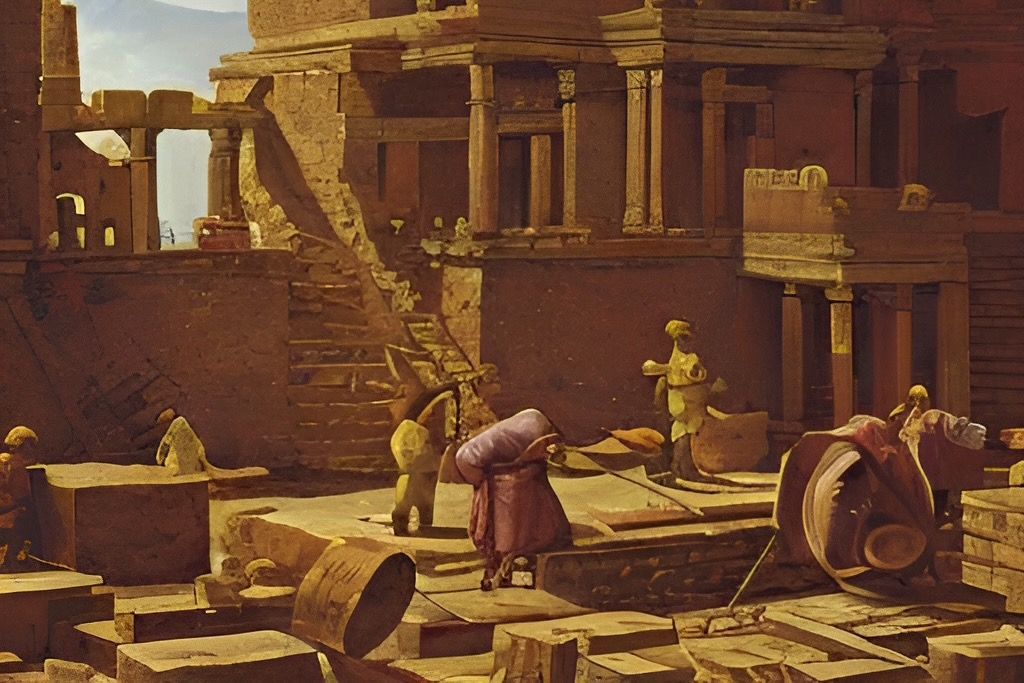
The featured image on today’s post was created with Wonder A.I.

Final Words

The words of Jeremiah end here.
Jeremiah 51:64 (NIV)

Along my journey I’ve had the privilege of officiating a  host of funerals. Some of them have been family members with whom I’ve had a life-long relationship. Many have been complete strangers to me. No matter the case, I’ve always approached these meaningful events with a desire to honor the person, her/her family, and to comfort those loved ones by telling the person’s story well.

I usually start by simply meeting with the family and asking them questions. As I listen, a story begins to emerge about the deceased, what the person did with his/her life, how he/she impacted the people around them, and what his/her journey was really about. I’ve got to be honest, sometimes the story is heart-warming, and other times it is painfully tragic. Either way, there is always a story to tell.

One of the things I’ve most appreciated about this long slog through Jeremiah’s prophetic anthology is the realization that we have a fairly thorough retrospective of Jeremiah’s 40 years of prophetic works from beginning to end. Jeremiah had a very specific message to convey throughout his career: Babylon was going to destroy his city of Jerusalem and take his people into exile. Then, Babylon would eventually suffer the same fate. When the former happens as prophesied, Jeremiah sends the latter message with a servant headed to Babylon. With that act, the editors tell us that they are Jeremiah’s final words (though the story ends with tomorrow’s final chapter).

Jeremiah’s words were never popular. He was threatened, attacked, imprisoned, left to die, and yet he always remained “on message.” He stuck doggedly to the message God gave him. When the Babylonians showed him unusual mercy for his prophetic “support” of their invasion, Jeremiah didn’t hesitate to tell them that their turn was coming. He never backed down. He completed the job. He stuck to the mission.

This morning I’m thinking about the end of Jeremiah’s words, and it’s prompting thoughts about my own life, and my own story. Someday the responsibility will likely fall on someone to listen to my family members and to sum up my story in just a few minutes of oratory. With each day of my journey I slowly pen that story. I hope it’s not unlike Jeremiah’s: sticking to the mission, completing the course set before me. More than anything, I hope the theme of the story is love.