Tag Archives: 1 Kings 7

“However…”

"However…" (CaD 1 Ki 7) Wayfarer

It took Solomon thirteen years, however, to complete the construction of his palace.
1 Kings 6:38-7:1 (NIV)

By its very nature, this chapter-a-day journey focuses on one chapter each weekday. It’s typically a quick read and allows for efficiently focusing on a limited amount of content. Those chapter numbers and verse numbers were not originally part of the text. Manuscripts as early as the fourth century reveal forms of chapter designations. The chapters we have today date back to the 12th century, introduced by a man named Stephen Langton. Verses came along in 1551, added by a translator named Robert Estienne.

The upside of chapters and verses is that they make referencing and cross-referencing simple. They also help break the text up into easily digestible chunks for purposes of planned reading like this chapter-a-day journey. The downside to chapters and verses, of course, is that it’s easy to think about each chapter in a vacuum, and sometimes the lesson is the context of the larger story being told or the larger lesson being conveyed. When the teaching team among our local gathering of Jesus’ followers was preparing a series of messages on 1 Corinthians, I made a copy of Paul’s letter to the believers in Corinth on plain paper without any chapter, verse, or headings. I printed it in a handwritten font. Many of them spoke of it being a transformational experience to read the letter as it was originally written, as a personal letter. I have found it important for me to occasionally get rid of chapters and verses in order for some lessons to become clear.

Today’s chapter is a great example of this. It begins with the statement, “It took Solomon thirteen years, however, to complete the construction of his palace.” The word “however” is referring back to the end of the previous chapter, but I read that chapter yesterday. That blog post was written and posted; The podcast was recorded and published. It’s a different day, and we’re on to the next chapter. It’s easy to simply ignore it.

The previous sentence at the end of chapter six says:

In the eleventh year in the month of Bul, the eighth month, the temple was finished in all its details according to its specifications. He had spent seven years building it.

Solomon spent seven years building God’s Temple.

He spent thirteen years building his palace.

There’s a lot of context missing, of course. It’s quite possible that Solomon invested a lot more manpower in order to make the Temple a priority and get it built in a shorter period of time. It’s easy to jump to conclusions. I couldn’t help but notice the numbers involved.

The Temple was built in seven years. Seven is associated with “completion” throughout the Great Story (e.g. seven days of creation). So, it would make sense that God’s Temple would be completed in seven years. In addition, it was completed in the eighth month. Eight is associated with “a new thing” as in “seven plus one.” Seven is completion, but add to it and we’re doing something new. This permanent Temple was a new version of the old traveling tent Tabernacle. Old things pass away and new things come.

Solomon’s palace was built in thirteen years. Now we have the number of completion (seven) and add to it six years. John’s Revelations speak very clearly that six is “man’s number” and the human anti-Christ’s number is 666 (three being the number of the Trinity, three sixes form an unholy trinity of man as God). I couldn’t help but think that Solomon’s palace stands as a lesson. As wise as Solomon was, this little “however” statement by the author, and the numbers involved, subtly point to the fact that Solomon’s human hubris was more important to him than a humble and obedient life in which he sought to make God the priority.

In the quiet this morning, I end this work week with a rather simple lesson resonating in my heart and mind. Do I give God a portion and save a larger portion for myself. Do I invest a part of my life in spiritual “treasure” while spending more time and energy chasing after earthly “treasure?” Will family and friends say at my funeral, “Tom was dedicated to the things of God, however...”

If you know anyone who might be encouraged by today’s post, please share.

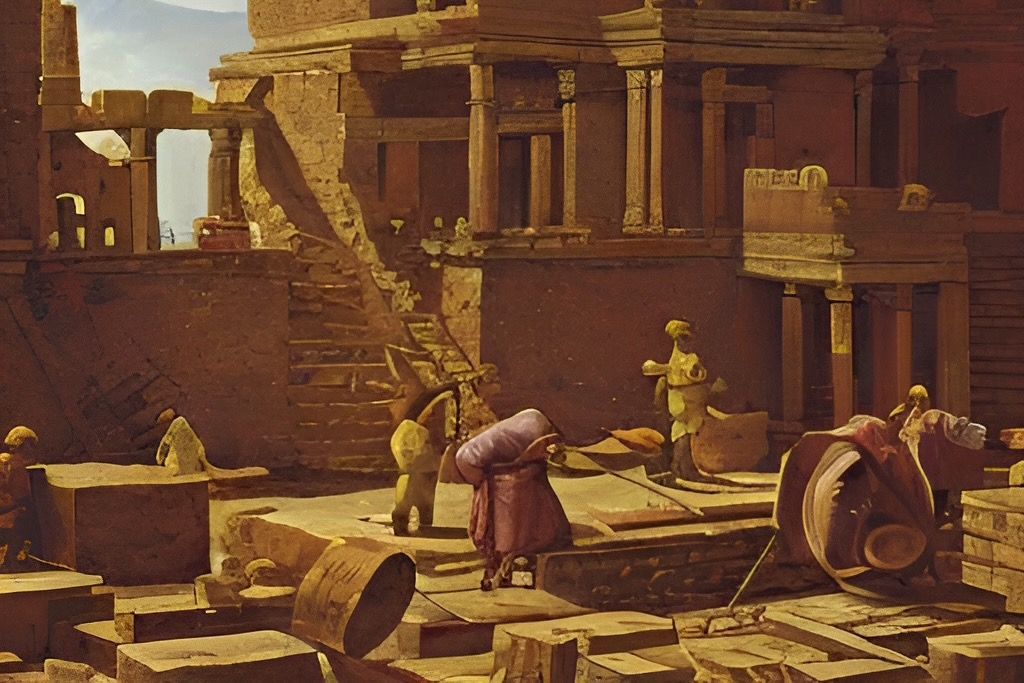
The featured image on today’s post was created with Wonder A.I.

The Right Craftsman for the Job

The Temple
Model of Solomon’s Temple

King Solomon sent to Tyre and brought Huram, whose mother was a widow from the tribe of Naphtali and whose father was from Tyre and a skilled craftsman in bronze. Huram was filled with wisdom, with understanding and with knowledge to do all kinds of bronze work. He came to King Solomon and did all the work assigned to him. 1 Kings 7:13-14 (NIV)

I come from a family of individuals skilled in construction. My great-grandfather started as a young man making small wooden dowels (used instead of nails) in the Netherlands. When he came to America he did construction and eventually owned a hardware store. My  grandfather taught shop. My dad and my brothers are also skilled craftsman in their respective mediums. I, however, am not skilled when it comes to construction. I know my way around a tool chest, and I can capably handle minor repairs and things. I have learned over time, however, that when it comes to major renovations or repairs that I will save myself a lot of time and frustration by hiring a skilled craftsman.

Wendy and I have been watching our house being built, and I have been marveling at the craftsman as they ply their respective trades. I have so much respect for those who do these things well.

I thought about this as I read about Solomon searching out the best craftsman to work on the bronze for his palace and the temple. He wanted it done right, and he wanted it done well, so he found the best craftsman for the job. This same principle applies to spiritual gifts and God’s work. To each person is given certain gifts for the equipping and building up of the Body of Christ and for the work of love to we are called. When we use our respective gifts then things are done right, and done well. When we have people plugged into the wrong activities for their gifts, the result is struggle and frustration.

Chapter-a-Day 1 Kings 7

Toms bass It took Solomon another thirteen years to finish building his own palace complex. 1 Kings 7:1 (MSG)

We live in such an instant society. We want gratification immediately. Our computers are never fast enough, and we complain when a page takes a few extra seconds. We pay extra to have our purchases delivered over night so we don't have to wait a few more days. We have microwaves to make prepared dishes so we don't have to take the time to actually cook something from scratch.

Perhaps that's why the beginning of today's chapter jumped off the page at me. It took seven years for Solomon's army of laborers to complete the temple and another thirteen years to build his own palace complex. That's a long time. In today's standards of construction, it was an eternity.

The truth is that some things do take time. My brother, the luthier, says that it takes in the neighborhood of 200 man hours to craft a guitar by hand, not counting the additional time that the guitar must sit at different places in the process. You don't take shortcuts. There are no microwave ovens for the process. It takes what it takes.

The same is true for maturity. When it comes to being a disciple of Jesus there is no "add water and stir." There is no Star Trek transporter to beam us instantly to a spot on the horizon. God is not making us into a microwaveable pot roast, he's crafting us into a finely tuned instrument. We must each press on and walk our own journey. It takes what it takes.

So, I'm lacing up my walking shoes. Today is another leg in the journey. There's a long way to go.