Tag Archives: Nehemiah 10

Second Marriage

“We assume the responsibility for carrying out the commands…
Nehemiah 10:32a (NIV)

Among some of the historical family ephemera in my personal archives is a marriage certificate for my great-grandparents. The certificate is for their second wedding. They were married, then got divorced, and then got remarried. Ironically, I think I have the second marriage certificate for our daughter, as well. It’s funny how history repeats itself.

Some relationships are like that. They work, and then they don’t, and then the parties work through their differences and return to covenant. They recommit.

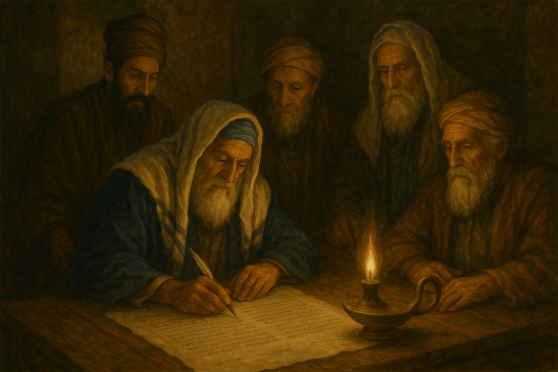
In today’s chapter, Nehemiah and the returned Hebrew exiles in Jerusalem return to their covenant with God. It’s a covenant that God refers to as a marriage on numerous occasions. In essence, the document that they sign and seal is a new marriage certificate. In yesterday’s chapter they confessed that they had broken faith and walked away from the marriage. Now, they are getting remarried.

In this marriage certificate, Nehemiah lists a number of things to which they are committing to make the relationship work. They agree to live according to the principles God laid out in the Law of Moses, to keep the sabbath, to be generous, and to be faithful to the system of worship God prescribed.

Nehemiah 10 invites me to ask not just “What do I believe?” but “What am I willing to commit to — publicly, practically, persistently?” The ink on Nehemiah’s covenant scroll reminds me that faith needs form the way that saying “I do” at the wedding needs daily relational acts that put flesh on the commitment. Promises whispered in private take root when I bind them to community, to habit, to rhythm.

I’m reminded in the quiet this morning that my relationship with God is a marriage, and each new day is like my own “signing day.” It’s a daily covenant renewal of the soul:

  • To rest when the world demands endless work.
  • To give generously when culture teaches us to hoarding.
  • To honor sacred time and sacred space.
  • To live and love distinctively, not for separation’s sake, but so that light may be visible in the dark.

Nehemiah and the Hebrews’ story is really a love story between God and a people saying again: “We’re still yours.” And that’s a sentiment I whisper in my actions each day to both God and Wendy.

If you know anyone who might be encouraged by today’s post, please share.

Promotional graphic for Tom Vander Well's Wayfarer blog and podcast, featuring icons of various podcast platforms with a photo of Tom Vander Well.
These chapter-a-day blog posts are also available via podcast on all major podcast platforms including Apple, Google, and Spotify! Simply go to your podcast platform and search for “Wayfarer Tom Vander Well.” If it’s not on your platform, please let me know!
An image featuring two marriage certificates, showcasing historical family ephemera, symbolizing commitment and covenant renewal.

Membership and Motivation

“We will not neglect the house of our God.”
Nehemiah 10:39 (NIV)

I had been serving as the pastor of a small church for about a year when I got a call asking for my presence at an emergency meeting of the church Elders. That’s never a comforting sign.

I arrived at the meeting to find that there was one major issue on the agenda: Me. Specifically, one of the Elders expressed grave concern that was not an official member of the church.

Big trouble.

“Um, you all called me to be your pastor. Doesn’t that, kinda by default, make me a member?”

Nope.

“So, what do I have to do to become a member?”

Write a letter requesting I be granted membership status, then present it to the congregation for a vote.

“Um…Okay.”

I happy to report that the vote was overwhelming in favor of me, the church’s Pastor, becoming a member.

Whew!” [cue: Wiping sweat from brow.]

What’s both funny and ironic is that the “membership” issue has arisen in almost every church I’ve attended and served. I admit that I am a bit of a maverick after having experiences like the one I’ve just related. It is a piece of the institution of church that is obviously very important to certain individuals. I take issue with it, however. Every church institution I’ve ever attended has had a large number of people who jumped through the institutional hoops to become official “members,” but they never come or participate in any way. No one ever complains or has a problem with this. Meanwhile, if I actively participate with my consistent attendance, service, and offerings but don’t jump through the institutional hoops to get a piece of paper telling me that I’m “in,” then certain people get their undies in a bunch.

Thank you for letting me vent.

In today’s chapter, Nehemiah records what amounts to a legal document that records the commitment of the exiles to follow the Law of Moses and to provide prescribed offerings that would be necessary for the carrying out of the sacrificial system of the Temple. This was no small thing. The sacrificial system established through Moses was an intricate, even burdensome, system of sacrifices that required a large population’s offerings to keep it moving as laid out. Their legal contract was signed and sealed. It is obvious that Nehemiah felt it important to make the people’s obedience to the sacrificial system legally binding.

Here’s what I find fascinating as I mull things over in the quiet. The sacrificial system had been in place for roughly a thousand years. Time and time again it fell apart and became given over to various forms of religious and political corruption. That was part of Nehemiah’s “recounting” in yesterday’s chapter. So, Governor Nehemiah decides to try a legally binding agreement to try and keep people in line.

It didn’t work.

Some 400 years later when Jesus arrives on the scene the Temple system had become a corrupt, powerful money-making racket run by Godfather-esque high priests bent on lining their pockets and controlling the system. That’s why Jesus went postal on the Temple’s currency exchange marketplace not just once, but twice. It’s why he brutally denounced and called out the priests and teachers of the law for their corruption (read Matthew 23).

It’s also why Jesus time and time again taught the masses by starting with “You have heard it said…” then “But, I say….” The crux of Jesus’ message was that God’s concern was not about rule keeping and legally binding adherence to prescribed religious practices. God’s concern was for a change of heart that motivates real, tangible change in the way we love, live, give, and relate to others.

As a follower of Jesus, that’s where I want to follow. I want to invest my time, energy, and resources through my local gathering of Jesus followers because the love of Christ compels me, not because I have a piece of paper telling me I’m a “member” of an institution subject to the responsibilities thereof.

For the record, I am an official member of my local church out of loving deference to my brothers and sisters who find such things important. But, that’s not why I serve, give, and support. My motivation for doing my part is a matter of the heart.

A Radical Shift in Paradigm

“We will not neglect the house of our God.”
Nehemiah 10:39 (NIV)

Over my journey I’ve worshipped in many different places. Growing up, there was a lot more emphasis that people placed on the church building itself. I still remember the Methodist church where I grew up. The area of that altar in the sanctuary was considered hallowed ground along with the “eternal light” that hung above it (which was a light bulb I’m quite sure needed to be replaced on occasion).

As I grew in my understanding as a follower of Jesus, I began to recognize that the special attachment Christians placed on their particular house of worship fell into two camps. The first camp were those who considered their local church building to be some kind of holy place that was, itself, sacred because it was a church. The other camp considered their local church special because the community of believers had built it together. It was communal space for worship and they wanted to take care of it.

In the days of Nehemiah, the temple where they worshipped was a holy place. It had been designated such by God when He gave the plans to Moses and called for its eventual construction. When Jesus came, however, the paradigm changed radically. Jesus made it clear that the times they were a changing. When confronted by the Samaritan woman at the well about where you should worship, Jesus replied, “But the time is coming—it has, in fact, come—when what you’re called will not matter and where you go to worship will not matter.”

With the pouring out of Holy Spirit into the hearts of every believer, our bodies themselves became the temple. Our worship center became wherever we happen to be at any given moment. The focus shifted from bricks and mortar to flesh and blood. We may appreciate and tend to our local church building because we want to be good stewards of the communal worship space, but the church building is not hallowed in and of itself. It’s when I and my fellow believers bring Holy Spirit in with me to worship that makes it a worship center.

Today I’m thinking once again about my body being a temple of Holy Spirit, a vessel in which God dwells. It lends a more intimate meaning to the commitment made by the folks in Nehemiah’s day: “I will not neglect the house of God.”

Guess I’m working out today.

chapter a day banner 2015