Among some of the historical family ephemera in my personal archives is a marriage certificate for my great-grandparents. The certificate is for their second wedding. They were married, then got divorced, and then got remarried. Ironically, I think I have the second marriage certificate for our daughter, as well. It’s funny how history repeats itself.
Some relationships are like that. They work, and then they don’t, and then the parties work through their differences and return to covenant. They recommit.
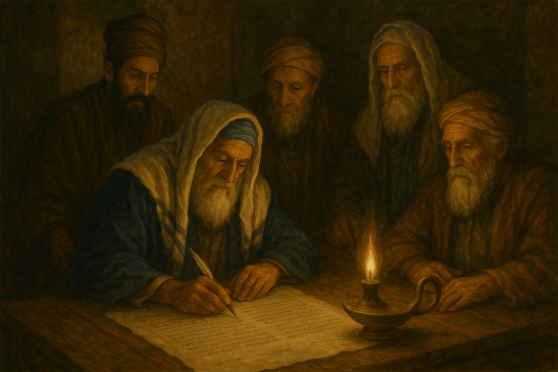
In today’s chapter, Nehemiah and the returned Hebrew exiles in Jerusalem return to their covenant with God. It’s a covenant that God refers to as a marriage on numerous occasions. In essence, the document that they sign and seal is a new marriage certificate. In yesterday’s chapter they confessed that they had broken faith and walked away from the marriage. Now, they are getting remarried.
In this marriage certificate, Nehemiah lists a number of things to which they are committing to make the relationship work. They agree to live according to the principles God laid out in the Law of Moses, to keep the sabbath, to be generous, and to be faithful to the system of worship God prescribed.
Nehemiah 10 invites me to ask not just “What do I believe?” but “What am I willing to commit to — publicly, practically, persistently?” The ink on Nehemiah’s covenant scroll reminds me that faith needs form the way that saying “I do” at the wedding needs daily relational acts that put flesh on the commitment. Promises whispered in private take root when I bind them to community, to habit, to rhythm.
I’m reminded in the quiet this morning that my relationship with God is a marriage, and each new day is like my own “signing day.” It’s a daily covenant renewal of the soul:
To rest when the world demands endless work.
To give generously when culture teaches us to hoarding.
To honor sacred time and sacred space.
To live and love distinctively, not for separation’s sake, but so that light may be visible in the dark.
Nehemiah and the Hebrews’ story is really a love story between God and a people saying again: “We’re still yours.” And that’s a sentiment I whisper in my actions each day to both God and Wendy.
If you know anyone who might be encouraged by today’s post, please share.
These chapter-a-day blog posts are also available via podcast on all major podcast platforms including Apple, Google, and Spotify! Simply go to your podcast platform and search for “Wayfarer Tom Vander Well.” If it’s not on your platform, please let me know!
“Speak to the Israelites and say to them: ‘If a man or woman wants to make a special vow, a vow of dedication to the Lord as a Nazirite…’” Numbers 6:2 (NIV)
This past week Wendy and I were blessed to spend time with our friend, Eric, who just returned from completing 29029, a three-day endurance event in which participants hike a marathon each day for three days at high altitude. Our friend has been steadfastly training for this event for months. It was fun to listen to him share about his experience and the lessons he learned along the way. The lessons were layered: physical, mental, and spiritual.
What has been clear over the past several months is that completing this event required our friend to be dedicated. It was an all-day, every day endeavor from a mental and physical perspective. Like most people, I struggle just to get the amount of exercise to be healthy. My friend is in a special class of individuals dedicating themselves to reach a completely different level of physical performance.
Today’s chapter is unique and fascinating. God is preparing the recently delivered Hebrew slaves for an entirely new way of living life in relationship to God, one another, and the people groups around them. In the book of Leviticus God laid down the regulations for every Hebrew as it related to conducting themselves daily in the camp and in community together with God in their midst. In today’s chapter, God gives every man and woman a choice to reach a completely different level of spiritual dedication.
It was called a “Nazirite” vow and the person who took this vow was referred to as a “Nazirite.” The term comes from the Hebrew word nāzar which means dedicated, separate, and abstain. The Hebrew word nāzîr from which the term “Nazirite” springs is translated as a special class of people dedicated to God. It could also mean “prince” and was used to refer to grapevines that went untended and dedicated to God during God’s prescribed “sabbatical” year of rest. In other words, choosing to take a Nazirite vow as the spiritual equivalent of our friend’s choice to hike three marathons in three days.
The Nazirite could choose the length of his or her vow and period of their consecration. The Nazirite vow wasn’t complicated:
Abstain from all alcohol, don’t even a grape or raisin.
Don’t cut a hair on your head during the period of your vow.
Don’t be in the presence of a dead body, even if your parent dies.
Upon completion of the vow, go before the Lord at the entrance of the traveling tent temple, shave your head and burn it as an offering as part of a prescribed ceremony.
If someone accidentally had a coronary and dropped dead in a Nazirite’s presence, it was a complete do-over. They had to complete a seven-day purification and then start back at day-1 of their consecration period.
One of the details in today’s chapter was that the reason for a Nazirite not cutting their hair was “because the symbol of their dedication to God is on their head.” In other words, this is a public dedication, which both ups the accountability of the Nazirite to keep their vow and challenges everyone else with the daily public reminder. If the every day Hebrew struggled just to keep up with God’s daily spiritual prescriptions for life, the Nazirite was there to remind them that there is an entirely different level of spiritual dedication to which they can ascend.
As I meditated on these things, I was reminded that periods of spiritual consecration and dedication have always been part of the spiritual tradition for Jesus’ followers. When Jesus was asked why He and his disciples feasted and drank with sinners, Jesus replied that everyone celebrates and feasts with the Bridegroom. He then noted that a time would come when “The Bridegroom” would depart. Then His disciples would fast. And, followers of Jesus have always traditionally done so in various ways at various times.
Fasting during the season of Lent leading up to Good Friday and Easter Sunday is probably the most common, but from the early days of the Jesus Movement there emerged a group of dedicated mystics known as the desert fathers. Their dedication to an ascetic life was the precursor to the monastic movement that is still with us thousands of years later.
To be honest, this morning’s chapter feels a bit like a divine appointment. In recent days and weeks I have had thoughts about a special, personal season of dedication. Spiritually picturing the ancient Nazirites and their long hair in the quiet this morning served God’s original purpose, reminding me there’s an entirely higher level of spiritual dedication. So, I find myself in contemplation and conversation with God about it.
Along this life journey I’ve learned that there are times to dedicate myself to taking things to another level.
If you know anyone who might be encouraged by today’s post, please share.
These chapter-a-day blog posts are also available via podcast on all major podcast platforms including Apple, Google, and Spotify! Simply go to your podcast platform and search for “Wayfarer Tom Vander Well.” If it’s not on your platform, please let me know!
“Speak to the Israelites and say to them: ‘If a man or woman wants to make a special vow, a vow of dedication to the Lord as a Nazirite….” Numbers 6:2 (NIV)
I run into some of the most interesting people in my job. Years ago there was a Customer Service Representative (CSR) for a client company who stood out from the crowd because he had the longest hair I’d ever seen on a man. The man was tall and thin and had incredibly straight, long hair that most women would envy. It went all the way down his back. It was so distinctive and prompted such curiosity that one of my colleagues went out of his way to ask the man about it.
It turns out that this man was a follower of Jesus, and he had a friend who was in prison. He wanted to find a tangible way to express his love and loyalty to his friend, and so he informed his friend that he was making a special vow to God, and his friend, that he would not cut his hair until his friend was released from prison. It had obviously been several years, and he was obviously committed to his friend and to God.
The CSR’s vow was a modified version of a voluntary, “special vow” that the ancient Hebrews called a Nazarite vow, as described in today’s chapter. The idea of the Nazarite vow was a way for individuals to “dedicate themselves to the Lord” for a particular period of time for a particular reason that may have been very personal between themselves and God. The reasons can be as diverse as the persons making them, but I have come to believe that there are stretches of life’s journey when a special vow can be an opportunity for incredible growth of spirit and/or witness.
This morning I’m thinking about the special vows individuals make from choosing a monastic life, to a lenten fast, and even to a chapter-a-day journey. The thing I appreciate about special vows is that they are not compulsory or demanded. Special vows come from a special place of the heart. They are Spirit led and Spirit driven. They may be for a brief period of time, for the remainder of the journey, or somewhere in between. That’s between the person making a special vow and God.
Years after our relationship with the client ended my colleague told me one day that our CSR friend had contacted him. The CSR reported that his friend had finally been released from prison. He was there to meet his friend at his release. Together, they went to the barber shop. To this day my heart smiles to think of what that moment must have meant to both of them. For me, it illustrates what special vows are all about.
He swore an oath to the Lord, he made a vow to the Mighty One of Jacob: “I will not enter my house or go to my bed, I will allow no sleep to my eyes or slumber to my eyelids, till I find a place for the Lord, a dwelling for the Mighty One of Jacob.” Psalm 132:2-5 (NIV)
When have I…
…put God’s priorities ahead of my own?
…eschewed momentary appetites for eternal purposes?
…sacrificed my comfort to address God’s concern?
…allowed spiritual hunger to rob me of sleep?
…swore to God, and it was a good and serious thing?
…been concerned about finding a space in my day, home, marriage, family, occupation, and life for God to dwell?