Tag Archives: Giving

Chapter-a-Day Proverbs 19

WASHINGTON, DC - JULY 22:  Treasury Secretary'...
Image by Getty Images via @daylife

If you help the poor, you are lending to the LORD—
      and he will repay you!
Proverbs 19:17 (NLT)

A month or so ago Wendy made an off-hand comment in the midst of a conversation. I can’t remember what we were talking about, but I remember the short comment she made. “You never regret giving,” was the gist of what she said and it stuck with me for the simple truth of it.

Throughout life there are many crossroad moments when the bills, the debts, and the stack of monthly payments seem overwhelming. The idea of giving a portion of my paycheck away to church, a friend in need, and/or a worthy charity suddenly seems ludicrous.

“My donation’s not much. It won’t really make a difference in the grand scheme of things.”
“I would feel better if I had a little more change in my pocket this month.”
“It’s my money anyway. Why should I give it away?”
“I can’t afford to be generous.”

But, I’m reminded of Wendy’s comment. In the end, I’ve never regretted writing that check or handing over that cash. We are so blessed and the act of giving is a regular reminder that it’s really not my money.  Giving is a way of counting my blessings, being thankful for all that I’ve been freely given, learning to be content, and consistently considering the needs of others rather than only thinking about myself.

Beyond that, I’ve experienced exactly what King Solomon was getting at in the proverb above. God always seems repay financial generosity (and does so with some very interesting examples of compounding spiritual interest).

Enhanced by Zemanta

Chapter-a-Day Deuteronomy 15

The First Thanksgiving Jean Louis Gerome Ferris
Image via Wikipedia

Give freely and spontaneously. Don’t have a stingy heart. The way you handle matters like this triggers God, your God’s, blessing in everything you do, all your work and ventures. There are always going to be poor and needy people among you. So I command you: Always be generous, open purse and hands, give to your neighbors in trouble, your poor and hurting neighbors. Deuteronomy 15:10-11 (MSG)

As a child my parents signed us up to provide food for Thanksgiving to a family who couldn’t afford it. I still remember driving with my mother to a section of town that we had always driven through. I remember the house with the run down porch and handing the bags of groceries, the frozen turkey, the cans of cranberry sauce and green beans over to a woman I did not know, whom I would never see again.

I remember my Great Aunt telling me of my grandfather. There were some terrible years after her divorce. Each time my grandparents drove the 200 miles to visit,  she said she would clean her apartment the next week and find a fifty dollar bill on top of the refrigerator. Knowing that her pride would never allow her to accept a freely given handout, my grandfather would slip the gift on top of the refrigerator where it wouldn’t be seen until cleaning day.

I remember a friend who, just a few years ago, told me in a passing comment what a miser she considered me to be. It was said in off-hand jest, but I perceived the sincerity of the jab. She really does consider me to be miserly.

And there is the rub. On one hand is the legacy, passed on to me by previous generations, of grace and generosity which I so desire be and to carry on; the desire to be the person described in today’s chapter giving freely and spontaneously: open, purse, open hands. On the other hand is the reality of a sinful and stingy heart that others see and perceive in me and my actions. I feel constantly the tension between Jesus’ challenge to give everything away and my heart’s penchant for hoarding everything for myself.

Lord, have mercy on me, a sinner.

Some days I am gratefully reminded that this is a journey and I have not arrived. I am not the person God desires, nor the person I, myself, desire. The work of molding and shaping is not complete. I am a work in progress. The key is to keep moving forward letting the regular motion of the journey keep my heart pliable like clay that is constantly worked in the hands of the potter. If I stop for too long and choose not to press on, then things sit and slowly begin to dry out and harden.

Here we go.

Enhanced by Zemanta

Chapter-a-Day Deuteronomy 14

WASHINGTON - MARCH 26:  A smiley face was draw...
Image by Getty Images via @daylife

At the end of every third year, gather the tithe from all your produce of that year and put it aside in storage. Keep it in reserve for the Levite who won’t get any property or inheritance as you will, and for the foreigner, the orphan, and the widow who live in your neighborhood. That way they’ll have plenty to eat and God, your God, will bless you in all your work. Deuteronomy 14:28-29 (MSG)

God’s Message talks more about economics than you might think. I’ve come to realize that there is a system that I like to call God’s economy. In the economic system of God’s kingdom each and every individual is called upon to personally set aside provision from their regular income that he/she will then give away to bless those who are less fortunate or in need. The thing that I appreciate about God’s economic system is that it applied to everyone across the board. Those who were more fortunate had larger portions to set aside and share, but even those with little income were responsible to use a portion of whatever small amount they were given to give to others. Everyone participated and the local community benefited.

Somewhere along the way we lost touch with the personal responsibility and management piece and handed it over to our representative government. The government takes it before we even receive our paycheck and so we lose sight and touch with how much of our income is even taken from us to feed the system. The government handles all of the distribution so we lose touch with any personal responsibility for managing it nor do the vast majority of us get the blessing of actually giving it to a person who needs it. Not all who produce share in the responsibility of giving to those in need and who gives what becomes a quagmire of political machinations.

Certainly, we all have the opportunity to save, tithe, and give above and beyond what we are taxed. I get that. The thing that I find really sad is that God’s economy was set up to build individual character along with building up the local community. Neighbors provided for neighbors. There was local accountability and local blessing. There were deep spiritual lessons and the development of maturity that came from the personal responsibility required of each and every person to manage and give away a portion of their income to family, friends, neighbors and strangers in their community who were in need.

I understand that this still happens to varying degrees on a small scale, but I find it sad that our economic system has strayed far from the economic system God prescribed. I believe it has happened to the detriment of ourselves, our communities and our society as a whole.

Enhanced by Zemanta

Chapter-a-Day Leviticus 27

International Money Pile in Cash and Coins
Image by epSos.de via Flickr

“A tenth of the land’s produce, whether grain from the ground or fruit from the trees, is God’s. It is holy to God.” Leviticus 27:30 (MSG)

When I was small, I was taught to give God ten percent of what I made in an offering. I received a box of envelopes from the church just to be a weekly reminder to give a portion of my newspaper route and lawn mowing income back to God. When my daughters were young, I taught them the principle of giving ten percent to God, putting ten percent in savings and learning to budget and live on eighty percent.

It’s funny to think that there are still pieces of our lives, our faith, and our culture that are still rooted in Levitical laws given by Moses 3500 years ago. There is, of course, no magic to giving the ten percent, first-fruits “tithe” of income to God. In fact, Jesus upped the ante on a regular basis, urging followers give everything to God. Offering a portion of our income back to God is spiritually profitable on a number of levels. It reminds us that what we “own” really belongs to God, it provides for the well-being and needs of those less fortunate, and it reduces our propensity to be self-centered and materialistic.

Today, I’m thankful that the principle of giving was taught to me as a kid, and I’m renewing my commitment to, as Psalm 112 says, “be generous and lend freely…to scatter abroad my gifts to the poor.”

Enhanced by Zemanta

Chapter-a-Day Leviticus 19

via Flickr and vanhookc

“When you harvest your land, don’t harvest right up to the edges of your field or gather the gleanings from the harvest. Don’t strip your vineyard bare or go back and pick up the fallen grapes. Leave them for the poor and the foreigner. I am God, your God.” Leviticus 19:9-10 (MSG)

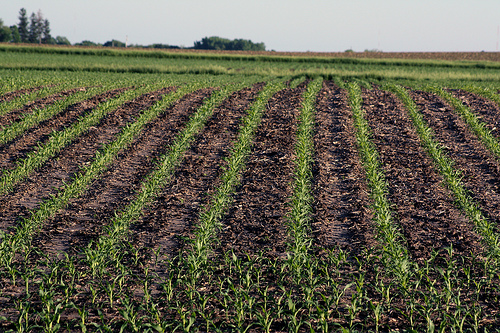
It is spring in Iowa and as I drive down the highway I can see the perfectly planted rows of corn and soybeans emerging in bright green dotted lines on a canvas of thick, espresso and black soil. Farmers have planted their fields wisely to get as many seeds in each row and as many rows in each field to ensure, God willing, a high yield and a measureable profit. Come harvest, they will gather as much grain as they possibly can for market.

I found it an interesting contrast to read God’s command to the farmers in the days of Moses. Poverty was as much a social issue and economic reality for people in the days of Moses as it is today. What I find fascinating in today’s chapter is that God’s prescription was for individuals to take personal responsibility for giving of their own means to the poor in their own community. The farmer left some of his field unharvested so that the poor in his community could eat and have a little to trade for their needs. There was a direct transaction of goods between people who knew one another and lived together in community. I also note that God did not command the farmer to harvest the crop and give some his profits to the poor, not did he command Moses and his cabinet of elders to take grain from farmers and administrate a system of distribution among the poor. The crop was left standing and the gleanings left so that the poor had to go to the field and do the work of harvesting it for themselves. It was a constant reminder to those of fewer means that the harder they worked, the more they had to eat and trade. There were no food stamps in the law of Moses, only food available for those who were willing to do the work to harvest it.

Enhanced by Zemanta

Chapter-a-Day Leviticus 2

Gold Medal Flour at Dot's Cafe
Image by ChicagoGeek via Flickr

When you present a Grain-Offering of oven-baked loaves, use fine flour, mixed with oil but no yeast. Or present wafers made without yeast and spread with oil. Leviticus 2:4 (MSG)

When my children were still babies, I made a habit of having them close their eyes, bow their heads and hold hands while we thanked God for their food. At bedtime I would read Bible stories and we would act them out together in little bed-top improvisations. On Memorial Day, grandma would pick them up each year to help her plant flowers on the graves of loved ones. These repetitious rituals are word pictures and reminders of thankfulness, offering, obedience, and honor that, hopefully, stick with children as they grown into adolescence and adulthood.

When I read Leviticus I often picture mankind and human society in its infancy. The sacrifices, rules and offerings are ritualistic word pictures prescribed by a Father to his people, who are just a toddler society beginning to understand their place in the world.

Today, two things struck me in the word picture of the grain offerings:

First, fine flour was to be used. When we give, to others and especially to God, we should give the best we have. It reminds me of the lyric to David’s song (which we know as Psalm 112) which says “Good will come to him who is generous and lends freely.” Am I giving God and my neighbors the fine stuff or the white elephant stuff on my basement shelf?

Second, the bread offering was not to contain yeast. God uses a word picture out of what was a daily chore at that time: the baking of bread. We bake a lot of bread in our house and the last ingredient you put in to the breadmaker is the yeast. It always amazes me how a little teaspoon of yeast makes such a HUGE difference in the outcome of the bread. That’s why God used it as a word picture for sin. A little sin taints the whole person the way a little yeast taints the whole loaf. You can’t bake a loaf that’s half leavened (with yeast) and half unleavened (without yeast). Once the yeast is added, the entire loaf is tainted. We often want to think of sin as this isolated part of our person. We’re mostly “good” people who have this hidden little sin problem back in our closet. By requiring bread without yeast as an offering, God was telling us “I demand a sinless sacrifice. A pinch of sin affects the whole person, and that’s a problem.”

Enhanced by Zemanta