Tag Archives: The Silmarillion

The Importance of the Backstory

If a man commits adultery with the wife of his neighbor, both the adulterer and the adulteress shall be put to death.
Leviticus 20:10 (NRSV)

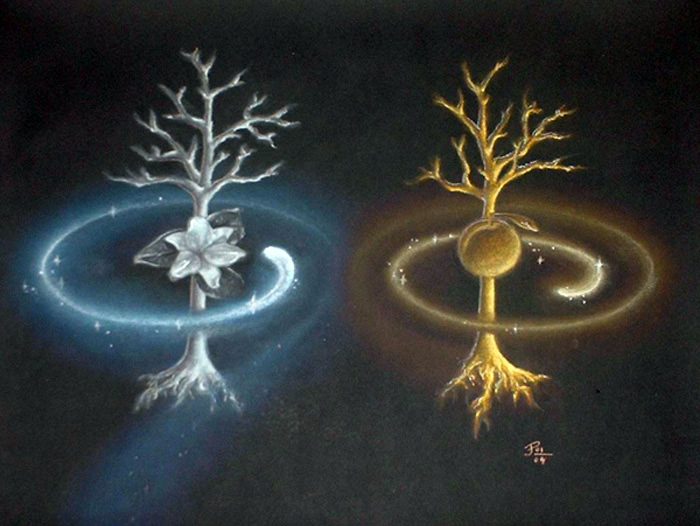
Over recent months I have been reading J.R.R. Tolkien’s The Silmarillion. It is not an easy read. Rather than a simple and continuous narrative, The Silmarillion is a collection of stories that, together, create the cosmology of Tolkien’s fictional universe from its creation.  Having a lot of excellent on-line reference material has been extremely helpful.

Slogging my way through The Silmarillion I am constantly inspired as I make connections and gain a broader understanding of the backstory of The Lord of the Rings. Knowing the backstory makes the story I know so well even more colorful and thought provoking. I better understand why the elves are leaving Middle Earth and where they are going. I better understand exactly what the “Three rings of elven kings” really are and represent. I learn the skinny on Shelob the giant spider and the evil Sauron, the scary faces in the Dead Marshes, all the obscure references made by the hobbits and about hoard they find with the barrow wights in the Old Forest, and the song Aragorn sings as he and the hobbits camp on the road to Rivendell.

In many ways The Silmarillion parallels the loose collection of history, poetry, prophecy, and legal text that make up what is commonly known as the Old Testament. For many people these ancient writings are difficult to wade through and understand. Nevertheless, I’ve always found that without them I have an incomplete view of who Jesus is, what His message was about, and why things happened the way they did. The stories of Jesus suddenly gain more color and depth in context with the backstory.

One such example struck me this morning. According to Levitical law in today’s chapter, those who committed adultery were to be put to death – both the man and the woman who committed the deed. I then thought about the story in John’s biography in which the religious leaders, seeking to trap Jesus and discredit him, bring a woman to Him. She had been caught “in the act” of adultery and deserved the death penalty. They wanted Jesus to render the verdict. If He let them kill her then it would be unpopular with the crowds, but if He let her off then they could accuse Him of being a lawbreaker.

But Jesus knew today’s chapter as well as they did. If she was caught “in the act” then where was the man who was committing adultery with her? He was to be put to death as well. The story said that Jesus sat doodling in the dirt as the religious leaders were making their case. Perhaps Jesus was symbolically writing the name of the woman’s lover into “the record.” Knowing the law, I begin to understand how hypocritical, misogynistic, and crooked these religious leaders proved themselves to be with their accusations. Without even saying a word, Jesus’ brilliant response called the leaders to a legal point-of-order. His gracious forgiveness of the woman means even more to me in light of this context. [Note: you can read the brief story in John 8]

This morning I’m thinking about backstories. Beyond The Silmarillion and the Old Testament, there are also backstories to our lives, our families, our communities, our nation, and our world. I realize, once again, this morning why I love history. Knowing backstories helps me better perceive and understand things in the present. With that, I can made better decisions and judgements in the present just as Jesus did with the woman caught in adultery.

chapter a day banner 2015

Abraham, Typology and the Tolkien Geek

Minas Morgul as depicted in Peter Jackson's Th...
Minas Morgul as depicted in Peter Jackson’s The Lord of the Rings: The Return of the King. (Photo credit: Wikipedia)

Chapter-a-Day Genesis 22

 “This is what the Lord says: Because you have obeyed me and have not withheld even your son, your only son, I swear by my own name that I will certainly bless you.” Genesis 22:16-17a (NLT)

I confess that I am a Tolkien geek. I read or listen to the unabridged audio of The Lord of the Rings every year or so and have since college. I can’t speak Elvish, so I’m not that kind of Tolkien geek, but when Wendy throws out the occasional trivial question related to the story or the movie (e.g. “What was that haunted castle place in the movie that glowed and the orc army came out of it?”) I generally know the answer (e.g. “Minas Morgul”) and will usually offer some elucidation (e.g. “It means ‘City of the Moon’ and it was actually built by the good guys as a fortress meant to keep the bad guys inside the evil land of Moria, but as Sauron and his evil grew in power, Minas Morgul was captured and given by Sauron to the chief of the Nazgul [a.k.a. the Black Riders] who was actually once a human king from the north subverted by Sauron and the power of the “nine rings for mortal men doomed to die” as referenced in the One Ring inscription and he eventually became known as the “Witch King of Angmar.”) at which point Wendy rolls her eyes, laughs, and says “You’re such a geek.” I know. I’ve confessed this.

So it is that I find myself spending time on the road listening through a series of lectures by The Tolkien Professor, Corey Olsen which are freely available on iTunes. Olsen, an English Professor at Washington College, takes a scholarly route through Tolkien’s works and, as a Tolkien geek, I’m utterly fascinated. In a moment of synchronicity, I was listening just last week to one of Professor Olsen’s lectures on the nature of Evil in Tolkien’s writings and he brought up the subject of Typology and referenced the story of Abraham sacrificing Isaac from today’s chapter. Tolkien generously used typology in his writings and stories of Middle Earth. Suddenly I was transported back to being a student in Biblical Hermeneutics class and the study of Typology.

In simple terms, Typology is the study of Old Testament references that foreshadow or echo New Testament events or realities. God is “the author of life,” and as the creative artist and author, He sprinkles the Great Story of history with foreshadowing. So in today’s story, Abraham sacrificing his “one and only Son” is a type of God sending His “one and only Son” to be the sacrifice for the sins of the world. “God providing the ram in the thicket” becomes a type of God providing the sacrifice for our sins through Jesus who becomes “the lamb of God who takes away the sins of the world.” As I’ve argued in the past, it’s not until you wade into the Old Testament that you gain a full picture of the depth of the whole story God is revealing.

I believe Professor Olsen would make a parallel argument that those who enjoy The Lord of the Rings do not have a full picture of the depth of the whole story Tolkien was telling without wading into the stories Tolkien penned in The Silmarillion and other works. It is no wonder that Tolkien’s works would use this kind of Typology. Tolkien was a professor of Medieval Literature at Oxford and the Christian study of Typology reached its height during the High Middle Ages.

Today, I’m laughing at myself and what a dweeb I can be. I’m also appreciative of a creative God who is the ultimate artist, author and story-teller. I love that all good stories are an echo of the Great Story (or as Tolkien would say, all tales are “leaves off the Great Tree of Tales”). I love when things tie together and tiny moments of unexpected synchronicity occur in life. I love being fascinated.