Tag Archives: Remnant

The Slave’s Return

The Slave's Return (CaD Jer 44) Wayfarer

“We will not listen to the message you have spoken to us in the name of the Lord!”
Jeremiah 44:16 (NIV)

Jeremiah is an old man.

Consider with me all that he has witnessed.

He began his prophetic ministry under the reign of the reformer King Josiah. Josiah heard the Book of Law read, and he followed the God of Abraham and Moses faithfully. He outlawed idolatry and destroyed all of the idols and shrines. He did what was right. Jeremiah was right there in the palace, and in Solomon’s Temple to witness it all for the first twenty years of his ministry.

Then Josiah died.

His successor, Jehoahaz, immediately turned back to idolatry and the people of Judah with him. Over the next thirty years, Jeremiah witnessed a succession of four kings and the people of Judah harden their hearts in idolatry despite Jeremiah’s persistent warnings of judgement at the hand of the King of Babylon.

Jerusalem is destroyed.

The palace is destroyed.

The Who’s Who of Judah are all living in captivity in Babylon.

God’s Temple is in ruins.

The nation of Judah is no more.

The old man Jeremiah wakes up to find himself in Egypt, the nation where it all began for his people. They started as slaves in Egypt. That’s where God came to rescue them from their chains. God freed them from Egypt, made a covenant with them, and led them back to the land promised to them through their ancestor, Abraham. All God asked in return was faithfulness. Worship him alone. Live differently than all the other nations and peoples. Bless others. Show them a different way.

They refused. They broke covenant. They chose to be like everybody else. They refused to listen to Jeremiah. More than that. They mocked him, beat him, imprisoned him, and tried to kill him.

Jeremiah gathers with all the Hebrew expatriates in Egypt. I imagine him looking at this rag tag crowd. In some fifty years he’s witnessed the long, steady decline from a good King on the throne determined that his people will be faithful to the God who delivered them from slavery in Egypt and raised them up there to small remnant, wandering, lost sheep without a shepherd living back in Egypt. How ironic. These Hebrews have come full circle. The former slaves return to the land of their slave master.

These chapters about Jeremiah after the destruction of Jerusalem are striking for a couple of reasons.

First, Jeremiah is still proclaiming God’s Word and the message hasn’t changed.

Next, the leaders of this group of remnants have become increasingly defiant to anything Jeremiah has to say. They started by at least asking the prophet if he had a word from the Lord. Now they are simply telling the crazy old man to shut-up.

Also, the women have decided that the destruction of Jerusalem and all of the troubles were not the result of God’s judgement, but because they stopped worshipping Asherah, the “Queen of Heaven.” It wasn’t their unfaithfulness to the God of Moses who freed them from slavery in Egypt that brought all of the calamity but their unfaithfulness to Asherah. God no longer registers for them at all.

Jeremiah, the crazy old man, stays on message. God proclaims that He will give His people in Egypt one more sign. Pharaoh will die at the hands of his enemies. Indeed, in 570 B.C. (The remnant likely fled to Egypt sometime around 576-575 B.C.) Pharaoh was deposed and killed in a military coup.

In the quiet this morning, I find myself meditating on this big picture irony of the former slaves returning to their slave masters. In His first public message, Jesus quoted the prophet Isaiah:

“The Spirit of the Lord is on me,
    because he has anointed me
    to proclaim good news to the poor.
He has sent me to proclaim freedom for the prisoners.”

He was speaking of freedom from sin, as Paul so beautifully explains in his letter to the followers of Jesus in Rome:

For we know that our old self was crucified with him so that the body ruled by sin might be done away with, that we should no longer be slaves to sin.

The lesson of the Hebrew remnant is a lesson for me. Am I spiritually growing in freedom toward a more intimate relationship with God and an increasing measure of love, joy, and peace in my daily life? Or, am I time and again returning to the shackles of pride, fear, shame, and the behaviors they produce in me?

If you know anyone who might be encouraged by today’s post, please share.

Connected to a Larger Story

Though I scatter them among the peoples,
    yet in distant lands they will remember me.
They and their children will survive,
    and they will return.
Zechariah 10:9 (NIV)

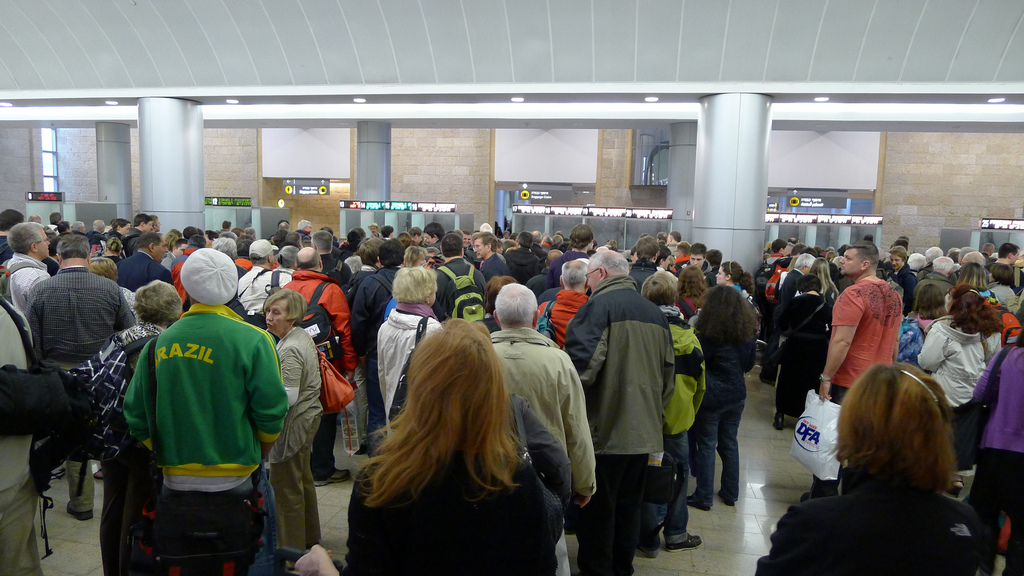
I walked into Ben Gurion airport in Tel Aviv as I and my friends were heading back to the United States. After spending a week in Israel I had an even greater appreciation for the surreal experience there. Every international airport is a melting pot, but Ben Gurion seemed to take things to an entirely new level. Not only were there people from all over the world, but there was also the unrivaled diversity of Jewish, Christian, and Muslim sub-cultures. My time in Israel was an amazing cultural experience of dining with and making new friends among both Jews and Arabs and from every religious persuasion. At Ben Gurion Airport all of diverse groups were represented and crammed together in one place at one time.

Looking around I saw Hasidic Jewish men in their tell-tale black clothing and hats as well as modern Jewish women with their own distinctive manner that radiates a certain larger-than-life personality. There were Jewish tourist groups from literally all over the world which was made evident by the cacophony of clothing and languages. There were Arabs in their turbans, Catholic priests and nuns in their robes, and even my fellow small-town American tourists with their own distinct drawls and a certain air of cluelessness.

And, of course there was tension. I found that there’s always tension in Israel. I felt surrounded at all times by the uncanny sense that something might just erupt at any given moment. In fact, as my friends and I stood in line at check-in a nearby baggage x-ray machine detected something amiss. Loud sirens suddenly blared at a deafening decibel level all around us. Bright lights flashed out in warning.

Paralyzed by the sensory shockwave, I turned to watch people of every religious, national, and political persuasion bolting for the doors out of fear that a terrorist’s bomb was about to explode. Thankfully, it was false alarm. Still standing in both panic and confusion, I was just as surprised at the speed with which things returned to normal, or what passes for normal in that place.

I mention my experience because, politics and religion aside, my time in Israel gave me a newfound respect for the amazing story of the Jewish people throughout history.  They have been scattered again, and again, and again, and again by wars, empires, politics, and persecution.

In today’s chapter, the ancient prophet Zechariah speaks to the scattering of his people and prophesies their return from the remote reaches of the world. This was a contemporary issue for Zac because he was part of a remnant who had returned to rebuild a destroyed Jerusalem. In the previous hundred or so years the empires of Babylon, Assyria and Persia had scattered his people to those regions. He and his contemporaries were acting in faith that if they took the risk of rebuilding Jerusalem that his people would return.

I’ve mentioned before that prophetic writing is layered with meaning. It can address something in the moment and something in the distant future all at the same time. As I stood in Ben Gurion Airport it was like witnessing what Zechariah wrote back around 500 B.C. :

I will signal for them
    and gather them in.
Surely I will redeem them;
    they will be as numerous as before.
Though I scatter them among the peoples,
    yet in distant lands they will remember me.
They and their children will survive,
    and they will return.
I will bring them back from Egypt
    and gather them from Assyria.
I will bring them to Gilead and Lebanon,
    and there will not be room enough for them.

This morning I’m reminded of the Great Story that God is telling in the life-cycle of human history. It’s part of why I love history so much because I believe that it’s all connected. I believe we are all connected by this same story and we are a part of it. I’m just in a different chapter than Zechariah, but knowing his story and reading his prophetic poem layers my own experiences with new and profound depths of meaning. Even the seemingly insignificant experience of standing in an airport suddenly connects my story to the Great Story that is so much larger than myself.

 featured photo via speaking of faith and Flickr

Judgement and Grace

source: aclamp via Flickr

The word of the Lord came to me: “Son of man, set your face against the mountains of Israel; prophesy against them….”
Ezekiel 6:1 (NIV)

At the time of Ezekiel’s prophetic messages (c. 590 B.C.), the nation of Israel had been split for over three centuries by civil war. Like the U.S. civil war, the nation had been divided north and south. Ezekiel came from the southern kingdom, called Judah because it was primarily made up of that particular tribe and Judah was the tribe from which King David had come. The southern kingdom followed the royal line of David and kept the capitol in Jerusalem.

The northern kingdom was called Israel and consisted of 10 of the other 12 Israeli tribes. Because the northern kingdom did not follow a particular royal lineage, the throne of Israel was continually up for grabs. The northern kingdom’s history is marked by political intrigue and bloody power struggles. Cut off from Solomon’s temple in Jerusalem, the northern kingdom had its religious center in the town of Bethel. Israel largely abandoned the religious law of Moses and generally worshipped the popular Canaanite gods of the day whose worship included sexual fertility rituals and, in some instances, child sacrifice.

In the previous chapters, Ezekiel’s prophecy has focused on God’s judgement on the southern kingdom of Judah and its capitol, Jerusalem. In today’s chapter, God’s message through Ezekiel takes an abrupt turn to the north. The earthly kingdoms may have been divided, but in God’s economy all 12 tribes of Israel were still His people. Just because Judah was going to face God’s judgement for their unfaithfulness did not mean Israel was going to escape His wrath.

There was an interesting parallel to the prophetic messages to both kingdoms. Amidst the messages of doom there was a measure of grace. A remnant would escape the judgement and be scattered, leaving hope of the nation’s ultimate survival.

Today, my mind is making parallels between God’s punishment of Israel and Judah, and the judgement I faced many times as a child. Like all children, I dreaded the judgement and wrath of my parents. The sting of corporal punishment and “time out” exile to my room was no joy to endure even when deserved. But amidst the punishment there was always a seed of grace. I was loved. Blessing and restoration would return with my repentance and obedience.