Tag Archives: Diaspora

In a System I Don’t Control

Esther again pleaded with the king, falling at his feet and weeping. She begged him to put an end to the evil plan of Haman the Agagite, which he had devised against the Jews.
Esther 8:3 (NIV)

Over the course of my career I’ve worked with a veritable plethora of clients—from companies you’d instantly recognize to many you’ve never heard of. For me, one of the most fascinating aspects of that journey has been encountering so many different corporate cultures.

In my upcoming book This Call May Be Monitored (What Eavesdropping on Corporate America Taught Me About Business and Life) [FYI: Book available mid-late April], I share a number of different experiences. One of them included a major retailer whose contact center was in the lower level of their corporate headquarters. Internally, we referred to it as “The Bunker.”

The Bunker was a rather small space crammed tight with tiny work stations. Agents were packed in like sardines. It was loud and uncomfortable. Agents were metaphorically chained to their desks. If you needed to use the restroom you were required to raise your hand and ask permission. It was no wonder they were struggling with poor customer experiences delivered by unhappy agents.

One of the challenges I have often faced in my career is that of trying to help clients move the needle on the customer experience within an antagonistic system. Often our team is hired by a lower-level executive who has little influence over whoever occupies the corner office of the C-suite. And corporate culture always flows out of the corner office.

In today’s chapter, Esther finds herself in a position that is both positive and precarious. Her nemesis, Haman, is dead but Haman’s genocidal decree remains in place. Victory over an enemy is not enough if the system he built still stands. She must risk her life a second time to approach the King, plead for her people, and request a reversal of his earlier decree.

Jewish scholars view Esther as a road map for life in exile and diaspora. Both Mordecai and Esther have no control over the culture of the foreign Persian Empire in which they live. Their exile began under the Babylonian Empire. Now the Persian Empire holds sway. In this game of thrones, they found themselves having to shift, adapt, and learn to live under very different cultures and realities.

Paul in his letter to the believers in Corinth echoes this same paradigm for followers of Jesus:

Though I am free and belong to no one, I have made myself a slave to everyone, to win as many as possible. To the Jews I became like a Jew, to win the Jews. To those under the law I became like one under the law (though I myself am not under the law), so as to win those under the law. To those not having the law I became like one not having the law (though I am not free from God’s law but am under Christ’s law), so as to win those not having the law. To the weak I became weak, to win the weak. I have become all things to all people so that by all possible means I might save some. I do all this for the sake of the gospel, that I may share in its blessings.
1 Corinthians 9:19-23 (NIV)

One of the joys of my career has been to participate with clients in making positive and transformative changes. The client began listening to customers and addressing the systemic issues that were undermining the customer experience. The Bunker was eventually scuttled and agents moved into a modern, spacious contact center space. The company grew and became even more profitable. I had a front row seat and had the opportunity of participating in the transformation.

In the quiet this morning, I’m reminded that I will often find myself operating within dysfunctional systems I don’t control. What I do control, however, are my own words and actions — and how I personally operate within that system. I can either participate in the dysfunction, or I can become an agent of change.

If you know anyone who might be encouraged by today’s post, please share.

Promotional graphic for Tom Vander Well's Wayfarer blog and podcast, featuring icons of various podcast platforms with a photo of Tom Vander Well.
These chapter-a-day blog posts are also available via podcast on all major podcast platforms including Apple, Google, and Spotify! Simply go to your podcast platform and search for “Wayfarer Tom Vander Well.” If it’s not on your platform, please let me know!
Icon of an open book on an orange background

Connected to a Larger Story

Though I scatter them among the peoples,
    yet in distant lands they will remember me.
They and their children will survive,
    and they will return.
Zechariah 10:9 (NIV)

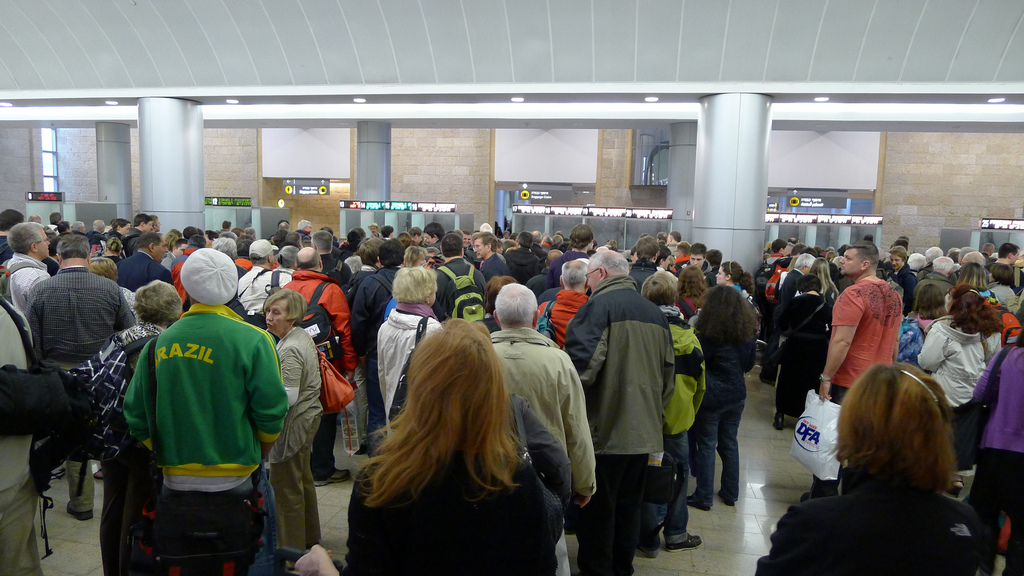
I walked into Ben Gurion airport in Tel Aviv as I and my friends were heading back to the United States. After spending a week in Israel I had an even greater appreciation for the surreal experience there. Every international airport is a melting pot, but Ben Gurion seemed to take things to an entirely new level. Not only were there people from all over the world, but there was also the unrivaled diversity of Jewish, Christian, and Muslim sub-cultures. My time in Israel was an amazing cultural experience of dining with and making new friends among both Jews and Arabs and from every religious persuasion. At Ben Gurion Airport all of diverse groups were represented and crammed together in one place at one time.

Looking around I saw Hasidic Jewish men in their tell-tale black clothing and hats as well as modern Jewish women with their own distinctive manner that radiates a certain larger-than-life personality. There were Jewish tourist groups from literally all over the world which was made evident by the cacophony of clothing and languages. There were Arabs in their turbans, Catholic priests and nuns in their robes, and even my fellow small-town American tourists with their own distinct drawls and a certain air of cluelessness.

And, of course there was tension. I found that there’s always tension in Israel. I felt surrounded at all times by the uncanny sense that something might just erupt at any given moment. In fact, as my friends and I stood in line at check-in a nearby baggage x-ray machine detected something amiss. Loud sirens suddenly blared at a deafening decibel level all around us. Bright lights flashed out in warning.

Paralyzed by the sensory shockwave, I turned to watch people of every religious, national, and political persuasion bolting for the doors out of fear that a terrorist’s bomb was about to explode. Thankfully, it was false alarm. Still standing in both panic and confusion, I was just as surprised at the speed with which things returned to normal, or what passes for normal in that place.

I mention my experience because, politics and religion aside, my time in Israel gave me a newfound respect for the amazing story of the Jewish people throughout history.  They have been scattered again, and again, and again, and again by wars, empires, politics, and persecution.

In today’s chapter, the ancient prophet Zechariah speaks to the scattering of his people and prophesies their return from the remote reaches of the world. This was a contemporary issue for Zac because he was part of a remnant who had returned to rebuild a destroyed Jerusalem. In the previous hundred or so years the empires of Babylon, Assyria and Persia had scattered his people to those regions. He and his contemporaries were acting in faith that if they took the risk of rebuilding Jerusalem that his people would return.

I’ve mentioned before that prophetic writing is layered with meaning. It can address something in the moment and something in the distant future all at the same time. As I stood in Ben Gurion Airport it was like witnessing what Zechariah wrote back around 500 B.C. :

I will signal for them
    and gather them in.
Surely I will redeem them;
    they will be as numerous as before.
Though I scatter them among the peoples,
    yet in distant lands they will remember me.
They and their children will survive,
    and they will return.
I will bring them back from Egypt
    and gather them from Assyria.
I will bring them to Gilead and Lebanon,
    and there will not be room enough for them.

This morning I’m reminded of the Great Story that God is telling in the life-cycle of human history. It’s part of why I love history so much because I believe that it’s all connected. I believe we are all connected by this same story and we are a part of it. I’m just in a different chapter than Zechariah, but knowing his story and reading his prophetic poem layers my own experiences with new and profound depths of meaning. Even the seemingly insignificant experience of standing in an airport suddenly connects my story to the Great Story that is so much larger than myself.

 featured photo via speaking of faith and Flickr