Tag Archives: Chains

Open Heart, Open Hands

If anyone is poor among your fellow Israelites in any of the towns of the land the Lord your God is giving you, do not be hardhearted or tightfisted toward them. Rather, be openhanded and freely lend them whatever they need.
Deuteronomy 15:7-8 (NIV)

It is Christmas Eve Day as I write this in the quiet of my home office. Wendy and I will prepare for the arrival of family this evening. It’s the start of what will be eleven days of festivity and celebration.

Sometimes on this chapter-a-day journey there are moments of unmistakable and unexpected synchronicity. So it is with today’s chapter. Moses speaks to his children and grandchildren, reminding them of God’s heart, and God’s ways. He speaks that they might not only hear them, but embrace them, live them, and pass them down through the generations.

Today’s chapter comes with a simple but physical metaphor.

We can live with open hearts and open hands,
or we can live with clenched hearts and closed fists.

Moses then speaks of God’s open-hand prescription for His people:

Cancel debts every seven years.
Release servants who have indentured themselves to survive.
Do not send anyone away empty-handed—fill their hands generously.
Set apart the firstborn and firstfruits for the Lord, for dedication and celebration.

Along the way, God provides some attitudinal warnings:

“Do not be hard hearted and tight-fisted…” (vs. 7)
“Be careful not to harbor this wicked thought (when considering whether or not to lend): ‘The seventh year, the year for cancelling debts, is near.’” (vs. 8)
“Give generously…without a grudging heart.” (vs. 10)
“Do not consider it a hardship to set your servant free…” (vs. 18)

I have learned over six decades of this earthly journey that generosity is not first a financial issue, but a heart issue. It is, perhaps, the most accurate barometer of spiritual health. Open-handed generosity is a sign that I have internalized two essential spiritual truths.

First, that God has been generous. Moses has been reminding his children and grandchildren of this for fifteen chapters. It is God who approached your ancestors and made a covenant. It is God who showed up and made Himself known. It is God who delivered you from your chains. It is God who has made you a promise. It is God who has led you, protected you, and provided for you.

God’s message through Moses is this: “I did not release you from your physical chains only to watch you shackle yourselves with spiritual ones.”

Second, that nothing I have is mine. I brought nothing into the world. Every earthly thing I think I possess or own will be left behind. Everything I think I possess or own flowed to me from God, and everything will ultimately flow back to God. When I am generous, I am being generous with God’s things. The more God has a hold on me, the less the things of this world have a hold on me. A hard heart and tight fists are a sign that both are bound by unseen spiritual cords—quiet chains I might not even realize are there.

Which brings me in the quiet back to Christmas Eve Day.

It is God who so loves that He gives—generously—His one and only Son.
It is God who shows up to reveal Himself to us.
It is God who shows up to cancel our eternal debts.
It is God who shows up to free us from our spiritual chains.
It is God who does not leave us empty-handed, but fills us with His Spirit and every good thing.

At Christmas, God provides an eternal object lesson of what Deuteronomy 15 is all about.

The proof of receipt is not in a church membership certificate, but in my joyful extension of that selfless generosity with every one every day.

Open heart. Open hands.

Freedom.

If you know anyone who might be encouraged by today’s post, please share.

Promotional graphic for Tom Vander Well's Wayfarer blog and podcast, featuring icons of various podcast platforms with a photo of Tom Vander Well.
These chapter-a-day blog posts are also available via podcast on all major podcast platforms including Apple, Google, and Spotify! Simply go to your podcast platform and search for “Wayfarer Tom Vander Well.” If it’s not on your platform, please let me know!
An open book icon with a stylized white illustration on an orange background.

Darkness & Chains

You know that everyone in the province of Asia has deserted me, including Phygelus and Hermogenes.
2 Timothy 1:15 (NIV)

I have a stack of letters from my college and young adult years. My friend Dave and I became pen pals during those years. It wasn’t something we consciously intended to do. He was still a senior in high school and I was a freshman in college. I told Dave to write me sometime. This was 1984. There was no internet or email. Cell phones were over a decade away from becoming a thing. Long distance phone calls were expensive. Snail mail was the go-to channel of communication for poor students like me.

When I got a letter from Dave, I immediately wrote him back. Then he wrote me back, and we never stopped. Dave went on to study and teach in France. The stack of letters and postcards I have from him in those years number into the hundreds.

Without the immediacy of digital communication, there was a lot that could happen in life between letters. I remember times in which I poured my heart onto the page knowing that Dave would not read it for a week or more and it would be another week or more before I got his response. It was a very different reality.

That reality is evident between Paul’s first letter to Timothy that we finished yesterday and his second letter we begin today. So much has happened between the two letters that it’s impossible to understand the full context of Paul’s words and emotions without knowing the events.

Paul had been a prisoner in Rome previous to the writing of 1 Timothy. He was arrested for creating a public disturbance in Jerusalem. He appealed his case to Caesar as was his right as a Roman Citizen. He sailed to Rome and lived under house arrest while awaiting trial. Eventually, he was released.

Whether his case was dismissed or he was released on furlough, we’ll never know. Paul began traveling and visiting the local gatherings of Jesus’ followers he’s established in various cities. That was the context of 1 Timothy as Paul instructed his young protégé and urged him to pray for all rulers and authorities, which included Roman Emperor Nero “that we may live quiet and peaceful lives.”

Sometimes our prayers don’t yield the results we desire, even for Paul.

Rome burned and the populace blamed Nero. Nero needed a political scapegoat to redirect the blame. He chose a pesky Jewish sect that had been on the rise and creating conversation across the empire. They were called Christians and they were an easy target. Nero blamed the burning of Rome on the Christians. He ordered the rounding up Christians that they might be tortured and executed in the most heinous of ways, and Rome had sadistically created many heinous forms of torture and execution.

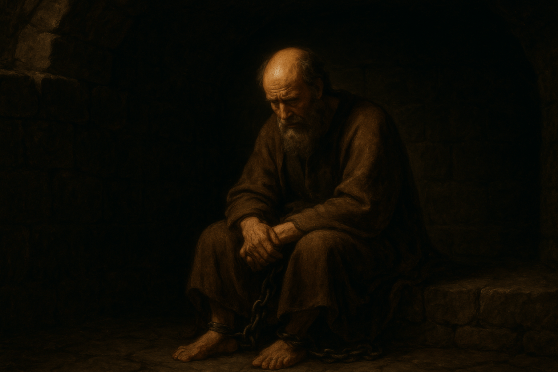
Paul, the firebrand preacher who stirred things up wherever he went, was arrested. No house arrest this time. Paul was thrown into a deep, dark dungeon. He was chained to a wall in the dark. With the Romans arresting, torturing, and executing Christians, many followers decided that maybe they didn’t believe after all. Others distanced themselves from Paul, not wanting to get swept up in his wake and find themselves chained next to him in the dungeon.

Paul was alone in the dark in his chains. He felt abandoned. He knew that his time was short. There would be no dismissing of the charges this time. There would be no furlough. His execution is imminent. His second letter to Timothy is Paul’s final letter. It’s his swan song and his last will and testament.

In today’s opening chapter, Paul is torn in two directions. With his impending death, he knows that Timothy is going to find himself leading the gathering of believers in Ephesus without Paul’s tutelage. He wants to encourage Timothy and provide some final instructions before he dies. At the same time, Paul is desperate for Timothy’s company and wants Timothy to visit him.

Stay and lead well, or leave to be with Paul in Rome?

Yes. The opening of the letter expresses the inner conflict and emotions with which Paul was struggling in his dire circumstances.

There was no postal service in the Roman Empire. You had to find people to carry and deliver letters for you. As Timothy cracks open the letter to read it, there is the added emotion of knowing that Paul might have even been executed in the time it took for the letter to reach him. If he does leave Ephesus to visit Paul in Rome, will he even find Paul alive? Will he be thrown into prison and executed with Paul. Colleagues like Phygelus and Hermogenes had clearly decided that they’d rather not risk their own necks to be associated with Paul. Timothy was faced with the same dilemma.

Meditating on the depressing realities that Paul and all believers were facing under Nero’s persecution, I am once again reminded that life in this fallen world does not always turn out the way we’d hoped. Sometimes prayers for lives of peace and safety are answered with the violence of the kingdoms of this world. Not just for Paul in Rome, but for believers around the world today.

Believers in China and North Korea regularly find themselves at risk for persecution, imprisonment, torture, and execution. Christins in Nigeria are being rounded up and slaughtered. It is estimated that 52,000 Christians have been killed by Muslim militants since 2009. Five million people have been displaced because of persecution against Christians.

In the quiet this morning, I find myself grateful for the peace, the quiet, and the safety with which I can currently pursue my faith and my life. I’m whispering a prayer for those who, like Paul, lie in darkness and chains. Those who feel alone and abandoned in their persecution. Those who face the possibility of being tortured or executed this day because of their faith in Jesus.

Lord, have mercy.

If you know anyone who might be encouraged by today’s post, please share.

Promotional graphic for Tom Vander Well's Wayfarer blog and podcast, featuring icons of various podcast platforms with a photo of Tom Vander Well.
These chapter-a-day blog posts are also available via podcast on all major podcast platforms including Apple, Google, and Spotify! Simply go to your podcast platform and search for “Wayfarer Tom Vander Well.” If it’s not on your platform, please let me know!

Opportunity in Interruption

For two whole years Paul stayed [in Rome] in his own rented house and welcomed all who came to see him. He proclaimed the kingdom of God and taught about the Lord Jesus Christ—with all boldness and without hindrance!
Acts 28:30-31 (NIV)

Over the past few weeks, I’ve mentioned that our local gathering of Jesus’ followers has been talking about “interruptions.” Sometimes life interrupts us with unexpected tragedies, challenges, or obstacles. Sometimes God interrupts us like Saul on the road to Damascus. When interruptions happen, how do we react, respond, and cope?

Today’s chapter is the final chapter of Acts. Luke obviously brought it to a conclusion before Paul’s earthly journey was finished. The events and experiences Paul went through, even in today’s chapter, are a good reminder that life does not always turn out the way we want or expect. Paul is shipwrecked. A poisonous viper bites Paul and dangles from his outstretched hand before he shakes it off. The castaways find themselves spending three months on the island of Malta, which none of them had even heard of, and dependent on the kindness and hospitality of others. When Paul finally does get to Rome, he is literally chained to a Roman soldier day and night while under house arrest.

I spent some time meditating on how I would have reacted and responded to these circumstances: shipwreck, castaway, snake bite, house arrest, and chained to someone 24/7/365 for two years.

Luke ends with a rather positive proclamation regarding Paul’s attitude. He was welcoming, upbeat, bold, and optimistic. He used his chains as an opportunity to share the love of Jesus with his guards and to be an example through his words and actions as he welcomed guests and extended hospitality to everyone. Paul was able to see the golden opportunities in life’s interruptions, including his chains.

In the quiet this morning, I find myself thinking about life’s most recent interruption that surfaced this past Friday evening. It was one of those moments when what you’ve been planning and expecting to happen for years suddenly vanished with the receipt of one unexpected email. Life’s trajectory suddenly changes. I can react with anxiety and/or fear. I can brood about how unfair it is. I can even look for a scapegoat to blame for this interruption. Or, I can “trust the Lord with all my heart and lean not on my own understanding. In all my ways I can acknowledge Him knowing that He will make my path straight.” (Proverbs 3:5-6)

I have learned along life’s road that when interruptions occur, my immediate emotional reactions aren’t very healthy or productive. When my mind, will, and spirit work together to respond with faith, I have the opportunity to see God’s opportunities.

If you know anyone who might be encouraged by today’s post, please share.

The Slave’s Return

The Slave's Return (CaD Jer 44) Wayfarer

“We will not listen to the message you have spoken to us in the name of the Lord!”
Jeremiah 44:16 (NIV)

Jeremiah is an old man.

Consider with me all that he has witnessed.

He began his prophetic ministry under the reign of the reformer King Josiah. Josiah heard the Book of Law read, and he followed the God of Abraham and Moses faithfully. He outlawed idolatry and destroyed all of the idols and shrines. He did what was right. Jeremiah was right there in the palace, and in Solomon’s Temple to witness it all for the first twenty years of his ministry.

Then Josiah died.

His successor, Jehoahaz, immediately turned back to idolatry and the people of Judah with him. Over the next thirty years, Jeremiah witnessed a succession of four kings and the people of Judah harden their hearts in idolatry despite Jeremiah’s persistent warnings of judgement at the hand of the King of Babylon.

Jerusalem is destroyed.

The palace is destroyed.

The Who’s Who of Judah are all living in captivity in Babylon.

God’s Temple is in ruins.

The nation of Judah is no more.

The old man Jeremiah wakes up to find himself in Egypt, the nation where it all began for his people. They started as slaves in Egypt. That’s where God came to rescue them from their chains. God freed them from Egypt, made a covenant with them, and led them back to the land promised to them through their ancestor, Abraham. All God asked in return was faithfulness. Worship him alone. Live differently than all the other nations and peoples. Bless others. Show them a different way.

They refused. They broke covenant. They chose to be like everybody else. They refused to listen to Jeremiah. More than that. They mocked him, beat him, imprisoned him, and tried to kill him.

Jeremiah gathers with all the Hebrew expatriates in Egypt. I imagine him looking at this rag tag crowd. In some fifty years he’s witnessed the long, steady decline from a good King on the throne determined that his people will be faithful to the God who delivered them from slavery in Egypt and raised them up there to small remnant, wandering, lost sheep without a shepherd living back in Egypt. How ironic. These Hebrews have come full circle. The former slaves return to the land of their slave master.

These chapters about Jeremiah after the destruction of Jerusalem are striking for a couple of reasons.

First, Jeremiah is still proclaiming God’s Word and the message hasn’t changed.

Next, the leaders of this group of remnants have become increasingly defiant to anything Jeremiah has to say. They started by at least asking the prophet if he had a word from the Lord. Now they are simply telling the crazy old man to shut-up.

Also, the women have decided that the destruction of Jerusalem and all of the troubles were not the result of God’s judgement, but because they stopped worshipping Asherah, the “Queen of Heaven.” It wasn’t their unfaithfulness to the God of Moses who freed them from slavery in Egypt that brought all of the calamity but their unfaithfulness to Asherah. God no longer registers for them at all.

Jeremiah, the crazy old man, stays on message. God proclaims that He will give His people in Egypt one more sign. Pharaoh will die at the hands of his enemies. Indeed, in 570 B.C. (The remnant likely fled to Egypt sometime around 576-575 B.C.) Pharaoh was deposed and killed in a military coup.

In the quiet this morning, I find myself meditating on this big picture irony of the former slaves returning to their slave masters. In His first public message, Jesus quoted the prophet Isaiah:

“The Spirit of the Lord is on me,
    because he has anointed me
    to proclaim good news to the poor.
He has sent me to proclaim freedom for the prisoners.”

He was speaking of freedom from sin, as Paul so beautifully explains in his letter to the followers of Jesus in Rome:

For we know that our old self was crucified with him so that the body ruled by sin might be done away with, that we should no longer be slaves to sin.

The lesson of the Hebrew remnant is a lesson for me. Am I spiritually growing in freedom toward a more intimate relationship with God and an increasing measure of love, joy, and peace in my daily life? Or, am I time and again returning to the shackles of pride, fear, shame, and the behaviors they produce in me?

If you know anyone who might be encouraged by today’s post, please share.

Villains, Justice, Wrestling

Villains, Justice, Wrestling (CaD Ex 11) Wayfarer

Every firstborn in the land of Egypt shall die, from the firstborn of Pharaoh who sits on his throne to the firstborn of the female slave who is behind the handmill, and all the firstborn of the livestock. Then there will be a loud cry throughout the whole land of Egypt, such as has never been or will ever be again.
Exodus 11:5-6 (NRSVCE)

The past few months of COVID shut-downs have been strange on a number of levels. For being non-athletic, creative types, Wendy and I both enjoy watching and avidly following certain sports and teams. We also have the shows we avidly watch. It’s been strange to have so little to watch. Not necessarily bad, mind you. I confess we’ve gotten a lot of things done that have been on the task list for way too long. I’m just recognizing how often we look forward to certain games or new episodes of a certain series.

Game of Thrones was a series to which I was late to the party. Wendy had no interest and I didn’t want to pay for HBO or for each year’s series on DVD. It was a ridiculous Black Friday deal for all but the last season on DVD that gave me many wonderful months of binging while on the road for work.

One of the hallmarks of the Game of Thrones series was the quality of the villains. I can’t think of another series with more despicable characters whom I wanted to get their just desserts and (I confess) die in despicable ways. The writers knew how to create characters I loved to hate, and how to keep me as an audience member passionately desiring a villain’s demise so for so long that when the climax finally arrived it was oddly satisfying in somewhat creepy ways.

Today’s chapter is a climactic point in the Exodus story, though I find it easy to lose sight of this fact. I think that it’s a combination of breaking up the narrative in small daily chunks, translating it into English from an ancient language, and the fact that the ancients weren’t exactly George Martin or Stephen King when it comes to crafting the narrative.

The final plague on Pharaoh and Egypt is the death of every Egyptian first-born, which feels rather heinous on the surface of things as we read with the eyes of 21st-century mindset. There are a couple of important parallels in this story which, I can’t allow myself to forget this, is at its heart about an enslaved, oppressed people being freed from their chains.

Pharaoh and the Egyptians have all the earthly power. They have the absolute authority, socio-economic status, and a system completely rigged in their favor. The Hebrews have one respected leader (Moses, who was raised an Egyptian member of Pharaoh’s household) and this mysterious God who has come out of a burning bush to reveal Himself as the One underdog champion of the oppressed Hebrews against over 1500 Egyptian deities.

[cue: Rocky’s Theme]

Pharaoh has just threatened Moses with death, but Moses informs his nemesis that it is his first-born son (always the favored-one in ancient Patriarchal systems) who will die. I believe most parents would say that losing a child is worse than dying yourself. Pharaoh and the God of Moses have already gone nine exhausting rounds. This plague is the knockout punch. At the very beginning of the story, it was established that the Hebrew slaves cried out in their suffering, and God heard their cries. Now, God proclaims through Moses, it will be Pharaoh and the Egyptian oppressors who will “cry out” in their suffering.

In the quiet this morning, I can’t help but think about my African-American brothers and sisters. Historically, it’s easy to see why the Exodus story has always resonated with African-Americans. Wendy and I just watched the movie Harriett a few weeks ago. “Grandma Moses” led her people to freedom. The heinous videos of Ahmed Aubrey and George Floyd (a brother in Christ) haunt me. The Moses story will always be relevant in a fallen world where broken earthly systems favor some people and not others.

As I meditate on these things, Jesus’ first recorded message echoes in my spirit:

[Jesus] stood up to read, and the scroll of the prophet Isaiah was given to him. He unrolled the scroll and found the place where it was written:

“The Spirit of the Lord is upon me,
    because he has anointed me
        to bring good news to the poor.
He has sent me to proclaim release to the captives
    and recovery of sight to the blind,
        to let the oppressed go free,
to proclaim the year of the Lord’s favor.”

And he rolled up the scroll, gave it back to the attendant, and sat down. The eyes of all in the synagogue were fixed on him. Then he began to say to them, “Today this scripture has been fulfilled in your hearing.”
 

Some mornings my soul is overwhelmed with questions. Like Jacob, I find myself wrestling with God.

Exaggerating My Exaggeration

You know that everyone in the province of Asia has deserted me, including Phygelus and Hermogenes.
2 Timothy 1:15 (NIV)

People always seem surprised when I tell them that I am, by nature, a pessimist. I think I hide it fairly well under my typically extroverted person. You can ask Wendy, and she can tell you about the annoying bookends of my temperament: pessimism and exaggeration. Not only do I regularly see the glass as half-empty, but I see it as the most half-empty glass that has ever been half-empty, and it’s destined to stay that way forever because fate itself has conspired against me since the beginning of time and always will!

You see? I’ve just exaggerated how much I exaggerate!

Hopeless.

Arrrrghh. I can’t help myself.

This morning I begin 2 Timothy which is the last surviving letter that Paul wrote. As he sits down with his stylus, ink well, and papyrus to write his faithful, young protégé, Paul had been in Roman custody for years.  Using his right as a Roman citizen, Paul appealed his case to Caesar. Not only do the wheels of Romany bureaucracy move slowly, but Paul had caused riots and pesky controversies that disturbed Roman peace and order wherever he went. Keeping him languishing in chains was likely to have been an easy decision for the Emporer to make. Having been taken to Rome to await his audience with the leader of the Roman Empire, Paul waited, and waited, and waited.

Reading the opening chapter in the quiet this morning, I can feel the melancholy and emotion. Memories, tears, constant prayers, and exhortation are present. As Paul writes about his own faith I can almost feel him reminding himself and affirming himself. He then tells Timothy that everyone in the province of Asia had deserted him, which he then immediately contradicts by describing how the runaway slave, Onesiphorus, sought Paul out and “refreshed him.”

I can totally forgive Paul a bit of gloom and exaggeration. Paul has spent years in Roman custody. He’s got legit reasons to be a little downcast and dramatic. I can go there when the Cubs lose.

Perspective.

And, that’s where I find my mind and spirit in the quiet this morning.  I’d like to believe that one of the reasons people are surprised to find out I’m a pessimist is that I’ve actually gotten better about recognizing it, catching myself, and consciously, in-the-moment, doing the inner work of choosing a different mental and emotional path. Doing so usually requires mentally reciting and embracing a few key passages of God’s Message that I’ve memorized, saying a few quick popcorn prayers, and going through a few positive mantras.

Looking back, I know I’m not as bad as I used to be. I’m pretty sure Wendy would affirm that, as well. That is, once again, why this is a journey. Slow and steady wins the race.

Pressin’ on into a new week.

All the best to you wherever you find yourself in your own journey, my friend. Cheers!

The People v. Paul of Tarsus (Part 3)

Agrippa said to Festus, “This man could have been set free if he had not appealed to Caesar.”
Acts 26:32 (NIV)

What do I believe in so strongly that I would be willingly imprisoned for it?

That’s the question that came to mind as I read today’s chapter which Chronicles Paul’s trial before Porcius Festus, King Agrippa II, and Agrippa’s sister, Bernice. One of the reasons the Roman Empire was so successful at occupying so much of the world for so long was that they found a way to occupy a region while allowing the local ruling families to continue to have certain power and jurisdiction. In this hearing, Paul is allowed to make his defense before both the local monarch, Agrippa II, and the Roman Procurator who represented Rome’s interest in the area.

Paul wastes no time in making his appeal to Agrippa who had life-long knowledge of Judaism, its laws, and the various sects that brokered for power within the Temple system. Festus may not have had very limited knowledge of what it meant for Paul to have been raised a strict, law-abiding Pharisee. Agrippa, on the other hand, could fully understand the weight of Paul’s testimony and defense. Sure enough, Festus appears baffled by it all and thinks Paul’s whole story crazy. Paul then calls on Agrippa’s belief in the prophets and attempts to convince the king of Jesus’ Message.

Today’s chapter ends with Festus and Agrippa agreeing that Paul could have been released had he not appealed to Caesar. But Paul knew his fate when he made his appeal. He knew what he was doing. He would write to the believers in Ephesus, “I am an Ambassador in chains.”

To the believers in Philippi he wrote:

Now I want you to know, brothers and sisters, that what has happened to me has actually served to advance the gospel. As a result, it has become clear throughout the whole palace guard and to everyone else that I am in chains for Christ. And because of my chains, most of the brothers and sisters have become confident in the Lord and dare all the more to proclaim the gospel without fear.

To the believers in Colossae he wrote:

And pray for us, too, that God may open a door for our message, so that we may proclaim the mystery of Christ, for which I am in chains. Pray that I may proclaim it clearly, as I should.

Once again, as I read all of the events of Paul’s choices, his arrest, and his trials, I don’t find him to be a victim. I find Paul to be a man on a personal mission of his own choosing. He’s sacrificing his own personal freedom and well-being to advance Jesus’ Message .

Which brings me back to the question spinning around in my spirit in the quiet this morning:  What do I believe in so strongly that I would be willingly imprisoned for it?

Of Cheesecake and Chains

Wendy's key lime cheesecake.
Wendy’s key lime cheesecake.

O Lord, the God of vengeance,
    O God of vengeance, let your glorious justice shine forth!
Arise, O judge of the earth.
    Give the proud what they deserve.
Psalm 94:1-2 (NLT)

International Justice Mission (IJM) is one of the groups Wendy and I regularly support financially. In fact, because Wendy has developed a bit of a reputation for her amazing cheesecake, she occasionally gets orders for them. She decided some time ago that we will eat the cost of making any cheesecake ordered and every cent of the money she charges people for her cheesecake goes directly to IJM who works around the globe to rescue victims of slavery, exploitation and other forms of violent oppression.

I couldn’t help but think of the work of IJM as I read Psalm 94 this morning. The psalms are all ancient song lyrics that express a wide breadth of human emotion. The lyrics of this one are a heart-felt calling out for God’s justice in a cruel and unjust world. When I hear about the horrors experienced by those IJM has delivered from bondage, it inspires to sing along with this ancient cry for vengeance and recompense.

At the same time, my thirty years of sojourn through God’s Message have taught me many things. One of the lessons learned is that I cannot forget the fact that as I call on God to rain down justice on evil-doers I am asking for judgment upon myself. Jesus used the metaphor of yeast when talking about wrong-doing. Anyone who’s made bread knows that you put in just a teeny-weeny pinch of yeast and it spreads throughout the dough, causing it to rise. In God’s economy, the person who has a pinch of wrongdoing in their life is as guilty as those who have a pound of it. We are all in bondage to uncontrollable appetites of one form or another.

There is something incongruent in my heart with this. I cry out for God to strike down those I see as evil doers while at the same time I cry out for God to have grace mercy with the evil that I do.  It is a natural human emotion to desire justice for evil. It is an equally human trait to diminish, ignore and excuse the evil in me.

Jesus said to bless our enemies and pray for persecutors. Jesus Himself had nothing but kindness, love and forgiveness for corrupt and unjust tax collectors, the thugs-for-hire who beat Him, and the Roman soldiers who executed Him in horrific fashion. Jesus’ most vehement and judgmental tirades were exclusively aimed at the good, clean-cut, upstanding religious people… like me.

Today I am pondering cheesecake, charity, and chains. Wendy will continue to make cheesecake and we will continue to support IJM and the work of delivering victims of oppression. But, my personal attitude towards those who do such evil is challenged this morning. I believe they deserve justice, but they also need God. They need God as much, if not more than I do. The evil and wrongdoing in me is well concealed and relatively controlled, but it is still there. If I had been born in a different time and place in different circumstances I might just as easily have been the one enslaving others.