Tag Archives: John 5

Who Am I Living to Please?

"Who Am I Living to Please?" (CaD Jhn 5) Wayfarer

By myself I can do nothing; I judge only as I hear, and my judgment is just, for I seek not to please myself but him who sent me.
John 5:30 (NIV)

I was 14 years old when I became a disciple of Jesus. My sister, Jody, joined me in this. This decision was not an institutional “profession of faith” or “confirmation” that was expected of us as part of the institutional church in which we were raised. In fact, both Jody and I had been through that established and corporate rite of passage. It provided us with knowledge. It resulted in us receiving a certificate and a box of offering envelopes. It did not, however, result in any meaningful transformation of spirit or of daily life.

When we willfully chose to give our lives to the Lordship of Jesus, and we committed ourselves to follow His teaching and example, everything changed. Some changes were immediate. Other changes took years, some took decades, and some changes are still in process. Being a disciple is a life-long journey of transformation.

One of the immediate changes for Jody and me was our relationship with one another, and our relationship with our parents. Jody and I had always been close as siblings, but suddenly we had experienced and shared a common love that transcended the petty sibling squabbles, rivalries, and conflicts that prevail in adolescence. In addition, without even thinking much about it, we became more respectful and obedient to our parents. Our parents would later testify that the change they saw in us led them to wonder what was going on, and eventually led them to the reaffirmation of their own faith.

John spends today’s chapter revealing and expounding on the “line in the sand” between Jesus and the ruling religious leaders in Jerusalem. We’re just 25% of the way through John’s account and he makes clear that the institutional religious leaders were already seeking to get rid of Jesus, whose popularity and anti-establishment rhetoric threatened their earthly power and authority.

When I read Jesus’ statement, “I seek not to please myself but him who sent me,” it resonated in my spirit. I find the question, “Who am I living to please?” worth pondering. The religious establishment crowd was trying to please itself. I’ve observed that human establishments and institutions end up serving themselves in what are often very unhealthy ways. I just finished watching the HBO Miniseries Chernobyl. I recommend it as Exhibit A. This is why the religious establishment saw a paralytic miraculously healed and walking for the first time after 38 years and immediately chastised him for carrying his mat on the day of rest.

John then records that Jesus contrasted this thinking by stating that He was interested in pleasing His heavenly Father, and him alone. I can’t help but ponder the fact that this motivation and commitment will only lead Jesus to conflict, persecution, prosecution, and execution by the establishment. That is what John is foreshadowing. This is the delineation between the establishment pleasing itself and the Son of God who wants only to please His heavenly Father and the Kingdom of God on His earthly mission. The line in the sand is clearly drawn.

As a disciple of Jesus, I must answer the question myself.

“Who am I trying to please?”

As a teenager, I saw how my desire to please God by honoring my parents had a positive impact on our relationship and on my parents themselves. I must confess, however, that I can look back at my life journey and see so many seasons, and so many examples, of me still choosing to please myself. The results were not so healthy or positive.

So here I am at the beginning of another day. I can’t change the past. I’m not promised a tomorrow. I have today. And so, my heart cries out in the quiet: “Heavenly Father, I choose this day to live to please you. May my thoughts, words, and actions toward others reflect Your ways, and the ways of Your eternal Kingdom, and not the ways of this world.”

If you know anyone who might be encouraged by today’s post, please share.

Stupid Question (Or Not)

Stupid Question (or Not) (CaD John 5) Wayfarer

When Jesus saw him lying there and learned that he had been in this condition for a long time, he asked him, “Do you want to get well?”
John 5:6 (NIV)

Thirty-seven years he’s been an invalid. His family carried him to the pool of Bethesda in Jerusalem and dropped him off to chill with all the other handicapped people.

Archaeologists have identified the place. I’ve been there. Historians tell us that the handicapped would often congregate around pools and springs in ancient times. Gentile shrines of that day, dedicated to Asclepius, the Greek god of medicine, often contained pools. The pool of Bethesda was said to have had healing properties. It was believed that when the water in the pool appeared to have been “stirred by an angel” the first person into the water would be healed. Archaeologists say the pool was roughly the size of a football field. Imagine how many handicapped and lame people would be along side waiting for an angel to stir the water. Besides, it was the Passover, and hundreds of thousands of spiritual pilgrims were in the city that week.

There he sat on his mat in the crowd, as he had been doing every day for…how many years? I have to believe he knew the regulars. They were his homies, his posse, the other “broken” people who were a drain on their families and society in general. The lame, paralyzed, blind, deaf, and dumb masses had all been told that something was wrong with them. Not just physically, but spiritually.

“You must have sinned.”
“Your parents must have sinned.”
“Bad seed.”
“Cursed by God.”

So they would gather and wait for Gabriel to stir the drink. Had anyone really ever been healed by dropping in the drink when they spied a ripple? What if they couldn’t swim? Archaeologists say the pool was 20 feet deep. Are you really going to throw yourself in to drown? I don’t think there was a lifeguard.

Into this scene walks Jesus. He’s still relatively unknown in Jerusalem, especially among the masses of Passover pilgrims. He walks up to the man and asks…

“Do you want to get well?”

On the surface, it appears a stupid question to ask a handicapped person.

The further I’ve progressed in my Life journey the more I’ve come to appreciate the endless depth of that question.

“Do you want to get well?” Because being handicapped has become your identity. These are your people. This pool is your home. Do you really want to leave the only life you’ve known for almost 40 years?

“Do you want to get well?” Because being handicapped has made you special all these years. No pressure to provide. Everyone is required to care for you. Do you really want to go back to being just another regular schmo like the minions who pass by the pool and pretend not to see you every day?

“Do you want to get well?” Because the moment you step back in your family’s house they will say, “You’ve got to get a job tomorrow morning and start contributing instead of taking from the family all these years.” Seriously, do you want to labor every day in the quarry with your brothers, or would you rather just hang here with your homies?

“Do you want to get well?” Because there’s all sorts of passive aggressive power in playing the victim card.

“Do you want to get well?” Because being an oppressed minority can be an addictively powerful drug that justifies all sorts of nasty thoughts, feelings, words, and behaviors.

“Do you want to get well?” Because it’s really more comfortable to remain as you are rather than face the challenge of becoming the healthy, true self God is asking you to be.

Perhaps it’s not such a stupid question after all. Perhaps this is the question I should ask myself in all the stubbornly broken places of my own life.

Jesus heals the man. Reaching down to give the man a hand, Jesus says, “Pick up your mat and walk.” Jesus lifts the man to stand on suddenly sturdy legs, then slips anonymously into the bustling crowd of passover pilgrims.

The man is immediately condemned by the religious leaders for breaking code 356, paragraph 6, sub-section 2, line 8 of the religious law book: Carrying your mat on the sabbath “day of rest.”

I mulled that over in the quiet this morning. The religious rule-keepers are suffering from a very different sickness and paralysis of Spirit. It is, nevertheless, very real. Completely ignoring the miraculous power that has been displayed and the life-changing event that the man has experienced, they squint their beady little self-righteous eyes to pick at a minor infraction of their fundamentalist rule-book.

I’ve observed along my own journey individuals and groups with this same spiritual illness.

“Do you want to get well?”

In the quiet this morning, I’m considering the possibility that I know more people who would answer the question with either “No,” or “But, I’m not sick” than the number of those I know who would sincerely answer, “Yes, I do.”

If you know anyone who might be encouraged by today’s post, please share.

Haunted by a Seemingly Simple Question

When Jesus saw him lying there and knew that he had been there a long time, he said to him, “Do you want to be made well?”
John 5:6 (NRSV)

As I journey again and again through God’s Message, there are certain words, phrases, and stories that haunt me. Every time I encounter them they impact my spirit in a profound way. I can’t escape them. They come to mind at random times. And, despite the perpetual impact I always sense that the full truth of them continue to elude me.

In today’s chapter, it’s the simple question Jesus asks of a paralytic who, for 38 years, had lain on his mat next to a pool that was rumored to have healing powers.

“Do you want to get well?”

Really, Jesus? Really? Seriously? Are you kidding me? I make my family carry me here every day for 38 years hoping for a miracle. I sit here every day. This is my life. And, you want to know if I want to get well. What a silly question.

But it’s not silly at all. I have learned along life’s road, and from my own experience, that my true motives are often hidden beneath carefully crafted appearances. I say I want healing, but the truth is I am content in my sickness. I complain about our sicknesses, weaknesses, and shortcomings , but I’ve become so used to living with them that I’m secretly afraid of life without them. I complain about my paralysis, but if actually do learn to walk my family is going to expect me to actually get a job. Hm.

Being a victim comes with addictive perks that we don’t really talk about.

“Do you want to get well?”

There’s a lot more to that question than it seems. There are layers of questions in those six words. Many of them are uncomfortable questions I’m not sure I want asked. Today, I’m once again haunted by a seemingly simple question Jesus asked.

Chapter-a-Day John 5

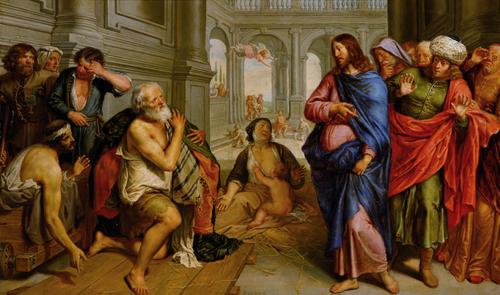
The healing of a paralytic by Jesus, after Mar...
The healing of a paralytic by Jesus, after Marten de Vos, ca. 1585, from the Bowyer Bible. (Photo credit: Wikipedia)

When Jesus saw him and knew he had been ill for a long time, he asked him, “Would you like to get well?” John 5:6 (NLT)

It seems like such a silly question to ask a paralytic sitting by a pool that, as the legend goes, had miraculous healing powers.

“Do you want to get well?”

I’ve found this to be one of the most haunting questions in all of scripture, because it cuts right to the heart of my motives, my desires, and my true willingness to act on them. What I say I want and what my life and actions reveal that I want are daily revealed to be two different things.

“Do you want to get well?”

I do, but maybe I’d rather be sick than have get a job. I like the attention and sympathy I get from others, and the disability check is nice.

“Do you want to get sober?”

I do, but tomorrow after I finish off this last bottle.

“Do you want to work?”

Yes! Are you kidding?! I’ve been searching for months, but I can’t find the job I want (the one that pays me a lot of money, gives great benefits, and doesn’t demand too much of me).

Do you want to know God?”

I do! But, I kind of want a God that fits my lifestyle. I don’t want to be uncomfortable or have to deal with guilt or anything like that. I want to know God, just as long as it’s all positive. You know, answering my prayers and blessing me and loving me and all that stuff without expecting too much of me.


I find it interesting that today’s chapter starts with a physically crippled man and ends with spiritually crippled men. Jesus asks the paralytic about his motives and heart desire about getting physically well, then His act of healing reveals the motives and heart desire of those who say they wanted to get spiritually well – but refused the One God had sent who was standing in their midst.

Today, I’m thinking about all of the things I say I desire … but don’t act accordingly. God, forgive me. It’s a good day to make a change.