Tag Archives: Midwest

The Conversational Dance of Cultures

Guest Check
Guest Check (Photo credit: Kevin H.)

Chapter-a-Day Genesis 23

Ephron answered Abraham, “My lord, please listen to me. The land is worth 400 pieces of silver, but what is that between friends? Go ahead and bury your dead.”

So Abraham agreed to Ephron’s price and paid the amount he had suggested—400 pieces of silver, weighed according to the market standard. The Hittite elders witnessed the transaction. Genesis 23:14-16 (NLT)

In case you didn’t notice it, today’s chapter is a conversational dance between Abraham, who was a wayfaring nomad without a country to call home, and the Hittite leaders among whom Abraham and his household were currently living. I’m sure that this was a formalized little conversation they went through in that culture when haggling over a plot of land. Notice how they negotiate the price and location of the burial site while maintaining the same basic conversation:

  1. Abraham insists on buying the land
  2. The Hittites insisting on giving it to him.

Abraham promises to pay full price for the land three times, and with each subsequent offer a little bit more information is given. Each time the Hittites offer to give it to him and maintaining an air of generosity. Each counter provides another scrap of information to the deal being made. At the end of the little conversational dance, the location of the land, the current owner, and the value are all established. Abraham pays the full price in front of the appropriate witnesses and the deal is done.

This is not unlike a conversation two midwestern people might have over a lunch tab, in front of their witnessing neighbors, at the Windmill Cafe uptown:

Hank: (waiting until Arvin grabs the check from the table before reaching for it) Let me get that…

Arvin: No, no. It’s my turn to buy today.

Hank: But, I’m the one who invited you to lunch. I should pay for it.

Arvin: Yeah, but I’m pretty sure you got it last time. I got it.

Hank: But, my Blue Plate Special was more than your Meatloaf Sandwich. At least let me pay for my own lunch.

Arvin: Nah. Don’t worry about it. Not a problem. You can get it next time.

Hank: Well, at least let me get the tip, then.

Arvin: Yeah, okay.

Hank: Thanks. I owe you.

Arvin: You betcha. Don’t mention it. You don’t owe me a thing.

Hank: Alright, then.

The more things change, the more they stay the same 😉

The Lost Art of Hospitality

Welcome mat
(Photo credit: Lynn Kelley Author)

Chapter-a-Day Genesis 19

Then [Lot] welcomed them and bowed with his face to the ground. “My lords,” he said, “come to my home to wash your feet, and be my guests for the night. You may then get up early in the morning and be on your way again.” Genesis  19:1b-2a (NLT)

As I started reading the chapter this morning I was struck by Lot’s hospitality, which parallel’s Abraham’s hospitality from the previous chapter:

My lord,” [Abraham] said, “if it pleases you, stop here for a while. Rest in the shade of this tree while water is brought to wash your feet. And since you’ve honored your servant with this visit, let me prepare some food to refresh you before you continue on your journey.”

About ten years ago I spent a short period of time in Israel and was struck by the tradition of hospitality that is shown by the cultures there. When I read about the way Abraham and Lot welcomed and honored their guests, it feels very much the same as the way I was treated by complete strangers in some of my travels. Taylor and Clayton reported similar experiences from their travels in Morocco and Uganda. Hospitality towards strangers and guests is a time-honored tradition.

As I look back over my lifetime and observe some of the drastic changes I’ve witnessed in our own culture, the loss of hospitality is one of them. I’m still proud of “midwest nice” that you’ll still find in our small town here in Iowa, yet when I remember the way my grandparents regularly welcomed visitors into their home I am struck at how different it was. The coffee pot was always on in the morning and the tea kettle in the afternoon. There were always treats ready for guests, and there were always guests.

Even in my childhood and youth the welcome sign was always out at our home. My parents used to say to us “your friends are always welcome here,” and they were. Friends would stop by for a visit even if we kids weren’t home. They knew my mom would feed them and they would be treated like honored guests.

Perhaps what I experienced was the exception not the rule, but I don’t think so. I tend to think that we shut ourselves in our warm homes in the winter and our air conditioned homes in the summer. We lock the door and socialize with others in front of a computer screen. Meanwhile, the art and tradition of hospitality – of welcoming one into your home and caring for them with honor and grace – has been slowly lost despite the fact that God’s Message hearkens to the previous two chapters we’ve read and calls us to perpetuate the very practice:

Don’t forget to show hospitality to strangers, for some who have done this have entertained angels without realizing it! Hebrews 13:2 (NLT)

I have tried to perpetuate the spirit of hospitality in our own home, though when I think back to the experiences of my childhood I realize that I haven’t always been as fine a host as the examples I was given. It’s a good reminder for me today.

If you’re in the area, stop on by. I’ll start a pot of coffee and the tea kettle will be boiling.

Ham Buns and Potato Salad Downloads

Photo Pete Zarria via Flickr

Sometimes you have no choice but to go home.

When Thomas Prins was 18 his hometown of Hebron, Iowa (population 318) was boiling in  a scandal that was never resolved. He packed his bags and left for college in New York City. He went to school, found unexpected success as a writer and never looked back.

Twelve years later, after his parents lose their lives in a tragic auto accident, Thomas has no choice but to return home. The town prepares for the funeral and the local residents are atwitter that “Tommy” is coming home. With his return, heat is turned up on the old scandal which has quietly simmered in the town’s collective conscience since his departure.

Ham Buns and Potato Salad is a play about going home. It’s about grief and hope. It’s about confronting our past and stepping into our future. It’s about small town quirks and human frailties. It’s about fear and love and grace and forgiveness.

I’ve received requests from those who’d like to read the script and so I’m making it available for download in a PDF format along with a low-tech MP3 recording of an informal table reading of the script (in the event you’d rather listen than read). In addition, this post will remain as a page on my blog. Simply click on the “Ham Buns and Potato Salad” link in the header of my blog’s homepage for quick access. Feel free to pass it along if you know of anyone who’d be interested.

The Skinny on the Play

Ham Buns and Potato Salad is a full-length play in two acts.
Ten Characters:
Five Adult Males (Ages 30-60)
Four Adult Females (Ages 30-60)
One adolescent female (Age 12)
All action takes place in one setting and can be performed with minimal set.

All copyrights and production rights for Ham Buns and Potato Salad are held by the author. The downloadable script and corresponding audio recording are intended for private individual perusal and/or listening. They may not be copied, produced, performed or broadcast without the expressed, written consent of the author.

Please direct any questions or requests to tomvanderwell@gmail.com.

Downloads:

Ham Buns and Potato Salad.pdf

Ham Buns & Potato Salad Reading.mp3 (1 hr 40 minutes; 45 Mb)

Please note that the MP3 audio recording is of a table reading of the second draft of the script. Changes to the script were made after this reading.  Be advised that the audio version will not match perfectly with the PDF (but it’s close!).

Tom’s 30 Day Blogging Challenge Day 4

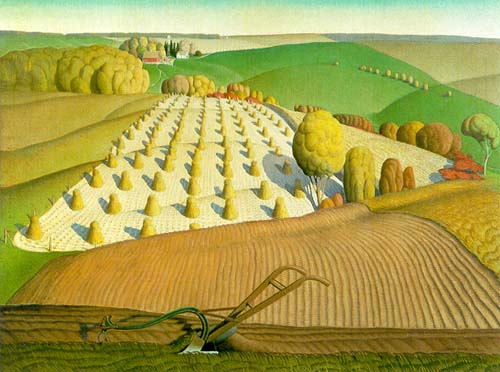
If you could own one painting from any collection in the world but were not allowed to sell it, which work of art would you select?

So many great works to choose from. There are so many works by Degas, Van Gogh, Rembrandt, and Vermeer I would love to have, but my heart always comes back to Grant Wood. Like midwest America itself, Wood is underappreciated. I have always thought that he was able to capture the beauty of the Iowa landscape better than anyone else and I feel an emotional connection to his work because it reminds me of my own connection to this land. Not to mention, his paintings would look great hanging in our home. This particular painting, Fall Plowing, captures one of my favorite times of year when the landscape is alive with everchanging colors and textures.