Tag Archives: Holy Land

The Tension

The Tension (CaD Heb 8) Wayfarer

By calling this covenant “new,” he has made the first one obsolete; and what is obsolete and outdated will soon disappear.
Hebrews 8:13 (NIV)

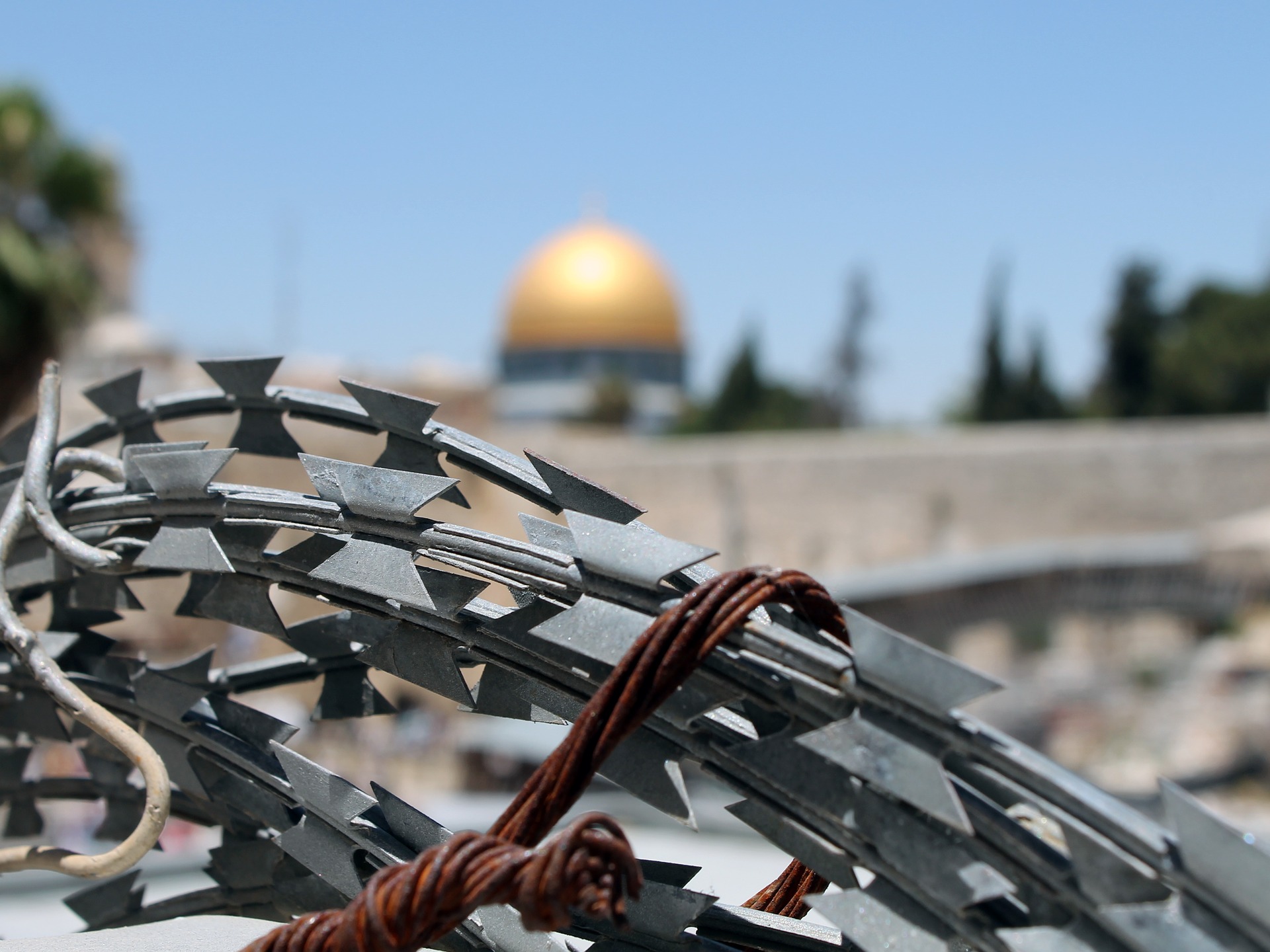
The Temple Mount in Jerusalem is, and likely will always be, a place of constant tension. The three major world religions consider it sacred space, and this means that there are frequent disputes that take many different shapes. The Al Aqsa Mosque with its gold dome sits atop the Mount surrounded by ancient walls. Below the western wall of the Mosque are remnants of the ancient Jewish Temple, commonly called “the wailing wall” where Jews and Christians pray daily. There is always tension.

I and my two companions were there during a particularly tense political period, things were largely locked down and access was limited. We had two interpreters and guides. One was an older woman, Jewish by birth, who had become a believer in Jesus and considered herself “a completed Jew.” The other was Arab by birth, Jewish by citizenship, and Christian by faith. He was a carpenter in Nazareth.

As we walked along the open area leading to the wailing wall, our female guide spoke of incidents in which Muslims violently attacked and killed Jews at the wall. A few moments later, our male guide quietly leaned into me to explain that the area where we were standing had once been a poor Arab neighborhood which the Jews bulldozed to make public space at the wall. Our time in Jerusalem was like that. Our guides, both followers of Jesus, saw everything from vastly different perspectives. They loved one another, but they often argued (always in Hebrew, which they both spoke but we didn’t). It was a microcosm of the much larger tension that exists there.

Our Arab brother, in particular, quietly saw to it that we experienced the tension first hand. The Temple Mount and Mosque were shut down to tourists because of the tensions, but he insisted on trying to get permission for us to see it briefly. We were grudgingly allowed to ascend a building of the Temple Authorities to view the mosque and its courtyard from the roof over the wall. The entire time we were followed, watched and made to feel the contempt and authority of our disgruntled hosts.

In a separate experience, our guide snuck us as tag-along with a group of Jews visiting the area’s Temple center. Not knowing that four Christians were in the audience, we were treated to hear about the group’s rabid desire to someday rebuild the Jewish Temple and return to the sacrificial system of Moses (complete with blueprints, exhaustive construction plans, and multi-media presentation). As a bonus, we got to hear the presenters speak mockingly of both Jesus and His followers.

I thought of these experiences this morning as I mulled over today’s chapter. The author of the letter to the Hebrews is facing similar tension as he explains that a spiritual shift of tectonic proportions has taken place through Jesus’ death and resurrection. For his fellow Hebrews, this means every religious thing they’ve ever known has changed. The old covenant between God and Moses is literally “obsolete” and a new covenant has taken its place. He then states quite emphatically that the “outdated will soon disappear.”

As I read this I had two thoughts. One was simply that tension that must have existed. Humans don’t like change, and I’ve observed it to be especially true when it comes to well-established and deep-seated religious traditions. The second thought was of Jesus and His followers as they left the Temple mount just days before His impending crucifixion. His followers were impressed with the Temple complex, but Jesus said, “Truly I tell you, not one stone here will be left on another; every one will be thrown down.”

And that’s what happened in 70 A.D. when Roman legions descended on Jerusalem to stomp out the Jewish rebellion against Rome. The Temple was torn down. All of the Jewish genealogical records were destroyed, ensuring that it could no longer be definitively established who the descendants of Aaron, Levi, or any other tribe were. Because only descendants of Aaron could be priests, and only Levites could serve in the temple, the sacrificial system was essentially wiped out with the Temple’s destruction.

In the quiet this morning, I’m reminded that Jesus promised His followers that there would be trouble in this world, along with trials, suffering, and persecution. He said that there will be wars and rumors of war. Nations conspire, people plot, and rulers rage.

There’s always tension.

At the very same time, Jesus told His followers not to allow their hearts to be troubled by such things. He said that there is a peace with which He would leave us. It’s not an international peace, but an inner and interpersonal peace that “passes all understanding” available to me.

In just a moment, I will descend to the kitchen to peruse today’s headlines with Wendy over breakfast. I already know what I will find there. Wars and rumors of war. People plotting. Rulers raging. Tension. I needed the reminder of peace this morning. The words of Isaiah come to mind as I wrap up today’s post:

You will keep in perfect peace
    those whose minds are steadfast,
    because they trust in you.

If you know anyone who might be encouraged by today’s post, please share.

Finding Wisdom Amidst the Ruins

Chorazin

“Woe to you, Chorazin! Woe to you, Bethsaida! For if the miracles that were performed in you had been performed in Tyre and Sidon, they would have repented long ago, sitting in sackcloth and ashes. But it will be more bearable for Tyre and Sidon at the judgment than for you. And you, Capernaum, will you be lifted to the heavens? No, you will go down to Hades.” Luke 10:13-15 (NIV)

When you visit Israel, there are a million places you can visit. Jerusalem and the temple mount are a big attraction. Floating in the Dead Sea and trekking up to the fortress of Masada makes the top of most tourist’s list as does a dinner cruise on the Sea of Galilee. Then there is Megiddo, Mount Carmel, Mount Gilboa, the Garden Tomb, the Church of the Holy Sepulcher, The Jordan River, and on and on and on.

As I and my companions made our way around the north shore of the of Sea of Galilee, our guide, George, took a turn onto some back roads. It was obvious that we were off the beaten path. Even George, who knows the area like the back of his hand, seemed a bit lost for a few minutes. Finally we pulled into a group of ruins and got out. The site was desolate and bare. Unlike many sites in the Holy Land there was no hoopla. There were no trinket shops or refreshment stands. This place was clearly among the official sites to get scratched off the “must see” list for most tourists. The place was dead.

We were in the ruins of Chorazin, a small backwater town where Jesus once taught and performed miracles. The people of Chorazin did not respond favorably to Jesus message and miracles, however. I pondered Jesus’ words of woe as I walked silently among the ruined walls and abandoned buildings.

Wendy and I have been talking a lot this past week about the small daily choices we make and their cumulative effects. “I place before you Life and Death,” God once told His people before adding, “Choose life.” Along this journey I’ve come to realize that the choice of Life or Death is not a one time monumental decision, but a series of small daily choices that I make every day. What I choose to eat and how much of it I consume slowly affects my weight, my mood, and a myriad of other health issues. If I choose to sleep in and forget an important meeting it will affect my client relationship and, eventually, my income. If I consistently choose to give in to little bad habits they will eventually lead to very big consequences.

I snapped the picture above from the rubble of Chorazin looking out over the Sea of Galilee. It’s become a constant reminder to me that Jesus is both Savior and Judge. I find that I love to think of Jesus the Savior, but I like to conveniently forget Jesus the Judge. Woe to me for doing so, for amidst a judged Chorazin there is wisdom to be found for those who choose to wander in the ruins and digest Jesus’ words.