Tag Archives: 1 Corinthians 5

An Awkward Moment at the Pub

An Awkward Moment at the Pub (CaD 1 Cor 5) Wayfarer

I wrote to you in my letter not to associate with sexually immoral people— not at all meaning the people of this world who are immoral, or the greedy and swindlers, or idolaters. In that case you would have to leave this world. But now I am writing to you that you must not associate with anyone who claims to be a brother or sister but is sexually immoral or greedy, an idolater or slanderer, a drunkard or swindler. Do not even eat with such people.
1 Corinthians 5:9-11 (NIV)

A number of years ago, I was running some errands in town one gorgeous spring afternoon. It was one of those amazing first warm days of spring here in the midwest when everyone opens windows and doors to air out the house after a long winter, and everyone gets outside to take a walk and enjoy warm weather.

With a little extra time on my hands, I decided to pop into the local pub for a pint before heading home. The pub had its front door propped open and I was sitting at the bar with my pint checking email, when I heard someone call my name.

I turned to find a Christian couple I know who had been passing by and saw me sitting there. I smiled, waved, and greeted them. Then it became clear that they wanted to have a conversation because they started right in making casual small talk, but it got really weird. They refused to step inside the pub. My friends even looked down a few times at their feet to make sure he hadn’t crossed the threshold. I was sitting twenty-five feet away. They were blocking the door and talking to me as if we were having an intimate conversation while semi-shouting so that the whole pub could hear. Eventually, they continued on their way, having successfully remained pure by not entering a sinful place. I finished my pint and went home.

As awkward and silly as the episode was, I knew exactly where my friends were coming from. I spent much of the early years of my spiritual journey being taught similar behavioral legalities. Avoid such sinful places or the sinful people inside might lead you astray. Don’t associate. Stay away.

Yet, in today’s chapter, Paul provides a command to the followers of Jesus in Corinth that I’ve never heard addressed among the legalistic circles who teach such things. Paul clarifies that when he told the Corinthian believers not to associate with immoral people, he was talking about immoral people inside the church, not outside. If I refuse to associate with immoral people outside the church then how will I ever be the light of the world, or the salt of the earth? Paul’s teaching is clear. He’s talking about those inside the church who claim to be disciples of Jesus but they live lives that are the obvious antithesis of Jesus’ teaching.

In my associations out in the world, I know exactly what I’m dealing with. These are people who don’t know Christ, who have no reason to act like they do. They’re the people Jesus associated with when the good religious leaders complained that He ate and drank with sinners.

“Yes!” Jesus answered his legalistic, religious critics unequivocally. “These are the people who need what I have to give! These are the people I came for!”

The people I’m really supposed to avoid are the hypocrites inside the church who faithfully go through the religious motions and put on its outward appearances, but whose daily lives and relationships are void of love, joy, peace, kindness, gentleness, or patience. In fact, that accurately describes the good legalistic religious people who were criticizing Jesus. Jesus told His followers to avoid them. And that’s the very point that Paul is making to the Corinthian believers. I don’t need to worry about an immoral person I meet in the pub. They’re lives are an honest reflection of their current world view and spiritual reality. I need to worry about the hypocrites in my pew on Sunday. They’re the ones whose lives are dishonest at the core. I need to avoid them like the plague if I want to be spiritually healthy.

At least, that’s what Jesus taught, and Paul. Though, you probably won’t learn that in a lot of churches.

In the quiet this morning, I find myself looking back at the years I led a very sequestered life. I, too, would have avoided crossing the threshold of a pub. And, I spent a lot of time hanging out with some really awful people, but they claimed to be Christians, so they were on the approved list. I am once again reminded that this life is a journey. Healthy things grow, and growing things change. I’m not in the same place I once was, nor should I be. If you’re ever in town, feel free to meet me at the pub. I’ll buy you a pint and introduce you to some friends.

If you know anyone who might be encouraged by today’s post, please share.

These chapter-a-day blog posts are also available via podcast on all major podcast platforms including Apple, Google, and Spotify! Simply go to your podcast platform and search for “Wayfarer Tom Vander Well.” If it’s not on your platform, please let me know!

Life, and Light, Under the Bucket

I wrote to you in my letter not to associate with sexually immoral people, not at all meaning the people of this world...
1 Corinthians 5:10 (NIV)

There once was a Christian man, raised in a Christian family. From his infancy he attended a Christian church and then was placed in Christian school where he had many Christian friends. He listened exclusively to Christian music on the Christian music station and read Christian novels from the Christian publisher that he purchased from the Christian book store. During high school he involved himself with Christian athletes and in his senior year he attended the Christian prom with his Christian girlfriend. After graduating from Christian high school, the young man attended a Christian college. He went on several Christian missions to the third world and interned at two different Christian organizations. He met a good Christian girl from a Christian family, and he married her. After graduating from the Christian college, the man returned to his hometown to start a Christian business, listed in the local Christian business directory, and joined a Christian men’s group to help him raise his Christian family. And, it started all over again.

Jesus said,

“Here’s another way to put it: You’re here to be light, bringing out the God-colors in the world. God is not a secret to be kept. We’re going public with this, as public as a city on a hill. If I make you light-bearers, you don’t think I’m going to hide you under a bucket, do you? I’m putting you on a light stand. Now that I’ve put you there on a hilltop, on a light stand—shine! Keep open house; be generous with your lives. By opening up to others, you’ll prompt people to open up with God, this generous Father in heaven.”

If I was the enemy of Light, and I wanted to keep the Light from penetrating the darkness, I would simply convince the Light bearers that “holiness” was totally dependent on keeping their Light hidden under an overturned bucket of social, cultural, and familial exclusivity. Then, I would sprinkle in the notion that those in darkness will either be  1) somehow attracted to their little circle of exclusivity under the bucket or 2) deserving of the hopeless, eternal darkness outside.

What the hell?

Immorality and Inquisition

I wrote to you in my letter not to associate with sexually immoral people— not at all meaning the people of this world who are immoral, or the greedy and swindlers, or idolaters. In that case you would have to leave this world.
1 Corinthians 5:9-10 (NIV)

This spring our local Christian high school is producing Arthur Miller’s classic play, The Crucible. I would daresay that any individual who loves theatre has a personal list of shows and roles that they dream of doing one day. The Crucible is one of those shows for me.

The Crucible is not a light-weight play. It’s a retelling of the infamous witch trials which began in Salem, Massachusetts in 1692. A group of teenage girls go into hysterics claiming that they have seen individuals within the community “with the devil.” The community is thrown into religiously-motivated chaos as community members are investigated, tried and eventually hanged.

Along my life journey I have met a number of people who have shared with me painful stories of how they were personally and publicly shamed by a church. These individuals who come to mind are beautiful, sincere persons who, despite their past mistakes, are following Jesus and living increasingly transformed lives marked by love, grace, mercy, honor and transformation. They were rebellious teenagers, individuals wrestling with addiction to various appetites, and hurting individuals who willfully acted out their pain. Instead of coming alongside the hurting individuals with love-motivated accountability, their local churches launched “witch hunts,” broadcast their sins, called them in front of the church to shame them. In some cases the church threw them out.

Let’s be real. When it comes to handling issues of morality and human foibles, the church has a long and sordid history of epic failures. We all know the stories from the Salem witch trials to the Spanish Inquisition. We can point to horrors of religiously motivated prejudice, persecution, violence, and genocide. Of course, I believe that there are also countless examples throughout history of religiously motivated grace, love and forgiveness which don’t get nearly enough press, but that’s a blog post for a different day.

In today’s chapter, we find Paul grappling with a sticky wicket within the community of Corinthian believers. There was a particular instance of a man who was involved in an incestuous relationship with his own mother, which is certainly not a great thing. There was, however, also a larger issue going on. One of the struggles the early believers had was the argument that many were making: “If Jesus offers me grace and forgives all my sins, then I’m free to do whatever I want and I’ll be forgiven. In fact, the more I sin the more grace is afforded me. So let’s go sin and produce more grace!”

Twice in Paul’s letter to the believers in Corinth he quotes “everything is permissible” which was obviously what some within the company of Jesus followers were arguing. “I have a right to do anything I want and act in any way I choose because Jesus’ forgiveness provides me moral carte blanche.” The implication is that the man who was having sex with his mother was among the “everything is permissible” faction, and it was having destructive spiritual effect within the community. Paul argues that those propagating this destructive teaching needed to leave the fellowship.

Paul goes on to make a clear distinction that Jesus’ followers have no right to be judgmental towards those who aren’t Jesus’ followers. Those who follow Jesus, however, must adhere to Jesus’ teaching which never condones the “everything is permissible” doctrine. The community of believers had a responsibility to deal with those within the church who were advancing this spiritually destructive teaching.

Of course, over time many religious movements and churches have taken Paul’s word to the believers in Corinth and twisted it. We have wrongfully believed we have carte blanche to investigate, weed out, and shame any persons who fail our moral benchmarks. We judge anyone who doesn’t meet our moral litmus tests (both inside and outside the walls of our churches, I might add). We have taken Paul’s directive about a destructive school of thought (which led to increasing, unchecked, immoral behavior) and used it to justify moral inquisitions of all kinds. The Salem witch trials stand as an example.

I’m reminded in the quiet this morning that I’m a follower of Jesus. I seek to follow Jesus’ example in my life, intentions, thoughts, words, and actions. Jesus was incredibly gracious to those who were struggling morally and simply trying to find their way to the Kingdom of God. He wanted people to leave the destructive behaviors that were harming themselves and others. Those persons Jesus judged most harshly were the religious people who looked down their noses on others and used religion as tool to empower themselves at others expense.

I’ve come to believe that destructive teaching needs to be called out for what it is and rejected. This includes the notion that “everything is permissible” whether that notion condones immorality or inquisition.

featured photo courtesy of bossdoss1 via Flickr

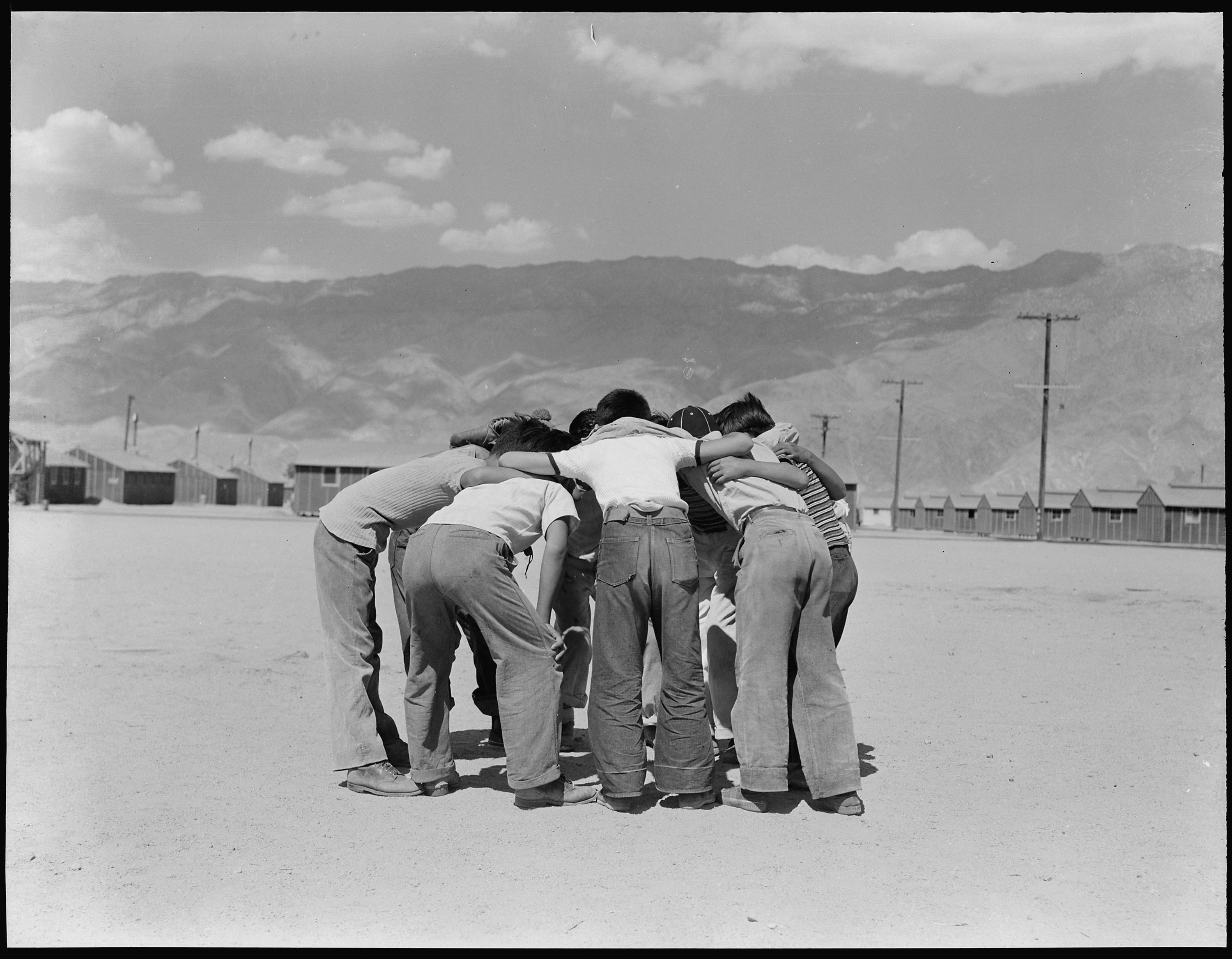
“Holy Huddle”

I wrote to you in my letter not to associate with sexually immoral people—not at all meaning the people of this world who are immoral, or the greedy and swindlers, or idolaters. In that case you would have to leave this world.
1 Corinthians 5:9-10 (NIV)

For my entire life’s journey I have belonged to a local church. I’ve actually belonged to many churches of different sizes and denominational affiliations. One of the patterns of behavior I have noticed among believers is referred to by some as “the holy huddle.”

The “holy huddle” is a group of Jesus’ followers who huddle together in life to the general exclusion of anyone else. The huddle worships together, socializes with one another, spends free time together, gathers on holidays, vacations together, and pretty much keep to themselves.

I have, at different times of life, been part of holy huddles. I get the allure of it and understand why it’s easy to fall comfortably into the pattern. We all like socializing with people with whom we share common thoughts, opinions, and socio-economic status. Followers of Jesus also tend to desire the avoidance of both temptation and conflict. As a young man, hanging out almost exclusively with members of my youth group meant being around an environment of positive peer pressure. That’s not a bad thing.

I’m reminded this morning, however, that the “holy huddle” was never God’s paradigm. Yes, those who follow Jesus are encouraged to meet together regularly. Yes, we need to be in relationship with our fellow believers to encourage, comfort, confess, and build one another up. This is not, however, to the exclusion of those outside our spiritual sphere.

In today’s chapter, Paul makes a very clear distinction that is important for any of us who follow Jesus. When Paul had told the believers in the city of Corinth that they were not to associate with immoral people, he was not talking about non-believers in their community. He was referring specifically to those individuals in their local gathering who claimed to follow Jesus but also considered God’s forgiveness as a license for doing whatever they wanted. These people boasted that they could do whatever they wanted morally because Jesus’ forgiveness covered it all, and they encouraged others to join them in their “freedom.”

This morning I’m reminded that I can’t make a difference in my world if I’m not living in it and fostering relationship with those who are not in my holy huddle. Jesus washed His followers feet and encouraged them to do the same. The word picture is both clear and powerful: “Your whole body is clean,” Jesus said, “but your feet get dirty when you’re out walking in a dusty, dirty world. So, you’ll need to wash each other’s feet on occasion.”

My feet will never be dirty if I confine my journey within the “purity” of my holy huddle.

chapter a day banner 2015

Cautious with Judgement; Generous with Love

source: cedwardbrice via Flickr

Chapter-a-Day 1 Corinthians 5

I meant that you are not to associate with anyone who claims to be a believer yet indulges in sexual sin, or is greedy, or worships idols, or is abusive, or is a drunkard, or cheats people. Don’t even eat with such people. 1 Corinthians 5:11 (NLT)

I stopped by a friends house the other night and we chatted. My friend shared that he had run into a mutual acquaintance who, like many, have chosen to live and think in a simplistic, black-and-white context. The acquaintance told my friend he did not want to be around him because my friend is divorced. Our acquaintance seemed to think it was contagious.

One of the unavoidable tasks of anyone who takes up a journey through God’s Message is the need to grapple with sections that make us uncomfortable. When we find ourselves struggling with a passage it’s important not to turn away, but to wade in. There is nothing to fear in struggling through a passage. Struggle, when approached correctly, tends to make one both stronger and wiser.

I honestly struggle with today’s chapter because on the surface it is too easy for us to take the simplistic, black-and-white approach of our acquaintance. “The Bible says not to associate with sinners, so I can’t be around you.” And yet, the Bible also says that we are ALL sinners, that committing one small sin makes us as guilty as committing the whole lot, and that thinking a lustful thought is as bad as committing the illicit sexual act itself. So, if we aren’t going to associate with sinners we might as well get used to a rather lonely and isolated existence.

It’s important to wade in an consider the context. Paul was addressing a situation in which the person in question was indulging in a destructive behavior, reveling in it, and bragging about it. The persons behavior suggested that his heart was hardened and he was flaunting his wrong doing rather than humbly and sincerely struggling to turn away from it. There is a huge difference in the motivation and intent between those two positions.

I was sad for my friend and for our acquaintance, for I perceive that the same difference applied. Even after my friend explained that he did not wish divorce on anyone, that he would not advise it to others, and that he was continually seeking after God to heal his heart and bring about recreation of his life, our acquaintance judgmentally walked away.

Today, I’m motivated to be both cautious and discerning with my judgement and both generous and indiscriminate with my love.