Tag Archives: Job 41

Sharks and Leviathans

Sharks and Leviathans (CaD Job 41) Wayfarer

Who has a claim against me that I must pay?
    Everything under heaven belongs to me.

Job 41:11 (NIV)

Wendy and I have a little library of children’s books that resides just past the entrance of our home in a corner of the living room. It’s there for grandchildren and wee friends who come over for a visit. Among some of our favorites, there are also a couple of picture books with an exhaustive number of different creatures, critters, and creepy-crawlers from the animal kingdom.

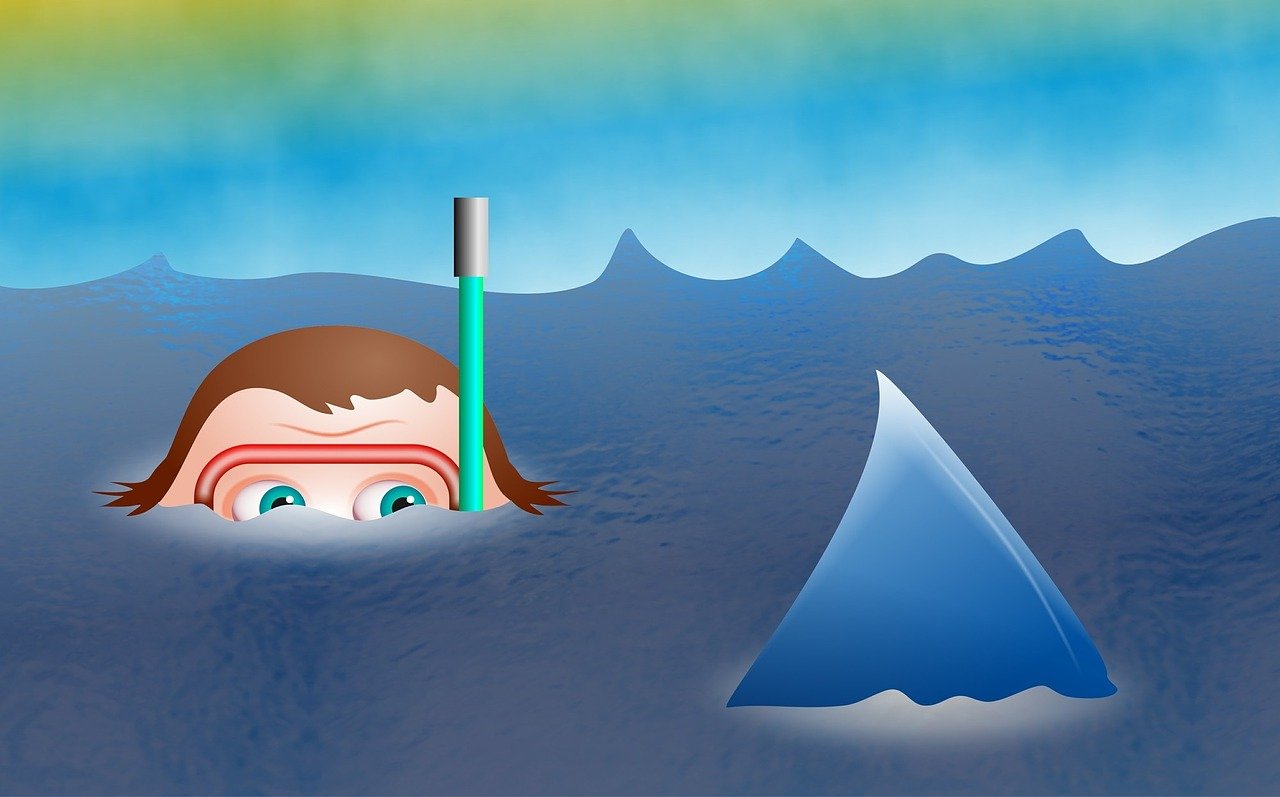
Milo quickly learned that Ya-Ya (Grandma Wendy) has this thing with sharks. She doesn’t like them. Sharks produce a fear in Wendy that she’ll admit is slightly irrational. She doesn’t even want to see pictures of them.

So, of course, Milo always wants to read the creatures book and make Ya-Ya look at sharks.

God’s final discourse to Job ends with two poems that are somewhat mysterious. Each describes a mighty creature. The first describes a Behemoth and the other a Leviathan. The words are transliterations of the original Hebrew words because the exact identification of the animal or creature being described has been lost. Thus, the mystery. Both the Behemoth and Leviathan are mentioned multiple times in other biblical texts.

Scholars over the years have suggested that Behemoth’s description as an amazingly strong, dangerous, semi-aquatic, herbivore might suggest it is a hippopotamus. Hippos are often mistaken as docile creatures. Hippo attacks account for the deaths of about 500 people each year.

Leviathan is a bit different story because while some scholars suggest that it could refer to a crocodile. If that is true, then the description is hyperbolic and exaggerated. It’s certainly possible that hyperbole was a literary device in the ancient Hebrew poem.

As I read the Leviathan poem in the quiet this morning, it appeared to me to describe your standard dragon. Other scholars agree and suggest that Leviathan is a variation on a mythological creature from ancient Canaan called Lôtan. Lôtan was a seven-headed dragon who mythologically symbolized almost invincible power that stands in opposition to God. This caught my eye as I read about it this morning because our local gathering of Jesus’ followers is studying the book of Revelation which describes an enormous red dragon with seven heads (Rev 12:3).

No matter what the mysterious Behemoth and Leviathan are, the point that God is making is perfectly clear. Each represents an untamed, dangerous creature that would immediately strike fear in Job. It’s kind of like young Milo showing Ya-Ya pictures of sharks. God is in essence saying, “If you’re afraid of confronting a Behemoth or a Leviathan, how much more afraid should you be of the Creator who made them? Isn’t the Creator far greater in power and danger than either of them?”

Which, in the quiet this morning, has me thinking once again about that which is holy. When Jesus took Peter, James, and John with him up on the mountain and they saw Him transfigured into blinding, glorious light before their eyes while the voice of God thundered. Matthew writes that the three disciples “fell facedown to the ground, terrified.”

I think about the three disciples who enjoyed an intimate, human relationship with Jesus. They laughed with Him, ate meals with Him, and told stories around the campfire at night. They enjoyed familiar friendship and companionship with Him. When they experienced His unveiled power and glory on the mountain, they got a dose of his holiness and they hit the ground face down.

God is reminding Job of His holiness, and it’s a good reminder for me. I have experienced a relationship with Jesus full of grace, love, and forgiveness. But I should always be mindful that Jesus love and grace does not diminish His holiness, and neither should I.

If you know anyone who might be encouraged by today’s post, please share.

The Point Amidst the Myth

Who has a claim against me that I must pay?
    Everything under heaven belongs to me.
Job 41:11 (NIV)

The description God gives of the great Leviathan in today’s chapter is one of the most intriguing passages in all of God’s story. Having just watched The Hobbit: The Battle of Five Armies in 3D a few weeks ago, I have to tell you that Leviathan appears to be a dead ringer for Smaug, the dragon who destroys Lake Town (watch the video, above):

Who can strip off its outer coat?
    Who can penetrate its double coat of armor?
Who dares open the doors of its mouth,
    ringed about with fearsome teeth?
Its back has rows of shields
    tightly sealed together;
each is so close to the next
    that no air can pass between.
They are joined fast to one another;
    they cling together and cannot be parted.
Its snorting throws out flashes of light;
    its eyes are like the rays of dawn.
Flames stream from its mouth;
    sparks of fire shoot out.
Smoke pours from its nostrils
    as from a boiling pot over burning reeds.
Its breath sets coals ablaze,
    and flames dart from its mouth.
Strength resides in its neck;
    dismay goes before it.
The folds of its flesh are tightly joined;
    they are firm and immovable.
Its chest is hard as rock,
    hard as a lower millstone.
When it rises up, the mighty are terrified;
    they retreat before its thrashing.
The sword that reaches it has no effect,
    nor does the spear or the dart or the javelin.
Iron it treats like straw
    and bronze like rotten wood.
Arrows do not make it flee;
    slingstones are like chaff to it.
A club seems to it but a piece of straw;
    it laughs at the rattling of the lance.
Its undersides are jagged potsherds,
    leaving a trail in the mud like a threshing sledge.

I have heard this passage interpreted many different ways. As John mentioned in his comment on yesterday’s post, we sometimes get so darned literal these days that we fail to appreciate the nature of poetry when we see it. In the spirit of poetic device, which we discussed yesterday, perhaps Leviathan is simply hyperbole layered over a description of an actual beast (i.e. crocodile, komodo dragon, or etc) and used for dramatic effect. We must remember that the epic poem of Job comes out of early human history which was very different than our post-enlightenment age of advanced science and modernity. Mythical beasts in epic poems were threads in the fabric of ancient society (i.e. Grendel in Beowulf). Perhaps there are extinct creatures that resemble the description more aptly than we know or can appreciate. It’s certainly fodder for spirited discussion over a pint.

Amidst the fun debate over the description of Leviathan, however, I don’t want to lose sight of the point of today’s chapter. I am constantly finding that people like to debate the jots and tittles of obscure textual references (e.g. prophecy, the Nephilim, Eden, angels, demons, heaven, hell and etc.) while ignoring the larger point of the overarching story. Let’s make sure we essentially get the point, and then I’ll buy you a pint and we can haggle over the non-essential question of what Leviathan actually is.

I found “the point” of  today’s chapter in verse 11 (pasted at the top of this post). God’s point to Job in His description of behemoth and leviathan were that these great beasts were created by Him and were under His dominion, which by contrast reveals how impotent Job’s authority and dominion are. God declares that everything, from mythical beasts to Job himself, belong to Him.

Today, I thinking about dragons and unicorns and Pegasus. I’m thinking of Grendel and Smaug and Faery. I’m mulling the intersection of human myth and spiritual reality, and how beautifully layered it all is across history with imagination and meaning.