Tag Archives: Warfare

Challenge the Assumptions

Challenge the Assumptions (CaD 1 Sam 17) Wayfarer

Then Saul dressed David in his own tunic. He put a coat of armor on him and a bronze helmet on his head. David fastened on his sword over the tunic and tried walking around, because he was not used to them

“I cannot go in these,” he said to Saul, “because I am not used to them.” So he took them off. Then he took his staff in his hand, chose five smooth stones from the stream, put them in the pouch of his shepherd’s bag and, with his sling in his hand, approached the Philistine.

1 Samuel 17:38-40 (NIV)

I recently listened to Malcolm Gladwell’s book David and Goliath. It’s a fascinating conversation about the assumptions we often make in life about the best choice for college, how to reduce crime in crime-ridden neighborhoods, or how to improve educational outcomes. In short, Gladwell’s book reveals that our basic assumptions are often completely wrong. And he begins his treatise with one of the most famous stories in all of human history.

Today’s chapter is the story most all of us learned as children. The story of a shepherd boy named David who defeats a giant warrior named Goliath. To this day, we use the term “David and Goliath” metaphorically to describe an improbable victory that defies the odds. A careful evaluation of the circumstances, however, reveals that David was a sure bet. That is Gladwell’s point.

Despite it being a popular children’s story, the actual account in today’s chapter drips with historical accuracy. In ancient times, warring tribes sometimes decided battles by “champion.” Each would put forward their best champion to duel one-on-one, winner takes all. This was not uncommon. The Philistines were a sea-faring people who emigrated into the region with the knowledge of how to smith iron into tools and weapons. This gave them a huge technological advantage over Saul and the Hebrew army. There were good reasons that the Hebrews were reticent to fight the Philistines.

What everyone assumed, however, was that a Hebrew champion would emerge in his armor and battle Goliath in hand-to-hand combat. It was a safe assumption that Goliath had the advantage. He was tall with tremendous arm length. He was well clad and equipped with armor and weapons made using cutting age-technology. No one on the Hebrew side of the battle lines could even come close to being an even match.

What the shepherd boy David knew was that everyone’s assumptions on that battlefield were wrong. His entire young life, David had honed the skill of using a simple sling. Slings were easy to make and were dangerous weapons. When David said he’d killed bears and lions, he wasn’t exaggerating. That’s why shepherds used slings because they could scare, incapacitate, or kill a deadly animal at a distance. History records that some ancient armies had entire companies of warriors using slings. When skillfully wielded, they are both accurate and deadly. Americans cans typically imagine how deadly a 95 m.p.h. fastball could be, like when Randy Johnson happened to hit a poor bird that flew in the way of his pitch.

Imagine a stone being hurled at 150 m.p.h. with even greater precision than a Randy Johnson fastball.

When Saul tries to clothe young David with his own armor, the King assumes that he was helping David. David knew the opposite. A bunch of heavy armor would only slow him down just like Goliath. When David looked at Goliath standing out in the Valley Elah, he saw a huge target whose mobility would be diminished by his heavy armor and weapons. With mobility and speed, David could stand at a safe distance and plant a three-inch stone square in the giant’s forehead and Goliath will never see it coming.

In the quiet this morning, I can’t help but think of this familiar story in the context of Gladwell’s book. How often do I make false assumptions because they are common assumptions? How often do I do the same things over and over despite the fact that they don’t yield great results?

Along my life journey, I’ve continually challenged some long-held assumptions of the institutional church. Ministry is not solely a professional vocation, but the calling of every individual who is a follower of Jesus. Spiritual gifts are given to all believers no matter one’s age, gender, education, social standing, human weaknesses, or past failures. The church was never meant to be a bricks-and-mortar building, but a flesh-and-blood, spiritual organism. Long ago, the institutional churches suppressed these spiritual realities in order to consolidate their earthly power and influence. Generations of institutional church members assumed that their leaders were right. They weren’t. In my lifetime, I’ve witnessed church institutions implode as the institutional “Christianity” of these organizations has been summarily dismissed by the world as impotent and out-of-touch. Many Christians are in a panic about this like the Hebrew army hiding in their trenches at the Valley of Elah.

I don’t fear this in the least.

David reminds us, that sometimes you have to challenge the widely held assumptions.

If you know anyone who might be encouraged by today’s post, please share.

Plunder

Plunder (CaD 1 Sam 15) Wayfarer

“The soldiers took sheep and cattle from the plunder, the best of what was devoted to God, in order to sacrifice them to the Lord your God at Gilgal.”
1 Samuel 15:21 (NIV)

Plundering has been an aspect of warfare for as long as people have made war on one another. In fact, throughout history, there have been people groups who made themselves rich by attacking weaker people groups and plundering all of their possessions as their own. Part of the horrors of the holocaust, less than 100 years ago, was the fact that the Nazis drove Jewish families from their own homes to death camps, and then plundered all of their possessions. American soldiers also plundered as they fought their way through Europe to Berlin. Plundering has always been a part of warfare.

In today’s chapter, it’s important to place Samuel’s directive to King Saul in this light. The Amalekites were a nomadic people who had violently opposed God and set themselves against God’s people since the days of Abraham. We read about the Amalekites warring against Abraham, Moses, and Joshua as well as in the days of the Judges. When Samuel gives Saul the instruction to destroy the Amalekites, the ancient Hebrew word refers to the irrevocable giving over of things or persons to God. In other words: No plundering. Destroy it all.

Of course, this directive would not have been popular with the fighting men who saw plunder as the reward for putting their lives on the line. Plundering was viewed as a right and privilege of warfare. There would have been grumbling and complaining. There might even have been talking amidst the troops of desertion or rebellion. This is a test of Saul’s leadership.

He fails.

Saul compromises on carrying out the directive, allowing his men to plunder “the best” of the Amalekites’ hoard. He then “set up a monument in his own honor.” When confronted by Samuel, Saul tries to justify his actions before confessing that he feared his own men. Samuel then declares that God has rejected Saul as king.

I noticed a small detail in the text that I believe might often be overlooked. When Saul is justifying his disobedience he twice tells Samuel that they took the Amalekite plunder in order to sacrifice them to “the LORD your God.”

As Jesus said, “out of the overflow of the heart, the mouth speaks.”

Saul distances himself from God, and God’s command. This is your God, Samuel. We did this to make sacrifices to your God.

This got me thinking this morning about my own relationship with God. I have long observed individuals who relate to God as other. Jesus, however, was quite specific about His desire to be one with His followers just as the Father, Son, and Holy Spirit are one in the mysterious union of being that is beyond human comprehension. I don’t consider God to be other, I consider God to be intimately personal, connected, and one with me, and me with God, in ways I can’t even comprehend.

As I wrap up my quiet time this morning and launch into a busy new work week, I’m not leaving God behind in the quiet. As St. Patrick’s prayer so aptly communicates, God goes with me, within me, before me, beside me, above me, behind me, on my right, and on my left. This, in turn, changes the way I think about the entire week.

I’m living to surrender and serve Christ, not plunder this world.

If you know anyone who might be encouraged by today’s post, please share.

The Improbable Actually Happens

[The Assyrians] shouted it with a loud voice in the language of Judah to the people of Jerusalem who were on the wall, to frighten and terrify them, in order that they might take the city.
2 Chronicles 32:18 (NRSVCE)

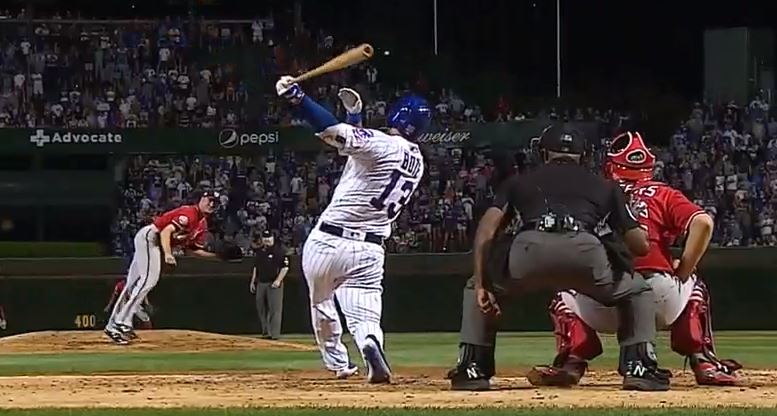
It’s such an improbable moment. Bottom of the ninth, two outs, bases loaded, and your team trailing by three runs. The grand slam to win the game. It actually happened on Sunday night when a Chicago Cub rookie named David Bote actually pulled off the improbable home run that every kid dreams about on the sandlot.

Sometimes the improbable happens. Jesus, who pulled off all sorts of improbable feats, reminded His followers that with God nothing is impossible, no matter how improbable.

Today’s chapter records one of the most improbable events in history. The Chronicler provides a condensed description of the events, which were more thoroughly told by the scribes who wrote the book of 2 Kings and by the prophet Isaiah.

The Assyrians of the ancient world were really bad dudes. They had taken warfare to a whole new level and made themselves fabulously powerful and wealthy by raiding, plundering, and decimating other nations. They were the first to use siege engines and had a corp of engineers who found all sorts of ingenious ways of breaching the walls of the cities they attacked.

The weapon the Assyrians used most effectively, however, was fear. They were heinously brutal in their treatment of conquered. They impaled people on spikes, skinned people alive, dismembered people, and burned others alive. The Assyrians discovered that the more brutal they were, the more fear they spread into the next cities on their campaign and the more fearful people were, the easier it was to defeat them.

In today’s chapter the Chronicler records another tactic the Assyrians used. They had a master manipulator who would stand outside the city walls and talk smack to the people inside in their own language, psychologically wearing them down with fear and intimidation. The Assyrian envoy loudly mocks King Hezekiah, mocks the Judeans, and mocks God.

Hezekiah stands firm. He reminds his people, “Be strong and of good courage. Do not be afraid or dismayed before the king of Assyria and all the horde that is with him; for there is one greater with us than with him. With him is an arm of flesh; but with us is the Lord our God, to help us and to fight our battles.”

The defeat of the Assyrians is an improbability bordering on impossibility. Jerusalem didn’t have the defenses to withstand a siege. The Assyrians were on a roll. They were better equipped, more experienced at war, and had everything in their favor. It’s the bottom of the ninth, two outs, and King Hezekiah is down to his last strike.

And then the improbable happened. The entire Assyrian army encamped around Jerusalem dies overnight. Historians to this day argue about what happened to the Assyrian army, but the improbable actually happened. Jerusalem was spared by the most improbable of events.

This morning I’m thinking about discouragement and fear. It’s so easy to get down and discouraged. I find myself bombarded in news media and social media with messages telling me to be afraid of everything. Everything is so bleak. There is so much to worry about. Things are so terrible, so awful,  and so hopeless. Ugh.

Today I’m encouraged by a grand slam and a historical event.

The improbable happens.

Siege and Parley

But the [Assyrian] commander replied, “Was it only to your master and you that my master sent me to say these things, and not to the people sitting on the wall—who, like you, will have to eat their own excrement and drink their own urine?
Isaiah 36:12 (NIV)

It was a day of doom. The walled city of Jerusalem was under siege just as everyone had feared; The city was surrounded by the Assyrian army. The Assyrian army of which so many rumors had been whispered. The large army, well-trained and well-equipped that had swept through the region swallowing up every city in its wake. The army that tortured their enemies mercilessly. The army thirsty for blood. The army bent on violent destruction.

In today’s chapter we have front row seats in witness of what historians call siege warfare. For many centuries of history cities were surrounded by walls to protect the residents from invading armies. In order to conquer a city, armies would lay siege to it. Besieging armies would completely surround a city to cut off the inhabitants from food, fresh water, and supplies. They would then wait (sometimes years) until the people of the town were starving, weak, despondent and desperate.

In siege warfare it was common for envoys of the besieged city and a commander of the besieging army to have a series of an ancient version of a diplomatic meeting, called a parley. The city’s envoy(s) would do their best to display confidence that the city would not fall. The besieging army’s commander would do his best try to play psychological games with threats, intimidation, and insults.

Shakespeare, in Henry V, dramatically stages one of the best examples of a parley as, between attacks, King Henry of the invading English army parleys with the mayor of  the besieged French town of Harfleur …

The field commander of the Assyrians in Isaiah’s recounting uses the same classic parley tactics in taunting the envoys of Jerusalem’s King Hezekiah. He insults them and threatens them. He threatens their God, and tries to instill fear in the common soldiers on the wall. It’s a fascinating exercise to deconstruct the envoys speech and discover all of the psychological tactics he employed in his two speeches.

This morning I’m thinking about the ways these very base tactics are still employed. From trash talking on the athletic field to advanced siege and interrogation techniques of the modern battlefield  in which subjects are bombarded with negative audio stimulation while not being allowed to sleep or rest.

This isn’t very different than the way our spiritual enemy continues to attack on an on-going basis. Spiritual attack is an attempt to lay siege to heart and soul. The enemy attempts to isolate me from any network of support, surround me so as to feel there is no escape, then bombard me with an steady attack of messages designed to heighten my shame, shake my faith, cast doubt, and instill fear.

I am reminded this morning that, along life’s journey, I’m going to be spiritually besieged. Recognizing the enemies tactics is the first step in thwarting them. Once recognized for what it is, sometimes the best response (just like Hezekiah’s envoys employed in today’s chapter) is silent assurance.

chapter a day banner 2015

Featured image by MKorchia via Flickr

Chapter-a-Day Isaiah 36

Under seige. The three men were silent. They said nothing, for the king had already commanded, "Don't answer him." Isaiah 36:21 (MSG)

It was common in Isaiah's day for conquering armies to send a "mouthpiece" to brag, boast and tear down the confidence of the beseiged city's people. It was a form of psychological warfare. If the city was scared enough, they might surrender and everyone would be delivered from bloodshed, starvation, and, potentially, years of tedious stand-off.  Armies would hurl insults and paint gruesome word pictures to try and convince the citizens of the town to surrender. Isaiah 36 is a great historical record of what this sounded like. We see this same tactic used through recorded history. Shakespeare's King Henry V did a little trash talking of his own outside the city gates of Harfleur:

If not, why, in a moment look to see
The blind and bloody soldier with foul hand
Defile the locks of your shrill-shrieking daughters;
Your fathers taken by the silver beards,
And their most reverend heads dash'd to the walls,
Your naked infants spitted upon pikes,
Whiles the mad mothers with their howls confused
Do break the clouds, as did the wives of Jewry
At Herod's bloody-hunting slaughtermen.
What say you? will you yield, and this avoid,
Or, guilty in defence, be thus destroy'd?

Henry V Act 3 scene III

Today, these same tactics are used through television, radio, and the internet to lay seige to ideas, faith, and world-views. There is a time and place for reasoned conversation and response. I am reminded today by King Hezekiah's command to his advisors that sometimes the best response is to say nothing and let God have the last word.

God's Message says that there is a time to speak and a time to be silent. Wisdom is often required to know which time you are in at any given moment. God, help me to know today when to speak, and when to be silent.

Creative Commons photo courtesy of Flickr and mharrsch

Chapter-a-Day 2 Kings 18

Then he stepped forward and spoke in Hebrew loud enough for everyone to hear, "Listen carefully to the words of The Great King, the king of Assyria: Don't let Hezekiah fool you; he can't save you. And don't let Hezekiah give you that line about trusting in God, telling you, 'God will save us—this city will never be abandoned to the king of Assyria.' Don't listen to Hezekiah—he doesn't know what he's talking about. 2 Kings 18:28-31a (MSG)

Taking a step back and looking at today's chapter and you find a great example of the ancient art of seige warfare. Seige warefare has been a lucrative enterprise throughout history and the Assyrians would have easily made the all-star team. It's bullying and extortion on a national level. You simply amass a large army, surround a weak city, and then demand a huge sum of money to back down. If the city refuses, you destroy it mercilessly (the Assyrians were known to hack the limbs off their victims and leave piles of disembodied arms and legs outside the city gate as a calling card). If the city was too big or well fortified, you simply waited and let the inhabitants of the city slowly starve to death and implode because you've cut off their supply lines. Of course, you make sure a few survivors make it out and escape to nearby towns so that the news of your terror psychologically begins to intimidate the next city on your list.

Part of successful seige warfare was the application of psychological pressure by continually taunting the surrounded city. It was the ancient form of talking smack that you still see on the football field or basketball court. If you can get inside your opponent's head, you have the edge.

I believe we all have experienced, even to a minimal degree, a feeling of being beseiged. It could be bullying on the playground, being the victim of the neighborhood gang, or being singled out and verbally beat down by a parent, teaching, coach or authority figure. I think that our spiritual enemy uses the same tactics: surround, cut off, harass, intimidate, and get inside the head.

The answer to a seige is perseverance, strong will, and a Deliverer.