Tag Archives: Nigeria

Darkness & Chains

You know that everyone in the province of Asia has deserted me, including Phygelus and Hermogenes.
2 Timothy 1:15 (NIV)

I have a stack of letters from my college and young adult years. My friend Dave and I became pen pals during those years. It wasn’t something we consciously intended to do. He was still a senior in high school and I was a freshman in college. I told Dave to write me sometime. This was 1984. There was no internet or email. Cell phones were over a decade away from becoming a thing. Long distance phone calls were expensive. Snail mail was the go-to channel of communication for poor students like me.

When I got a letter from Dave, I immediately wrote him back. Then he wrote me back, and we never stopped. Dave went on to study and teach in France. The stack of letters and postcards I have from him in those years number into the hundreds.

Without the immediacy of digital communication, there was a lot that could happen in life between letters. I remember times in which I poured my heart onto the page knowing that Dave would not read it for a week or more and it would be another week or more before I got his response. It was a very different reality.

That reality is evident between Paul’s first letter to Timothy that we finished yesterday and his second letter we begin today. So much has happened between the two letters that it’s impossible to understand the full context of Paul’s words and emotions without knowing the events.

Paul had been a prisoner in Rome previous to the writing of 1 Timothy. He was arrested for creating a public disturbance in Jerusalem. He appealed his case to Caesar as was his right as a Roman Citizen. He sailed to Rome and lived under house arrest while awaiting trial. Eventually, he was released.

Whether his case was dismissed or he was released on furlough, we’ll never know. Paul began traveling and visiting the local gatherings of Jesus’ followers he’s established in various cities. That was the context of 1 Timothy as Paul instructed his young protégé and urged him to pray for all rulers and authorities, which included Roman Emperor Nero “that we may live quiet and peaceful lives.”

Sometimes our prayers don’t yield the results we desire, even for Paul.

Rome burned and the populace blamed Nero. Nero needed a political scapegoat to redirect the blame. He chose a pesky Jewish sect that had been on the rise and creating conversation across the empire. They were called Christians and they were an easy target. Nero blamed the burning of Rome on the Christians. He ordered the rounding up Christians that they might be tortured and executed in the most heinous of ways, and Rome had sadistically created many heinous forms of torture and execution.

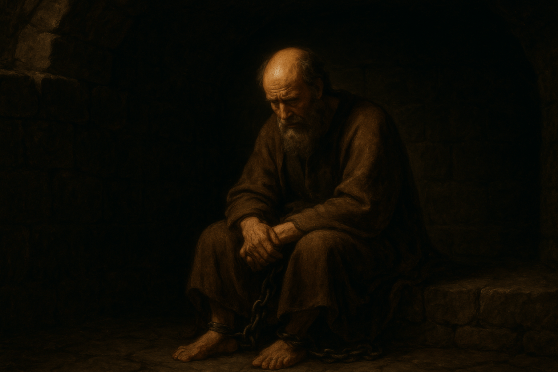
Paul, the firebrand preacher who stirred things up wherever he went, was arrested. No house arrest this time. Paul was thrown into a deep, dark dungeon. He was chained to a wall in the dark. With the Romans arresting, torturing, and executing Christians, many followers decided that maybe they didn’t believe after all. Others distanced themselves from Paul, not wanting to get swept up in his wake and find themselves chained next to him in the dungeon.

Paul was alone in the dark in his chains. He felt abandoned. He knew that his time was short. There would be no dismissing of the charges this time. There would be no furlough. His execution is imminent. His second letter to Timothy is Paul’s final letter. It’s his swan song and his last will and testament.

In today’s opening chapter, Paul is torn in two directions. With his impending death, he knows that Timothy is going to find himself leading the gathering of believers in Ephesus without Paul’s tutelage. He wants to encourage Timothy and provide some final instructions before he dies. At the same time, Paul is desperate for Timothy’s company and wants Timothy to visit him.

Stay and lead well, or leave to be with Paul in Rome?

Yes. The opening of the letter expresses the inner conflict and emotions with which Paul was struggling in his dire circumstances.

There was no postal service in the Roman Empire. You had to find people to carry and deliver letters for you. As Timothy cracks open the letter to read it, there is the added emotion of knowing that Paul might have even been executed in the time it took for the letter to reach him. If he does leave Ephesus to visit Paul in Rome, will he even find Paul alive? Will he be thrown into prison and executed with Paul. Colleagues like Phygelus and Hermogenes had clearly decided that they’d rather not risk their own necks to be associated with Paul. Timothy was faced with the same dilemma.

Meditating on the depressing realities that Paul and all believers were facing under Nero’s persecution, I am once again reminded that life in this fallen world does not always turn out the way we’d hoped. Sometimes prayers for lives of peace and safety are answered with the violence of the kingdoms of this world. Not just for Paul in Rome, but for believers around the world today.

Believers in China and North Korea regularly find themselves at risk for persecution, imprisonment, torture, and execution. Christins in Nigeria are being rounded up and slaughtered. It is estimated that 52,000 Christians have been killed by Muslim militants since 2009. Five million people have been displaced because of persecution against Christians.

In the quiet this morning, I find myself grateful for the peace, the quiet, and the safety with which I can currently pursue my faith and my life. I’m whispering a prayer for those who, like Paul, lie in darkness and chains. Those who feel alone and abandoned in their persecution. Those who face the possibility of being tortured or executed this day because of their faith in Jesus.

Lord, have mercy.

If you know anyone who might be encouraged by today’s post, please share.

Promotional graphic for Tom Vander Well's Wayfarer blog and podcast, featuring icons of various podcast platforms with a photo of Tom Vander Well.
These chapter-a-day blog posts are also available via podcast on all major podcast platforms including Apple, Google, and Spotify! Simply go to your podcast platform and search for “Wayfarer Tom Vander Well.” If it’s not on your platform, please let me know!

Hot Times and Cold Love

Hot Times and Cold Love (CaD Matt 24) Wayfarer

“Because of the increase of wickedness, the love of most will grow cold…”
Matthew 24:12 (NIV)

Our daughter, Taylor, works for a software company that has developed an amazing product, Storii, for those with dementia and Alzheimers. It started with the simple idea of helping those who are losing their memory to build and store their stories for their family and loved ones, but it basically applies to any person who wants to archive their lives and stories for subsequent generations. It’s brilliant.

One of the features of Storii prompts automated calls to the individual a few times a week. Each call asks a question like, “What radio or television programs did you watch growing up?” It then records the answer, places it on that person’s Storii page, and any connected loved ones get an email giving them access to the recording.

In recent weeks, Taylor asked me to help her test this audio recording feature, so I’ve been recording my answers and having a fun time doing it. I confess that it has put me in a nostalgic frame of mind. I’ve even placed a couple of Grumpy Old Man memes on our family text string. So much has changed in 50 years it’s mind-blowing. For my aging parents, I can only imagine that the feeling is magnified.

In today’s chapter, Jesus speaks apocalyptically about the end times. It’s pretty bleak stuff. The Great Story is, after all, a grand epic of conflict between good and evil. The end of most every good vs. evil tale is a final climactic conflict: think of the final battle at the Black Gate in Lord of the Rings, the battle of Hogwarts in Harry Potter, or the final scenes of every Marvel, DC, and Star Wars movie. The last installment of the Chronicles of Narnia is simply titled The Last Battle. You catch my drift. Jesus told His followers to expect the same in the end times, with creation itself adding to the havoc with famines and earthquakes.

What resonated in my heart this morning was Jesus’ prophetic statement that amidst the “increasing wickedness” and heated build-up of the final conflict, as evil persecutes followers of Jesus, the love of many followers will grow cold. I have to imagine that this is true whenever the persecution of believers takes place, like in Nigeria where over 10,000 followers of Jesus have been slaughtered in the last couple of years. When heads literally start to roll, I can only imagine that one asks themselves, “How much do I really believe this?”

In the quiet this morning, I find myself thinking about my own story. I’m thinking about the rapid decline and rejection of Christians and Christian thought across social institutions. I hear echoes in my head of my friend Chuck who helped market Corrie Ten Boom’s movie The Hiding Place. Corrie told him that she was making the film to prepare American Christians for the persecution that they will soon face. As a teenager, I couldn’t imagine that ever happening. Now, I’m not so sure. Am I just being a grumpy old man? It’s entirely possible. Forgive me. I again confess I’ve been in that frame of mind of late.

Whether or not I ever face serious persecution in my lifetime, the big question resonating in my heart on this frigid winter morning in Iowa is this: “As my life story continues to be told, could my love for Jesus ever grow cold?” (rhyme unintended, but nice…😉)

If you know anyone who might be encouraged by today’s post, please share.

Trouble and Peace

Trouble and Peace (CaD John 16) Wayfarer

They will put you out of the synagogue; in fact, the time is coming when anyone who kills you will think they are offering a service to God.” 
John 16:2 (NIV)

The little Iowa town where Wendy and I live has a fascinating history. It was founded and designed by a pastor who was escaping persecution in the Netherlands. That sounds odd to most people since the Netherlands is known for being a place of tolerance. In the early 1800s, however, the King of the Netherlands, and the government, controlled the church of the Netherlands. Pastors were told what to preach, and were threatened and punished if they disobeyed.

There was a group of rebellious young pastors who led an organized secession from the state church. Some were imprisoned for it. The leader of the secessionist movement was H.P. Scholte, and it was during this period of conflict with the state church of the Netherlands that he decided he wanted to experience the freedom of religion and the freedom of speech guaranteed to all Americans. In 1847, he led hundreds of followers to the Iowa prairie and created a town out of nothing.

In America, Scholte fully exercised his freedoms. Always a maverick, he refused to join any denomination and eventually built his own church which he led as a local, independent, non-denominational congregation. He practiced his freedom of speech by publishing his own paper, loudly speaking out for the abolition of slavery, and getting involved in the political process. He became a friend of Abraham Lincoln. The faith and spirit that Scholte and his wife imbued in this town is still evident for those who have eyes to see it.

Today’s chapter is the third of four chapters that John dedicates to all the things Jesus told His followers on the night before His crucifixion. Almost 20% of his biography is dedicated to those few hours on a Thursday evening.

Two chapters ago, I observed that all of the players present in the “fall” in the Garden of Eden (Genesis 3) are represented and/or referenced on this fateful evening. Again in today’s chapter, Jesus references the “prince of this world.” Jesus points to the fact that the events of this evening are part of a larger story; They are part of the Great Story.

What fascinated me as I, once again, read Jesus words to His followers this morning was both the warning and the promise with which today’s chapter is bookended. Jesus begins by warning His followers of the difficulties they will soon face: institutional persecution and the threat of death. Jesus wasn’t lying. All but one of the eleven disciples listening to these words (Judas was, at that moment, carrying out his betrayal) would be killed, martyred, for carrying out Jesus’ mission. At the end of the chapter, Jesus reiterates the “trouble” that they will experience in this world adding that “in Him” they would find peace amidst the conflict.

As I contemplate this, I am reminded of three things:

First, that when Wendy and I attended our local gathering of Jesus’ followers yesterday, it was the result of a legacy of believers who literally risked life and limb to escape “trouble” to carve out lives in the freedom of America.

Second, I am reminded of the “trouble” that many followers of Jesus face this day. I recently read that in Nigeria, 43,000 followers of Jesus have been killed in the past 12 years. An additional 18,000 have permanently disappeared. 17,500 churches have been attacked. There are 49 other countries in which the risk of “trouble” for being a follower of Jesus is rated “very high” to “extreme.” Those are dangers a follower of Jesus in America can largely ignore because it’s not my reality.

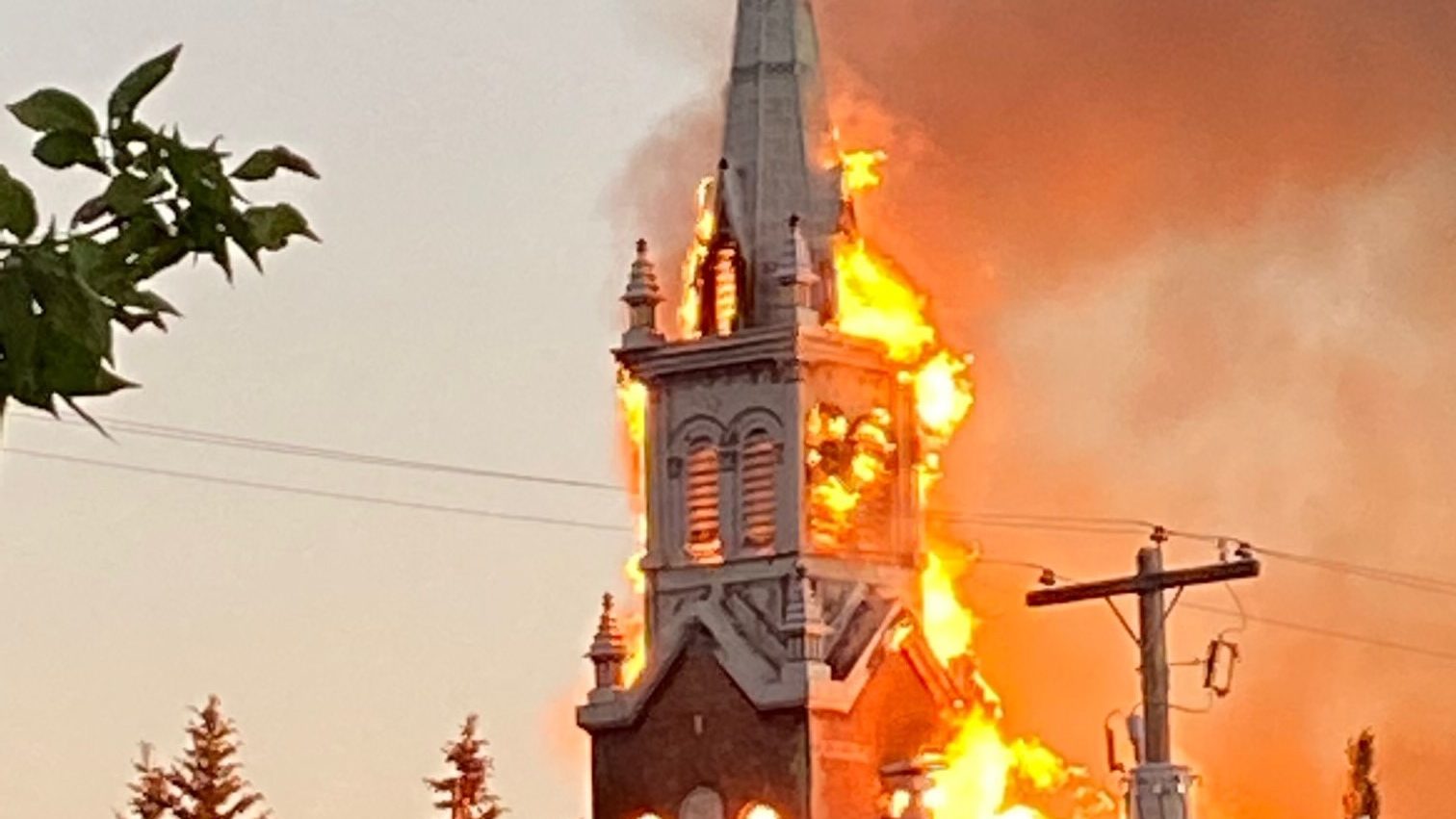
Which brings me to my third thought. In recent weeks, almost 60 churches have been attacked and burned in Canada, and last week a group of followers exercising their right to freely assemble and publicly worship were physically attacked by Antifa while police allegedly stood by and did nothing. “Trouble” is suddenly hits closer to home in ways I never expected to see in my lifetime.

In the quiet this morning, I’m reminded of Jesus’ promise which was a very direct contrast statement: In this world you will have trouble,” He stated, while In me you will have peace.” The latter was never intended to negate or escape the former. Rather, it was intended as the means to endure it.

If you know anyone who might be encouraged by today’s post, please share.

Chapter-a-Day Leviticus 21

via Flickr & gawwdkristen

God spoke to Moses: “Tell Aaron, None of your descendants, in any generation to come, who has a defect of any kind may present as an offering the food of his God.” Leviticus 21:16 (MSG)

One of the tasks of my job is helping companies establish a standard for quality when it comes to serving customers on the phone. My experience is that most companies establish a low standard because they want to make sure that all of their employees can meet the standard with very little effort. Some companies establish a very high standard so that their employees must work very hard to improve their performance and reach their goal. I have never watched a company set such a high standard that a perfect score always meant an exceptionally great service experience. Even with the toughest quality scales, you can listen to calls that received the highest possible score and find opportunities for improvement.

As I read today’s chapter, I couldn’t help but see a parallel. I read the list of rules and expectations for the priests and I felt like I was reading a list of performance management expectations from God’s HR department. And, the scale was unbelievably tough. The smallest defect in person or performance rendered the priest unfit to serve on God’s team.

Once again, I find myself left with a clear picture of a holy God demanding holy perfection. The result is a quality assessment scale which sets the bar so high that no one ever reaches 100. And, that is the point of the scale. When we finally realize that we can never reach the demands of moral and spiritual perfection from holy God, we will be ready to understand God’s priceless gift and sacrifice God made on our behalf.

Enhanced by Zemanta