Tag Archives: Devotion

Building People

Building People (CaD Ex 39) Wayfarer

They made the rosette of the holy diadem of pure gold, and wrote on it an inscription, like the engraving of a signet, “Holy to the Lord.”
Exodus 39:30 (NRSVCE)

As I’ve mentioned many times in these posts, I have been part of many different churches along my spiritual journey. I’ve been part of small rural churches, various types and sizes of denominational churches, and suburban mega-churches. It’s been fascinating to have a plethora of experiences.

I recall being part a very large church who was in building mode. There was a giant fundraising campaign, and I remember being invited to a big dinner where the plans for the building were announced. The plans were impressive to say the least. It would be the largest church in that state with state-of-the art everything inside. One might even say that it was opulent.

I remember speaking with one of the staff members and questioning the grandiosity of plans and whether it was necessary. He pointed me to these past few chapters of Exodus and the design of the Tabernacle with its gold diadem, the priestly breastplate of precious gems, the tent made of expensively dyed cloth, and the ark made of wood overlaid with gold leaf. His point was that God appreciates and desires his temple be richly fashioned.

But, Jesus both lived and taught a very different way:

“Foxes have dens and birds have nests, but the Son of Man has no place to lay his head.”
Luke 9:58 (NIV)

The Jews then responded to him, “What sign can you show us to prove your authority to do all this?” Jesus answered them, “Destroy this temple, and I will raise it again in three days.” John 2:18-20 (NIV)

Do you not know that your bodies are temples of the Holy Spirit, who is in you, whom you have received from God? You are not your own; you were bought at a price. Therefore honor God with your bodies.
1 Corinthians 6:19-20 (NIV)

Don’t hear what I’m not saying. I believe that having a building to meet in is a good thing. I also believe that people across history have created beautiful works of architecture and artistry in a sincere attempt to honor and glorify God. At the same time, I can’t escape the fact that Jesus never once told His followers to build a building, temple, chapel, sanctuary, cathedral, or basilica. The only time Jesus mentioned building a church He was speaking metaphorically about Peter’s faith being the rock that would be the church’s foundation; Not bricks-and-mortar but flesh-and-blood.

In retrospect, I learned a huge lesson as I observed a pastor and staff driven by an edifice complex that they desperately tried to justify, an edifice they desperately made happen, and a church that eventually imploded from within. Last I knew, the edifice has sat empty and in disrepair for many years.

I keep coming back to the understanding of context as I near the end of this journey through Exodus. I’ve found a lot of spiritual lessons in the 39 chapters of Exodus, but much of the lessons come from understanding what God was doing with Moses and Hebrews in the context of their time and place in history. Like the good religious Hebrew, Paul, the best lessons are in how humanity has grown and matured; How God has matured the relationship and led to a much deeper understanding of the mystery. Exodus has reminded me just how dramatically Jesus changed things and how humanity, myself included, keeps getting stuck and falling back into our ancient patterns of religious thought. Just like that pastor justifying a building that no one needed.

I believe that this spiritual journey has a destination, and as I make progress on Life’s road I’m also supposed to also be progressing in my spiritual maturity and my relationship with God. As Paul wrote to the followers of Jesus in Colossae: “So then, just as you received Christ Jesus as Lord, continue to live your lives in him” … the Son of Man with no place to lay His head. Jesus, who taught His followers to build people instead of buildings.

If you know anyone who might be encouraged by today’s post, please share.

More Than Enough

More Than Enough (CaD Ex 36) Wayfarer

[The artisans making the Tabernacle] said to Moses, “The people are bringing much more than enough for doing the work that the Lord has commanded us to do.”
Exodus 36:5 (NRSVCE)

When I was fifteen I went to a weekend long conference just south of the Chicago area. I’d never been to Chicago, so I and my two friends drove into the city and spent the afternoon sightseeing. When we got back to the car, we discovered that my duffel bag had been stolen out of the car. It had everything I brought with me including my money for the conference. I was left, literally, with nothing but the clothes on my back for the weekend.

Upon arrival at the conference we explained my situation to the people at the registration table. They assured me that it was not a big deal, and they’d make arrangements to have my parents send a check for my registration. At the beginning of the first session that evening I was asked to stand and the host explained to everyone at the conference what had happened.

I was unprepared for the outpouring of generosity I was about to experience. All weekend long people were handing me cash. People who lived nearby went home and brought back boxes full of clothes for me. No matter how much I implored people that I had more than enough to get me through the next two days of the weekend conference, it just kept coming. I went home with far more than I had stolen, including a really good spiritual lesson.

That was my first experience in life with having something stolen from me, and I’d never been in a position where I was on my own and in need. I can remember being kind of freaked out by the experience and how I was going to manage, but I quickly learned that God provides through the generosity of others. I’ve endeavored for just about forty-years to pay it forward whenever the opportunity arises. That’s how Kingdom economics works.

In yesterday’s chapter, Moses asked the Hebrew people to bring an offering of materials for constructing this temple tent God told them to build. In today’s chapter, the outpouring of generosity is overwhelming and Moses tells everyone to stop bringing more materials for the work.

I couldn’t help but think of Jesus words this morning as I pondered the Hebrews generosity, and the generosity I experienced at the very beginning of my spiritual journey:

What I’m trying to do here is to get you to relax, to not be so preoccupied with getting, so you can respond to God’s giving. People who don’t know God and the way he works fuss over these things, but you know both God and how he works. Steep your life in God-reality, God-initiative, God-provisions. Don’t worry about missing out. You’ll find all your everyday human concerns will be met.

“Give your entire attention to what God is doing right now, and don’t get worked up about what may or may not happen tomorrow. God will help you deal with whatever hard things come up when the time comes.

Matthew 6:31-34 (MSG)

I also thought of the early followers of Jesus generously bringing everything they had to life’s potluck and making sure that everyone had enough.

In this time of COVID craziness with many people out of work, in the wake of small family businesses burned to the ground by riots, there are a lot of people worried “about what may or may not happen tomorrow.” I confess that I’m feeling the anxiety, at times. Today’s chapter is a good reminder of God’s provision. In the economy of God’s Kingdom, there is always more than enough. My priority is to be generous in meeting the needs of others and then trust God’s generosity in meeting mine.

Have a great weekend, my friend!

If you know anyone who might be encouraged by today’s post, please share.

Positively “Horny” with Light

Positively "Horny" with Light (CaD Ex 34) Wayfarer

When Aaron and all the Israelites saw Moses, his face was radiant, and they were afraid to come near him.
Exodus 34:30 (NRSVCE)

“Let there be light.”

That’s the first act of creation in the poetic description of the beginning of everything in the opening verses of Genesis. This simple beginning, however, is not so simple. In fact, it’s hard to contain its meaning. It is part of the mystery of God and the universe that both theology and science have endlessly been attempting to understand. I can’t explain it any better than the Encyclopedia Brittanica does:

No single answer to the question “What is light?” satisfies the many contexts in which light is experienced, explored, and exploited. The physicist is interested in the physical properties of light, the artist in an aesthetic appreciation of the visual world. Through the sense of sight, light is a primary tool for perceiving the world and communicating within it. Light from the Sun warms the Earth, drives global weather patterns, and initiates the life-sustaining process of photosynthesis. On the grandest scale, light’s interactions with matter have helped shape the structure of the universe. Indeed, light provides a window on the universe, from cosmological to atomic scales. Almost all of the information about the rest of the universe reaches Earth in the form of electromagnetic radiation. By interpreting that radiation, astronomers can glimpse the earliest epochs of the universe, measure the general expansion of the universe, and determine the chemical composition of stars and the interstellar medium. Just as the invention of the telescope dramatically broadened exploration of the universe, so too the invention of the microscope opened the intricate world of the cell. The analysis of the frequencies of light emitted and absorbed by atoms was a principal impetus for the development of quantum mechanics. Atomic and molecular spectroscopies continue to be primary tools for probing the structure of matter, providing ultrasensitive tests of atomic and molecular models and contributing to studies of fundamental photochemical reactions.

In the same way, light is fundamentally a part of the spiritually supernatural:

  • Light was the first order of creation on the first day of creation in the Genesis creation ( keep in mind the sun, stars, and moon weren’t created until the fourth day).
  • After healing a boy born blind, Jesus said, “I am the light of the world.”
  • In the sermon on the mount, Jesus told his followers, “You are the light of the world.”
  • Jesus took his inner-circle (Peter, James, and John) up on a mountain (just like Moses in today’s chapter) and was “transfigured” before them (e.g. Matthew records the He shone like the sun while Luke describes it as bright as a flash of lightning). And Moses appeared with Him.
  • Angelic beings are consistently described throughout the Great Story as shining radiantly.
  • At the very end of the Great Story in Revelation (spoiler alert: the end is a new beginning) “There will be no more night. They will not need the light of a lamp or the light of the sun, for the Lord God will give them light.”

In today’s chapter, Moses returns to the top of the mountain and spends another 40 days with God. When he returns, the text says that his face was so radiant that it freaked out the Hebrews (for the record, Peter, James, and John were equally freaked when Jesus revealed the light of His glory).

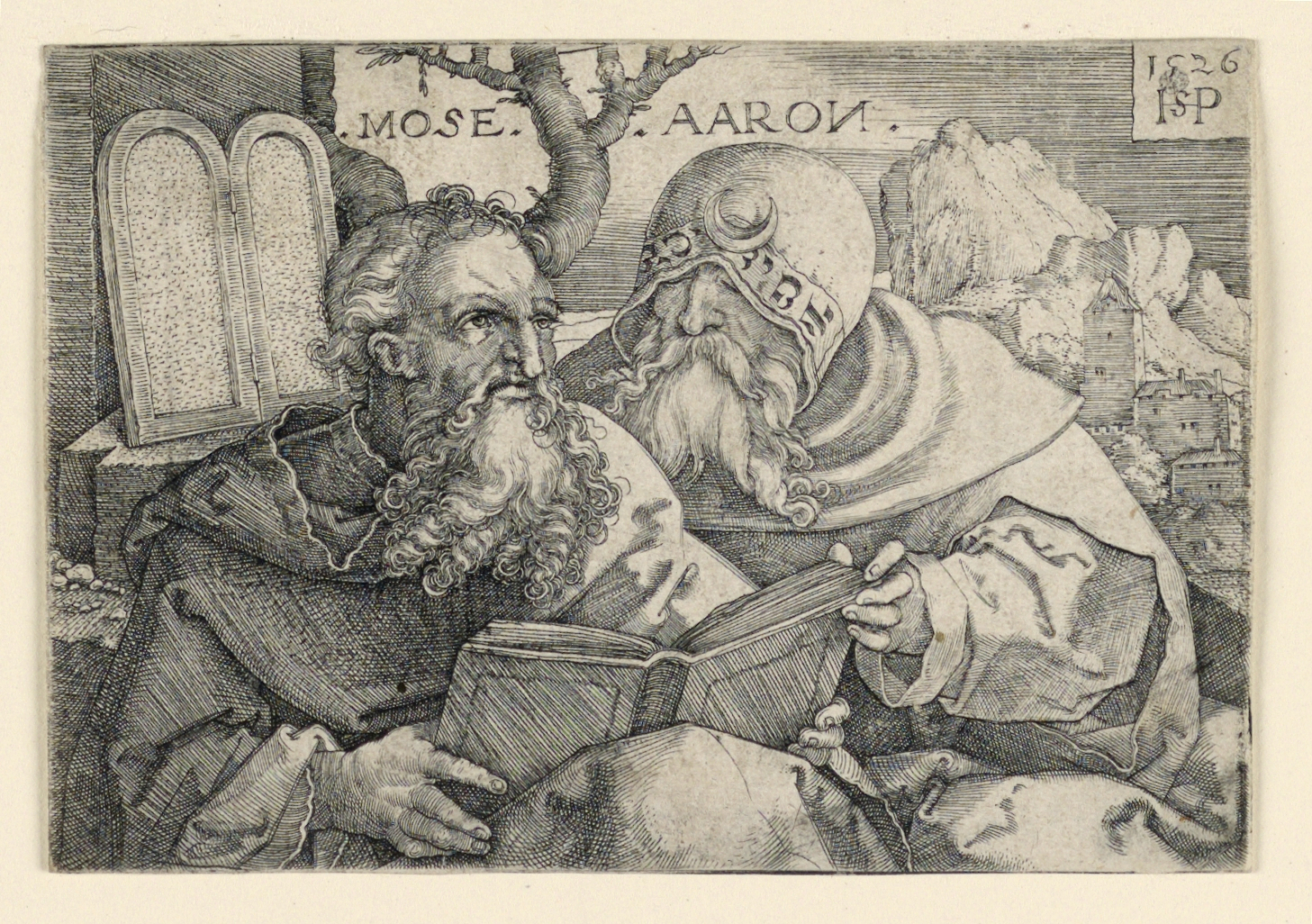
Here’s a bit of additional mystery for you. The Hebrew word used here is actually translated “horns.” That’s why many artistic depictions of Moses (the most famous is Michaelangelo) show him having horns on his head:

Moses

So, what’s up with that?! I talked in my podcast, A Beginners Guide to the Great Story Part 1 about the fact that when thinking about the ancient stories we have to consider the context of the times in which they were living. The mystery of Moses’ horns is a great example. There is an ancient Babylonian text that uses the Sumer word si which is also the word for “horn” to describe a solar eclipse in which the sun’s light appears like “horns” (think “rays of light”) shooting out from behind the darkened moon. It’s quite possible that the word “horns” was layered with meaning and the ancients understood what we call “rays” of light to be “horns of light.”

In the quiet this morning, I find my brain buzzing with all sorts of thoughts about light and how it is part of the mystery of both the spiritual and the scientific. Humanity has so often made the two into binary, either-or, opposites and enemies. The further I get in my journey, the more I am convinced that, in the end, we will understand that they are two parts of the same mystery. It’s a “both, and.”

As a follower of Jesus, I can’t help but go back to Jesus’ call for His followers to be “light” to the world”:

“Let me tell you why you are here. You’re here to be salt-seasoning that brings out the God-flavors of this earth. If you lose your saltiness, how will people taste godliness? You’ve lost your usefulness and will end up in the garbage.

“Here’s another way to put it: You’re here to be light, bringing out the God-colors in the world. God is not a secret to be kept. We’re going public with this, as public as a city on a hill. If I make you light-bearers, you don’t think I’m going to hide you under a bucket, do you? I’m putting you on a light stand. Now that I’ve put you there on a hilltop, on a light stand—shine! Keep open house; be generous with your lives. By opening up to others, you’ll prompt people to open up with God, this generous Father in heaven.”

-Jesus (Matt 5:13-16 [MSG])

What does that mean for me? Am I a light-bearer? Do these posts and podcasts shine? More importantly, do my daily words and interaction with family, friends, neighbors, strangers, community, enemies, acquaintances, and foreigners radiate with love, joy, peace, patience, kindness, goodness, gentleness, faithfulness, and self-control? Am I being generous with my life? Is my house open? Am I opening up to others?

It’s what I’m endeavoring to do increasingly today, each day of this earthly journey. I want the words of my mouth, the meditations of my heart, the work of my hands, and my interactions with everyone to be positively “horny” with Light.

If you know anyone who might be encouraged by today’s post, please share.

Breaking a Stiff-Neck

Breaking a Stiff-Neck (CaD Ex 33) Wayfarer

For the Lord had said to Moses, “Say to the Israelites, ‘You are a stiff-necked people; if for a single moment I should go up among you, I would consume you. So now take off your ornaments, and I will decide what to do to you.’”
Exodus 33:5 (NRSVCE)

One of the ironies of this period of COVID-19 pandemic is that everyone has been stuck inside with nothing to do, but because the quarantine includes actors, crews, studios, and production companies there’s been nothing new to watch on television! So, Wendy and I have been extra excited to have new episodes of Yellowstone airing the past three weeks.

If you haven’t watched Yellowstone, it’s about the patriarch of the largest ranch in the United States that also happens to be some of the most valuable and sought after land in the world. Kevin Costner plays the widowed, wealthy, and powerfully connected rancher John Dutton who struggles to control his dysfunctional family and protect his ranch from a host of enemies who want to take him down and get their hands on his land. Wendy and I have both observed that it’s a lot like a modern-day Godfather, but rather than Italian mobsters in New York it’s cowboys in Montana.

One of the subtle, recurring themes in the show is that of wild horses that need to be broken. In the first season, we’re introduced to Jimmy, a drug-addicted, two-strike loser going nowhere. As a favor to Jimmy’s grandfather, Dutton takes Jimmy on as a ranch-hand. In an iconic moment, Jimmy is tied and duct-taped onto a wild horse that no one else could break. All-day long Jimmy is bucked, spun, and tossed on the back of the horse. By the end of the day, the horse is finally broken, and so is Jimmy.

Today’s chapter is a sequel to yesterday’s story of the Hebrew people abandoning Moses, and the God of Moses, by making an idol for themselves and reverting to their old ways. In response, God calls the people “stiff-necked” (other English translations and paraphrases use words like “stubborn’ or “willful”). One commentator I read stated that the imagery of the original Hebrew word was an ox, bull, or another animal that was unbroken and wouldn’t yield to being yoked. I couldn’t help but think of poor Jimmy duct-taped to that horse.

One of the things I’ve observed in certain human beings is an unbroken spirit. I recall Wendy sitting with a toddler who was determined to climb up our bookcase at the lake which, of course, would have been a dangerous thing to do. The little one had revealed a habit of willfully proceeding whenever an adult said “No.” Wendy sat there and repeatedly pulled the child’s hand and foot off of the bookcase over, and over, and over again as she gently and firmly repeated: “No.” I remember Wendy explaining to the child that she would sit there all day and repeat the process until the child understood. The child cried, wailed, and threw a tantrum in frustration as Wendy calmly continued to deny the toddler’s willful, stiff-necked desire.

Of course, adults can be simply grown-ups who are stuck in childish patterns of thought and behavior. One of the most fascinating things about the story of the early Jesus movement is the transformation in the strong-willed, stiff-necked followers such as Peter, Paul, and John. With each one there was a process involved in the spiritual transformation that included moments of their strong-wills being broken and their spirits humbled as they learned what Jesus meant when He said things like “Take my yoke upon you and learn from me, for I am gentle and humble in heart, and you will find rest for your souls” and “Whoever tries to keep their life will lose it, and whoever loses their life will preserve it.”

In the quiet this morning I am looking back on my nearly 40 years as a follower of Jesus. I’ve had a lot of ups and downs. Life has tossed me around a time or two. Some stretches of the journey felt like I was spinning in place. But I’ve come to realize that the spiritual journey is just me being poor Jimmy on that horse. I’ve found God to be a lot like Wendy at that bookcase repeatedly and gently telling a childish, stiff-necked Tommy “No.” The breaking of my will is a prerequisite for discovering God’s.

If you know anyone who might be encouraged by today’s post, please share.

Sabbath

Sabbath (CaD Ex 31) Wayfarer

[The Sabbath] is a sign forever between me and the people of Israel that in six days the Lord made heaven and earth, and on the seventh day he rested, and was refreshed.
Exodus 31:17 (NRSVCE)

One of the things that becomes really clear when you read through the Moses story is the emphasis that God placed on the idea of what’s called Sabbath. It’s one of God’s Top Ten rules and God keeps bringing it up, over and over again, and reminding the Hebrew people how important it is to knock off work every seven days. In concept, Sabbath is really pretty simple. The Creation story at the very start of Genesis describes God as having created the universe in six days. Then, on the seventh day, He took the day off and got some rest. Easy. Work six days, then take a day off. Get some rest. Be refreshed.

I have always scratched my head at what a sticking point Sabbath has been for people ever since. I mean, just a few weeks ago Grandma Vander Hart reminded me that God doesn’t want me mowing my lawn on Sunday, and she was quite serious. She also has a thing with tattoos, but that’s a post for another day.

When I grew up, my family were regular church attenders and sincere about God in a general sort of way. Going to church on Sunday was pretty much a given. We had rote prayers for family meals and bedtimes. During Christmas or Lent, mom might make us do the family devotion prescribed by our church which always felt a little awkward. The religious thing was always there, but it wasn’t a pervasive part of life. Sundays were always a restful day. After church mom usually made brunch, and then the rest of the day was spent chilling out. We kind of did Sabbath by default but nobody got uptight about it.

After becoming a follower of Jesus and becoming exposed to the traditions of other families and churches, I learned that this “Sabbath” thing was something certain churches and denominations took very seriously. Mothers prepared all of the Sunday meals on Saturday so they wouldn’t have to work. But that didn’t make sense because they still had to warm it up, serve it to the family, and clean up afterwards. So, I guess women still had to work, but less. I had friends tell me that they literally sat around in their living room with their family doing nothing. Some of them even had to be quiet. Maybe they got to read, but some couldn’t watch television because that meant you were making someone else work to entertain you and that was considered “conspiracy to commit Sabbath-breaking” in their religious code.

As I started to try and study and understand it, it got so confusing because the 7th day of the week was prescribed as the Sabbath. We read it again today! I knew my Jewish friends treated Saturday as “church day” but all the Christian churches I knew treated Sunday (which is the first day of the week) as the Sabbath day. When I asked about this I was told that when Jesus rose from the dead on Sunday, the Sabbath changed to Sunday in the Christian tradition, but I knew for a fact that wasn’t anywhere in the Bible. After the resurrection, there’s not one shred of evidence that Jesus said, “Hey boys, we’re going to make an official Sabbath switch.” In fact, the record states clearly that the Twelve continued to follow all of the Hebrew traditions. So, these same people who were being ultra-legalistic and literal about obeying the Sabbath weren’t literal or legalistic at all about obeying the Sabbath on the only day prescribed for the Sabbath in scripture!

Sabbath confusion and conflict has been around forever. It started with the Hebrews and Moses and it was still causing conflict when Jesus showed up. Jesus was perpetually hounded by the religious leaders about keeping the Sabbath. If Jesus healed someone on the Sabbath He got in trouble. If His disciples picked a fig off a tree as they were walking by He got in trouble. And each time it came up, Jesus brushed it off. In fact, He made a point of healing someone on the Sabbath just to make it clear to the religious fundamentalists when He said: “The Sabbath was made to help humans. Humans weren’t made to serve the Sabbath.”

And, in the quiet this morning I’m reminded that this was the point. The Hebrews in Moses’ day had been slaves for hundreds of years. They never got a day off. The concept of a day of rest was foreign to them. They were an agrarian people with farms and livestock, and it’s easy to become a workaholic when there are fields and animals that need constant tending. When you’re so focused on your work all the time, you have very little physical, mental, or spiritual energy left. It’s unhealthy on multiple levels. What did Jesus say were the two commands from which all the others flow?

  1. Love God with everything you got. But if I’m working all the time then God ends up getting little or nothing from my depleted body, mind, and soul.
  2. Love others as you love yourself. But, if I’m working all the time then I’m really not loving myself well, and everyone around me gets nothing of me but what meager leftovers of self I have left.

I’m also reminded of observing how the legalism and fundamentalism I experienced early in my spiritual journey created really sad, angry, and bitter people whose lives, and even their worship, appeared to me to be void of anything close to resembling peace, love, or joy. I observed that what it did create were people driven to keep up religious appearances in public while sneaking around doing what they shouldn’t in secret.

This is exactly what Jesus came to free us from. And Sabbath is a great foundational lesson. It’s easy. We each need regular rest, relaxation, and relationship with our fellow sojourners on life’s road. We need to stop work for a day and fill the life tank with a good meal, some meaningful conversation, playing together, laughing together, and sharing of life together. Sabbath is about lifting the burdens and the drudgery of everyday life, not adding to it.

And, speaking of Sabbath, it’s the 4th of July holiday weekend coming up here in the States. Wendy and I will be doing a little extended Sabbath, exactly as I just described, with a couple of other families who are dear friends. So, I’ll be taking a few days off of blogging.

I hope you experience some Sabbath, as well, my friend. And, experience it in the fullness of the way God always intended it. Cheers!

If you know anyone who might be encouraged by today’s post, please share.

I Smell.

I Smell (CaD Ex 30) Wayfarer

“You shall make an altar on which to offer incense…”
Exodus 30:1 (NRSVCE)

I typically keep a fragrant candle on the desk in my office. I like scents of vanilla the best. Right now I’ve been trying out a candle labeled as “tobacco and vanilla.” I thought it might remind me of the smell of my grandfather’s pipe. Not so much. I do, however, like the scent.

Along my life journey, I’ve observed that smell is the physical sense to which we give the least attention. Sight, hearing, taste, and touch get the most of our attention. Our olfactory senses aren’t as necessary for human survival as they once were. Nevertheless, a scent can create a powerful response with me. Some experts say that smells plays more of a role in attracting a mate than we even realize. More consciously, it can bring back a memory like the smell of a rose reminding me of my Grandma Vander Well’s perfume. It can create a sense of peace and security like the smell of freshly baked bread wafting up from the kitchen. It also works in negative terms. Some smells give me a headache or can make me feel physically ill.

Incense played a large part in ancient religious ceremonies. In today’s chapter, God continues to prescribe to Moses how the Hebrew tribes will worship. The chapter begins with designs for an altar on which incense is to be perpetually burned and it ends with a unique recipe for the fragrant ingredients a perfumer is to blend the incense. Because the fragrant oil used to anoint Aaron and the priests, and the incense burned in the traveling temple was unique, the smell would become associated in the hearts and minds of the Hebrews with being present at God’s place and giving their sacrifices and offerings. The smoke of the burning incense also became a metaphor for the prayers of God’s people wafting up to heaven.

Incense once again became part of worship in the Roman Catholic and Orthodox traditions in Christianity, though I have head it argued that it was primarily a practical way for the priest to overcome the powerful pungency of body odor emanating from the poor, unbathed masses packing into the church on Sunday. It was never a formally prescribed practice of the early followers of Jesus. In the New Testament, the only references to incense point to either the practice in the Hebrew ritual or else to John’s visions of heaven in Revelation.

The use of incense in Hebrew worship was, however, linked to an important metaphor understood by early believers. In his second letter to the followers of Jesus in Corinth, Paul writes:

But thanks be to God, who always leads us as captives in Christ’s triumphal procession and uses us to spread the aroma of the knowledge of him everywhere. For we are to God the pleasing aroma of Christ among those who are being saved and those who are perishing. To the one we are an aroma that brings death; to the other, an aroma that brings life.
2 Cor 2:14-16 (NIV)

Once again, I find that the physical bricks-and-mortar (or in this case oil-and-incense) of the Hebrew system matures through Jesus and shifts into a flesh-and-blood understanding of what God is doing. In the former, people came to a central location where the fragrance of the priests and the burning incense reminded them of God’s presence. In the latter, every follower of Jesus becomes part of a “royal priesthood” taking the fragrance of Jesus with us wherever we go and among any and all people with whom we interact in our circles of relationship and community.

I have spent twenty-five years in a career in which I travel and regularly visit our clients in their places of business around the country. I am always praying that I will be the fragrance of Christ while I am there conducting training sessions, making executive presentations, and coaching or mentoring individuals.. What’s fascinating to me is that I have on several occasions had someone literally ask me if I’m a Christian. When I confess that I am, the response is typically, “I knew it. I could just tell.” Equally fascinating to me is that in almost every long-term engagement with a client there is an individual or two who react to my presence with intense animosity. In those instances, I get to practice returning curses with blessings and showing (often unreciprocated) kindness.

In the quiet this morning, I can’t help but think of the message I gave yesterday among my local gathering of Jesus’ followers. Today’s chapter so beautifully illustrates a point I was making. I observe that many are stuck in the old paradigm of a religious institution founded on the notion of bringing God’s Kingdom to earth. People gather to do the regularly scheduled religious bit, then forget about it until my next scheduled appearance on Sunday, or Christmas, or Easter.

Jesus changed all that in practice. He started with getting the Kingdom of God into the individual, transforming the human being into the Temple in whom God’s Spirit dwells. It is the individual who takes God’s Kingdom wherever they go and impacts people in every relationship and circles of influence. I don’t burn incense at the temple, I am the temple from which God’s fragrance seeps out in my love, kindness, gentleness, patience, faithfulness and self-control. Some are attracted. Some are repelled. That’s something I don’t control, though how I respond to it is.

Monday. Another week. Holiday coming up. I have appointments, a little travel, and a weekend full of friends. Hope I’m fragrant in all the good ways.

If you know anyone who might be encouraged by today’s post, please share.

Another Choice

Another Choice (CaD Ex 29) Wayfarer

…Aaron and his sons shall eat the flesh of the ram and the bread that is in the basket, at the entrance of the tent of meeting. They themselves shall eat the food by which atonement is made…
Exodus 29:32-33 (NRSVCE)

Along my life journey, I have observed that we like things simple. In fact, we like things in twos, binary, either-or, black-or-white. Even when it comes to spiritual matters, human beings find it easiest to reduce things down to binary terms.

We teach children that they are either “good” or “naughty.” It’s one or the other. As David Sedaris once noted, if you’re naughty then Santa will fill your stocking with coal. If you’re good and live in America, Santa will pretty much give you whatever you want.

As an adult, I am supposed to mature in my understanding, but I’m not sure I do it all that well. The systems still largely cater to lumping me in one of two binary choices. I’m either a Republican or a Democrat. I’m either left or right, liberal or conservative. I’m either woke or a racist. I’m either selflessly trying to protect the world from COVID or I’m selfishly contributing to the perpetuation of the pandemic. I’m either FoxNews or CNN. I am privileged or oppressed.

Even in spiritual terms, I am good or evil, going to heaven or hell, saved or sinner.

For the ancient Hebrews we read about in today’s chapter, they spiritually saw things in a binary option, as well: clean or unclean. The ancient Hebrews perceived that they moved spiritually back and forth between clean and unclean based on what they ate, what they touched, or bodily fluids were recently excreted. If you were unclean, then you needed to cleanse yourself in order to be “clean” before God. It happened all the time.

In today’s chapter, God is cultivating another spiritual level altogether as the system of worship and sacrifice is prescribed through Moses: being “holy.” The text describes a strange, mysterious, and somewhat gross set of rituals that consecrated Aaron and his boys to make them “holy” priests who could stand before God to represent their people.

What fascinated me as I read about all of the rituals was the fact that Aaron and the priests were asked to sacrifice a bull and a ram and then eventually they would eat the meat of the animal whose blood was shed to atone (that is, to make right and correct what is wrong) for their sin.

Hold the phone.

Fast forward 1500 years or so. Jesus is in the middle of nowhere with thousands of people. They’re all hungry (yeah, kind of like Moses and the Hebrews). When Jesus asks the Twelve what they can spare from their lunch box, it’s nothing but a loaf of Wonder Bread and a couple of fish sticks. Jesus has them split it into baskets and then spread out and start serving the people. Miraculously, there was enough filet-o’-fish sandwiches for everyone plus leftovers (Sounds a lot like the Manna and quail God provided for the Hebrews).

That night, Jesus slips into a boat and goes to another region. The next day, the crowds hurried to rush around the shore and find Jesus before lunchtime. They were thinking in the simplest of binary terms. I’m hungry. Jesus is giving out food.

Then Jesus does something very, well, un-Jesus-like. He cuts them off. No more free meals:

When they found him back across the sea, they said, “Rabbi, when did you get here?”

Jesus answered, “You’ve come looking for me not because you saw God in my actions but because I fed you, filled your stomachs—and for free.

“Don’t waste your energy striving for perishable food like that. Work for the food that sticks with you, food that nourishes your lasting life, food the Son of Man provides. He and what he does are guaranteed by God the Father to last.”

To that they said, “Well, what do we do then to get in on God’s works?”

Jesus said, “Throw your lot in with the One that God has sent. That kind of a commitment gets you in on God’s works.”

They waffled: “Why don’t you give us a clue about who you are, just a hint of what’s going on? When we see what’s up, we’ll commit ourselves. Show us what you can do. Moses fed our ancestors with bread in the desert. It says so in the Scriptures: ‘He gave them bread from heaven to eat.’”

Jesus responded, “The real significance of that Scripture is not that Moses gave you bread from heaven but that my Father is right now offering you bread from heaven, the real bread. The Bread of God came down out of heaven and is giving life to the world.”

They jumped at that: “Master, give us this bread, now and forever!”

Jesus said, “I am the Bread of Life. The person who aligns with me hungers no more and thirsts no more, ever. I have told you this explicitly because even though you have seen me in action, you don’t really believe me…

“Only insofar as you eat and drink flesh and blood, the flesh and blood of the Son of Man, do you have life within you.”

from John 6 (MSG)

In the quiet this morning I can’t help but once again see the parallel between the Exodus story, and the Jesus story. Exodus was the foreshadow provided to an infant nation. Jesus came to mature our understanding of what God’s Kingdom is all about in contrast to the simple satiation and indulgence of our earthbound appetites of the flesh. The Kingdom of God is not like the kingdoms of this world, and it requires the eyes and ears of my heart to see and hear beyond the simplistic choices fed to me by this world.

As mentioned in the last couple of posts, Jesus’ death was the fulfillment of the word-picture God gave Moses and Hebrews in the sacrificial system. Aaron sacrificed a bull, was sprinkled with the blood, and then ate the sacrifice to make things right.

Jesus came to be the sacrifice.

“This is my body broken for you,” He said as he passed the bread and told His followers to eat.

“This is my blood shed for you,” He said as he passed the wine and told His followers to drink.

Just like Aaron and his boys, we spiritually consume the sacrifice.

The sacrifice consumes us.

Everything is made right.

Holy.

Jesus said to the crowds that day:

“Every person the Father gives me eventually comes running to me. And once that person is with me, I hold on and don’t let go. I came down from heaven not to follow my own whim but to accomplish the will of the One who sent me.

“This, in a nutshell, is that will: that everything handed over to me by the Father be completed—not a single detail missed—and at the wrap-up of time I have everything and everyone put together, upright and whole. This is what my Father wants: that anyone who sees the Son and trusts who he is and what he does and then aligns with him will enter real life, eternal life. My part is to put them on their feet alive and whole at the completion of time.”

Until that day, I keep pressin’ on, one-step-at-time, one-day-at-a-time trying to be an agent of God’s Kingdom on this earth. So begins another day in the journey.

Have a great day, my friend.

If you know anyone who might be encouraged by today’s post, please share.

From Bricks-and-Mortar to Flesh-and-Blood

From Bricks-and-Mortar to Flesh-and-Blood (CaD Ex 26) Wayfarer

You shall hang the curtain under the clasps, and bring the ark of the covenant in there, within the curtain; and the curtain shall separate for you the holy place from the most holy.
Exodus 26:33 (NRSVCE)

When I was a child, I had a fascination with spaces that were off-limits to me. Perhaps it was simply part of my personality or the fact that, as the youngest of four siblings, there were so many places that were forbidden and so many things from which I was banned from touching, looking at, or checking out.

As I grew up, I was keenly aware of the rites of passage I passed through. Some where public and institutional like church confirmation, getting my driver’s license, and graduation. Others were more subtle and social, like being an underclassman invited to a party with all upperclassmen, or my older brother letting me have a beer during my weekend visiting him at college. In each of these cases there was an understanding that I had reached a new level of experience. Things that were once off-limits had opened up to new possibilities.

In today’s chapter, God provides Moses with instructions for what is commonly referred to as the Tabernacle, or the Tent of Meeting. It was basically a large, portable temple that they could take with them as they wandered their way to the Promised Land and set up wherever they were encamped.

The design for the Tabernacle included three concentric spaces. There was an open outer courtyard. Then there was a smaller covered inner section known as “The Holy Place,” with a third even smaller section known as “The Most Holy Place” or “The Holy of Holies.” This smallest area was the most sacred, and it was where the Hebrews put the Ark of the Covenant. There was a giant, thick, and colorful curtain that separated this Most Holy space from everyone. Only the High Priest was allowed in this space, and that happened only once a year. It was exclusive. It was special. It was a sacred space that constantly reminded the Hebrew people of the clear divide between them and the divine.

Granted, all of the instructions for the design of this temple tent in today’s chapter are not the most inspiring thing to read. Nevertheless, I find a really cool and inspiring lesson buried in the blueprint. As with yesterday’s chapter, the lesson is hidden in the understanding of the maturing relationship between God and humanity.

An often overlooked detail recorded in Luke’s biography of Jesus is something that happened the moment Jesus died on the cross. Luke records:

It was now about noon, and darkness came over the whole land until three in the afternoon, while the sun’s light failed; and the curtain of the temple was torn in two. Then Jesus, crying with a loud voice, said, “Father, into your hands I commend my spirit.” Having said this, he breathed his last.

I find the curtain separating the Hebrews from God’s Holy Presence was like a parent telling their young child that there are some things that are simply off-limits. When Jesus died and rose from the dead, it was a spiritual rite of passage for humanity. The off-limits curtain was torn. The Spirit of God would be poured out for any and all. Now, the focus shifted from sacred space being a 16’x48’x15′ inner sanctum fixed in Jerusalem to the possibility that sacred space could be anywhere at any time.

Along my journey, I have sat in small corporate conference rooms while clients have shared with me some of the most intimate things. In that moment, it was sacred space. I was once in a humble Junior High camp chapel in rural Iowa when Holy Spirit poured out like at Pentecost. In that moment it was a sacred space. I have communed with God and received the Spirit’s guidance driving in the car, taking a shower, and while mowing the lawn. A Volkswagen, a bathroom, and a yard were sacred spaces. Perhaps most commonly, I have experienced sacred space around the dinner table just as I shared in yesterday’s post.

I have observed that for many in the generations before me this fundamental spiritual paradigm shift was never understood. For the majority of believers I observed in my childhood and youth, the bricks-and-mortar church building and inner sanctum of the church building’s sanctuary were treated like modern versions of the Tabernacle. After Jesus’ death tore the curtain and made it possible for sacred space to be any place at any time, it seems to me that the institutional church sewed the curtain back together and hung it back up in their Cathedrals.

I believe, however, that we are moving into a time when followers of Jesus are tearing the curtain once more and rediscovering the fullness of what Jesus meant when He told his followers, “I will destroy this temple and raise it in three days.”

A rite of passage for all of humanity. From bricks-and-mortar to flesh-and-blood.

“Old things pass away. Behold, new things come.”

If you know anyone who might be encouraged by today’s post, please share.

An Accomplice to Change

An Accomplice to Change (CaD Ex 21) Wayfarer

When you buy a male Hebrew slave, he shall serve six years, but in the seventh he shall go out a free person, without debt.
Exodus 21:2 (NRSVCE)

Slavery has always been a part of the human social equation though it has taken various forms in different periods of history. If you think that slavery is a thing of the past, then you need to get to know organizations like International Justice Mission, an amazing outfit that Wendy and I have supported financially for many years.

I find it ironic (or perhaps it’s God’s synchronicity) that I happen to be reading through Exodus and grappling with these texts at the same time that we are having a massive social conversation about America’s history with slavery and the continued repercussions of the race issues it created which continue to plague us. Wendy and I have been having on-going, daily conversations about our roles and responsibilities to make a positive difference. Over coffee this morning, Wendy shared that she’d heard someone mention being an “accomplice” to positive change, which we differentiated from being an “ally.” We want to more than just agree. We want to act, to be part of the solution; We want to be “accomplices” to change.

How do I, as a 21st century follower of Jesus, relate to today’s chapter? It’s an ancient Hebrew text that is basically a code of law dealing with specific instances of slavery around 3,500 years ago. How can this possibly relate to my life today?

I have a couple of thoughts.

First, it provides me with context. Slavery was not invented by Dutch traders kidnapping and sailing Africans to the America’s to be sold. As I mentioned in the outset of this post, slavery has always been a part of the human societal equation. What the European, American, Indian and Arab slave trade did with Africans was particularly heinous compared to the slavery we read about in today’s text.

Throughout the Near East in the time of the Exodus, life was particularly harsh and human existence was largely a fight for mere survival. The clan, the tribe, the community were essential for safety, protection, and provision. It’s hard for me as a “rugged individualist” in America to even relate to a world in which the tribe was more important than me as an individual, and a world in which human life was viewed as economic capital. Producing children, especially sons who could work, fight, and protect was among the most critical components to the survival of your family and community. The more men you had, the better your odds were of surviving against other tribes bent on killing you and taking everything you had (including your children to become slaves and your women to produce more men for their tribe).

Because humans were capital in the economy, debts could be paid and collected (within your own tribe or people group) by using your own life or the lives of your family members. You worked off your debt by becoming a slave to the person you owed money. Life (more particularly work and service) was a form of currency. Working for my creditor or giving a family member over to work for the creditor was part of the economy of that day.

Another important piece of context for me is that, through much of history, forms of slavery were legitimate forms of life-long protection and provision that some individuals chose into. In today’s chapter, the Hebrew code of law allowed for individuals who said, “I love my master,” and chose to remain in service. The individual chose to remain in service to his master and in return he received provision, protection, security, and sometimes kept his family together.

Please don’t read what I’m not writing. I’m not making excuses for, nor am I saying that slavery’s history makes it okay or acceptable. I’m simply saying that I believe I must understand and accept that slavery was part of daily Hebrew life and survival in 1500 B.C. It’s all that they knew.

The second lesson for me from today’s chapter is that God called His people to do better, and to do more. If you had a person in your service because they owed you a debt, you were expected to free that the person and forgive the debt in the seventh year no matter the size of the debt. The number here is significant. Seven in the Great Story always relates to completion as in seven days of creation, and the series of seven plagues prophesied in Revelation. This code went further than any other legal code we know about from that time. God expected His people to do better than those around them, to forgive debt, and to free people who owed you. This is the root of what Jesus brought to fruition when He called on me, as His follower, to look beyond the letter of God’s law. Murder isn’t just about killing a body, it’s also about murdering a person’s esteem and soul. Adultery isn’t just about sexual intercourse with someone who isn’t your spouse, it’s about letting your appetite for lust see another person as an object on which to indulge your sexual cravings.

Finally, I find that there’s a piece of what theologians call “free will” in all of this. God allowed for Hebrew society to operate like all the human societies who were living and surviving “East of Eden” during that time. What God instructed from His people was that they could do better than those around them. They were called to a higher standard. I can’t help but think of the Abolitionist movement in Britain and the United States that was motivated by Christ followers who refused to accept slavery as part of the human societal equation and instilled in their day that we have to do better. We have to change. In Jesus words, we have to do more than what’s expected and walk the extra-mile, love our enemy, bless those who curse us, pray for those who persecute us, and show by our love-motivated actions that there is a better Way.

In the quiet this morning, this takes me full-circle back to Wendy’s comments over coffee. As a follower of Jesus, I am called to be more than an ally for justice. I am to be an accomplice in showing others, by love in action, that we can do better in this community, this state, this country, and this world.

If you know anyone who might be encouraged by today’s post, please share.

Road Trip

So God led the people by the roundabout way of the wilderness toward the Red Sea.
Exodus 13:18 (NRSVCE)

I find myself in the middle of an unexpected and impromptu road trip this morning. The past week has been ugly for me personally, and that is layered on top of the ugly that permeates our world on so many levels right now. I am broken. I am humbled. There are many moments in life’s journey when things don’t seem right with my world. At different waypoints of the journey I’ve experienced things not being right with my world of work, my world of relationships, my world of community, the world of my nation, the world of family, friends, faith, or finances. But usually when it happens it is an acute ugly with just one part of my world.

Right now, the ugly feels like it’s permeating every one of my worlds.

Even as I typed that last sentence, I know it’s not true. I’m a Enneagram Four, remember. If there was a profession in which pessimism and extreme emotional angst was a requisite, we’d dominate the field.

Nevertheless, the ugly has permeated several of my worlds in the last week. And so, I jumped at the chance for a road trip. Jesus went off to a mountainside by Himself to pray. I sequestered in the car driving down I-49. I meditated. I prayed. I talked a little. I tried to listen a lot.

In today’s chapter, God is leading His people out of slavery. Hundreds of thousands of men, women, children uprooting their lives and everything they’ve known and hitting the road to who knows where. Everything is changing. Nothing seems right with their worlds. There is fear of their oppressors coming after them. There is fear of what lies ahead. There is confusion about what is happening and what this all means.

And then, God leads them “by the roundabout way of the wilderness.” He didn’t lead them on straight-and-narrow way to the Promised Land, even though there was one. God led them on a difficult path fraught with obstacles and difficulties. It’s on the roundabout path through the wilderness that I am humbled and actually learn what faith means. It’s on the roundabout path through the wilderness that I find that I can’t do things on our own and that I need God and others. It’s on the roundabout path through the wilderness that I learn to forget what lies behind, press on, and persevere. It’s on the roundabout path through the wilderness that I learn the power of praising God in all circumstances and the chain reaction that follows: activated faith, powerful prayers, overcoming evil, and learning what it means to be part of the divine dance.

In the car yesterday I found myself myself meditating on this:

Trust in the Lord with all your heart, and lean not on your own understanding. In all your ways acknowledge Him, and He will make your path straight. (Proverbs 3:5-6)

The straight path is found at the end of the roundabout way through the wilderness because the straight path can only be found via trust, loss of self-reliance, and faith.

Road trips are good for the soul (in more ways than one).