Tag Archives: Death

Lay Your Hands

Lay Your Hands (CaD Lev 4) Wayfarer

The elders of the community are to lay their hands on the bull’s head before the Lord, and the bull shall be slaughtered before the Lord.
Leviticus 4:15 (NIV)

I did not grow up on a farm, but Wendy did. It’s been fun for me over the years to hear the stories of her and her six siblings and the adventures they had. There’s the story of Wendy’s dad having to sell a bull in order to have the money to buy their wedding rings. There are also the stories of her and her siblings raising livestock and showing them at the county fair, a tradition some readers may not realize is still very much alive in rural America. And of course, there are the requisite stories of the siblings first realizing as children that the hamburger they were eating was actually the cow they raised, cared for, and knew by name. That is a reality most of us never experience.

One of the things that modern readers struggle with most is the blood and guts of ancient sacrifices in Leviticus. It is so foreign to both our modern realities as well as sensibilities. In today’s chapter, the fourth of the five main offerings God is introducing to the ancient Hebrews is presented, and it’s a big one. It’s the “sin” offering. As I meditated on today’s chapter, I realized that there’s so much here that I could write a book to delve into all of it. So, I want to stick with two simple concepts.

First of all, the Great Story establishes in the very beginning that when Adam and Eve used their free will to do the one thing that was forbidden to them, it introduced a spiritual problem within humanity called sin. The spiritual problem resulted in a subsequent problem: physical death. The sacrificial system being established for the ancient Hebrews is establishing another spiritual reality: for the sin/death problem to be addressed, a substitutionary sacrifice must be offered. This is why Jesus’ death and subsequent resurrection is essential to our faith. The seeds of understanding what Jesus would ultimately do are here in today’s chapter. Without Leviticus and today’s chapter, one’s understanding of Jesus and what He did are incomplete and at risk of being grossly misunderstood.

Second of all, I find it fascinating that with each sacrificial offering, it was required for those making the sacrifice to “lay hands” on the sacrificial animal. I can’t help but think about Wendy and her siblings and the intimacy they experienced in the process of raising, caring for, and knowing the animal who would ultimately be sacrificed to put food on the family table. This was the common human experience throughout human history until the last 150 years. God insisted that there be a human connection, the laying of hands and an intimate touch, between the sinner needing forgiveness and the animal that was about to be sacrificed on his or her behalf.

For modern readers who get squeamish about the notion of animal sacrifice, I’d like to point out that every year here in America there are approximately 35 million cows systemically slaughtered so we can grab a quarter pounder at the McDonalds drive-through on a whim or pick up a wonderfully convenient, prepackaged pound of ground beef at the grocery store. Most of us never see the cows. We never raise them. We don’t care for them from birth, give them a name, feed them as calves, or transport them to their death. And yet 100,000 cows will be sacrificed today on the altar of our modern convenience and blissful human ignorance and arrogance.

If you ask me, there is something that seems innately more real and nobly human when there was an intimate connection between a human and the animal that was sacrificed, whether that be for sin or for the daily sustenance required for survival. Keep in mind that the food from most of the sacrifices in Leviticus ended up putting daily food and nourishment on the table of the entire Hebrew tribe of Levi and their families. For them, the sacrificial system was part of daily survival in the brutal reality they lived in each day.

Which leads me to where my heart and mind ended up in the quiet this morning. I was raised in the church. I learned all the stories of the Bible. I went through the classes and got my membership certificate, but it still wasn’t real for me. Then came an evening when it all became real, and I understood the reality of my own pride and willful, sinful choices. I made the mind, heart, and spirit connection between what Jesus willingly suffered on the cross and the forgiveness of my pride and willful, sinful choices. In a spiritual sense, it wasn’t until I “laid my hands” on Jesus and made that intimate connection between my sin and His sacrifice that I understood His amazing grace and my undeserved salvation.

If you know anyone who might be encouraged by today’s post, please share.

These chapter-a-day blog posts are also available via podcast on all major podcast platforms including Apple, Google, and Spotify! Simply go to your podcast platform and search for “Wayfarer Tom Vander Well.” If it’s not on your platform, please let me know!

Shalom

Shalom! (CaD Ezk 47) Wayfarer

Then he led me back to the bank of the river.  When I arrived there, I saw a great number of trees on each side of the river. He said to me, “This water flows toward the eastern region and goes down into the Arabah, where it enters the Dead Sea. When it empties into the sea, the salty water there becomes fresh.
Ezekiel 47:6b-8 (NIV)

When most people hear the Hebrew word “Shalom” it is understood as a greeting like “Hello” or “Bonjour.” And that’s because “Shalom” is used as both a greeting and a departing salutation, more like “Aloha.” But what many people don’t know is that Shalom which is literally translated into English as “peace” has a meaning that cannot be simply contained by one comparable English word.

Shalom is a word that embodies a larger sense of wholeness, well-being, good health, rest and tranquility. It is both a greeting but also a blessing to the person to whom you say it. Shalom is derived from the root word “Shalam” which is used repeatedly in Exodus 21 and 22 regarding instructions for “making things right” between people when there has been material loss or injury. God was instructing his people to “make it right” (Shalam) which becomes the foundation for the wholeness, well-being, peace, rest, and tranquility of Shalom.

This is important in understanding what is being described in this vision Ezekiel is having of the restoration of his defeated and destroyed nation in these final chapters. On a macro level, everything Zeke is describing is the “making things right” on multiple levels. His vision is of ultimate Shalom.

In today’s chapter, there are three amazing concepts being communicated.

First, Zeke sees a river that flows out of the temple he’s just described. The temple is the source of a river of life that flows out of the temple into the Dead Sea and turns the Dead Sea into a living, flourishing source of life and provision for all. This foreshadows two things. First, it foreshadows Jesus, who says Himself that He is Living Water springing up to transform any who are dead in their sins to eternal life (or, you might say, ultimate Shalom!). It also foreshadows the vision John is given of the New Jerusalem in Revelation 21-22. In fact, I encourage you to read and compare the first part of today’s chapter with those last two chapters of the Great Story.

Second, in Zeke’s vision he’s given the general boundaries for the restored Promised Land that God had always promised to His people where they would find Shalom. Throughout the history of humanity, land means life. From the land we find security, shelter, provision, and prosperity.

Finally, and this is huge, God tells Zeke that “foreigners living among you” are to be considered “native-born Israelites.” In other words, there is no longer any distinction between Jews and the Gentile outsiders. God’s shalom is for everyone. Everyone becomes a child of Abraham. Everyone is given an inheritance of God. Everyone is an heir of the Divine. Everyone is given an allotment of God’s ultimate shalom.

In the quiet this morning, I am overwhelmed with God’s goodness and the desire He has expressed from the beginning for humanity to experience shalom. I’m reminded what Jesus told His followers just moments before His arrest and just hours before His execution. He told them that they can expect trouble and suffering in this world, but He also told them “Peace (Shalom) I leave with you; my peace (shalom) I give you. I do not give to you as the world gives. Do not let your hearts be troubled and do not be afraid.”

Yesterday morning, Wendy shared a song with me that I had never heard before (I’m really awful at keeping up with current culture!) by Jelly Roll called “I’m Not Okay“. I haven’t been able to get it out of my head. It gets to the heart of what Jesus was saying to His followers, to us, to me. Even when things are not okay, everything is going to be alright.

Shalom, my friend.

If you know anyone who might be encouraged by today’s post, please share.

This is the Way

This is the Way (CaD Ezk 37) Wayfarer

Therefore prophesy and say to them: ‘This is what the Sovereign Lord says: My people, I am going to open your graves and bring you up from them; I will bring you back to the land of Israel.
Ezekiel 37:12 (NIV)

I have mentioned in recent weeks that our local gathering of Jesus’ followers has been journeying through the book of Exodus and the story of God revealing Himself to Moses and leading the Hebrew people out of slavery in Egypt. It is the very beginning of God’s relationship with the Hebrew people as an entire people, a nation. I gave a message about it this past Sunday. FWIW: You can watch/listen here.

It was not a conscious decision to have our chapter-a-day journey trekking through Ezekiel at the same time, but I’ve been amazed at the parallels. Ezekiel is roughly 1,000 years after Exodus. They are two different stages of history, two different chapters of the Story. Yet the same theme weaves through them both and foreshadows what is yet to come.

Today’s chapter is one of the most iconic prophetic messages in the entire Great Story. If you didn’t actually read the chapter today, I encourage you to take two minutes (that’s all it will take) and read the first 14 verses of Ezekiel 37. It’s an apt passage to read the week of Halloween, by the way. Ezekiel is taken in the Spirit to a valley full of dry bones all across the valley floor. God has Zeke prophesy to the bones and the bones begin connecting themselves, tendons grow to hold them together then flesh grows on top and finally skin completes the bodily resurrection of the bones. God has Zeke prophesy once more and Life is breathed into them.

We have to remember that just a couple of chapters ago, Zeke and the Hebrews living in exile in Babylon got word that their nation was destroyed. Jerusalem was turned to rubble and burned. Solomon’s Temple was razed to the ground. What was left of their people were slaughtered or else they fled. Their hopes are dashed. Their souls are crushed. Their nation is dead. I can hear the wails of Zeke and his compatriots crying out to the Lord… just like a thousand years before:

The Israelites groaned in their slavery and cried out, and their cry for help because of their slavery went up to God. God heard their groaning and he remembered his covenant with Abraham, with Isaac and with Jacob. So God looked on the Israelites and was concerned about them.
Exodus 2:23b-25 (NIV)

The Hebrews were hopeless, crushed, and dead in their slavery. God brought ten plagues on Egypt that metaphorically deconstructed the seven days of creation in Genesis. Then, God leads them out of the death of slavery and begins to infuse new life and new ways of living.

Now the same people find themselves crying out a thousand years later. Once again, they are surrounded by death, hopelessness, and despair. The vision God gives Zeke is a repeat of the theme. “Amidst your death, despair, and hopelessness I am going to raise new life.”

Life –> Death –> New Life

God tells Zeke, “Then you, my people, will know that I am the Lord, when I open your graves and bring you up from them. I will put my Spirit in you and you will live…”

As a follower of Jesus, it is impossible not to see God pointing 500 years into the future and foreshadowing the exact thing Paul wrote to Jesus’ followers in Ephesus. Picture Zeke’s valley of dry bones as you read this:

“As for you, you were dead in your transgressions and sins, in which you used to live when you followed the ways of this world and of the ruler of the kingdom of the air, the spirit who is now at work in those who are disobedient. All of us also lived among them at one time, gratifying the cravings of our flesh and following its desires and thoughts. Like the rest, we were by nature deserving of wrath. But because of his great love for us, God, who is rich in mercy, made us alive with Christ even when we were dead in transgressions—it is by grace you have been saved.”
Ephesians 2:1-5 (NIV) emphases added

Life –> Death –> New Life

In the quiet this morning, my heart is encouraged, lightened, and hopeful. In one week, our nation will have a Presidential election. On both sides of the aisle, people and pundits are prophesying the death of our nation, the demise of democracy, and the end of all things should the other side win. I have talked to people who are on the brink of despair because of their fear of the outcome. I personally think it’s all overblown fear-mongering that politics has always used to motivate people to action. Please refer to all of human history. But I am also reminded this morning that no matter what happens next Tuesday there is a theme that God has been revealing to humanity over and over and over again for thousands of years that dispels any of my fears. It is amidst death and despair and hopelessness that new life emerges.

Jesus said to [Martha], “I am the resurrection and the life. The one who believes in me will live, even though they die; and whoever lives by believing in me will never die. Do you believe this?”

Yes. Yes, I do.

Life –> Death –> New Life

This is the way.

If you know anyone who might be encouraged by today’s post, please share.

Stupid Decisions

Stupid Decisions (CaD Ezk 18) Wayfarer

Rid yourselves of all the offenses you have committed, and get a new heart and a new spirit. Why will you die, people of Israel? For I take no pleasure in the death of anyone, declares the Sovereign Lord. Repent and live!
Ezekiel 18:31-32 (NIV)

Wendy and I have several good friends who are currently residing in that stretch of life’s journey when one has the responsibility to parent teenagers. No one seems to be having any fun.

The thing about the teen years is that kids begin to get a taste of freedom and of free will, but they’re still about ten years from having fully developed brains. They make really stupid decisions. And, because they are old enough to get into serious trouble, those stupid decisions run the risk of quickly becoming tragic.

As I listen to some of the stories, it brings back memories of both Taylor and Madison. The girls were good kids and I’m happy to say they made far more good decisions that stupid decisions. But make no mistake, they both made stupid decisions. We caught a few of them. Certain stupid decisions are stupid because they’re so stupid that getting found out is a certainty. I’m certain there were stupid decisions that they got away with. Parents are stupid too, to believe that somehow our children won’t make the same stupid decisions we made when we were their age.

Stupid teenager decisions are a great example of what we call sin. We know it’s wrong, but we do it anyway. We do it for any number of reasons.

In the Great Story, sin is the major spiritual problem. It enters the Story in the third chapter of Genesis. Adam knew that he wasn’t supposed to eat the fruit of one tree. But, dang it, it looked so beautiful and juicy and he was really craving a taste of sweet succulent fruit at that moment.

Stupid decision.

Stupid decisions have consequences.

The consequence of Adam and Eve’s stupid decision, God says, is death. Not right away, but eventually. The human body will break down, wear out, and return to the dust of the earth from which it was formed. Ashes to ashes. Dust to dust.

As Paul wrote to Jesus’ followers in Rome:

sin entered the world through one man, and death through sin, and in this way death came to all people, because all sinned

The message God continues to relay to humans throughout the rest of the Great Story is that He is for life. He wants me to be for life. He wants me to experience life.

At the same time, God does not like death any more than the. parent of a teenager likes to get a call from the Police because they have a teenager in custody.

In today’s chapter, Ezekiel relays what, at the heart of it, this very simple message. In fact, it’s as simple as they come. If you make stupid decisions and live a life of selfishness, pride, stealing, cheating others, living in immorality, and never looking out for anyone but numero uno then death is the just consequence for squandering the opportunity life affords.

But that’s not what God wants. He takes no pleasure in it. It’s a tragic consequence of endless stupid decisions.

God wants life, and He even makes a way for it. Ezekiel proclaims it beautifully in today’s chapter:

Rid yourselves of all the offenses you have committed, and get a new heart and a new spirit. Why will you die, people of Israel? For I take no pleasure in the death of anyone, declares the Sovereign Lord. Repent and live!

In other words, turn around. Make different choices. Follow God. He’s offering a new heart and a new spirit. A fresh start.

Paul put it this way to the believers in Rome:

For if, by the trespass of the one man, death reigned through that one man, how much more will those who receive God’s abundant provision of grace and of the gift of righteousness reign in life through the one man, Jesus Christ!

Just as death to all came through one sin, so God would arrange for life for all to come through one death. Life…death…new life.

I will tell you, that the new life began for me when I made one good decision to take the first step:

I admitted I was powerless over my stupid decisions — that my life had become unmanageable.

This day I call the heavens and the earth as witnesses against you that I have set before you life and death, blessings and curses. Now choose life, so that you and your children may live and that you may love the Lord your God, listen to his voice, and hold fast to him.
Deuteronomy 30:19-20 (NIV)

If you know anyone who might be encouraged by today’s post, please share.

Water

Water (CaD Rom 6) Wayfarer

Or don’t you know that all of us who were baptized into Christ Jesus were baptized into his death? We were therefore buried with him through baptism into death in order that, just as Christ was raised from the dead through the glory of the Father, we too may live a new life.
Romans 6:3-4 (NIV)

Over the past few months, there have been mass baptism events around the world. It’s not the type of thing that mainstream media is going to report, but it’s out there. A reported 12,000 individuals were baptized at Huntington Beach, California on Pentecost Sunday. Another nearly 5,000 were baptized in multiple events in Florida. In New Guinea, 300,000 people were baptized. Just weeks ago, I was honored when a young friend drove a long way in order that I might baptize her. It was a precious event. Just a week before that, our local gathering of Jesus’ followers baptized several people, and the place was packed with witnesses celebrating each one.

Over the years, I have repeatedly stated that God’s base language is metaphor. All of creation is an expression of God’s being and a reflection of His eternal nature. Time and time again, throughout the Great Story, God uses metaphors to communicate spiritual truth. That is what baptism is really all about, but it’s even more than that because metaphors are layered with meaning.

In Genesis 1:1 the Great Story begins with God’s Spirit moving over the “deep” regularly translated as “sea” or “waters.” In his Revelation, John describes Heaven’s throne room as having a sea that looks like crystal. From beginning to end, water plays a major role both physically and spiritually.

God destroys the world with a flood. Noah and his family are saved through the waters. Peter makes the spiritual connection between the Great Flood and the baptism of believers.

God delivers the Hebrews from slavery in Egypt and the freed slaves escape through the waters of the Red Sea. In today’s chapter, Paul writes of being freed from our slavery to sin. Spiritually, baptism is a person’s Red Sea moment.

God leads the Hebrews to the Promised Land, and they enter the Promised Land by passing through the River Jordan. Paul speaks today of the spiritual transformation of a believer from the “old life” of slavery to sin and into the “new life” in Jesus. Spiritually, baptism is also a person’s River Jordan moment.

Life for every human being begins in the protective water of the womb, As the “water breaks” it ushers the baby into their earthly journey. Jesus told Nicodemus that salvation is about being “born again” spiritually. The water of baptism metaphorically becomes a sign of the water breaking and ushering a newborn believer into their new life.

Jesus said that He came to bring us “living water,” a spring welling up within a person to eternal life. Baptism is a metaphor for being “buried” in the “living water” just as Jesus was buried in the tomb and raised up out of the “living water” just as Jesus was raised from the dead.

David presciently describes the metaphor of baptism in his lyrics to Psalm 18:

[God] reached down from on high and took hold of me;
    he drew me out of deep waters.

As I meditate on the metaphor of water and baptism in the quiet this morning, I find myself encouraged. That’s what metaphors do. They are physical reminders of spiritual truth. It was a crazy weekend of an assassination attempt and being reminded of the division, violence, and vitriol that is seemingly so prevalent in our current times. But then I think of 12,000 people on a California beach whose lives have spiritually changed for the better. I think of 5,000 people in Florida who experienced a spiritual rebirth. I try to imagine the positive impact that the transformed lives of 300,000 people could have on their nation and world as they follow Jesus into obediently loving God and loving others. I think of the smile and joy of my young friend as she came up out of the baptismal pool and gave me a hug. She was so excited about God’s spiritually transforming work inside her. Death-to-life. Buried-to-risen. Slavery-to-freedom. A new birth in which old things pass away and new things come.

Yes, there’s a lot of chaos out there in the world, but God’s Spirit is still moving over the “deep.” The Good Shepherd is still leading His flock to still waters. This wayfaring stranger is looking forward to crossing Jordan into an eternal Promised Land and seeing the crystal sea.

If you know anyone who might be encouraged by today’s post, please share.

Death & Discipleship

Death & Discipleship (CaD Acts 21) Wayfarer

When [Paul] would not be dissuaded, we gave up and said, “The Lord’s will be done.”
Acts 21:14 (NIV)

The great German theologian, Dietrich Bonhoeffer wrote, “When Christ calls a man, he bids him ‘Come and die.’”

That’s not the kind of sentiment you’ll find stamped on key chains and coffee mugs at your local Christian bookstore. Nevertheless, the path of discipleship is one of surrender and obedience to go wherever I might be led. Along my life journey, I’ve observed that people love Jesus’ statements about knowing the truth, loving little children, and being set free. His statement that no one can be a disciple unless they are willing to suffer and die doesn’t get as much airplay.

In today’s chapter, Paul makes his return to Jerusalem despite the fact that it was a tremendous risk for him to do so, and Paul knew it. In yesterday’s chapter, he was convinced he would never see his friends in Ephesus again. In today’s chapter, a prophet proclaims that he will be arrested and bound if he goes there. Everyone tries to convince him not to do it. Paul will not be deterred. He declares to his friends that he’s willing not only to be arrested but also killed if it comes to that. Indeed, this will be a fateful trip that will set the course for the rest of his earthly life.

Luke does not record Paul’s reasoning for being so adamant about going to Jerusalem. From his letters, it is obvious that Paul was constantly seeking divine guidance regarding his travels and ministry. His stubborn determination and resignation regarding his fate can only lead me to believe that he believed, without a doubt, that this was what God was leading him to do.

Having just been through the season of Lent and having just completed our chapter-a-day journey through John, I am reminded that Jesus went to Jerusalem with equal determination. Jesus was urged not to do so for fear of being arrested. Jesus literally pushed the buttons that led to His execution. Paul is doing the exact same thing.

In the quiet this morning, I find myself meditating on this core tenant of being Jesus’ disciple in which one comes to understand that an earthbound perspective is all wrong. God’s eternal kingdom is the ultimate reality while this earthly existence and journey is but a shadow of that reality. Paul understood that well. He wrote to the disciples in Corinth: “For our light and momentary troubles are achieving for us an eternal glory that far outweighs them all.” He wasn’t afraid of what might happen to him. He welcomed it.

If you know anyone who might be encouraged by today’s post, please share.

Watershed Moment

Watershed Moment (CaD Jhn 11) Wayfarer

“But Rabbi,” they said, “a short while ago the Jews there tried to stone you, and yet you are going back?”
John 11:8 (NIV)

Certain movie scenes stand out in my memory because of the way the entire storyline of a movie hinges on that one moment. For example, in The Godfather, it is Michael’s late-night visit to the hospital to find his father alone. In the darkness, he whispers to his father, “It’s okay. I’m with you now.” From that point on, the son who wanted nothing to do with his father’s business will be on a trajectory to become the very thing he once despised.

Today’s chapter contains a similar dramatic and pivotal episode in Jesus’ story. This is the seventh and final miraculous “sign” that John chooses to share before shifting to Jesus’ fateful and final days. It is not only the most dramatic of the seven because of the miracle itself, but because the event pushes Jesus’ enemies into a conspiracy to commit murder and rid themselves of Jesus once-and-for-all.

The conflict between Jesus and the chief priests in Jerusalem was already at a boiling point. Jesus had escaped attempts to arrest Him and stone Him the last time He had been in Jerusalem. Because of this, He left the region altogether. But now Jesus gets word that His good friend, Lazarus is gravely ill. Lazarus and his sisters live in Bethany, a stone’s throw from Jerusalem and the Chief Priests.

By the time Jesus arrived, Lazarus had been lying in the grave for four days. Mourners from Jerusalem had gathered to comfort the family. There is a big crowd on hand.

Part of the drama of the moment for me is in John’s careful crafting of the human emotion of the moment. He emphasizes Jesus’ love for Lazarus and his sisters. There’s the wailing and lamenting of the friends gathered with the sisters at the tomb. John also records Jesus’ own emotions with the simple declaration “Jesus wept.” And then, amid the grief and despair, Jesus orders the stone rolled away and loudly commands Lazarus to exit the grave.

The raising of Lazarus from the dead was a watershed moment on multiple levels. The crowd of witnesses and the public display ensured that word would spread like wildfire. The proximity to Jerusalem ensured that word would quickly reach Jesus’ enemies. With this particular sign, Jesus also foreshadows the impending end of His own earthly journey through death to resurrection. Lazarus, meanwhile, would be a living witness to Jesus’ miraculous power, leading Jesus’ enemies to conspire to send him back to the grave as well.

As I meditated on this dramatic scene in the quiet this morning, it once again seemed clear to me that Jesus was not a victim of circumstance. He was very clearly driving the action. Jesus had already declared how His earthly journey would end. With the raising of Lazarus, He was putting the wheels into motion that would lead right where He always knew things would end up.

Along my own earthly journey as a disciple of Jesus, I have been able to look back on my journey and see how certain watershed moments in my story were instrumental in driving the action. Even difficult and hard times have resulted in spiritual growth, deeper levels of maturity, and they have led to places where I’ve experienced life in greater and more fulfilling ways.

The story of Lazarus is really a microcosm of the Great Story itself. Death leads to new life just as winter leads to spring. Or, as David penned in his lyrics of Psalm 30, weeping may last for the night, but joy comes in the morning.

I find this a good reminder for the start of a new work week. Just as Jesus shared with Lazarus’ sisters, if I believe Jesus truly the Resurrection and the Life, I am assured that the darkest of earthly circumstances eventually end in light, the saddest of times ultimately give way to joy, and even death itself is simply a gateway to new life.

If you know anyone who might be encouraged by today’s post, please share.

Best of 2023 #2: Death-to-Life

Death-to-Life (CaD Rev 21) Wayfarer

He who was seated on the throne said, “I am making everything new!” Then he said, “Write this down, for these words are trustworthy and true.”
Revelations 21:5 (NIV)

Yesterday among our local gathering of Jesus’ followers I witnessed three teenagers and an adult being baptized. These baptisms were by immersion in which the four publically professing their faith stepped into a small pool of water. They were plunged into the water and brought back up out of it. It is a metaphor. The Greek word baptizo means to “plunge forcefully.”

Buried with Christ in the likeness of His death.
Raised with Christ in the likeness of His resurrection.
Sin washed away.
A new creation.
A new start.
A new life.

Life and death. Resurrection. Death-to-Life.

It is the meta-theme of the Great Story. Metaphors are layered with meaning, and God layered this theme in creation itself as every year we experience the death of winter and experience resurrection and new life in the spring. It is revealed in Jesus’ story: born in the darkness of exile, dying as darkness covers the land, and raised to new life at the dawn of a new day, the first day of a new week.

God revealed it to His people at the beginning of the story.

This day I call the heavens and the earth as witnesses against you that I have set before you life and death, blessings and curses. Now choose life, so that you and your children may live… Deuteronomy 30:19 (NIV)

It is revealed spiritually in the life of every one who follow Jesus.

Therefore if anyone is in Christ, this person is a new creation; the old things passed away; behold, new things have come. 2 Cor 5:17 (NASB)

Or don’t you know that all of us who were baptized into Christ Jesus were baptized into his death? We were therefore buried with him through baptism into death in order that, just as Christ was raised from the dead through the glory of the Father, we too may live a new life. For if we have been united with him in a death like his, we will certainly also be united with him in a resurrection like his. Romans 6:3-5 (NIV)

We know that we have passed from death to life, because we love each other. 1 John 3:14 (NIV)

The end of the Great Story is a new beginning. John’s vision reveals that earth and heaven as we know them “pass away” and a new heaven and new earth are created. I’m always surprised that I rarely hear these final chapters of the Great Story discussed, even among believers, given that it is an epic grand finale that so perfectly captures the grand theme of the Great Story itself.

Today’s chapter describes the vision revealed to John of an eternal city, a New Jerusalem, in which God and His people dwell. The city described is not novel. In fact, it’s an epic culmination of what God revealed from the beginning. The City is square like the camp prescribed through Moses for the Hebrews as they made their way to the promised land. The City is a giant cube, just like the “Most Holy Place” in the tabernacle and temple. The old “Most Holy Place” was an exclusive place for God’s holy presence, and only the High Priest entering once a year. This new “Most Holy Place” is for God and His people to dwell together. No sun or moon, because the Light of God’s glory illuminates the city in perpetuity. No more darkness, or crying, or pain. The old has passed away, the new has come.

In the quiet this morning, I’m thinking of the baptisms I witnessed yesterday. Parents, family, loved ones gathered as witnesses and even participating in the ritual. An individual’s choice to make public profession of his/her personal faith. An outward sign of an internal spiritual reality. Old things have passed away, new life has begun.

It is the meta-theme of the Great Story.

It is where I’m headed, this wayfaring stranger. Today, each day of this earthly sojourn I’m traveling through this world of woe. One day I will cross over to a place where “everything is made new.”

But there’s no sickness, no toil or danger
In that great City to which I go
.

If you know anyone who might be encouraged by today’s post, please share.

Best of 2023 #5: Will the Circle Be Unbroken?

Will the Circle Be Unbroken? (CaD Job 19) Wayfarer

I know that my redeemer lives,
    and that in the end he will stand on the earth.
And after my skin has been destroyed,
    yet in my flesh I will see God;
I myself will see him
    with my own eyes—I, and not another.
    How my heart yearns within me!

Job 19:25-27 (NIV)

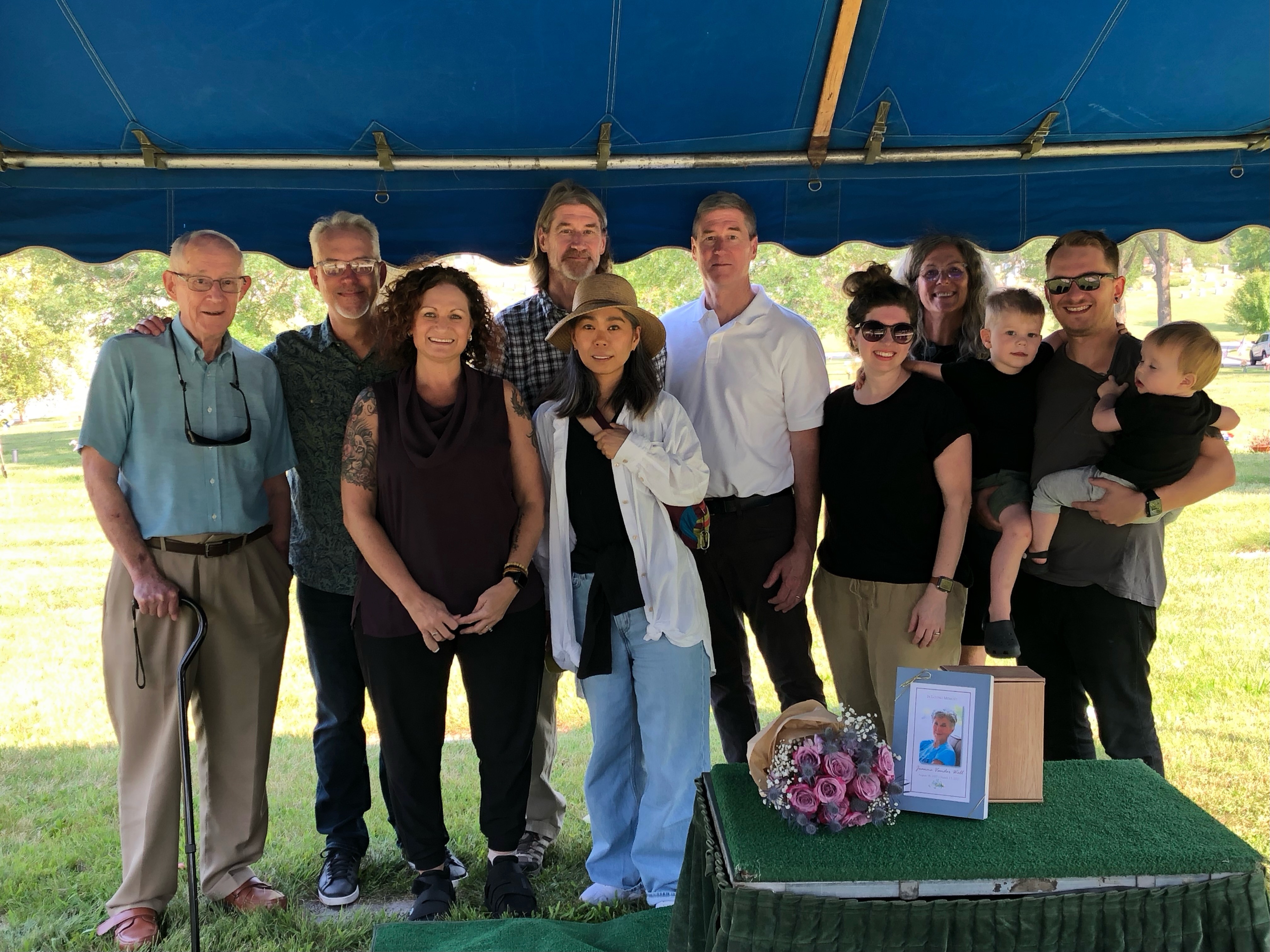
On August 18th my family gathered at Glendale Cemetery in Des Moines to bury my mother’s ashes. She passed back in March of this year, but the weather was nasty and cold. There was no need to rush the burial of the ashes. We opted to wait for a nice summer day. August 18th would have been her 86th birthday.

Mom was diagnosed with Alzheimer’s years ago, but we’d seen the signs of it well before the diagnosis. It’s an awful disease, and it was hard to watch her slowly descend into the prison of forgetfulness as her body wasted away. In the end, she was just as Job describes:

“I am nothing but skin and bones;
I have escaped only by the skin of my teeth.”

In the final weeks of mom’s life she would sleep most of the day. When I visited, I would sit by her bed and read scripture out loud to her. I read a lot of Psalms, and some of Jesus’ words. As I had once read to her mother, my grandmother, on her deathbed, I read the final two chapters of Revelation as if it were a travel brochure for the journey mom was about to take.

Occasionally, as I read, mom would open her eyes, stare at me, and smile. She wouldn’t speak. She’d just smile, and then slowly close her eyes again and drift away. That smile will forever stay with me until I see her again.

In today’s chapter, Job answers his friend Bill’s latest rant in which Bill accuses Job of some unknown wickedness that has spawned God’s wrath and the suffering Job is going through. Job grieves that he has become abhorrent to his wife, his extended family, and that he is scorned by everyone.

Then Job makes a most astonishing claim of faith. He will be redeemed by the Redeemer. At the end of his earthly suffering, after his body has completely wasted away into the dust of death, he will stand and see God. As Job considers he has nothing left to live for except more suffering, he yearns for this after-life reality.

What’s fascinating about Job’s claim is that ancient notions of the after-life were quite different than ours. Even in Jesus’ day many religious scholars believed there was no resurrection or after-life. Job’s proclamation of faith reads like he was one of Jesus’ own disciples who had personally seen the resurrected Christ and then proclaimed the promise of eternal life for all who subsequently believed. The ancient, suffering Job makes a shockingly prescient and contemporary declaration of faith.

I wish I had remembered it as I was reading to my mom. She would have loved it.

Mom’s burial was a small family affair. My dad, my siblings, one cousin, and one grandson and his family. We stood in a circle and each shared a favorite memory or the thing that we loved about her. There was a lot of laughter and, of course, a few tears. I briefly shared Pauls description of our resurrected bodies from his letter to Jesus’ disciples in the city of Corinth. I expressed gratitude that mom had been freed from the prison of her Alzheimer’s riddled brain and body. In her new resurrected body she was with God, seeing God with her own eyes, just as Job described.

We as family stood in a circle and held hands. I uttered a brief prayer.

There are loved ones in the glory
Whose dear forms you often miss,
When you close your earthly story
Will you join them in their bliss?


Will the circle be unbroken
by and by, Lord, by and by?
In a better home awaiting
in the sky, in the sky?

If you know anyone who might be encouraged by today’s post, please share.

The Earth and Eternity Connection

The Earth and Eternity Connection (CaD Lk 16) Wayfarer

“[Abraham] said to [the rich man], ‘If they do not listen to Moses and the Prophets, they will not be convinced even if someone rises from the dead.’”
Luke 16:31 (NIV)

I have confessed in previous posts that I was foolish with money when I was young. When I got my allowance, I spent it and I didn’t spend it wisely. I made a lot of foolish choices.

As a child, I remember being plagued with existential angst. I was this unique person with fingerprints, thoughts, and personality. I was a soul trapped inside this one-of-a-kind body living on this planet in a vast universe. Who am I really? What am I doing here?

Was there a connection between my existential angst and my foolish choices with money?

When I became a disciple of Jesus, those existential questions went away. Jesus was very straightforward in His teaching. There is an eternity that lies beyond this life, and His disciples are to live this life with that eternity top-of-mind. My earthly thoughts, words, relationships, and financial choices should be made with an eternal perspective.

In today’s chapter, Jesus is focused on money and material wealth in this life. He started by telling a parable that highlighted how shrewd people become when they believe this earthly journey is all there is. People learn to cover their rear ends, take advantage of others, and hoard wealth and possessions for themselves. If this world is all there is, then the things of this world will be what you treasure.

Luke finishes today’s chapter with a different parable. A rich man had a homeless beggar who slept on the sidewalk outside his house. Both men died. The beggar ended up in heaven hanging out with Father Abraham, while the rich man landed in the torment of Hades. The rich man realized what a foolish mistake he’d made and begged Father Abraham to send the beggar to his family to tell them about the eternal consequences of their lives.

Abraham tells the rich man a hard truth. The message of eternity has been proclaimed through the centuries. It’s right there for any who are willing to hear it. Sending the beggar won’t do any good, Abraham explains. Those unwilling to believe won’t even listen to a person who rises from the dead.

Even after I chose to become a disciple of Jesus, it took a while for this eternal perspective to change some of my patterns of thought and behavior. The truth is I’m still working on it every single day. But it has changed me, and it continues to do so. If I really believe what I say I believe, then my earthly choices will reflect my eternal perspective. If they don’t, then Jesus’ words convict me: “If you have not been trustworthy in handling worldly wealth, who will trust you with true riches?”

If you know anyone who might be encouraged by today’s post, please share.