Tag Archives: Circumstances

The Flow

At the Lord’s command the Israelites set out, and at his command they encamped. As long as the cloud stayed over the tabernacle, they remained in camp.
Numbers 9:18 (NIV)

Over ten years ago I had an idea. It was a great idea. The idea was for a book I would write. Everything flowed right out of my head and heart onto the page one day. It was such a great idea that I was really excited about it.

There it sat on the page for more than a decade. I’ve never forgotten it. I’ve even transferred all of the ideas from my journal to my computer. I thought about it often. About six months ago, things began to shift in life and at work. A couple of months ago a random networking contact introduced me to another random networking contact saying the two of us needed to meet. The person to whom I was introduced is a publisher. We connected on multiple levels in multiple ways, including being disciples of Jesus. Suddenly, everything aligned: circumstances, timing, and people.

I’m writing my book.

Along this earthly journey, as I have sought to follow God’s leading in my life, I’ve had to learn about flow. If I really believe what I say I believe, that God is authoring my Story and that there is a plan and purpose for my life, then I have to trust the Story. In turn, that means that sometimes the Story doesn’t fit the narrative that I would prefer if I were to write my Story myself. In fact, I have plenty of examples of trying to author the story myself the way I thought it should play out. That typically does not end well. Sometimes I have to wait. Sometimes it feels like nothing is happening. Sometimes things happen suddenly, unexpectedly, all at once like a flood.

In today’s chapter, the ancient Hebrews are learning about life with God in their midst. There was a cloud that covered God’s traveling tent temple. At night, the cloud glowed like fire. When the cloud lifted from the tent temple, they broke camp and followed. If it remained, they stayed put. Sometimes it stayed for a long time. Sometimes it lifted every day. Their job, was to go with the flow of when God was moving and where God was leading.

In the quiet this morning, I am reminded that God is God and He still operates the same way today as He did with the Hebrews. I don’t have a physical cloud, but I have God’s Spirit within me. I have prayer and discernment. If I am quiet. If I remain spiritually aware. If each day I am asking, seeking, and knocking at God’s door seeking God’s direction, then I will perceive and experience God’s flow.

I’ve discovered across my entire life journey that being a disciple of Jesus means learning to perceive, discern, and follow God’s flow.

If you know anyone who might be encouraged by today’s post, please share.

Promotional graphic for Tom Vander Well's Wayfarer blog and podcast, featuring icons of various podcast platforms with a photo of Tom Vander Well.
These chapter-a-day blog posts are also available via podcast on all major podcast platforms including Apple, Google, and Spotify! Simply go to your podcast platform and search for “Wayfarer Tom Vander Well.” If it’s not on your platform, please let me know!
An orange icon featuring an open book, symbolizing a digital Bible or scripture reference.

Watershed Moment

Watershed Moment (CaD Jhn 11) Wayfarer

“But Rabbi,” they said, “a short while ago the Jews there tried to stone you, and yet you are going back?”
John 11:8 (NIV)

Certain movie scenes stand out in my memory because of the way the entire storyline of a movie hinges on that one moment. For example, in The Godfather, it is Michael’s late-night visit to the hospital to find his father alone. In the darkness, he whispers to his father, “It’s okay. I’m with you now.” From that point on, the son who wanted nothing to do with his father’s business will be on a trajectory to become the very thing he once despised.

Today’s chapter contains a similar dramatic and pivotal episode in Jesus’ story. This is the seventh and final miraculous “sign” that John chooses to share before shifting to Jesus’ fateful and final days. It is not only the most dramatic of the seven because of the miracle itself, but because the event pushes Jesus’ enemies into a conspiracy to commit murder and rid themselves of Jesus once-and-for-all.

The conflict between Jesus and the chief priests in Jerusalem was already at a boiling point. Jesus had escaped attempts to arrest Him and stone Him the last time He had been in Jerusalem. Because of this, He left the region altogether. But now Jesus gets word that His good friend, Lazarus is gravely ill. Lazarus and his sisters live in Bethany, a stone’s throw from Jerusalem and the Chief Priests.

By the time Jesus arrived, Lazarus had been lying in the grave for four days. Mourners from Jerusalem had gathered to comfort the family. There is a big crowd on hand.

Part of the drama of the moment for me is in John’s careful crafting of the human emotion of the moment. He emphasizes Jesus’ love for Lazarus and his sisters. There’s the wailing and lamenting of the friends gathered with the sisters at the tomb. John also records Jesus’ own emotions with the simple declaration “Jesus wept.” And then, amid the grief and despair, Jesus orders the stone rolled away and loudly commands Lazarus to exit the grave.

The raising of Lazarus from the dead was a watershed moment on multiple levels. The crowd of witnesses and the public display ensured that word would spread like wildfire. The proximity to Jerusalem ensured that word would quickly reach Jesus’ enemies. With this particular sign, Jesus also foreshadows the impending end of His own earthly journey through death to resurrection. Lazarus, meanwhile, would be a living witness to Jesus’ miraculous power, leading Jesus’ enemies to conspire to send him back to the grave as well.

As I meditated on this dramatic scene in the quiet this morning, it once again seemed clear to me that Jesus was not a victim of circumstance. He was very clearly driving the action. Jesus had already declared how His earthly journey would end. With the raising of Lazarus, He was putting the wheels into motion that would lead right where He always knew things would end up.

Along my own earthly journey as a disciple of Jesus, I have been able to look back on my journey and see how certain watershed moments in my story were instrumental in driving the action. Even difficult and hard times have resulted in spiritual growth, deeper levels of maturity, and they have led to places where I’ve experienced life in greater and more fulfilling ways.

The story of Lazarus is really a microcosm of the Great Story itself. Death leads to new life just as winter leads to spring. Or, as David penned in his lyrics of Psalm 30, weeping may last for the night, but joy comes in the morning.

I find this a good reminder for the start of a new work week. Just as Jesus shared with Lazarus’ sisters, if I believe Jesus truly the Resurrection and the Life, I am assured that the darkest of earthly circumstances eventually end in light, the saddest of times ultimately give way to joy, and even death itself is simply a gateway to new life.

If you know anyone who might be encouraged by today’s post, please share.

Best of 2023 #1: I Don’t Know What I Don’t Know

I Don't Know What I Don't Know (CaD Job 34) Wayfarer

‘Job speaks without knowledge;
    his words lack insight.’
Job 34:35 (NIV)

It’s been almost two decades since my first marriage ended. Back in those days there was quite a public stir around the divorce. A lot of speculation was making the rounds on the local grapevine, most all of it incorrect. I remember the feeling of helplessness to stop or control any of it. I learned many things during that stretch of my life journey.

One of the lessons that I still carry with me from those days is the fact that when it comes to what others are going through, I don’t know what I don’t know. I think of all the ignorant speculation that swirled around my divorce from people who knew very little about me, my marriage, or my circumstances. I also can easily make ignorant speculations about others despite having very little knowledge and without having all of the facts. I have become much more reticent to make speculative judgments of others. As a disciple of Jesus, my default is to be love not judgment.

In today’s chapter, Eli the younger continues his discourse. Once again, he recalls Job’s own words in an effort to refute them. Once again, he gets Job’s words mostly, but not completely, right. Young Eli then defends God from what he perceives to be Job’s insistence that God had done evil in his circumstances. He passionately defends God’s goodness, rightness, and just judgments.

Young Eli then makes the statement that Job “speaks without knowledge.”

This caught my eye because he is correct. Job has no knowledge of the conversations that took place between God and the evil one. But the same is also true of young Eli and his three elders. They have all made speculative arguments in reaching their conclusions.

In the quiet this morning, my mind conjures up the names and faces of individuals in my own circles of influence who have been at the center of public scrutiny for a variety of reasons. I’m thinking back to my own thoughts, words, and actions towards those individuals both in their presence and when they have come up in conversation. My endeavor is to be gracious and humble in the knowledge and acknowledgment that I don’t know what I don’t know.

If you know anyone who might be encouraged by today’s post, please share.

“Perhaps…”

"Perhaps…" (CaD Phm 1) Wayfarer

Perhaps the reason he was separated from you for a little while was that you might have him back forever— no longer as a slave, but better than a slave, as a dear brother.
Philemon 1:15-16 (NIV)

Just this morning I received an unexpected text from a friend asking Wendy and me to pray. Life has thrown one of those wicked curveballs and suddenly everything in life is reeling in ways that feel completely out of control. As I confessed in a poster a few days ago to having a pretty miserable week myself, I’m feeling acute empathy for my friend. Prayers have commenced for them.

When life throws a wicked curve, I always find myself asking some of the same questions:

“How did we get here?”

“Why is this happening?”

“God?! What are you doing? Don’t you care?!”

“Where is this going to lead?”

Today’s chapter is a letter that Paul wrote from prison to a wealthy friend and fellow believer. His name was Philemon (hence the title of the epistle), and he was a good friend of Paul’s, a financial supporter of Paul, and Paul had previously lived as a guest in Philemon’s home.

Philemon had a slave named Onesimus. Long story short, Onesimus stole from Philemon and made a run for freedom. While we don’t know the back story of the relationship between Onesimus and Philemon, I can assume that Onesimus’ actions amounted to throwing a wicked curveball at Philemon and his household. It would not surprise me if Philemon had written Onesimus off and harbored ill feelings towards him.

What happens next is amazing. The runaway Onesimus somehow runs right into Paul. How and why, we don’t know, but Paul graciously takes Onesimus under his wing, Onesimus becomes a believer, and Paul comes to consider the runaway his “son.”

This very tender letter is sent to Philemon in the very hands of the runaway, Onesimus. The runaway slave arrives at his former owner’s house, letter in hand. I can only imagine what emotions each of them was feeling at this reunion.

I love Paul’s letter when he communicates that perhaps there was a divine purpose in Onesimus running away. Perhaps that needed to happen so that he could run into Paul and become a believer, and ultimately bring about an unforeseen reunion, restoration, and a redemptive ending to an otherwise wicked curveball situation.

I have written many times in these posts about the Chain Reaction of Praise that Wendy and I have been practicing for years. In the heat of the moment when the curveball comes at us in what appears to be a total strikeout, we step away from the plate, take a deep breath and consciously move into “perhaps” mode. We may not see clearly, in that moment, how God might redeem our circumstances. It might even feel hopeless. But time and time again we have experienced God ultimately redeeming circumstances in ways we could never have imagined, and weaving purpose into our stories that were impossible to see when we were initially reeling in the circumstances.

In the quiet this morning, I find myself recounting all of the wicked curve balls life has thrown at me. I find myself remembering what it felt like in the moment, as well as the redemptive endings that eventually occurred in each one. In doing so, it reminds me that there is a “perhaps” to my miserable week. I just don’t see it yet.

Note to my regular readers, listeners, and subscribers!
I am taking a three week vacation starting next week. While I’m gone, I’m going to be republishing the top fifteen chapter-a-day posts from 2023 as determined by the total number of page views and podcast plays. We’ll start at number 15 next Monday and end up with number 1 on Friday, February 16. See you in a few weeks!

If you know anyone who might be encouraged by today’s post, please share.

Three Things in Misery

Three Things in Misery (CaD Mi 7) Wayfarer

“What misery is mine!”
Micah 7:1a (NIV)

May I be honest with you? The past couple of days have been miserable. Like, they’ve been really miserable. I’ll spare you the details. My point is not about sharing my misery, but about how God met me in today’s chapter.

As I have always said, prophesy is layered with meaning. As I wrote in my post last week, the ancient’s prophetic words can at once be about what was, what is, and what yet will be. The ancient prophet Micah’s words in today’s final chapter are certainly about the spiritual, social, and political issues that were happening back in his day. But on a morning when I am acutely feeling misery in the moment and the first words I read are “What misery is mine!” I know there’s something that God’s Spirit has to say to me, today, in this miserable moment.

The first thing God had for me was an empathetic identification of my present reality.

“Now is the time of your confusion.
Do not trust a neighbor;
Put no confidence in a friend.
Even with the woman who lies in your embrace
Guard the words of your lips.”

I am feeling confused. I am feeling distrustful. I am feeling caution with every word I say. Reading these words was God’s Spirit whispering, “I get it.” I needed that.

The second thing God had for me in today’s chapter was a statement of both faith and hope.

But as for me, I watch in hope for the LORD.
I wait for God my Savior;
my God will hear me.”

As I read these words, it felt like a guttural cry of my soul. They became a defiant stance, amidst my present circumstances, in faith that I can trust God and trust the story He is authoring in and through me.

The third thing God had for me was a promise.

The day for building your walls will come,
the day for extending your boundaries.”

Sometimes, it’s good to be given a glimpse of what’s ahead. I may find myself in a deep valley on life’s road, but there are good things ahead just over the next hill.

So today, I’ll just press forward one step at a time.

If you know anyone who might be encouraged by today’s post, please share.

Shift in the Story

Shift in the Story (CaD Lk 9) Wayfarer

While he was speaking, a cloud appeared and covered them, and they were afraid as they entered the cloud.
Luke 9:34 (NIV)

I have a friend whose story intersected with mine in college. As happens, our paths on life’s journey took us in different directions. A few years ago, our paths brought us back together. My friend is going through a particularly painful chapter of his personal story. As we have talked over the last few years, my friend regularly mentions one of our college professors. This professor meant a lot to him, and he always expresses how he would love to connect and what an encouragement it would be to him.

Yesterday, that very professor posted a comment on my blog and said that one of my blog posts unexpectedly “popped up” and prompted him to send a “remember me?” comment to the blog post.

Hmmmm.

In yesterday’s post/podcast, I talked about stories. My story. Your story. How my story has intersected with countless other people and their stories. They become part of my story and I become part of theirs whether it is for a moment, a season, a few different seasons, or the whole earthy journey.

I believe that every person’s story, and our respective intersections with each other’s stories, are ultimately about our respective intersections with the Great Story that God is authoring in the grand scheme. I believe they are all connected in ways we can’t humanly fathom.

The further I get in my spiritual journey, the more I recognize that everything is connected.

Today’s chapter marks a definitive shift in Luke’s version of the Jesus Story. We’re less than halfway through, but having given a broad brush summary of Jesus’ first two years of ministry he’s going to shift to the climactic final months. Here’s how the good doctor clues us in:

First, Jesus asks The Twelve who they think He is. Peter says he thinks Jesus is God’s Messiah. Jesus warns them to keep this to themselves and immediately tells them what is going to happen: He will be handed over to the religious institution, be killed, and rise from the dead. (vs 18-27)

A second time Jesus tells The Twelve that He will be “delivered into the hands of men.” (vs 43-45)

Dr. Luke then states that as these events approached Jesus “resolutely set out for Jerusalem” where all these things would take place. (vs 51)

Smack dab in the middle of this setup (vs 28-36) is one of the funkiest episodes of the Story, also referenced by both Matthew and Mark in their versions.

Jesus takes Peter, James, and John up to the top of a mountain. The three amigos start to nod off, and when they wake up Jesus is standing there shining like the sun talking to two others talking to Him. The two others turn out to be Moses and Elijah and they are talking to Jesus about His “departure.” Then a thick cloud appears and the boys are freaking out. The cloud is so thick they can’t see anything and a voice from the cloud says, “This is my Son, whom I have chosen; Listen to Him.”

What most casual readers miss is that this entire episode is rooted in the ancient story of the Exodus (you can read it in Exodus 20), when God delivers the Hebrews from slavery in Egypt and makes a covenant with them, that they will be His people and He will be their God. Everything in the Great Story is connected. If I don’t learn the whole Story, I’ll always miss the connections. Let me break it down:

Moses was the appointed deliverer of the Hebrews from slavery in Egypt, just as Jesus is about to be the deliverer of all humanity from slavery to sin. Both episodes happen on mountains, Moses on Mount Sinai, Jesus on an undisclosed mountain (probably Mount Hermon). In both cases, a cloud covers the mountain and God speaks from within the cloud. Moses (the Lawgiver) and Elijah (representing the Prophets) speak to Jesus about his impending “departure” (literally, the Greek word “exodos”) from this earth to establish a new “covenant” in which all who believe are His people, and He our God.

Everything in today’s chapter is a foreshadowing of the rest of the story. The mysterious mountaintop miracle connects what’s happening to Jesus’ story to what God was doing thousands of years earlier. The events are connected. It’s all part of one big story.

As I sit in the quiet this morning, I’m simply resting in the connections and flow of this Great Story. Daily circumstances so easily take up so much of my mindshare and they demand so much of my emotional reserves. It’s easy to forget the bigger picture. These momentary circumstances are connected to a larger story – my story – which is connected to other peoples’ stories – which is connected to the Great Story. If I lose sight of this, the daily circumstances easily become overwhelming, meaningless, futile even. Jesus reminds me that I need to shift focus and pull back on the camera to see the larger story.

And, I need to trust the Story.

I’m looking forward to connecting my dear friend with his beloved professor today.

If you know anyone who might be encouraged by today’s post, please share.

I Don’t Know What I Don’t Know

I Don't Know What I Don't Know (CaD Job 34) Wayfarer

‘Job speaks without knowledge;
    his words lack insight.’
Job 34:35 (NIV)

It’s been almost two decades since my first marriage ended. Back in those days there was quite a public stir around the divorce. A lot of speculation was making the rounds on the local grapevine, most all of it incorrect. I remember the feeling of helplessness to stop or control any of it. I learned many things during that stretch of my life journey.

One of the lessons that I still carry with me from those days is the fact that when it comes to what others are going through, I don’t know what I don’t know. I think of all the ignorant speculation that swirled around my divorce from people who knew very little about me, my marriage, or my circumstances. I also can easily make ignorant speculations about others despite having very little knowledge and without having all of the facts. I have become much more reticent to make speculative judgments of others. As a disciple of Jesus, my default is to be love not judgment.

In today’s chapter, Eli the younger continues his discourse. Once again, he recalls Job’s own words in an effort to refute them. Once again, he gets Job’s words mostly, but not completely, right. Young Eli then defends God from what he perceives to be Job’s insistence that God had done evil in his circumstances. He passionately defends God’s goodness, rightness, and just judgments.

Young Eli then makes the statement that Job “speaks without knowledge.”

This caught my eye because he is correct. Job has no knowledge of the conversations that took place between God and the evil one. But the same is also true of young Eli and his three elders. They have all made speculative arguments in reaching their conclusions.

In the quiet this morning, my mind conjures up the names and faces of individuals in my own circles of influence who have been at the center of public scrutiny for a variety of reasons. I’m thinking back to my own thoughts, words, and actions towards those individuals both in their presence and when they have come up in conversation. My endeavor is to be gracious and humble in the knowledge and acknowledgement that I don’t know what I don’t know.

If you know anyone who might be encouraged by today’s post, please share.

Weighed & Found Wanting

Weighed & Found Wanting (CaD Dan 5) Wayfarer

“But you, Belshazzar, his son, have not humbled yourself, though you knew all this.”
Daniel 5:22 (NIV)

About a month ago, this chapter-a-day journey trekked through 2 Kings 19, the historic account of a true and miraculous event. The Assyrian army encircled the city of Jerusalem laying siege to it. King Hezekiah tore his clothes, dressed in sackcloth (a sign of humility), reached out to the prophet Isaiah for prayer, and went personally to the temple to ask God for deliverance. In this instance, the miraculous happened and the city was spared.

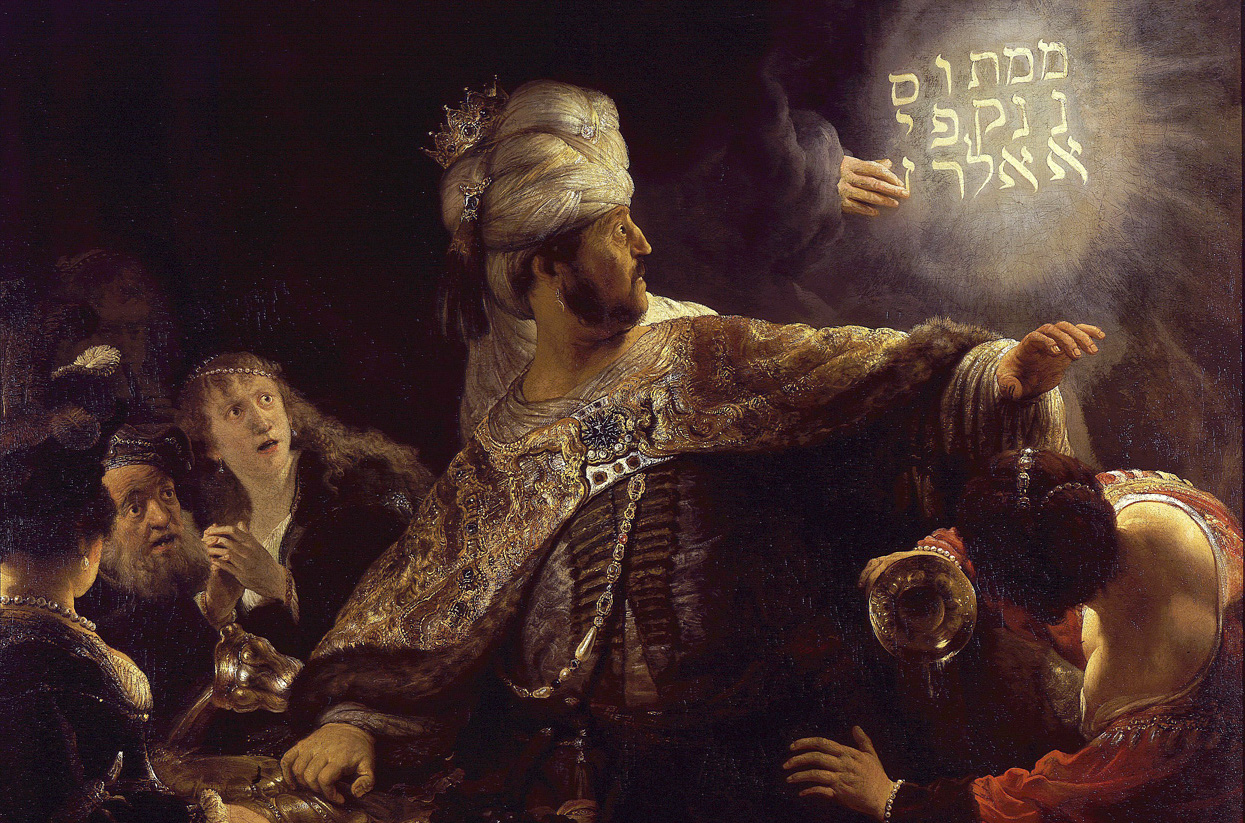
Today’s chapter is one of the more fascinating stories in all of the Great Story. It is also the source of two famous phrases that are still commonly used today: “Handwriting on the wall” in reference to a clue or sure sign of something that is about to happen, and “weighed and found wanting” which has been re-used multiple times in stories and films like A Knight’s Tale.

What the narrative of today’s chapter doesn’t state is that the situation for Belshazzar was not unlike that of Hezekiah. The Persian army is on a campaign to destroy the Babylonian empire. They are close to Babylon and have been making steady progress. Belshazzar is the regent of Babylon, and should be leading his people in preparing for the defense of the city. Instead, he gathers his wives, concubines, and nobles to party hard.

As I contemplated this in the quiet this morning, I realized that Belshazzar’s revelry could have been a cop-out, as in “There’s no hope so let’s get drunk and enjoy our final days!” Given the fact that Babylon was one of the most securely fortified cities in the world, it may have also been a party thrown out of sheer hubris, as in “We have nothing to worry about. Babylon is impenetrable. Don’t worry. We have nothing to fear! Let’s party!”

The situation also sheds light on why Daniel, who has been offered a robe of purple, great wealth, and the third-highest position in the kingdom if he interprets the mysterious handwriting on the wall, tells Belshazzar to keep his gifts. Being in the third-highest position of the kingdom when the Persians arrive is a death sentence.

Daniel reads the cryptic message written by a disembodied hand on the wall for Belshazzar, pronouncing his doom. What is particularly damning, according to Daniel’s explanation, is that Belshazzar knew Nebuchadnezzar’s story of going insane and returning to sanity in acknowledging that everything he had and everything he was came to him from the Most High God. Still, Belshazzar was unwilling to learn the lesson. Rather than humble himself, he chose to either ignore or dismiss his precarious circumstances.

I pray that when I find myself in precarious circumstances on this life journey and things hang in the balance, I will choose to follow Hezekiah’s example, not Belshazzar’s. I’d rather be weighed and found faithful.

Featured Image: “Belshazzar’s Feast” by Rembrandt
Public Domain. National Gallery, London, UK.

If you know anyone who might be encouraged by today’s post, please share.

“What on Earth?”

"What on Earth?" (CaD 1 Sam 29) Wayfarer

Achish answered [David], “I know that you have been as pleasing in my eyes as an angel of God; nevertheless, the Philistine commanders have said, ‘He must not go up with us into battle.’ Now get up early, along with your master’s servants who have come with you, and leave in the morning as soon as it is light.” 1 Samuel 29:9-10 (NIV)

Thus far, 2022 has been a challenging year for our business. Last year Wendy and I began praying for God to bless us with abundant growth, but instead, we encountered some significant setbacks. We entered 2022 with more questions than assurances. It seemed that God was doing just the opposite of what we were asking. It was enough to make us scratch our heads and ask “What on earth are you doing God?” Have you ever had one of those moments?

In today’s short chapter, we find David and his men living among the Philistines under the protection of King Achish. This was not an uncommon practice in ancient times when warriors fell out of favor with their own king. Other kings would take them on as mercenaries, providing them a place to live in exchange for military service when it was needed. Achish liked David so much, that he made David and his men his personal security detail, saying “I will make you my bodyguard for life.” For the record, David does the same thing in the future, making a contingent of Philistine mercenaries his personal security detail (2 Sam 15:18).

King Achish and the Philistines prepare to attack Saul and the Hebrew army, and David and his men are protecting King Achish. If David had a plan for what he was going to do when the battle started, the author doesn’t share. What we do know is that David finds himself in a dilemma. He certainly believes he should not raise his hand against God’s anointed, Saul, and it wouldn’t be good for him to fight against his own people when he’s God’s man to succeed Saul. At the same time, he needs to keep up appearances that he’s loyal to Achish. He’s having his own “What on earth?” moment.

The commanders of the Philistines, however, are not as trusting of David as King Achish is. They know David’s reputation as the champion of Goliath and a successful military leader. They fear that David’s loyalty to Achish is just a ruse, and they demand that Achish send David away. This puts Achish in a political dilemma with his commanders, and he sends David away. Crisis averted. God protects David’s standing with Achish while ensuring that David will not be entangled in the battle that will be Saul’s downfall. It turns out that God was present and working behind the scenes even while David may have been wondering “what on earth” God was up to.

As I look back on this year of business challenges, two things have become clear over time. First, we’ve always had projects come up just when we need them. Just like when God fed the Hebrews daily with manna from heaven. There’s always just enough for that day. God has been faithful. The second thing is that our challenges have actually served to highlight the need for some necessary strategic changes. If God had blessed us with abundant growth, we would have had the time to implement these changes, nor would we have felt the need. We might not have even seen the need.

So, in the quiet this morning, God is reminding me that when I’m asking “What on earth are you doing, God?” He is actually doing a great deal.

My job is to keep pressing on and trust His faithfulness.

If you know anyone who might be encouraged by today’s post, please share.

God in the “Hevel”

God in the "Hevel" (CaD Gen 45) Wayfarer

[Joseph said] “And now, do not be distressed and do not be angry with yourselves for selling me here, because it was to save lives that God sent me ahead of you…So then, it was not you who sent me here, but God.”
Genesis 45:5, 8 (NIV)

Two weeks ago, among our local gathering of Jesus’ followers, I was tasked with giving the final message in a twelve-weeks series on the book of Ecclesiastes. One of the main themes of the ancient book of wisdom is that everything is “meaningless,” a word the author uses 33 times in the book. The Hebrew word the ancient Sage used was “hevel” (or “hebel“, it can be transliterated either way) for which there’s not really a good English equivalent. It’s like smoke or vapor that you can see with your eyes but can’t physically grasp or hold onto. It evades full comprehension or understanding.

In an earlier message in the series, I used my blog post on Ecclesiastes 9 as a springboard to try and help communicate what I think the Sage was trying to get at by describing life as smokey hevel:

One couple in our midst prayed for a baby and gets pregnant. Another couple prayed for a baby and remains childless. “What the hevel?”

We watch so many young people grow to adulthood while a family tragically loses a child at a young age. “What the hevel?”

One person in our community is miraculously cured while another suffers and dies when no miracle occurs. “What the Hevel?”

I provide you this flashback on Ecclesiastes because the story of Joseph could be Exhibit A in understanding hevel. I even used it as an illustration in my message. The fact that I was reading through the story at the same time I was tasked with the message felt like a divine appointment. Joseph, the favorite son did nothing more than share with his family a dream he had. He’s beaten, sold into slavery, wrongfully accused of rape, unjustly imprisoned, and unfairly forgotten. He had every reason to sit in prison groaning “What the hevel?! Why is this happening to me? Life isn’t fair. It’s all smoke and mirrors. Why me, God? What did I ever do to you to deserve this? Why!?”

We find out in today’s chapter, which is the climax of the story. Joseph, having been raised to a leadership position in Egypt, and having miraculously been given prophetic foreknowledge of a seven-year famine, reveals himself to his brothers. The same brothers who sold him into slavery now come and bow down to him, begging him for food. Joseph reveals himself to them. It all comes together, and Joseph sees God’s hand in the hevelish circumstances that brought him to this moment. As Paul might have described it: All things worked together for good.

Just yesterday morning, over coffee, Wendy and I recounted some painful moments and relationships we’ve experienced over the years. With each one, we were able to look back and see how God used those moments and difficult stretches of the journey both in our lives and the lives of others involved.

I ended my message two weeks ago with an observation. Just a few chapters further into the story, in the book of Exodus, God will lead the Hebrews out of Egypt and through the wilderness to the Promised Land. Each day, for 40 years, God will lead them by appearing in the form of a cloud. What is a cloud? It’s water vapor. It’s like smoke. You might say it’s hevel.

God is in the hevel.

My friends even gave me a coffee mug to remember the lesson. 😉

FWIW: Here’s a link to the message I referenced in today’s post. You can find it and an archive of other messages on my Messages page.

If you know anyone who might be encouraged by today’s post, please share.