Tag Archives: Weeds

Attention and Maintenance

Land that drinks in the rain often falling on it and that produces a crop useful to those for whom it is farmed receives the blessing of God. But land that produces thorns and thistles is worthless and is in danger of being cursed. In the end it will be burned.
Hebrews 6:7-8 (NIV)

When Wendy and I built our house ten years ago, it became a long-term lesson for me in lawn care. In the division of labor here at Vander Well Manor, you’ll find my name at the top of the org chart when it comes to the outdoor lawn and landscaping. Looking back, there were so many things we would have done differently from the very beginning.

It took several years for us to get our lawn to a point where it looked decent, and it required regular treatments and on-going maintenance. Finally, it was beginning to look great and I was feeling better about it than ever. So, I decided to save a few pennies and take a year off of the treatments to see if it was healthy enough to simply perpetuate.

Weeds. Bare spots. Brown patches. It was awful. Ugh!

Today’s chapter contains a passage that has stirred controversy within the church for centuries:

It is impossible for those who have once been enlightened, who have tasted the heavenly gift, who have shared in the Holy Spirit, who have tasted the goodness of the word of God and the powers of the coming age and who have fallen away, to be brought back to repentance.
Hebrews 6:4-6a (NIV)

The question, of course, is whether salvation can be lost? Can a person be saved and then lose that salvation? My friends of pentecostal persuasion tend to say “yes.” My reformed, Calvinist friends say “absolutely not.”

In the quiet this morning, my heart finds no joy in wading into that debate. Instead, my meditations pulled back to look at the context of what the author of Hebrews is communicating to the weary, persecuted first century believers. He follows this passage about fallen away believers with his metaphor of land drinking in the rain.

There are two contextual references the author is tapping into. For his Jewish audience, his metaphor resonates with the Law of Moses in Deuteronomy 11 in which God promises that the land will be blessed in obedience but cursed if the people lose faith and are disobedient. He is also referencing Jesus in the Sermon on the Mount when He states that the rain is going to fall on the land, both good and bad. The question is what the land is going to produce.

The rain will fall. The sun will shine. When I was dutiful in tending my lawn, feeding it and mindfully tending it, the land produced a thick carpet of healthy grass. When I took a year off it began to produce weeds, bare spots, and brown spots in unhealthy ways.

That’s the simple spiritual lesson the author of Hebrews is trying to communicate to his readers. He is not harshly warning them of a bean counter God who holds salvation in the balance ready to yank it away based on who knows what infraction. The author is simply adding to the message he began in the previous chapter about his readers not spiritually growing into maturity. The seeds were planted, the lawn sprouted, and it even looked healthy for a while. Life will continue to happen. The rain will fall. The sun will shine. Without regular maintenance the land will not be healthy and fruitful, but rather filled with weeds, thorns, and thistles.

So, I am reminded in the quiet this morning that my spiritual life, just like my lawn, needs regular attention and maintenance if it’s going to be healthy, mature, and fruitful. The rain of grace keeps falling; what I tend determines what grows.

If you know anyone who might be encouraged by today’s post, please share.

Promotional graphic for Tom Vander Well's Wayfarer blog and podcast, featuring icons of various podcast platforms with a photo of Tom Vander Well.
These chapter-a-day blog posts are also available via podcast on all major podcast platforms including Apple, Google, and Spotify! Simply go to your podcast platform and search for “Wayfarer Tom Vander Well.” If it’s not on your platform, please let me know!
Logo of the Bible Gateway website, featuring an open book symbol and the site name.

My Green Thumb Pursuit Continues!

From [Christ] the whole body, joined and held together by every supporting ligament, grows and builds itself up in love, as each part does its work.
Ephesians 4:16 (NIV)

It’s summer, and here at Vander Well Manor my annual pursuit to develop a green thumb is in full swing. For anyone who has followed my posts or podcasts for any length of time has heard me speak of my life-long brown thumb and inability to keep plants alive and growing. But, I’m not giving up. This year Wendy got her cactus to bloom. I started an indoor herb garden this winter that has been highly successful for a long time. I even transplanted a couple of them and moved them outdoors and they are doing well. Then, the indoor herb garden became a breeding ground for little fruit fly type bugs, so I’m having to start over with that.

It’s a process. And, I’m getting better.

In today’s chapter, Paul shifts the subject of his letter to Jesus’ followers in Ephesus from the supremacy of Christ Jesus to the difference this should make in the lives of those who believe. Belief is not the endgame, but the entrance of a life-long journey that is a process of growing, maturing, developing, and becoming. Paul describes the endgame of this journey in today’s chapter too:

...so that the body of Christ may be built up until we all reach unity in the faith and in the knowledge of the Son of God and become mature, attaining to the whole measure of the fullness of Christ.

That’s like me and my brown thumb becoming a master gardener.

He goes on to describe the journey to that destination as one of a perpetual growth cycle in which I am constantly “putting off” things such as:

falsehood,
anger,
mooching off of others,
worthless and ‘unwholesome’ conversation,
bitterness,
rage,
slander,
and malice.

Instead of allowing those things to take over like weeds in my garden, I am constantly learning and growing in character qualities such as:

honesty,
truthfulness,
peace,
hard work,
generosity,
worthwhile conversation,
encouragement,
mentoring others,
kindness,
compassion,
and forgiveness.

It’s a perpetual spiritual growth process. It’s learning how to develop a spiritual green thumb in which my life becomes a garden of life-giving, growing, and fruitful thoughts, words, relationships, work, and community.

Like developing a green thumb it takes time. If happens in fits and starts. Mistakes are made. Things die. Weeds take over. Bugs breed. But lessons are learned, and as I persevere there is more growth than withering, more life than death, more fruit and blooms and less weeds and bugs.

This weekend in separate occasions we had friends over for some life-giving conversation and refreshment. I was able to offer and make some refreshing summer cocktails made with fresh basil and mint from my herb garden. It was a lot of fun.

In the quiet this morning, I’m reminded that being a disciple of Jesus and developing a green thumb are basically the same pursuit.

If you know anyone who might be encouraged by today’s post, please share.

A collage of podcast and streaming service icons alongside a portrait of Tom Vander Well, featuring the title 'Wayfarer blog and podcast' in stylized text.
These chapter-a-day blog posts are also available via podcast on all major podcast platforms including Apple, Google, and Spotify! Simply go to your podcast platform and search for “Wayfarer Tom Vander Well.” If it’s not on your platform, please let me know!
Logo for Bible Gateway, featuring an open book icon inside an orange square.

Soil and Spirit, Weather and Weeds

Soil and Spirit, Weather and Weeds (CaD Matt 13) Wayfarer

Still other seed fell on good soil, where it produced a crop—a hundred, sixty or thirty times what was sown.
Matthew 13:8 (NIV)

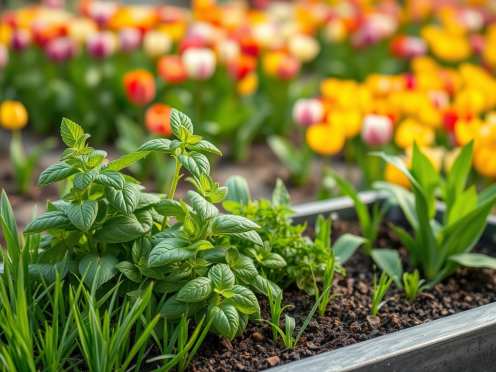
Happy Easter! It is spring and here in Iowa the landscape is quickly changing from the dull neutral tones of gray, beige, and deep brown that dominate the death of winter into vibrant and lush green of new life and a rainbow of blossoms that it brings. Here in Pella, the tulip beds are in full bloom and our annual Tulip Time festival is just ten days away.

In today’s chapter, Jesus famously teaches the crowds in parables, and the subject of His parables are all about soil, seeds, and weeds. This got me thinking a bit about the spiritual parable of my own experiences this season…

I’ve already mowed my lawn a couple of times. It was 10 years ago that Wendy and I moved into our newly constructed house. The company we hired to do our lawn was one of the more difficult contractors we worked with in the process. The soil on our property wasn’t the greatest and we had loads of black dirt brought in to supplement it. Even so, the yard was not grated well, and the soil was not spread well. The result has been a decade of trouble and hard work. Every spring as I break out the lawn mower and begin working the lawn I confess feeling a bit embittered regarding how much better and easier it would be if the soil had been done well, and done right, from the beginning.

Meanwhile, inside the house I’ve been experimenting with one of those countertop herb gardens advertised online. I have confessed many times in these posts/podcasts to my brown thumbs and lack of ability to successfully garden, even while living my entire life on the richest, most productive farmland on the face of the earth. I’m happy to say that my tiny little herb garden has been highly productive despite the multiple mistakes I’ve made getting started. I’ve been supplementing my dinner salads with Romain lettuce from countertop. Our supply of fresh Basil is slowly growing, and I’ve got plenty of fresh mint growing to mix some Mojitos to enjoy on the back patio this summer.

One of the things I’ve noticed about my little countertop herb garden has been both the soil, which I’ve never seen anything like it in my life, and the watering system which is genius in allowing the soil to soak up what the plants need without drowning them and takes my human incompetence and lack of disciplined attention out of the equation.

Which has me thinking about Jesus’ parable in the quiet this morning. The difference between the 25% of seeds that became productive and fruitful plants in Jesus’ parable and the 75% of seeds who didn’t make it was the quality of the soil. Which has me thinking about my contrasting experiences with my lawn and my countertop herb garden. The profoundly simple question Jesus’ parable, and my experience, leads to is: “What is the quality of the spiritual soil of my heart, mind, and life?”

As I meditated on Jesus’ parable, I realized that there are both things that I control and things that are out of my control with regard to the spiritual cultivation of my heart and mind. I don’t completely control the weather of life, the circumstances around me, or even the weeds that might have been sown to my right or left and are flourishing to my perpetual aggravation. I do, however, control the inflows of what I draw into my eyes, my ears, my heart, my mind, and my body. I control my time and my energy expenditure. I can push my spiritual roots deeper where springs of Living Water can nourish me, or I can simply choose to soak up the shallow and toxic run-off this world ceaselessly sheds from its surface.

The words of the Serenity Prayer came to me as I pushed my roots deeper this morning:

Lord, grant me the serenity to accept the things I cannot change,
the courage to change the things I can,
and the wisdom to know the difference.

Or, in other words:

Lord, help me to be the best spiritual soil I can be for Your Word to take root that my life might be as fruitful and productive as possible today. Grant me patience, grace, and peace amidst the weeds and weather of this world that I do not control. And give me wisdom to know the difference.

If you know anyone who might be encouraged by today’s post, please share.

These chapter-a-day blog posts are also available via podcast on all major podcast platforms including Apple, Google, and Spotify! Simply go to your podcast platform and search for “Wayfarer Tom Vander Well.” If it’s not on your platform, please let me know!

Profound Simplicity

Profound Simplicity (CaD Jer 35) Wayfarer

“Jehonadab son of Rekab ordered his descendants not to drink wine and this command has been kept. To this day they do not drink wine, because they obey their forefather’s command. But I have spoken to you again and again, yet you have not obeyed me.”
Jeremiah 35:14 (NIV)

I mentioned last week that I was prepping for a message that I delivered this past Sunday among our local gathering of Jesus’ followers (you can find it on the Messages page). It was part of a series in which our local gathering has been unpacking seven metaphors that Jesus used to describe Himself (Bread, Light, Gate, Shepherd, Resurrection, Way, and Vine).

Last night Wendy and spent some time talking about the series and all of the messages we’ve heard from different teachers. One of the observations we made as we contemplated all that we’ve heard was that sometimes metaphors are so powerful in their simplicity that it can be a challenge to find anything else to say about it.

Ironically, I’m finding that to be the case with today’s chapter. It’s profound in its simplicity.

Back in Jeremiah’s day there were a tribe of nomads known as the Rekabites. They and their flocks wandered in the land, feeding their flocks, and living in tents just as Bedouin tribes still do to this day. The lived among the Hebrews and were on friendly terms with them. So, when the Babylonian army came into the area bent on conquest, the Rekabites chose to move inside the walls of Jerusalem for protection.

God tells Jeremiah to bring the tribal leader of the Rekabites, Jaazaniah, and his whole family to the Temple and offer him some wine. They refuse the offer, explaining that one of their tribe’s patriarchs said that his descendants must never drink wine, plant vineyards, raise crops, or build houses, but must always live in tents. In doing so, the tribe would always enjoy blessed lives as nomads. So, they have always obeyed their ancestor’s command and politely refused Jeremiah’s offer.

God through Jeremiah proceeds to state the meaning of this very simple metaphor. The Rekabites have for generations had trusted and obeyed the command of their forefather, but the Hebrews had refused to listen to, trust in, or obey the commands that God Himself had given through the law and the prophets simply to eschew idolatry and worship God alone. When the Babylonians leave, the Rekabites will take their flocks and tents and return to their simple, blessed nomadic lives wandering the land just as their forefather promised. The Hebrews, however, will suffer captivity, exile, and destruction.

As a disciple of Jesus, I have spent over forty years reading, studying, seeking, and plumbing the depths of what it means to follow Jesus. I have learned much and have forgotten much. I’ve read works of theology and philosophy so dense that getting through it is like cutting a brick with a butter knife. I’ve participated in conversations and studies that get so deep in the weeds that I lost my sense of direction and couldn’t find true north.

Along my journey, I’ve come to appreciate Jesus for His profound simplicity. He asks very simple questions like “What is it you are seeking in life?” and “Who do you say that I am?” His commands are equally simple. “Love God with your whole being, and love your neighbor as yourself.” His requirements are also pretty basic: “Believe in Me and do the things I tell you to do.”

It’s not unlike Jeremiah’s word picture in today’s chapter. Simply be like the trusting, faithful, obedient Rekabites, not like the stubborn, willful, rebellious Hebrews.

Whenever I find myself deep in the weeds, I stop and grab hold once again of Jesus’ profound simplicity. Believe in Me. Love God. Love others. Do what I tell you. Trust the Story.

That’s my true north. Once I find it, I find my way.

If you know anyone who might be encouraged by today’s post, please share.