Tag Archives: Tower of Babel

A Step Toward Refuge

If the Lord your God enlarges your territory, as he promised on oath to your ancestors, and gives you the whole land he promised them, because you carefully follow all these laws I command you today—to love the Lord your God and to walk always in obedience to him—then you are to set aside three more cities.
Deuteronomy 19:8-9 (NIV)

As Wendy and I sit in the morning and peruse the news of the day I’ve observed a distinct difference between us. Wendy regularly wades into the comments that readers make to the article or editorial she’s just read. She finds it interesting to gauge response to the topic or opinion. Wendy is an Enneagram Type Eight. For Eights, conflict is a form of intimacy.

I, on the other hand, rarely look at the comments. As an Enneagram Type Four, contention can quickly lead me to despair. When I read comments I find so many thoughtless words, hasty judgments, and seeds of anonymous hate spewed on the digital page. It leaves me desiring my morning shower.

I had the honor of delivering the message yesterday among our local gathering of Jesus’ followers. We’re launching a year-long theme that, looking back at my spiritual journey, I find doesn’t get much play these days.

Refuge. Specifically, Refuge Over Rejection.

Where do I run when I need mercy, grace, and a shelter from the storm?

I find it fascinating that thousands of years ago God made refuge a cornerstone of the community He designed and called for to be implemented among His people. In a moment of synchronicity, “refuge” appears once again in this morning’s chapter.

God through Moses reminds His children, just preparing to cross into the Promised Land, that they are to quickly establish three cities of refuge—spread equidistant across the geography. These cities must be accessible to everyone. They must be clearly marked. The roads leading to them must be clear and easily trodden.

God paves the way to grace.

Mercy has an address.

The chapter goes on to mention that accusations must be corroborated by two or three witnesses. These are not exclusionary sections of the chapter. There is a thread of thought God is weaving through His refuge design. As I meditated on the chapter I came to realize that this divine justice system allows for time.

Rage does not get the final word.
Truth must be corroborated.
Witnesses must agree.
The community must slow down before rendering judgment.

As I pondered this, my mind quickly returned to our digital age and all those comments. Instant news, trending topics, and billions of people with laptops, tablets, and smart phones. We can broadcast our momentary rage, venomous thought, hasty judgment, vengeance, and condemnation to the entire world 24/7/365. And it can all be done behind the anonymity of a username.

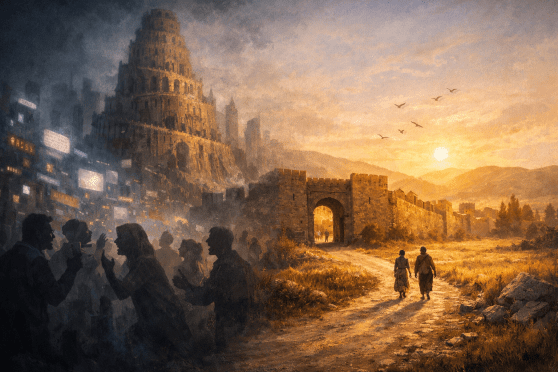
As I meditated on the stark contrast between God’s ancient design and our modern Twitter-esque technology, I found both wisdom and solace in the former. The latter strikes me as a modern day Tower of Babel constructed of server farms and cell towers – ending in confusion, chaos, division, and babbling voices that offer no peace, no mercy, no grace, no refuge.

Finally, my thoughts landed on the fact that God calls for three cities of refuge to be established, though the total number in God’s ultimate Promised Land blueprint was six. In other words, God is calling for phased mercy. He doesn’t want His people to wait until the land is completely settled. He wants them to quickly take the first step toward refuge.

Yesterday, as our worship concluded there was an unexpected outpouring among our local gathering. It appeared that everyone in the room was ready to take a step toward refuge. Perhaps I’m not the only one weary of our modern world and culture of Babel.

As our local gathering sets off on our year-long road to refuge. As I set off on this another work week at the beginning of a new year, my soul is mulling over the answers to a few questions surfaced in the quiet:

Is the road to mercy in my life clear—or cluttered?
Do people know how to reach grace through me, or do they hit barricades of judgment and suspicion?

Do my words shelter truth—or endanger it?
False witness isn’t just perjury. It’s gossip. Spin. Tweets. Convenient silence.

Do people find refuge in my presence?
Am I a safe place where people know they will be seen, heard, and loved?

I serve a God of refuge. This morning’s chapter reminds me that from ancient days, God has made being a refuge a priority for His people. I endeavor today, this week, this year, to take steps towards that calling.

If you know anyone who might be encouraged by today’s post, please share.

Promotional graphic for Tom Vander Well's Wayfarer blog and podcast, featuring icons of various podcast platforms with a photo of Tom Vander Well.
These chapter-a-day blog posts are also available via podcast on all major podcast platforms including Apple, Google, and Spotify! Simply go to your podcast platform and search for “Wayfarer Tom Vander Well.” If it’s not on your platform, please let me know!
Icon of an open book with an orange background, representing a digital Bible.

Babylonian Lessons

Babylonian Lessons (CaD Jer 51) Wayfarer

Then say, ‘So will Babylon sink to rise no more because of the disaster I will bring on her. And her people will fall.’”
The words of Jeremiah end here.

Jeremiah 51:64 (NIV)

Babylon still exists, at least its remnants exist. It was during the U.S. war with Iraq that I first saw images of the site of ancient Babylon. Sitting just over 50 miles south of Baghdad, the walls of the ancient city remain, and one source I read said that 85 percent of the ancient city has not been excavated. Iraq began to rebuild some of the walls and a major gate with a long-term dream of restoring the ancient city as a landmark and center for tourism. Fascinating.

Babylon occupies a deep historical and metaphorical presence throughout the Great Story. From the erection of the Tower of Babel in the opening chapters of Genesis, to the angelic destruction of a metaphorical Babylon in the final chapters of John’s end-times Revelations, Babylon is synonymous with humanity’s hubris, pride, and spiritual antagonism.

Today’s chapter is the continuation and end of Jeremiah’s prophetic message against Babylon, and it marks the end of his recorded prophetic works. It’s a long one, coming in at a total of 64 verses. It’s ironic that for the better part of fifty chapters, God uses Babylon and its ruler, Nebuchadnezzar as a vehicle of divine judgement, but in the end they can’t escape judgement for their own evils.

As I have meditated on the roles of good and evil in life, history, and literature, I’ve observed some recurring themes. One theme is that evil will at times unwittingly play into the hand of good or become its agent. In my annual reading of The Lord of the Rings, I’ve been contemplating how Saruman’s turn to evil actually creates a chain-of-events that assures victory for the forces of good at Helm’s Deep which, in turn, creates the momentum which prompts Sauron’s arguably fatal mistake in launching his offensive too early. It was Nebuchadnezzar’s own pride, thirst for power, and self-aggrandizing hubris that motivated his rise to Imperial power in Mesopotamia (see Daniel 1-4). Jeremiah’s prophetic messages simply reveal how God wove His eternal purposes through Neb’s own power-hungry empire building.

Another recurring theme I’ve noticed in the conflict between good and evil is the fact that evil tends to implode from the inside-out. Once again drawing from my most recent reading of The Lord of the Rings, Frodo and Sam are able to survive Frodo’s abduction at Cirith Ungol and make their way into the land of Mordor because all the orcs of Cirith Ungol got into a fight and killed one another. Likewise, it was the conflict between the orcs holding Merry and Pippin that allowed for their eventual escape into Fanghorn forest. In the same way, I would argue that Nebuchadnezzar’s own ruthlessness, arrogance, and self-centeredness assured that his empire could not long outlast him. He failed to look beyond his own life and success in order to ensure his descendants would be a dynasty that would ensure his legacy for generations to come.

In the quiet this morning, this has me thinking about my own life journey. There is so much in life that I cannot control. I live in a fallen world in which evil exists and holds sway in so many ways. This trek through Jeremiah has reminded me that even evil can unwittingly become an agent of God’s purposes. I may not escape the momentary pain and consequences of evil, but I can trust the larger story God is authoring, knowing that all things work together for good, for those who love God and are called according to His purposes (Rom 8:28). Likewise, when I see evil succeeding on the landscape of current events, I can take solace in the fact that evil eventually implodes.

In both of these observations, I just might have to wait for it.

I end this morning with Peter’s words which came time mind in the quiet this morning:

But do not forget this one thing, dear friends: With the Lord a day is like a thousand years, and a thousand years are like a day. The Lord is not slow in keeping his promise, as some understand slowness. Instead he is patient with you, not wanting anyone to perish, but everyone to come to repentance.
2 Peter 3:8-9 (NIV)

If you know anyone who might be encouraged by today’s post, please share.

Back to Babel

Back to Babel (CaD Gen 11) Wayfarer

Then they said, “Come, let us build ourselves a city, with a tower that reaches to the heavens, so that we may make a name for ourselves…”
The Lord said, “If as one people speaking the same language they have begun to do this, then nothing they plan to do will be impossible for them.
Genesis 11:4, 6 (NIV)

Over the past month, Wendy and I have been listening to a podcast called The Rise and Fall of Mars Hill. The podcast documents the story of a small group of people in Seattle who started a church, which became a movement, and then it was gone almost overnight. It’s also the story of the pastor, a young man who became one of the most famous and influential individuals in Christian circles. Yesterday, while I spent the day driving on a business trip, I listened to a bonus episode about another young man who also became famous and influential at about the same time, and then deconstructed his faith (something of a fad at the moment, FYI) and eventually announced on social media that he no longer identifies as a Christian.

After I returned home last night, Wendy and I discussed the episode. On one hand, there’s a morality tale in the stories of these individuals about the effects of celebrity, fame, and influence. There’s also a larger societal story about our culture of celebrity itself in which an individual can be a famous celebrity without having any particular talent or having accomplished anything other than to have become a celebrity.

Today’s chapter tells the story of the Tower of Babel and is the final story in Genesis which scholars would classify as primeval. It joins the story of creation, the Garden, Cain and Abel, Noah, and the Great Flood as foundational stories of the Great Story. On the surface, the Tower of Babel is intended to describe how humanity went from one people and then was scattered into different nationalities, cultures, and languages. Under the surface, it’s about humanity’s pride nature, and its ends.

Humanity is one homogeneous people group, and they conspire to build a tower to the heavens “to make a name for ourselves.” I thought this a bit of synchronicity in the quiet this morning as my heart and mind continue to mull over the stories I heard in the podcast about two young men who “made a name for themselves” only to find their own lives and the worlds of those who followed them crumble. In the case of the intervie w I listened to yesterday, at least one of the two is still reeling, confused, and lost like humanity itself at end of the Babel story.

But there’s another aspect to the Babel story that I recognized thirty years ago. As my life journey and spiritual journey have progressed, the more important I think this lesson is. In the story, God recognizes that humanity’s capabilities coupled with sinful pride will result in “nothing being impossible for them.” It seems that the narrative of the storyline is moving too quickly for God’s design, and the scattering of the peoples and confusing of the languages appears to be God’s way of slowing the pace of the narrative back down.

My earthly journey has been a fascinating time to live. I’ve watched the dawn of the computer age, experienced the beginning of the internet, I watched it grow, and witnessed how technology has effectively united the globe. Think about the coronavirus, which originates in China where scientists and countries from around the world had invested in woring together on biomedical research in a country who is considered less than friendly. I can’t imagine this happening even a generation ago.

Never, since the Tower of Babel, has humanity been more of a global village increasingly uniting under the umbrella of technology and connected to all countries and cultures through social media. Just last week the Wall Street Journal said that Facebook will soon be the sole news source for 80-90 percent of the entire world population.

I’ve also come to recognize that perhaps, for the first time since the Tower of Babel, we’re living in a generation that can say “nothing is impossible for us.” We can genetically design babies. Scientists hope to birth a Wooly Mammoth in the lab within a few years. W illiam Shatner, at 92, will take a commercial ride in space next month. In the last month I’ve read articles about scientists who are focused on making it possible for humans live forever. Mining asteroids, life on Mars, and now Amazon announced a robot for your home that rolls around to assist you and monitor your home for threats. I can have my own personal Wall-E.

The question, of course, is where does it all lead? What fascinates me the most as I contemplate the answer to this question is that, factually, life on Earth has never been better on the whole. There’s less extreme poverty, less sickness, longer lives, better education, higher status for women, more access to information, better access to clean water supplies, and less starvation and malnutrition. This is true. It is a fact. Read Hans Rosling’s book Factfulness.

At the same time, I observe more and more confusion about who we are. Adults are asking children what gender they believe they are, then arranging to physically alter their biology. Scientifically, there are still just two genders, but philosophically we’re how told that there are endless genders to choose from based solely on my choice to identify in the moment. After centuries of progress towards ending slavery, reducing prejudice, and accepting bi-racial and cross-cultural marriages in an increasingly large global village, we’re suddenly regressing back into racial separation and segregation. What was once good is now bad. What was once bad is now good. What was once regressive is now progressive. Children now make life-altering adult decisions. Adults now chase an endless childhood. I am who I identify myself as in the moment, but that might change. What is important is what’s trending in the moment. What’s not important is anything in the past or that which is not trending.

In the quiet this morning, I find myself fascinated by the world in which I live, where increasingly “nothing is impossible.” I find myself mulling over the possibility that we are in process of building a new Tower of Babel with DNA, 5G networks, stem cells, lasers, robotics and fiber optics. I find myself marveling at a culture that appears to me to be increasingly confused despite all of our knowledge and advancement.

I find myself grateful for my simple identity…

“Yet to all who did receive him, to those who believed in his name, he gave the right to become children of God.” John 1:12 (NIV)

If you know anyone who might be encouraged by today’s post, please share.

Basic Questions Old and New

In the Womb
In the Womb (Photo credit: Wikipedia)

For you created my inmost being;
    you knit me together in my mother’s womb.
I praise you because I am fearfully and wonderfully made;
    your works are wonderful,
    I know that full well.
My frame was not hidden from you
    when I was made in the secret place,
    when I was woven together in the depths of the earth.
Your eyes saw my unformed body;
    all the days ordained for me were written in your book
    before one of them came to be.
Psalm 139:13-16 (NIV)

Wendy, Suzanna and I have been watching the new science fiction show Almost Human this year. While it’s not the greatest television show in the world, it is certainly one of the most unique. The basic premise of the show is that in the future technology will allow us to create human-like androids that can be used as police officers, soldiers, prostitutes, and etc. The android robots are almost human, and scientists in this future world are struggling with how to give these androids a human-like soul and emotions. Previous experiments to do so failed in disastrous ways forcing the extermination of the effort and the androids that were created from it.

Wendy and I have found the theological and spiritual issues/questions underlying the show fascinating. At the heart of it are questions about what it means to be human (and inhuman). Our conversations about the show lead me back to the beginning. They’ve led me back to the oldest, most foundational stories of humanity. Hidden in the temptation of Eden’s forbidden fruit was the desire to become God ourselves and supplant the will of our Creator and our accountability to Him. As our human technology builds Babel-like towards the mysteries of the heavens I see at the pinnacle of our current Tower’s blue-print the desire to wrestle the power of Life and Death away from God and to create and control Life ourselves. Cloning, medicine, cryogenics, robotics, genetics, and countless other areas of study are expanding into these basic, foundational questions about human life.

David’s lyrics in Psalm 139 are both beautiful and absolutely relevant to this conversation. David’s song leads me to ask if God is part of the equation in all of these foundational questions, or if we have successfully eaten the forbidden fruit and have ourselves become god without need or accountability to our Creator. If there is divine purpose in conception, if our days are ordained and the knitting together of the human soul is a mystery beyond human technology to replicate, then will our desire to harness, control and disseminate it like gods have disastrous spiritual consequences? I fear we will find our current technological and scientific pursuits will simply lead us back at the locked gate east of Eden and/or to the rubble of Babel.

These are the questions that have most plagued me with the issue of abortion (Please note: I am asking spiritual questions, NOT making political statements!). Science and technology push further and further into saving one mother’s prematurely born baby while at the same time medical science helps another mother discard an unwanted baby in her womb. In some cases the aborted life in the latter example was at a later stage of development than baby whom science saved in the former example. The common denominators between the two scenarios are the ability of medical science to save life or end it, and the will of the mother to choose which it will be. Setting the fate of the unborn aside, I wonder if we have unwittingly done long term spiritual harm to mothers in whom we’ve placed the power and responsibility to choose life or death.

I am increasingly concerned that science and technology are progressing faster than we can capably wrestle with the spiritual and sociological questions emerging from them. I believe these basic questions and conversations about who we are in relation to God, ourselves, each other, and the world around us are critical. I hear and perceive the sentiments of many who consider God a foolish myth and who place their faith in the limitless capacity and progression of human science and technology. Deep in my spirit, however, my soul echoes David’s lyrics and the notion that God the Creator is still very much involved in the ongoing acts and works of creation. No matter how far human knowledge and ability progresses, I suspect there will always be infinite mysteries “too lofty for me to attain” and I never want to lose sight of that nor disrespect it.

wayfarer chapter index banner

Enhanced by Zemanta

Rebuilding Babel

The Netherlands (Flanders)
The Tower of Babel by Pieter Brueghel the Elder (Photo credit: Wikipedia)

Chapter-a-Day Genesis 11

“Look!” he said. “The people are united, and they all speak the same language. After this, nothing they set out to do will be impossible for them! Genesis 11:6 (NLT)

Over the past ten years I have come to be more and more intrigued by the story of the Tower of Babel presented in today’s chapter. I believe that the story is more relevant today than ever and I believe it’s important for us to connect the dots. For those who’ve never read the story (and haven’t read all of today’s chapter), the Cliff Notes version goes like this: All of the people spoke one language. They began to advance quickly as they learned how to make bricks and construct cities. Using their advancing technology they made a tower which would “reach to the sky” and “make them famous.” God, not happy with how quickly human kind was advancing and concerned about human pride, responded with the verse I’ve quoted above. God scattered the people across the globe and confused their languages.

I believe the story of human history is the story of our slow return to Babel. From being scattered and our languages confused, we have slowly reached out, explored, conquered, mapped, and increased our knowledge, technology and communication. In the past few decades we have once again become people of one language: the language of the internet. As we become one people and one language technology is advancing at unheard of levels. How ironic that last week I attended a professional conference last week in which the technology of Speech Analytics (e.g. computers translate and analyze mass quantities of recorded customer interactions and place a dizzying amount of information at your fingertips) was presented to those in attendance as the emerging solution that will revolutionize the way we all do business. The name of the particular product that was presented: Contact Babel complete with a logo of a little stair-step tower

I submit that our generation has begun to rebuild the Tower of Babel using Cat-5 cable, fiber optics, micro processors, satellite streams and DNA strands. We hear whispers in the press and on the web of doing what previously would be thought impossible. Not only can we cure disease with genetics but we can also order genetically designed children ala carte. The internet is tearing down international boundaries and making it impossible for governments to control information (it’s no wonder the U.N. wants to bring the internet under its control). We are hearing more and more about becoming a one world economy without a physical currency. And, all along the way I watch and listen as God becomes more and more irrelevant, passé, and obsolete to a popular culture hell-bent to embrace its own self-deification.

Then I sit at my desk in the wee hours of the morning and ask myself where this is all leading. Don’t worry, we’ll get back to the book of Revelation at some point. In the meantime, hold on tight. I think we’re in for a bumpy ride.