Tag Archives: Swarm

Best of 2023 #3: Plague and Blessing

Plague and Blessing (CaD Joel 1) Wayfarer

A nation has invaded my land,
    a mighty army without number…

Joel 1:6a (NIV)

For Father’s Day this year, the girls bought me a Wisteria vine in honor of my mom, their Grandma Jeanne, who crossed over into eternity back in March. My mother’s favorite color was purple and the Wisteria blooms with large purple flowers.

When I went to plant the Wisteria, Wendy instructed me to plant it a long distance from our patio. Flowers bring bees and m’luv Wendy has a thing about bees and wasps. With her gorgeous mane of thick, curly hair, Wendy has a fear of a bee or wasp getting caught in her hair.

Of course, one can only control nature to a certain extent. So, during the summer months, Wendy is often confronted with the random reality of her flying nemesis “buzzing her tower” like Maverick in his fighter jet. Her intense reactivity to the presence of the flying pests is a sight to behold.

This week, our chapter-a-day journey is going make a quick trek through the short, ancient prophecies of Joel. Joel is a bit of a mysterious prophet on the historical landscape. The historical record both within the Great Story as well as non-Biblical tradition are silent regarding who exactly Joel was and when exactly he lived and carried out his prophetic ministry. He appears out of nowhere and writes one prophetic poem warning of a coming plague and calling the people of Judah to repentance.

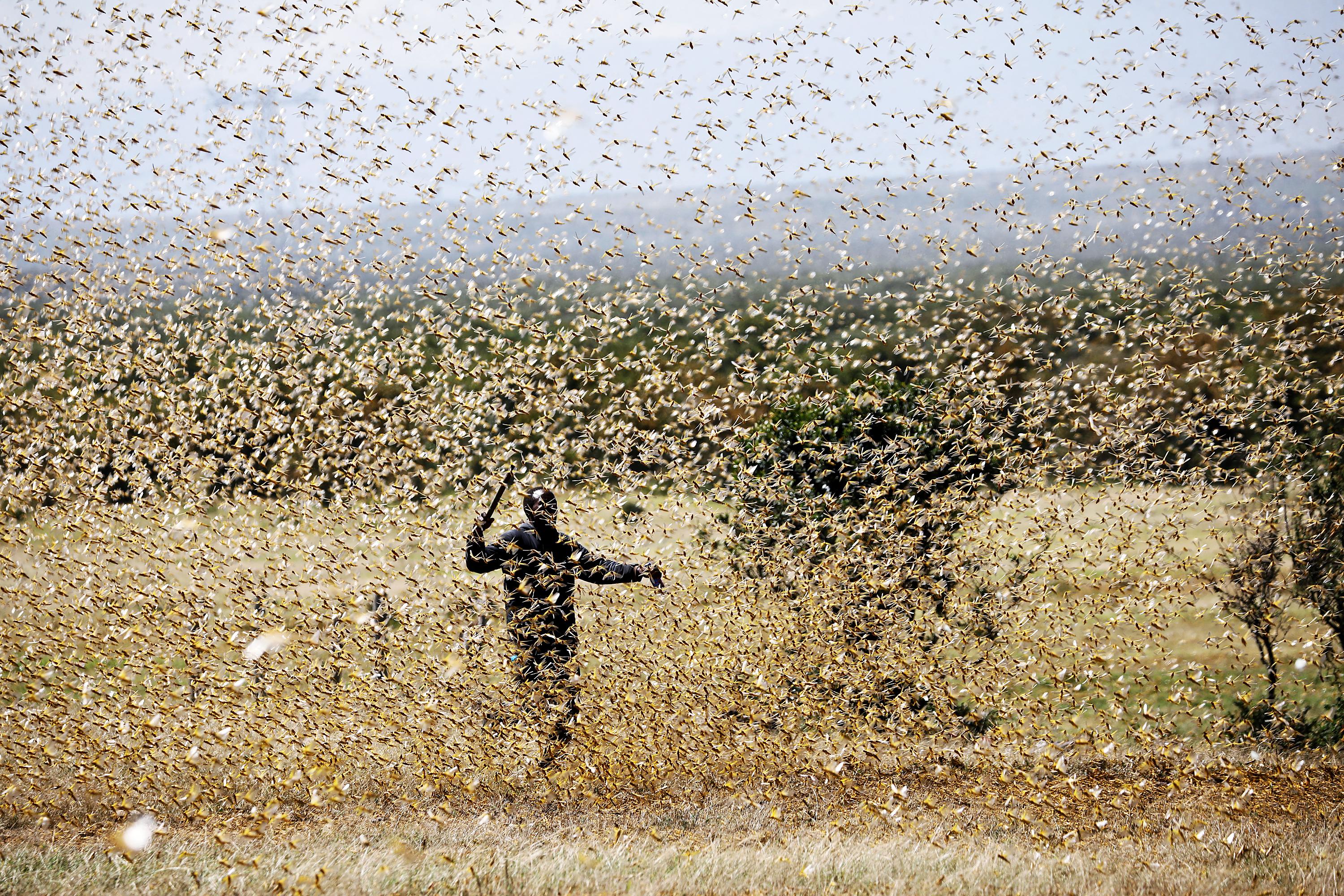
The plague Joel warns about is a plague of locusts. For a modern reader here in America, this sounds archaic and mythological, but plagues of locusts devastated parts of Africa just a year ago. It’s horrendous.

As Joel opens his prophetic prognostication, he compares the swarm of locusts to “a mighty army without number.” This isn’t the first time that this phrase was used in conjunction with a locust plague. Psalm 105:34 uses the same phrase to reference the plague of locusts used against Egypt in the time of Moses when Pharaoh refused to let the Hebrews go.

I mulled this over in the quiet this morning. It’s a fascinating connection. In Exodus 10 the locust plague is used against the Hebrews’ antagonist to motivate a change of heart. Now, Joel predicts, God is going to use the same natural plague against His own people to motivate a change in theirs.

What goes around, comes around.

I’m reminded that there is so much in this life that I do not control. As Jesus said in His famous message on the mountainside: “[God] causes his sun to rise on the evil and the good, and sends rain on the righteous and the unrighteous.” Tragedy sometimes befalls the best of us, while blessing sometimes rains down on the worst of us. I have observed along my life journey that in either circumstance, Jesus’ question remains essentially the same:

“What will I do if the plague tragically strikes? “

What will I do if I’m undeservedly blessed?”

Joel is promising the former, and calling his people to respond accordingly. But how I answer both questions and how I respond in either circumstance is equally important in God’s Kingdom economy. I’ve observed that we as humans like to think of earthly things in simple binary terms. I’m either the victim of tragedy or blessed beyond measure. The truth of what Jesus taught is that I will likely experience both on this earthly journey, and how I respond is a barometer of my spiritual health.

For Wendy’s sake, I just hope I planted the Wisteria far enough away from the patio.

If you know anyone who might be encouraged by today’s post, please share.

Plague and Blessing

Plague and Blessing (CaD Joel 1) Wayfarer

A nation has invaded my land,
    a mighty army without number…

Joel 1:6a (NIV)

For Father’s Day this year, the girls bought me a Wisteria vine in honor of my mom, their Grandma Jeanne, who crossed over into eternity back in March. My mother’s favorite color was purple and the Wisteria blooms with large purple flowers.

When I went to plant the Wisteria, Wendy instructed me to plant it a long distance from our patio. Flowers bring bees and m’luv Wendy has a thing about bees and wasps. With her gorgeous mane of thick, curly hair, Wendy has a fear of a bee or wasp getting caught in her hair.

Of course, one can only control nature to a certain extent. So, during the summer months, Wendy is often confronted with the random reality of her flying nemesis “buzzing her tower” like Maverick in his fighter jet. Her intense reactivity to the presence of the flying pests is a sight to behold.

This week, our chapter-a-day journey is going make a quick trek through the short, ancient prophecies of Joel. Joel is a bit of a mysterious prophet on the historical landscape. The historical record both within the Great Story as well as non-Biblical tradition are silent regarding who exactly Joel was and when exactly he lived and carried out his prophetic ministry. He appears out of nowhere and writes one prophetic poem warning of a coming plague and calling the people of Judah to repentance.

The plague Joel warns about is a plague of locusts. For a modern reader here in America, this sounds archaic and mythological, but plagues of locusts devastated parts of Africa just a year ago. It’s horrendous.

As Joel opens his prophetic prognostication, he compares the swarm of locusts to “a mighty army without number.” This isn’t the first time that this phrase was used in conjunction with a locust plague. Psalm 105:34 uses the same phrase to reference the plague of locusts used against Egypt in the time of Moses when Pharaoh refused to let the Hebrews go.

I mulled this over in the quiet this morning. It’s a fascinating connection. In Exodus 10 the locust plague is used against the Hebrews’ antagonist to motivate a change of heart. Now, Joel predicts, God is going to use the same natural plague against His own people to motivate a change in theirs.

What goes around, comes around.

I’m reminded that there is so much in this life that I do not control. As Jesus said in His famous message on the mountainside: “[God] causes his sun to rise on the evil and the good, and sends rain on the righteous and the unrighteous.” Tragedy sometimes befalls the best of us, while blessing sometimes rains down on the worst of us. I have observed along my life journey that in either circumstance, Jesus’ question remains essentially the same:

“What will I do if the plague tragically strikes? “

What will I do if I’m undeservedly blessed?”

Joel is promising the former, and calling his people to respond accordingly. But how I answer both questions and how I respond in either circumstance is equally important in God’s Kingdom economy. I’ve observed that we as humans like to think of earthly things in simple binary terms. I’m either the victim of tragedy or blessed beyond measure. The truth of what Jesus taught is that I will likely experience both on this earthly journey, and how I respond is a barometer of my spiritual health.

For Wendy’s sake, I just hope I planted the Wisteria far enough away from the patio.

If you know anyone who might be encouraged by today’s post, please share.

God Revealing, Then and Now

God Revealing, Then and Now (CaD Ex 10) Wayfarer

Then the Lord said to Moses, “Go to Pharaoh; for I have hardened his heart and the heart of his officials, in order that I may show these signs of mine among them…”
Exodus 10:1 (NRSVCE)

Wendy and I have some connections to east Africa. We have, for years, supported a Compassion child in Kenya named Joyce. Taylor and Clayton spent time working in Uganda, and Clayton’s doctoral research has taken him repeatedly to Tanzania where we also support another Compassion child, Michael, who is slightly older than Milo and they share the same birthday.

Because of these connections, we tend to pay a little more attention to the situation there. In case you didn’t know it, they have been battling locust swarms this year. Massive locust swarms that I would tag as being of “biblical proportions.” A second wave of swarms hit the region just as they began fighting COVID.

In my recent series of podcasts, A Beginner’s Guide to the Great Story, I talk a lot about context. An adult can’t reason with a two-year-old by getting him or her to sit and listen to you read a psychology textbook that explains his or her need to modify behavior. In the same way, understanding ancient stories require me, a 21st-century reader, to think outside the box of my 21st-century thought and sensitivities. They require me to think about how God is meeting with and interacting with humanity in the context of the way they lived, thought, believed, and interpreted their world. Today’s chapter is a great example.

Locust swarms have been part of the ecosystem forever. They happen on occasion just like floods, droughts, hurricanes, tornados, and viral outbreaks. Our post-enlightenment, educated minds turn to science to understand these things, deal with them appropriately, and lessen the negative effects.

In Moses’ day, no one thought in such a way. In Moses day, natural phenomena were always considered to be a manifestation of the gods. If something bad happens, the gods must be angry. If something good happens, the gods must be pleased.

In today’s chapter, God tells Moses that the plagues had a purpose. The purpose was to reveal Himself and His power to Pharaoh and his officials. What is lost on a 21st-century reader is the fact that the types of plagues being visited upon the Egyptians had connections to various deities they worshiped across the pantheon of more than 1500 gods they worshiped. Because many, if not most, of the plagues were natural occurring phenomena, the Egyptians may have historically associated them with other deities. Now, the God of Moses turns them on-and-off at will, which is a direct challenge to Egypt’s religious system. Each time a plague is turned on or off by “stretching out” their hand and staff, it is a direct challenge to Pharaoh’s claim of being a god who rules by “my mighty hand.”

In the quiet this morning, I find myself thinking about God revealing Himself. The story of Moses is an early chapter in the Great Story. There has been no described system of worship. There is no Bible or sacred text. There is no institution or organization. God has simply revealed Himself to Abraham and his descendants in mysterious ways. The plagues we’ve been reading about are the first recorded time in the Great Story that God attempts to reveal Himself to another people group in contrast to their own gods. This is a major shift in the narrative, and this theme will continue.

Interestingly, Jesus also made it clear that His mission was one of revelation:

At that time Jesus said, “I thank you, Father, Lord of heaven and earth, because you have hidden these things from the wise and the intelligent and have revealed them to infants;

“All things have been handed over to me by my Father; and no one knows who the Son is except the Father, or who the Father is except the Son and anyone to whom the Son chooses to reveal him.”

Jesus answered, “Neither this man nor his parents sinned; he was born blind so that God’s works might be revealed in him”.

God has always been in the process of revealing Himself, and does so in multiple ways, including the very act of creation:

Ever since the creation of the world his eternal power and divine nature, invisible though they are, have been understood and seen through the things he has made. So they are without excuse.

Along my earthly journey, I have been ever-grateful to live in our current period of human history. Despite the doom and gloom peddled in the media, we live in a period of human history that is unprecedented with regard to low levels of extreme poverty, disease, starvation, war, violence, and high levels of education and safety across the globe compared with any other period of history. Humanity is in a very different chapter of the Great Story, and I believe God is revealed very differently in our world than in Moses’ day.

The basic dance remains the same. God revealing, inviting, drawing in. Me asking, seeking, knocking, humbly accepting, and receiving.

I’m glad it no longer requires a plague of locusts. In my quiet time this morning I’m praying for those who are actively trying to help the people of Africa to minimize the damage and for those who are suffering because of it.