Tag Archives: Royal Priesthood

Spiritual Toddlers in an Adult World

In this way you are to set the Levites apart from the other Israelites, and the Levites will be mine.
Numbers 8:14 (NIV)

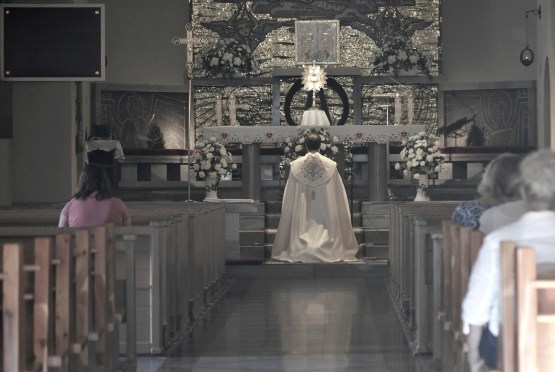
In the tradition I was raised, the Reverend of our church was treated as a special class of spiritual person. He dressed different. He wore robes on Sunday. He was the only one allowed to serve Communion. His pulpit was the highest point in the Sanctuary so that he was elevated above us. Everything in the pomp and pageantry of the “high church” tradition wordlessly affirmed that he was spiritually upper-class compared to us every day working class sinners in the pews.

The entire paradigm of the “Priestly class system” is rooted in the Great Story. It’s what today’s chapter is all about. God establishes that if the holy Creator of the universe is going to be present in their midst in His traveling tent temple then they are going to have to understand that God ’s holiness is so overwhelmingly pure and powerful that it’s fatal to a normal, sinful human being. Therefore, everything God has arranged in this system of sacrifices, offerings, cleansing, and purification is established to both protect God’s people and to teach them. Aaron’s sons were the priests, and the only ones allowed inside God’s tent Temple. Even then, inside the tent was a thick curtain. Behind that curtain was the “Most Holy Place.” That’s where the Ark of God’s presence was. Only the high priest could enter the Most Holy Place behind the curtain, and even then it was a special ceremony held once a year for a special systemic purpose. The tribe of Levites were helpers to the priests and caretakers of the tent temple, but they couldn’t offer sacrifices or enter the tent. They were like a hedge of protection between the fatally pure power of God’s holy presence and the people.

The priests and the Levites were a spiritually special class in that system.

I have been constantly repeating that these events and God’s newly established relationship with humanity through the Hebrew people is the toddler stages of human development. In natural circumstances, humans don’t remain toddlers forever. We grow. We mature. Our relationship with our parents also matures and changes.

Fast forward thousands of years. God sends Jesus, His one and only Son, to become the once-and-for-all sacrifice. At the moment of Jesus’ sacrificial death, the curtain in the Temple was split from top-to-bottom. The same curtain that divided God’s presence from the people.

As Bob Dylan put it, “The times they are a changin’.”

Before, God’s presence was behind the curtain and there were priests to go into God’s presence on humanity’s behalf. Now, God tore down the curtain, poured out His Spirit to be present in the heart of every believer. Priests no longer necessary. Every believer, one with God and God’s Spirit dwelling within them, is now made holy.

“And by that will, we have been made holy through the sacrifice of the body of Jesus Christ once for all.” Hebrews 10:10 (NIV)

Peter goes on to explain that together, all believers make up a “royal priesthood.” Writing to all believers scattered abroad by early persecution, he writes:

“But you are a chosen people, a royal priesthood, a holy nation, God’s special possession, that you may declare the praises of him who called you out of darkness into his wonderful light.” 1 Peter 2:9 (NIV)

Every believer is a Most Holy Place, God’s Spirit dwelling within. The Kingdom of God going out wherever I go. I take it with me. My job, no matter how menial, is now a ministry as “whatever I do, I do all to the glory of God.”

At least, that’s what it says in the Great Story after Jesus’ death and resurrection, and after Pentecost. But, I’ve observed that we human beings don’t much like change. Plus, there’s still an enemy, the Prince of this World, who is motivated to keep believers from realizing the power of God’s presence in their lives and their Kingdom responsibilities. Thus, I’ve observed that we like the old toddler traditions like the tradition in which I was raised. Even both Peter and Paul recognized that believers were slow to grow into this understanding. Both of them used the metaphor of believers being like toddlers sucking on their bottles when they should be adults eating solid food at the table.

Please don’t read what I’m not writing. I appreciate and embrace all of the spiritual metaphors that exist in high church traditions. I don’t think they’re wrong. But metaphors are layered with meaning. The metaphors of the high church tradition in which I was raised communicated spiritual lessons that were part of the old spiritual paradigm of the Levites, not the new spiritual paradigm of the priesthood of all believers. I had to spiritually mature to discern the difference.

Granted, it’s simple and easy to believer there’s a special person, a special class of spiritual persons, who provide a protective hedge between God and us every day working sinners. They take care of being holy for us. They handle the holy God stuff while I just sit in the pew with no expectations other than showing up and asking forgiveness for my sinful self. It may not be intended that way, but in practice I’ve consistently observed that it’s the way things play out in the mind of most church members. And, perhaps that’s the crux of the issue. If I’m simply a church member and I’m not a believer, then there is still, spiritually, a big thick curtain between me and God.

If you know anyone who might be encouraged by today’s post, please share.

Promotional graphic for Tom Vander Well's Wayfarer blog and podcast, featuring icons of various podcast platforms with a photo of Tom Vander Well.
These chapter-a-day blog posts are also available via podcast on all major podcast platforms including Apple, Google, and Spotify! Simply go to your podcast platform and search for “Wayfarer Tom Vander Well.” If it’s not on your platform, please let me know!
The logo of Bible Gateway featuring an open book icon against an orange background.

Priests

Priests (CaD Hos 4) Wayfarer

“Because you have rejected knowledge,
    I also reject you as my priests”

Hosea 4:6 (NIV)

As I have continued to read and study the Great Story over my lifetime, I’ve come to the realization that I can’t truly understand or appreciate what God is doing unless I understand the concept of being a priest.

The concept of being a priest is one who spiritually stands in the gap between God and others. A priest is a go-between, a representative, and a spiritual conduit. If I look at how the priesthood works in the institutional church, the priest is the one who presides over the rites and sacraments. In the Roman tradition, it is through the priest that absolution for sin is granted; The priest being the conduit between the penitent and God, through which forgiveness flows.

But I find the concept of the “priesthood” far more expansive in God’s point-of-view than the narrow definition the institutional church has made it out to be. When God initiated His covenant with Abraham, He told Abraham that he would be the father of many nations through which “all the nations of the earth will be blessed” (Gen 18:18). When God led the Hebrew people out of slavery in Egypt, gave them the Law, and established them as a nation He called them “a kingdom of priests” (Exodus 19:6). In the early Jesus Movement, Peter wrote to his fellow believers and said:  “But you are a chosen people, a royal priesthood, a holy nation, God’s special possession, that you may declare the praises of him who called you out of darkness into his wonderful light.” (1 Peter 2:8) In John’s Revelation, he sees people of every tribe, nation, and language and is told that Jesus has “made them to be a kingdom and priests to serve our God.” (Revelation 5:10)

In each of these instances the priesthood is not a special ecclesiastical position held by a few educated and appointed men. Throughout the Great Story, God refers to the priesthood in terms of an entire group of people beginning with the Hebrew nation and then, through Jesus, expanding it to the spiritual nation of believers of every tribe, nation, and tongue.

This is not a small matter of definition. It gets to the heart of what God has always been doing, is currently doing, and will continue to do: Establishing an entire collective of people who will be a conduit through which those who are strangers to God can find their way to God.

In today’s chapter, God through Hosea tells the people of Israel that He is rejecting them, collectively, “as my priests.” Once again, God views the entire nation of Hebrews as His priests, not just the sons of Aaron and Levites who performed the rituals in the Temple.

When the Jesus Movement became the Holy Roman Empire in the fourth century, a change slowly took place in which the organism of the church became the organization known as the Church. The spiritual Jesus movement became a human empire, the most powerful political and religious institution in the western world. With it, the priesthood was transformed into an exclusive position for educated (or connected) men controlled by the institution. This paradigm was perpetuated through the centuries, even by the plethora of protestant denominations after the Reformation. It is still the pervasive paradigm, though I sense the winds of change shifting as the institutions have imploded during my lifetime.

In the quiet this morning, I am reminded that as a believer and follower of Jesus, I am a priest in the royal priesthood made up of all believers. Just as God called Hosea to be a living lesson as I described in yesterday’s post, God calls every follower of Jesus to live as priests – those who daily live in such a way that God’s love, joy, peace, patience, kindness, gentleness, faithfulness, and self-control are evident to all through my life, words, relationships, and actions.

Throughout history, I’ve observed that the institutional church has separated every day believers from those in the institution’s clergy. We’ve made different spiritual “classes.” The clergy have all the spiritual power, authority, and responsibility, while the every day members and believers are, by-and-large, stripped of any spiritual power, authority, or responsibility. This was never God’s paradigm. As a disciple of Jesus, I am gifted, empowered, called, and responsible to be a priest, a living lesson. As Jesus put it, I am to live in such a way that others might “see my good works, and glorify my Father in heaven.”

And so, I enter another day, endeavoring to fulfill my role as a member of the royal priesthood of all believers.

If you know anyone who might be encouraged by today’s post, please share.

Finding the Thread

Do we not all have one Father? Did not one God create us? Why do we profane the covenant of our ancestors by being unfaithful to one another?
Malachi 2:10 (NIV)

Over the past couple months, I gave three “whiteboard” messages among my local gathering of Jesus’ followers. We were going through the metaphorical “I am” statements Jesus made as recorded by John in his biography of Jesus. I used the same approach in each of the three messages, which was to unpack the fact that in proclaiming the metaphor for Himself (e.g. “I am the bread of life,” “I am the gate,” “I am the resurrection and the life” – each links to YouTube of the corresponding message), Jesus was connecting to spiritual themes throughout the Great Story from Genesis to Revelation.

One the pieces of repeated feedback I’ve received from people with regard to these messages was that they’d never seen the connections or recognized the metaphorical thread that ran throughout the Story. I get it. I’ve observed it to be very common for individuals to simply look at a verse or a chapter with a myopic magnifying glass. It is not necessarily a bad thing, but when that is the only way one views it, they effectively look at every verse or chapter with blinders on. The context of the larger whole is never seen or understood.

That’s why I continue in my chapter-a-day journey, even through what most people would consider the “boring” texts. I have found the text to be “boring” only if I expect it to read the same way as the biographies of Jesus or one of Paul’s letters. The text of the prophets expects something different from me in the way I read, study, and think. One of those expectations is for me to see the connections; To see the thread of consistent message running through them.

For example, I recognized in today’s chapter a message thread running through the messages of Jeremiah, Malachi, and Jesus. In today’s chapter, Malachi specifically addresses the priests and religious leaders. It’s the same group of people Jeremiah confronted for being “shepherds” who only led the people astray with their heartless corruption. It was the reason God sent His people into exile, hoping they would learn the lesson, repent, and return with a different attitude. They obviously didn’t, because Malachi addresses the same lot and accuses them of being hypocrites and bad examples who effectively were the same covenant breakers that Jeremiah prophesied about 150 years before. It is the same lot for whom Jesus saved his most scathing rebuke and condemnation.

But the thread doesn’t end there, and this is most critical to understand.

After Jesus’ resurrection and ascension, the entire paradigm changed. No longer was the priesthood confined to a small group of people with certain strands of genetic DNA or with institutionally educated and approved “ministry” professionals. Every follower of Jesus, indwelled with the Holy Spirit, becomes what Peter called “a royal priesthood.” Every follower of Jesus is essentially a priest, a conduit through whom others are to find Jesus by the examples we set in our lives, words, relationships, and actions. The institutional church has never truly embraced this. Human institutions, by their very nature, consolidate power among a few in order to control the many.

This means that the same lot that Jeremiah addressed, the same lot that Malachi addressed, and the same lot that Jesus addressed is now….me.

Jesus said, “By this everyone will know that you are my disciples, if you love one another.” In other words, Jesus expected all of his followers to live by our loving example towards others. It’s the same message Malachi addresses to the priests. The way they were treating their own people profaned God’s established covenant relationship (see yesterday’s post).

In the quiet this morning, if I truly understand that I am now part of the “royal priesthood of all believers” then I can’t help but feel the sting of Malachi’s prophetic rebuke. In the realm of the Spirit and the Kingdom of God, I am just as much a priest as the Levites Malachi is addressing. The expectations of being a loving example of Father God is as much on me as it was on them, if not more so.

And so I enter another day of the journey, endeavoring to be a living example of Jesus’ servant-hearted love in my peace, joy, patience, kindness, gentleness, goodness, faithfulness, and self-control.

Pray for me.

If you know anyone who might be encouraged by today’s post, please share.

Chapter-a-Day Leviticus 7

From the day they are presented to serve as priests to God, Aaron and his sons can expect to receive these allotments from the gifts of God. This is what God commanded the People of Israel to give the priests from the day of their anointing. This is the fixed rule down through the generations. Leviticus 7:35-36 (MSG)

When the law of Leviticus was given to Moses around 3500 years ago, the fledgling nation of Israel were nomads wandering in the desert and they were split into twelve tribes. The sons of Aaron (Moses’ Chief Operating Officer) and the rest of his tribe of Levites, were appointed the job of priests and caretakers of the Tabernacle, which was a giant tent sanctuary that they took with them and set up wherever they went. Once the people had settled in the Promised Land, the plan was for the Levites to continue to be caretakers of God’s temple. As priests, they would not own and control a section of land from which to earn their living. The daily sacrifices offered by the other tribes would provide what they and their families needed to survive.

In the Levites, we find another brilliant word picture of God’s ultimate plan. God’s message calls those who follow Jesus a “royal priesthood”  (1 Peter 2:9-10). Just as the Levites found their provision in the sacrifices offered in the Tabernacle and the Temple, those of us who follow Jesus find our provision in the ultimate sacrifice of Jesus made when He gave Himself up to die on a cross.

This morning as I read the chapter and the bread offerings that became daily provision for the priests and their families, I couldn’t help but think of the prayer Jesus taught His followers to pray: Give us this day our daily bread. And I thought of the last supper when He broke the bread: This bread is my body given for you.

As followers of Jesus, we are given daily sustenance and provision through the sacrifice of Jesus. He is the Bread of Life. The system of sacrifice set up in the law of Leviticus is a beautiful word picture that foreshadowed God’s plan to send Jesus, the lamb of God who takes away the sins of the world, to be the ultimate sacrifice for sin. It was a metaphor for the royal priesthood Jesus’ followers become, and the daily provision Jesus’ sacrifice becomes for those who partake. Without Leviticus, we don’t have a complete a picture of who Jesus was (and is, and is to come).