Tag Archives: Orthodoxy

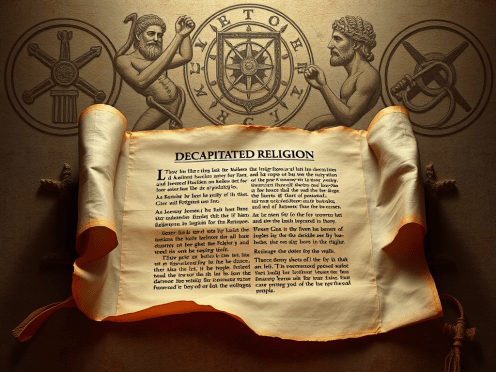
Decapitated Religion

See to it that no one takes you captive through hollow and deceptive philosophy, which depends on human tradition and the elemental spiritual forces of this world rather than on Christ.
Colossians 2:8 (NIV)

The early years of the Jesus Movement were messy. You have to think about it. All of the scripture we trek through on this chapter-a-day journey, the texts on which Christian theology has been established for 2,000 years hadn’t yet been written. They were being written as handwritten letters by Paul and the other apostles, delivered by personal carrier, distributed to each local gathering of Jesus’ followers, and read to the believers.

The first century world in which the Jesus Movement emerged was filled with religions. There was certainly the Jewish religion from which Jesus and His followers emerged. There was a pantheon of Roman gods and Greek gods that each had their own temple, cult, worship, and traditions. There was a cult worshipping Caesar as god. There were also Greek philosophies that had all the hallmarks of being religions in-and-of themselves. As local gatherings of new believers in Jesus met on a regular basis to worship, learn Jesus’ teachings, and encourage one another to live their lives daily as His disciples, they were confronted from within and without with other religious and philosophical thoughts that some individuals wanted to connect to and with Jesus.

Reading between the lines of Paul’s letter to the believers in Colossae, it is obvious that he is addressing this very reality. Others were introducing religious thoughts, traditions, and philosophies into the local gathering that had nothing to do with Jesus. Over the centuries, scholars have argued about what competing religion or philosophy Paul is addressing. I don’t think it’s one. I think he’s addressing all of it: Jewish legalism, pagan rituals and traditions, Greek philosophy, and even the worship of angels are all described by Paul’s words.

What I have found fascinating while meditating on the letter yesterday and today is to circle and count the number of times Paul uses the word “Christ.” Ten times he uses it in today’s chapter. He’ll use it 30 times total in this brief letter. So, I took some time to consider what Paul is saying about Christ:

Christ is the mystery of God.
All creation was created in Christ, through Christ, for Christ.
In Christ, all of creation holds together.
Christ is the fullness of God in bodily form.
In Christ we are brought into that fullness.
Once dead in our sin, we are made alive in Christ.
Christ is the reality of God.
Christ is the head of all power and authority.
Christ is supreme.

I then listed and compared the adjectives Paul uses in describing these competing religious and philosophical thoughts that others are trying to introduce and merge into Jesus’ teaching:

fine-sounding arguments
hollow
deceptive philosophy
human tradition
elemental spiritual forces of this world
shadow
false humility
idle notions
rules of this world destined to perish
merely human commands and teachings
mere appearance of wisdom
lacking any value in restraining sensual indulgence

Wow, what a contrast. Paul then makes a point that all of these religious and philosophical notions have “lost connection with the head and he had just identified “the head” a few paragraphs earlier as Christ. We all know of what worth the body is once it’s been decapitated.

In the quiet this morning, I find myself meditating on Jesus who is the Christ. Paul will make this point 30 times in this letter. He will make it 50 times in his letter to the believers in Ephesus. The point he is making is that the crucified and resurrected Jesus is the “anointed one,” the “messiah,” the Creator, Sustainer, Redeemer, Reality of God, Mystery of God and Supreme Head over everything.

As a disciple of Jesus, I believe that if I diminish Jesus the Christ in any way, I’ve lost connection to the head and have become decapitated from the Truth.

If you know anyone who might be encouraged by today’s post, please share.

These chapter-a-day blog posts are also available via podcast on all major podcast platforms including Apple, Google, and Spotify! Simply go to your podcast platform and search for “Wayfarer Tom Vander Well.” If it’s not on your platform, please let me know!

Opposition!

Now John’s disciples and the Pharisees were fasting. Some people came and asked Jesus, “How is it that John’s disciples and the disciples of the Pharisees are fasting, but yours are not?”
Mark 2:18 (NIV)

One of the things that I have learned along my life journey and in my career is that when you step up into the spotlight in front of a group of people, and you have something to say, you make yourself an easy target. When the something you have to say pushes against the orthodoxy of whatever group you’re addressing, then you’re an easy target stirring a hornet’s nest.

Mark’s biography of Jesus is the shortest of the four biographies of Jesus known as the “gospels” (Gospel means “good news”). In fact it’s 3700 words shorter than the next one on the list as far as word count (John) and almost 10,700 words shorter than Luke’s account.

What that means is that Mark is moving fast through the story and he’s only sharing the essentials. John wrote at the end of his biography that if all the stories were told about Jesus that could be told then all the libraries in the world could not contain them all. So, it begs the question of me as a reader, what can I learn from the choices Mark is making?

In today’s chapter, Mark shares four quick scenes from the early days of Jesus’ ministry. In each of the four, Jesus’ words or actions are challenged by others. Three of the four challenges come from different constituencies.

Jesus tells a man that his sins are forgiven, and “teachers of the law” told him he’d committed blasphemy. “Teachers of the law” refers to Scribes, which can be considered vocational lawyers who spent their lives interpreting the Law of Moses (the first five books of the Bible).

In the next scene, Jesus is having dinner with His new disciple, Levi (Matthew). Matthew was a tax collector, which meant he was seen as a Roman collaborator, he had money, and he didn’t hang out with good, religious Jews. Jesus is challenged by “teachers of the law who were Pharisees.” The Pharisees were a quasi-political party who held sway over the Jewish religion in Jesus’ day. So these challengers were not only vocational lawyers, but they were members of the most powerful political party within the rulers of Judaism. They challenged Jesus for mingling with socially and religiously unacceptable people.

As Jesus is beginning His ministry, His cousin John the Baptist, is at the height of his own popularity. John was rogue preacher. The same religious and political establishment who challenged Jesus, challenged John as well. John had a huge following with a lot of his own disciples. So in this next scene, it becomes clear that John has his disciples fasting and they notice that Jesus’ disciples are not. I love that Mark mentions “some people” who questioned this because along my life journey I’ve had many experiences with being told that “some people” have taken issue with something I’ve said or done. Even Jesus is getting the “some people” challenges from within the constituency of people who would naturally be His likely supporters and followers.

The final scene Mark shares has to do with rule-keeping. This time it is the straight-out members of the Pharisees who challenge the fact that Jesus’ disciples were picking off grain in a field for an afternoon snack. It happened to be the Sabbath, a religious day of rest that Pharisees policed to a fault.

In these four scenes, mark is telling us:

Jesus claimed to have the divine authority to forgive sins, and did a miracle to prove it. The religious establishment called it blasphemy.

Jesus socialized with people who were socially unacceptable to the fundamentalist and orthodox religious set.

Even the anti-establishment, populist types who were followers of John and were keenly interested in what Jesus was doing challenged the fact that He didn’t demand the same rigorous spiritual disciplines that John did.

And Jesus taught His disciples to follow the Spirit of the law of the Sabbath and not worry so much about the rule-keeping bureaucrats who took it upon themselves to police such things and punish the rule-breakers. Those rule-keeping bureaucrats got stirred up like hornets when Jesus claimed that His authority as “Lord of the Sabbath” trumped their authority as bureaucratic, establishment minions.

In the quiet this morning, I’m reminded of a quote by Albert Einstein who said that “Great spirits have always encountered violent opposition from mediocre minds.” I can’t help but be reminded that life is not only full of challenges, but also challengers. Mark seems to be telling me that Jesus Himself was challenged and opposed on all sides by both His supporters and His detractors. In the same way, I can expect to be challenged when I am being who God calls me to be, doing what God calls me do to, just like Jesus.

As a disciple of Jesus, I already know what He expects of me when challenged. It starts in my spirit which He tells me should be love, kindness, gentleness, and self-control. It then comes out in the form of blessing and praying for those who challenge me, hate me, and say all sorts of bad things about me. Jesus said,

“Not only that—count yourselves blessed every time people put you down or throw you out or speak lies about you to discredit me. What it means is that the truth is too close for comfort and they are uncomfortable. You can be glad when that happens—give a cheer, even!—for though they don’t like it, I do! And all heaven applauds. And know that you are in good company. My prophets and witnesses have always gotten into this kind of trouble.
Matthew 5:11-12 (MSG)

If you know anyone who might be encouraged by today’s post, please share.

Of Change and Health

Would you rather listen? Subscribe to The Wayfarer Podcast Now on Your Favorite App!

Awake, harp and lyre!
    I will awaken the dawn.

Psalm 108:2 (NIV)

Do you ever have random conversations that stick in your memory? I was on a trip with a colleague. While aware that we are each followers of Jesus, we didn’t talk about spiritual things very often. My colleague comes from a very conservative, almost fundamentalist viewpoint on things and he surprised me by wanting to ask my opinion about the weekly worship among the institutional church where he was a member.

It happened that my colleagues tribe had recently made the switch from a very traditional worship experience that involved singing traditional hymns, many of them having been in existence for hundreds of years. The church was migrating to using songs of the present-day genre. He was clearly struggling with this.

I have shared many times that I have been a spiritual wayfarer who has experienced and participated in a rich diversity of spiritual traditions. I have been in the emotionally rockin’ pentecostal tradition, the corporate silence of the Quaker Meeting House, the high-church liturgy of Roman Catholic church, the call-and-response of the black church, the intellectual approach of mainline institutions, the simplicity and sincerity of rural worship in a developing country, and the down-home family environment of a “house church.” My attitude has never been to ask “Which is right?” In fact, I’ve never really worried about asking “Which is right for me?” I’ve always tried to be fully present where I have been been led and ask myself “What good can I gain from this experience?”

I am aware, however, that my colleague has a more black-and-white view of both faith and life. The change in music genres within his local gathering had him rattled.

Colleague: “I’m struggling with these ‘seven-eleven’ songs. It’s the same seven lines sung eleven times.”

Me: “You mean like Psalm 117 that only has two lines which were likely repeated in worship?”

Colleague: “It’s just so repetitive. Singing the same thing over and over.”

Me: “You mean like Psalm 136 that repeats ‘His love endures forever’ twenty-six times?”

Colleague: “It’s not right. They take little pieces of a great hymn and mess it up by changing it. It was meant to be sung in its entirety!”

As this point, I could have pointed my colleague to today’s chapter, Psalm 108, because the entire thing is simply a cut-and-paste mash-up of Psalm 57:7-11 and Psalm 60:5-12. In fact, there are multiple examples both in the Psalms and in the writings of the ancient prophets when entire sections would be cut-and-pasted into an updated work. There are also examples of this in other ancient Mesopotamian cultures. It was quite common.

I don’t really know how the conversation landed with my colleague. I could tell that he was disappointed (maybe even a little frustrated) that I didn’t agree with him and provide him an affirmation of his opinions. He never brought it up again.

In my life, I have found change to be really difficult for people in almost any circle of life. When you mix in both change and religious tradition it can take on an added layer of emotion. Suddenly the change gets escalated to a level of religious orthodoxy. Sides are taken. The discussion escalates to arguments. Then comes entrenchment. Very often the next step is the severing of relationships. Groups split.

Along my spiritual journey, I have always assumed that change is a natural part of creation. Most things in life cycle in one way or another. What goes around comes around. Styles come back around and get freshened up. Religious traditions and practices that were once abandoned as “old and outdated” come back in vogue to bless a new generation of Jesus’ followers.

So it is that as I watch the changes that constantly happen around me on multiple levels, I try to keep my emotional reactions in check. Instead of digging in my heels and demanding that my love of the perfectly acceptable way of doing things is understood, I try to divert my energy to asking “What good might be gained from this change?”

In the quiet this morning, I find myself reminded of a mantra that I was introduced to by my friend. It made its way around the internet and I am unsure of the source. I once used it in a message, but I don’t know that I’ve ever referenced it in one of my chapter-a-day posts. It’s always stuck with me:

Healthy things grow.
Growing things change.
Change challenges me.
Challenges force me to trust God.
Trust leads to obedience.
Obedience makes me healthy.
Healthy things grow.
..

Lord Protectors of Orthodoxy and Tradition

Keeping a close watch on him, they sent spies, who pretended to be sincere.
Luke 20:20 (NIV)

It’s been years, but I can still see their faces. The look on most of those faces is a scowl. Along my journey, I have been a member and have taught in many different churches of diverse denominational bents. I have found these individuals in almost every one of them.

They are the thought police, the guardians of tradition, and the Lord Protectors of the Orthodox Realm. They wear the mantel of righteousness, believing themselves responsible to strictly observe and question anything they perceive to seep outside the rigid box in which they hold their tradition and orthodoxy. They often believe themselves to be spiritual heirs of the first century Berean Jews who are described as follows:

Now the Berean Jews were of more noble character than those in Thessalonica, for they received the message with great eagerness and examined the Scriptures every day to see if what Paul said was true.

Acts 17:11 (NIV)

My experience, however, leads me to believe that “noble character” is not an apt description for most of these individuals. They don’t receive my message with eagerness and open examination but with skepticism and censure. I have come to believe that their motivation is often fear and or pride cloaked in religiosity. Their minds and spirits are not open but closed. The fruit of their words and actions is rarely love, joy, peace, patience, kindness, or gentleness. I have observed that the root of their words and actions lie in the soil of fear, pride, self-righteousness, and anger. The fruit of their words and actions is conflict, quarrels, division, and dissension.

The faces of these individuals came to mind today as I read Luke’s account of the final week of Jesus’ earthly journey. We find Jesus in Jerusalem teaching in the Temple courts. He is drawing large crowds. He is the talk of the town. And, the orthodox power system of that Temple is angry and afraid. Jesus threatens their lucrative religious racket that has amassed their wealth. Jesus threatens their power and social standing with the people whom they control through religious rule-keeping, condemnation, judgment, and shame. Their tradition is holding onto power and they are bent on taking Jesus down.

So these teachers of the law and religious authorities send people to question, to trap, and to report anything the upstart Nazarene says which might be used to make a case against Him. They are already trying to find a way to send Jesus to the Roman Governor, for under Roman occupation it is Pontius Pilate alone who can sentence one to death, and they want Jesus dead.

Don’t hear what I’m not saying. As a follower of Jesus, I firmly believe that I must be responsible to consider, weigh, and test the things said, written, and taught in the name of Jesus. At the same time, I am called upon to be both shrewd and gentle. I have been commanded to follow the law of love in all things. I have been told to reserve judgment for the One true Judge. I am not judge, jury, and executioner of orthodox justice with a Junior Holy Spirit badge pinned to my chest. What a sad way to live and be. It doesn’t seem like the “full life” Jesus wanted His followers to experience and live out.

Back to the faces and the individuals. I have learned along the way to always try responding thoughtfully, gently, and with self-control. If they are open to a sincere and kind conversation to explore and discuss, then wonderful! However, when a thoughtful and gentle reply is fruitless (and it typically is), then I endeavor to press forward on the path to which God has led me. I keep loving, keep praying, keep reading, keep seeking, keep asking, keep knocking, and I focus on the only things in my control: my intentions, thoughts, words, and actions. And, I pay as little attention to my scowling critics as is humanly possible.

Sometimes, the most loving thing I can do is to walk away.