Tag Archives: Orientation

Time to Forget

Brothers and sisters, I do not consider myself yet to have taken hold of it. But one thing I do: Forgetting what is behind and straining toward what is ahead,  I press on toward the goal to win the prize for which God has called me heavenward in Christ Jesus.
Philippians 3:13-14 (NIV)

Over the past few years, Wendy and I have discovered a difference in the way we perceive and approach life. As we have dug into it, it’s allowed us to learn about ourselves and to better understand one another. It has to do with our orientation to time.

I have a strong orientation towards the past. I’m a lover of history. I have spent much of my life digging into I and my family’s genealogy. As I contemplate current events, I tend to seek the past for context. Even as I look to the future I tend to look to the past for patterns that might inform where things are headed.

Wendy, on the other hand, is very much future oriented. Her brain is constantly looking a step or two ahead and it informs both her present tasks and their relative priorities. Life for Wendy is a constant anticipation of what is next, while I give little thought to it.

Our very different orientations towards time often creates clashes in how we function both independently and in relationship. Knowing these differences has allowed us to be more empathetic and understanding towards one another.

This past week our local gathering of Jesus’ followers focused our thoughts on Jesus’ words in the Lord’s Prayer: “forgive us our sins as we forgive those who sin against us.” Wendy and I spent some time talking about forgiveness and resentment, exploring whether or not we have truly forgiven those who have hurt us in the past.

As we continued our conversation, Wendy began quizzing me about a couple of individuals in my own life story who have been the source of considerable struggle for me. As we discussed these individuals and I have continued to meditate on my relationship with them and their impact on my life, it has struck me that my time orientation towards the past might lend itself to unhealthy thought patterns.

In today’s chapter, Paul references his own past and as a disciple of Jesus he had a lot of baggage. Once the most rabid enemy of Jesus and His followers, Paul had the blood of martyrs on his hands. Paul oversaw the stoning of Stephen. It is unknown how many other individuals suffered, were imprisoned, or died as a result of Paul’s zealous persecution of the Jesus Movement, but it is certainly likely that at least some of the opposition he constantly faced linked back to the suffering he once inflicted on others.

This came to mind as I read Paul’s words in today’s chapter:

But one thing I do: Forgetting what is behind and straining toward what is ahead,  I press on toward the goal to win the prize for which God has called me heavenward in Christ Jesus.

I happen to be entering a new stretch of my life journey. Old things are passing away. New things are emerging. As this happens, I am reminded by Paul’s words that I need to spiritually strain against my natural time orientations which often keep me mentally, emotionally, and even spiritually mired in what lies behind. There are some things on the road behind me that I need to forget in order to focus my mental, emotional, and spiritual energies on straining toward what is ahead.

Fortunately, I’m married to a partner whose natural orientation toward time can help me with that.

If you know anyone who might be encouraged by today’s post, please share.

Promotional graphic for Tom Vander Well's Wayfarer blog and podcast, featuring icons of various podcast platforms with a photo of Tom Vander Well.
These chapter-a-day blog posts are also available via podcast on all major podcast platforms including Apple, Google, and Spotify! Simply go to your podcast platform and search for “Wayfarer Tom Vander Well.” If it’s not on your platform, please let me know!
Bible Gateway logo featuring an open book icon

Inspired by the Past

Inspired by the Past (1 Chr 22) Wayfarer

“Now devote your heart and soul to seeking the Lord your God. Begin to build the sanctuary of the Lord God…”
1 Chronicles 22:19a (NIV)

As a baseball fan, I have been enjoying the outpouring of honor for Willie Mays the past few days. Not only was Mays possibly the greatest all-around player ever, but he is among the last players who transitioned from the Negro Leagues to the Major Leagues after Jackie Robinson broke the color barrier. He is one of the greats.

“We were playing for generations of players who were held back. We had a lot to play for, not just [for] us,” Mays told John Shea, co-author of Mays’ memoir 24.

One of the things that I love about history is its power to inspire, and there is plenty of inspiration in a man like Mays who was not only a great ball player, but a stellar human being who helped move history forward out of the sickness of segregation.

As I mentioned in yesterday’s post/podcast, we have entered a new phase of 1 Chronicles. Once again, I found it important this morning to place myself in the sandals of the Chronicler and the people to whom he is writing his history of King David and the Kingdom of Israel. His generation has returned to the rubble of Jerusalem left by the Babylonian army almost a century before. Their generation has been given the monumental task of turning the debris into a new Temple.

How does he inspire them? With the history of their larger-than-life hero King David. King David’s greatest desire was to build the temple, but God made it clear that it would be his son, Solomon, who would do the job. So, David made all of the preparations he could, and in today’s chapter, he passes the responsibility to his son with history’s version of an inspirational locker room speech.

I think it’s important to note that all of these details are not found in the earlier historical account in Samuel. This is the Chronicler’s unique addition to the story. When he writes of David urging his son to succeed in completing his life’s greatest ambition he knows that he is writing to the “sons of David” who have the same task before them hundreds of years later. He is using history to inspire.

In the quiet this morning, I’m reminded that everyone has a natural bent with regard to time. My bent is to look to the past for its lessons and inspiration. Wendy’s bent, on the other hand, is to always be looking to the future so that she can plan and execute that plan well. Still, others have a bent to living in the moment and focus on the present realities. There is no right or wrong. It’s not an either-or, but a yes-and. I have learned along the journey that we all need to learn from and appreciate those who have a different bent. And from time to time everyone needs the pasto to inspire us. The Chronicler certainly understood this.

If you know anyone who might be encouraged by today’s post, please share.

Nostalgia

Nostalgia (CaD Job 29) Wayfarer

“Oh, for the days when I was in my prime,
    when God’s intimate friendship blessed my house,
when the Almighty was still with me
    and my children were around me…”

Job 29:4-5 (NIV)

Over the past year or two, Wendy and I have been observing and discussing how the two of us think differently about time. As an Enneagram Eight, Wendy is future oriented. She is always thinking about what is ahead and what needs to be done to ensure that everything runs smoothly once we get there. As an Enneagram Four, I have a past orientation. I’m a lover of history and I’ve always had a freakish kind of memory. To this I can pull up a photo of my first grade class and tell you the name of pretty much every classmate. I could also point out the house where about half of them lived.

So, yesterday while grocery shopping Wendy asked me if we had a bottle of cranberry juice left on the shelf of the pantry because I had just opened a new bottle from the pantry the day before. In Wendy’s future orientation one should naturally make note of these things so that when we’re at the store we can get one, if needed, to make sure there’s at lest one on the shelf at all times for that morning when we run out at breakfast. I think there was one more on the pantry shelf when I opened a new bottle the day before. I think there was. I don’t know. But, I distinctly remember when I was five and we had this corner cupboard with a lazy susan, and things would fall off in the back of the cupboard and because I was the smallest my. mom would have me crawl onto the lazy susan and she’d spin me around to retrieve the fallen cans from the bottom of the cupboard in the back. That, I remember.

Herein lies the issue.

For that past twenty-some chapters, the ever-suffering Job has been sitting on his local refuse burn pile telling his three amigos that he would like to have his day in court with God. He’d like to put God on the witness stand and cross-examine the Almighty because Job is convinced that he has been wronged and God is the perpetrator. With today’s chapter, we enter a new phase of the Job story. Starting today, and with the following two chapters, Job makes his closing arguments in the metaphorical trial he’s been living out inside his head and heart.

Like a defense attorney speaking to me, his audience and jury, Job begins with a trip down Memory Lane. He waxes nostalgic of the days before that day when a rogue derecho killed all of his children and, simultaneously, some neighborhood gangs stole all of his flocks and fortune. He’s pulling the heart-strings of this past-oriented jury member. I feel it, Job. Oh how good life was, back in the day when I rode my Schwinn five-speed Stingray to the 7-Eleven on Douglas Avenue. It was a half-block east on Madison, hang a right and head south on 31st street, then just three blocks past the Cron’s house to Douglas. The 7-Eleven was on the northwest corner. It used to be a DX station. I’d fill up the Briggs and Stratton push mower. Gas was about 25 cents a gallon. But the DX closed and it became a 7-Eleven where almost every day in the summer I bought a Big Gulp for a quarter that I’d probably earned doing Scott Borg’s paper route at the VA hospital that morning.

Oh…I’m sorry…we were talking about Job, weren’t we?

Along my life journey, I’ve observed that it’s easy to glorify the past, especially for those of us who have a natural bent toward nostalgia. When life gets complicated, when I’m suffering in the present and find it difficult to see any hope for the future, I can reach back to the past like a drug. It provides cherished memories and drums up nostalgia-fueled good feelings. And, that’s what Job does in today’s chapter. The chapter follows an ancient poetic structure in which Job not only waxes nostalgic about how blessed he was, but at the center, he extolls the virtues of his generosity and benevolence (in defense of his friend Eli’s accusation in 22:9):

I was blessed (vss 2-6)
I was honored (vss 7-10)
I was generous and benevolent to the poor and needy (vss 11-17)
I was blessed (vss 18-20)
I was honored (vss 21-25)

In the quiet this morning, I am reminded that my natural bents can end up with crooked and unintended consequences. The glorification of what was can easily lead to me not being fully present in what is nor prepared for what is to come. For Job, I wonder if his trip down Memory Lane is essentially serving to emotionally pick at the scabs of his present suffering and fuel the fire of his resentment. I have learned along my life journey that sometimes I have to will and to discipline myself to be fully present in the moment, and give time and energy to preparing for what’s ahead. Gratefully, I have a partner who provides me with a really good example to follow.

If you know anyone who might be encouraged by today’s post, please share.

A Selective Backward Glance

A Selective Backward Glance (CaD Job 8) Wayfarer

“Surely God does not reject one who is blameless
    or strengthen the hands of evildoers.”

Job 8:20 (NIV)

I mentioned a previous post some of the different ways people communicate, and I hinted at time orientation. I hadn’t given a ton of thought to this until earlier this year when Wendy and I began to really explore how it affects our relationship and communication.

I have a very strong past orientation. I love history. When I was young adult and really began digging into understand myself, I began to dig into my family history. I am a product of the family system into which I was born and raised. My parents were products of the family systems into which they were born and raised. Human systems have certain ways they function and operate which can be generational in nature. In digging into the past I discovered a lot about my family and myself. Often look back in time to gain clarity on my present circumstances.

Wendy has a very strong future orientation. She appreciates my love of history, but also she rolls her eyes when I geek out on it. Unlike me, she is always thinking ten steps ahead with her internal radar because she knows that future circumstances will go much smoother for everyone involved if things are planned well, prepped for, and executed properly.

We have come to realize that some of our marital strife comes from the different time orientations with which we navigate life, but that’s another blog post.

In today’s chapter, we find Job continuing to sit on the refuse ash heap in his off-the-charts agony joined by three friends. Eli insinuated that Job’s suffering must point to some secret sin that caused the Almighty to punish Job. Job’s response was that he was innocent and did nothing to warrant his suffering, and challenged his friends to prove him wrong. So, his friend Bill steps into the batter’s box to take his swing.

Bill is a straight-shooter. He is direct and gets right to the point. He takes issue with Job’s claim of innocence and anguished cries to the Almighty. To Bill and his theological world-view, this is a black-and-white issue: “Your children sinned. God took them out. Period. End of sentence.”

What follows is fascinating because Bill clearly has a past time orientation. He tells Job to look to the past, the wisdom of the ancients and ancestors. in order to gain clarity on his present circumstances. Bill then shares a Hebrew wisdom poem (vss 11-19) about how the godless suffer the consequences of their godlessness. He then concludes in his black-and-white worldview that suffering is a spiritually natural consequence of godlessness and if Job was really blameless then God would restore Job’s fortunes and blessings.

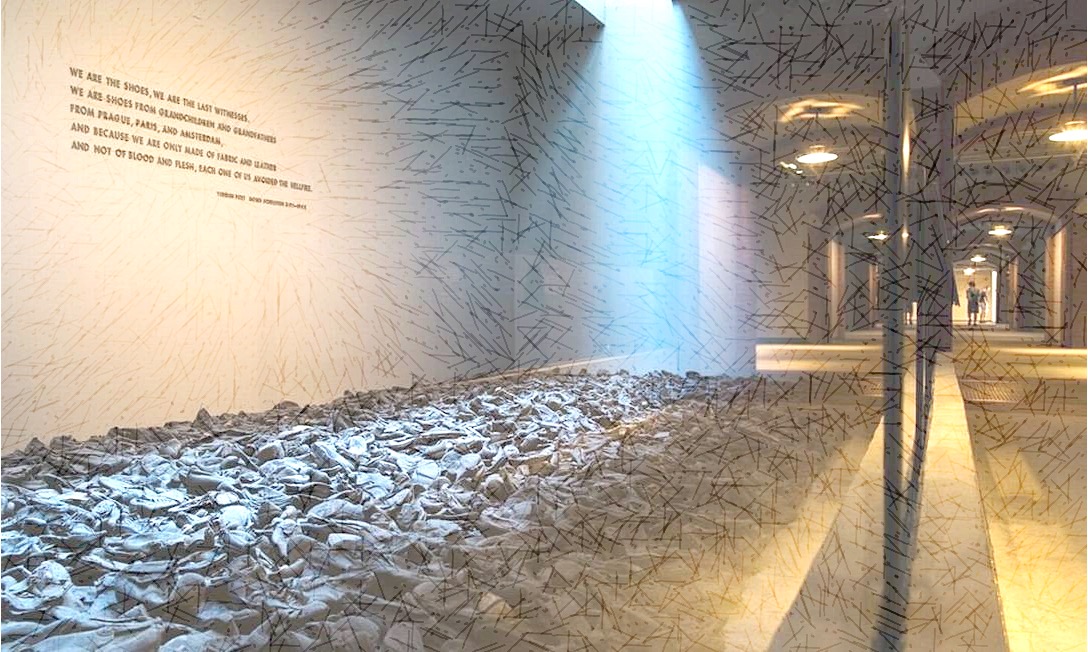
I pondered Bill’s words in the quiet this morning. As someone with a strong past orientation, I quickly found Bill’s argument ludicrous. Human history is a long string of stories about human suffering, punctuated by certain events in which suffering happened on a massive scale. Within those events are nameless, faceless human beings who did not deserve their fate. My mind immediately reminded me of my trip to the U.S. Holocaust museum and the sight of all those shoes piled up just as they were piled up when their nameless, faceless owners were stripped and sent to the gas chambers.

My brain then provided me with a name, and a face from the past: Corrie Ten Boom and her family. Every other member of her family took of their shoes and placed them in that pile. Their only crime was that their love of Jesus and their desire to do the right thing led them to hide Jews in their home in an effort to save their lives. Her story of suffering in the concentration camp echoes Job’s anguished cries, and rightly so.

So, all due respect Bill, but in telling Job to take a backward glance to the past, to the ancients and their wisdom, you have chosen to be carefully selective in your stated evidence, so as to justify your simplistic conclusion. History is filled with nameless, faceless individuals who echo Job’s anguished cries in the suffering and death they blamelessly endured. Bill, you told Job that his words were “a blustering wind,” but it is your simplistic, theological world-view that I find as hollow as that pile of old, footless shoes.

If you know anyone who might be encouraged by today’s post, please share.