Tag Archives: Mark 1

Flyover Country

Jesus replied, “Let us go somewhere else—to the nearby villages—so I can preach there also. That is why I have come.” So he traveled throughout Galilee, preaching in their synagogues and driving out demons.
Mark 1:38-39 (NIV)

Other than a four year sojourn to the outskirts of Chicago for college, I have lived my entire life in Iowa. As I network for work with business people on both coasts, I find that most people a) don’t know exactly where Iowa is on the map and b) have never been here. Iowa is known as “flyover” country. Business, politics, and culture in America are driven primarily by people on the either coast. Here in Iowa It’s mostly rural farmland dotted with small towns. We’re an easy target for comedians. The only reason anyone pays attention to Iowa is our first in the nation caucuses every four years that kick of the presidential race, and every four years the important and elite talking heads on the coasts gripe in the media about us having that little sliver of the political pie.

In the 40-plus years that I’ve been studying this Great Story from Genesis to Revelation, one of the things that I find lost on most people is the giant cultural divide between the worldly powers of Jesus’ day and where Jesus chose to begin His earthly ministry. For those living in Judea, the center of everything elite and important was in Jerusalem. The city of Jerusalem was New York, L.A., and Washington D.C. rolled into one. Just as people flock to those centers of business, politics, and entertainment to “make it” in the world today, so would those who wanted to “make it” in Jesus day go directly to Jerusalem. Every one who was anyone of power and prestige was in the big city.

The north shore of Galilee, on the other hand, was the “flyover” country in its day. That’s where Jesus chose to begin his ministry. When I visited the area I was amazed how remote it still feels today. To get to some of the little villages where Jesus taught we had to navigate back-country roads to places it’s obvious few people ever visit. It’s remote, isolated, and about as far away from “worldly power” as one could get.

Today our chapter-a-day journey begins a trek through the gospel of Mark, written by a man named John Mark, who has his own interesting story. Mark was a young man when his mother, Mary, became a follower of Jesus. He was among the throng of followers who are often forgotten in the shadows behind The Twelve who got most of the attention. Mark’s mother was among the women with means who financially supported Jesus’ ministry and in the events after Jesus’ crucifixion and resurrection, Jesus’ disciples and followers met at and lived in Mary’s home. Mark is in the background of most of the events of those early years of the Jesus’ Movement. He was with Paul on the first missionary journey, spent much of his adult life living with and assisting Peter. At the end of Paul’s life, Mark is there by his side.

I felt a spiritual connection between person and place this morning as I meditated on the first chapter of Mark’s biography of Jesus. Jesus chose to center His ministry in a rural area dotted with small villages of simple people just trying to catch fish, grow crops, and survive. Jesus’ followers were, for the most part, blue-collar workers with little education and zero prominence in the world. People like Mark, who was just a kid whose mom decided to follow Jesus, and so he lived his life in the background of events that would change the world. He was a stage-hand in the drama of the Jesus Movement – listening, learning, and then sharing Jesus’ teaching. Just one of those names in the program to which no one really pays attention.

And, I think this is the point. Through the prophet Isaiah, God said that His ways are not our ways. He doesn’t do things the way Wall Street, Washington, Hollywood, or Silicon Valley believe that things should be done. God sent His Son to flyover country to simple people living in rural areas who are just trying to make a living and figure out life.

I find something endearing and profoundly significant in this, especially in a culture where popularity, fame, and influence have become the currency of power in an online world that has become an endless cacophony of voices. Jesus’ message has never broadly resonated in the power centers of this world where the kingdoms of politics, education, commerce, and even religion hold sway. I am reminded that at the very end of the Story in Revelation, those kingdoms will still be lined up against God.

And so, in the quiet this morning, I sit in flyover country. Few people can find me on a map, and most people will avoid visiting. The further I get in my life journey the more I appreciate it. Jesus taught that I should seek first the Kingdom of God. Along life’s road I discovered that the closer and more enticed I become with the Kingdoms of this world, the harder it becomes find the eternal treasures that Jesus said were most important. I think Mark understood this. What a great role model; Living life in the background listening, learning, and sharing Jesus’ teaching among simple people who are just trying make a living and figure out life.

If you know anyone who might be encouraged by today’s post, please share.

Source, not Compensation

Source, not Compensation (CaD Mk 1) Wayfarer

And a voice came from heaven: “You are my Son, whom I love; with you I am well pleased.”
Mark 1:11 (NIV)

Looking back on my life journey, it’s obvious to me that my early thirties were an important stretch of road. My late teens and early twenties were a period of being cocksure of myself. Entering marriage, fatherhood, and adulthood in my early twenties was, for me, a heavy dose of reality. The side-effects of that reality dosage led to a period of intense personal chaos which eventually led to intense introspection, and this eventually led to a more healthy sense of what psychologists would call my individuation. In the parlance of our times, as the Dude would say, I grew up. I became my own person.

As I trekked through that time of life, I began to inspect my family of origin with a critical eye. As with any human system, there were shortcomings which I had to honestly acknowledge, address, and forgive. But I also discovered strengths which had to be equally acknowledged, addressed, and appreciated.

It was during this time of life that I began to witness a common soul wound that effected a number of my male friends. They had never experienced a father’s love. Never had their ears heard the words “I love you” uttered by their dad. Never had they received a word of affirmation, encouragement, or paternal pride. “The old man” had simply been a stoic source of silence, or constant criticism, or unattainable expectations. The result was a seemingly adult male who was, in reality, the walking wounded endlessly striving to earn a blessing that was hopelessly beyond price.

It was this observation that gave me a much needed contrast in my own process of individuation. Every day of my childhood ended with a hug and kiss from my parents and an “I love you.” My father, as well as my mother, was present, loving, affectionate, proud, and trusting. So much so, in fact, that I was blind to it. I took it for granted. I had no idea how priceless of a gift it was.

With today’s chapter, my chapter-a-day journey embarks on Mark’s biography of Jesus. It is the shortest of the four Jesus Stories contained in the Great Story. It is believed to be the earliest to have been written. Mark, also known as John Mark, was a colleague and assistant to both Peter and Paul. Mark’s mother was one of the circle of women who followed and supported Jesus’ ministry. The early believers met in her home. It is believed that Mark’s biography is his compilation of the stories Peter told as they traveled and taught others in the first century.

It is also believed that a curious side note of Mark’s biography of Jesus was, well, autobiographical. It’s found in his description of Jesus’ arrest:

A young man, wearing nothing but a linen garment, was following Jesus. When they seized him, he fled naked, leaving his garment behind.

This somewhat comical detail stands out, in part, because Mark’s biography of Jesus is short on details compared to Matthew, John, and Luke. It is a condensed compilation of stories, especially in the early chapters. A dramatization of today’s chapter would contain eight different scenes. That’s a lot of material to chew on in one quiet time.

What resonated most with me this morning was the scene of Jesus’ baptism in which all members of the Trinity are present. Father, Son, and Holy Spirit mark the beginning of Jesus earthly ministry and the Father’s voice from heaven declares His love and pleasure with His Son, Jesus. What always stands out to me is that Jesus hasn’t done anything yet.

He hasn’t successfully faced temptation.
He hasn’t hasn’t preached his first sermon.
He has no disciples.
He hasn’t healed anyone.

Jesus has been ritually dunked by His cousin, John. That’s it.

“That’s m’boy,” says the Father. “Man, I love Him. Couldn’t be more proud. It’s such pleasure to be this kid’s Dad!”

Years ago I made this same point during a message I was giving among my local gathering of Jesus’ followers. One listener accosted me after the service to take issue with this.

“He was thirty years old,” this person exclaimed. “He’d done stuff!”

This individuals insistence quickly made clear to just how wounded their soul was. They could not fathom parental love, pride, or pleasure that had not been demanded, earned, and merited. I have observed along my life journey that much of religious Christianity suffers from this wound. Churches talk about grace (literally, unmerited favor) while demanding that members faithfully earn the system’s social acceptability by carefully being obedient to the silent rules of dress, speech, relationships, and public behavior. In a meritocracy, love, pride and pleasure are a carrot dangled as motivation. They are to be dearly earned through strict obedience.

Not Jesus’ family system. Love, pride and pleasure are the source of the motivation. The divine love and relational intimacy of the mysterious One-is-Three and Three-is-One is what fueled Jesus’ ministry, His mission, His service, and His sacrifice.

In the quiet this morning, I find myself grateful to my father and mother for modeling love. It has mades it easier for me to understand this essential truth about Jesus’ message: Love is the source not the compensation. It is there. It’s right there. All I have to do is believe, receive, and make room. “We love because He first loved us.”

Perhaps the single-most important lesson of my life journey, thus far, was the realization that God’s eternal love, complete forgiveness, and total acceptance was not the result of my “doing stuff” or not “doing stuff.” It is a gift to be simply received. The realization of just how priceless that gift is has been the greatest motivation of my life and has led me to “do stuff” for forty years, like writing this post.

If you know anyone who might be encouraged by today’s post, please share.

Non-Transactional Love

At that time Jesus came from Nazareth in Galilee and was baptized by John in the Jordan. Just as Jesus was coming up out of the water, he saw heaven being torn open and the Spirit descending on him like a dove. And a voice came from heaven: “You are my Son, whom I love; with you I am well pleased.”
Mark 1:9-11 (NIV)

Years ago I was asked to give a message among a weekly gathering of Jesus’ followers. The text above was part of the message that I shared that morning. The observation that I made in that message was the same thing that struck me again this morning as I read the chapter. It’s so subtle that I missed it for many years of my spiritual journey.

The observation is simply this: the Father’s love and pleasure we’re given to Jesus and we’re just ten verses into the story. Jesus’ ministry hadn’t started. He hadn’t preached a sermon. He hadn’t healed anyone, performed miracles, or cast out a demon. So God’s love was there, it had already been there, and it was always going to be there. The Father’s love for the Son was not dependant on His dutiful and obedient carrying out of, and completion, of the mission. Therefore, in the same way, God’s love for me is not dependent on my good works, purity, morality, church attendance, or my upstanding life. It’s always been there.

After my message, I was immediately confronted by an angry person. There was no preamble to the conversation. They immediately dove into an argument to let me know that Jesus was thirty years old when He was baptized, so He obviously had “done stuff” and proven Himself to the Father. In other words, Jesus had to have earned the Father’s love and pleasure.

Along my spiritual journey, I came to realize that quid pro quo theology was so deeply ingrained in me that I was blind to it for many years. While I cognitively agreed with the doctrinal statement that salvation was “by grace through faith,” I functionally lived, acted, and treated others as if God’s love was dependant on my obedience and theirs. I discovered that I was treating it like a transactional relationship, and I liked it that way. If God’s love was earned by my being a “good person” then there was a measuring stick I had understood since I was a child; A measuring stick I could use to decide whether others were worthy of my love. God’s love and grace being transactional made things so simple for me on a human level. Be good: Heaven and acceptance. Be bad: Hell and rejection. It was a religious version of the Santa Claus principle my parents used to get me to behave when I was a child that I could now apply on an adult level.

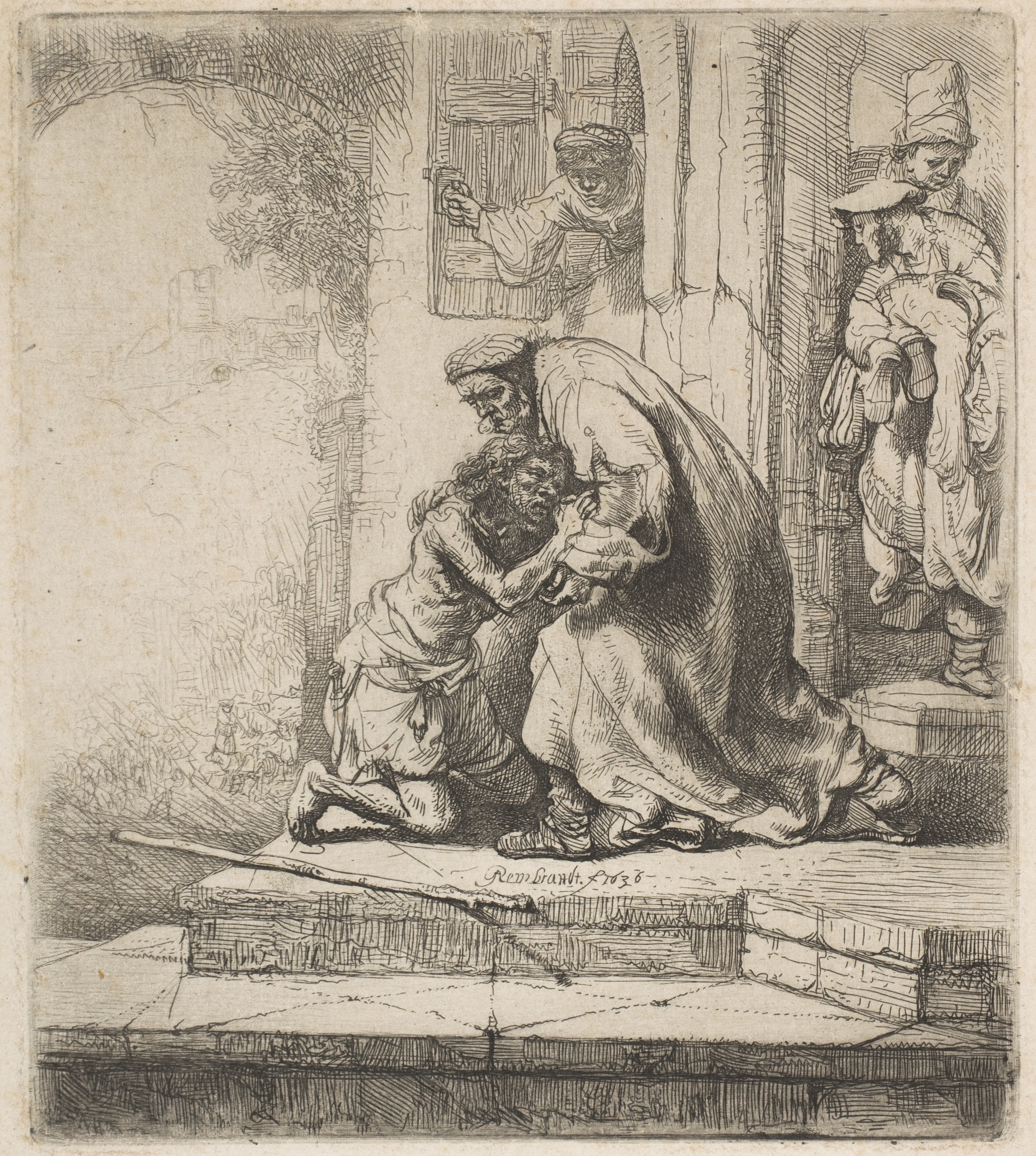
In His parable of the Prodigal Son, Jesus told the story of a younger rebellious brother who does all of the wrong and sinful things. When he returns home the poor, penniless, sinful, broken child is greeted by his father who runs to embrace him and forgive him. The father throws a huge homecoming party. The older brother, who has been dutiful and obedient is indignant. The point Jesus was making is this: the father loved both of his sons. His love belonged to both of them, had always been there from the beginning, and had remained with both even when the younger one was lost and the elder was obedient.

In the quiet this morning I find myself reflecting on my own life journey. You can look back at my life and find me playing both roles in my own life’s production of the Prodigal Son. I have been the wasteful, wandering, rebellious child squandering what I’d been graciously given. I have also spent years being the indignant, dutiful son projecting my miserly, transactional world-view onto a loving and gracious Father.

I’m older now. The reality for any actor is that as you get older you find yourself cast in very different roles than when you were young. C’est la vie. It strikes me this morning that I’d like to think I’m ready to play the role of the father with everyone in my circles of influence, extending grace and love freely, regardless of a person’s actions.

And so, I find myself coming back to that argumentative, angry “older brother” who conversationally accosted me after my message those years ago. I get where that person was coming from. I pray that they experience the fullness of God’s love that has always belonged to them and has nothing to do with their goodness.

Have a great week, my friend.

Chapter-a-Day Mark 1

Lakhovsky: The Convesation; oil on panel (Бесе...
Image via Wikipedia

Before daybreak the next morning, Jesus got up and went out to an isolated place to pray. Mark 1:35 (NLT)

Over the past few weeks I’ve had a handful of encounters with people in which I’ve mainly listened as the person on the other side of the conversation talked, and talked, and talked. Don’t get me wrong; It wasn’t a big deal. In each case, I understood that the person needed to get something out, and I was generally happy to listen. It was not, however, a conversation. It was a running monologue.

Healthy relationships required a steady stream of two-party communication. Both sides of the relationship must actively listen and actively speak. When the dialogue is skewed towards either person, the relationship begins to strain.

It is no different in our relationship with God. It requires an on-going conversation. Reading God’s Message to us is actively listening to what God has to say to us. Prayer is how we actively communicate to God. When either is lacking, our spiritual health strains.

Enhanced by Zemanta