Tag Archives: John 4

No Signs Needed

No Sign Needed (CaD Jhn 4) Wayfarer

And because of [Jesus’] words many more became believers.
John 4:41 (NIV)

For the past four months, since the heinous events of October 7, 2023, the headlines have been dominated by the intense conflict between the terrorists of Hamas and Israel. We have seen heated and sometimes violent demonstrations around the world. We have witnessed the impassioned feelings on both sides of the conflict. What many fail to understand is that the conflict between people groups in this region can be traced back thousands of years. They were as real for people in Jesus’ day as they are today.

In the first three chapters of John’s version of Jesus’ story, he has made a point of the “signs,” or miracles, that Jesus performed. He went on to describe the religious leaders for whom no “sign” was good enough as they demanded a bigger, better, more magnificent miracle, while the crowds who saw Jesus’ miracles/signs at the Temple during the Passover festival believed because of them.

For the largely Jewish audience that John was addressing when he wrote his account, today’s chapter takes a shocking twist. Jesus leaves the region near Jerusalem and heads back north to His home region of Galilee. To get from one to the other in a straight line, Jesus had to travel through a region called Samaria. This was an issue.

The people in the Samaritan region were Jews who hundreds of years before Jesus had intermarried with non-Jewish inhabitants during the time when the northern kingdom had been taken into exile by Assyria. To Jesus’ people, the Samaritans were half-breeds (or mud-bloods if you’re into the whole Harry Potter nomenclature). Good Jews would walk miles out of their way to avoid walking through Samaria. I can’t help but think about the delineations drawn today between Israel and Palestinian regions and the antipathy between them. Jesus was like a Jew walking into and through Gaza or the West Bank.

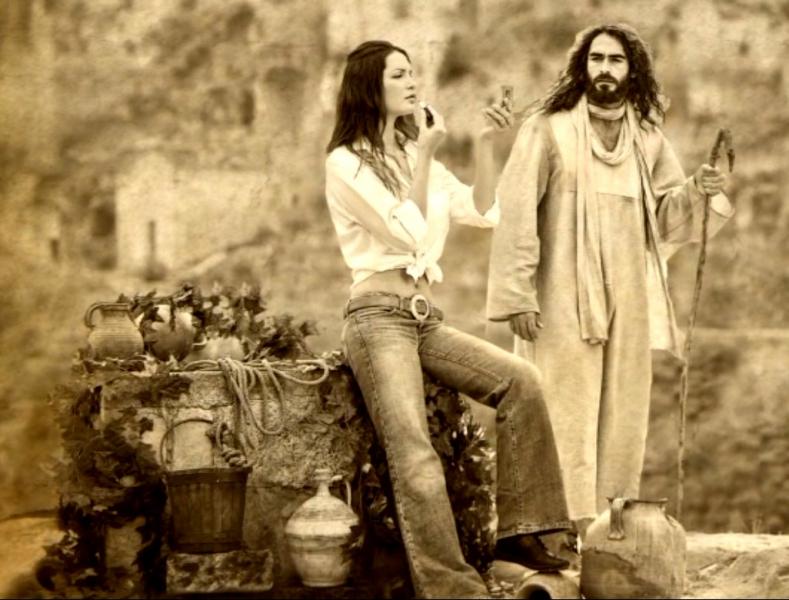
Jesus not only leads His disciples directly through Samaria, but He strikes up a conversation with a Samaritan woman. It was socially unacceptable for a Jewish man of Jesus’ day to speak to any woman in public. Jesus strikes up a conversation with a Samaritan woman. If Jesus was playing poker with the cultural rules of His day, His conversation with the Samaritan woman was Him going “all in.”

I find it fascinating that John shares this episode so early in his version of Jesus’ story. John’s audience was well aware that the Jesus movement had torn down traditional social and cultural distinctions between men and women, Jews and non-Jews, along with slaves and slave owners. In writing about Jesus’ conversation with the Samaritan woman, their two-day stay with the Samaritans there, and the Samaritans’ belief in Jesus, John was providing his readers with the reason that Jesus’ followers were so revolutionary in crossing such entrenched social mores. It’s what Jesus did Himself, and the example Jesus commanded them to follow.

As I meditated on this in the quiet this morning, I couldn’t fail to notice one small detail that I find of profound importance. John has already established how important Jesus’ “signs” and miracles were in leading His Jewish audience to believe in Him. When it came to the Samaritan woman and her people, there were no miracles worked. There was no “sign.” Instead, John specifically states that these socially unacceptable half-breed deplorables believed Jesus simply at His word.

I’m reminded this morning that as much as the world has changed since Jesus’ two-day stay in Samaria, the human condition hasn’t changed. People groups still hate one another with generationally perpetuated hard hearts and homicidal intensity. Individuals still seek “signs” from God as a prerequisite to belief. I find in the despised Samaritans an example I hope I emulate every day on this chapter-a-day journey: Simply taking Jesus at His word without the need for any other signs.

I couldn’t help but think of the episode John will share in the final chapters of his account. The risen Jesus invites Thomas to touch His wounds and verify that it was really Him. After Thomas proclaims his belief, Jesus responds “Blessed are those who have not seen and yet have believed.”

God, make me less like Doubting Thomas and more like the Samaritans.

If you know anyone who might be encouraged by today’s post, please share.

Contrasts

Contrasts (CaD John 4) Wayfarer

When a Samaritan woman came to draw water, Jesus said to her, “Will you give me a drink?”
John 4:7 (NIV)

One of the things I’ve observed in life is the way human beings see others and then begin to identify self in contrast to others. I see myself in contrast to what others seemingly have, or have not. I see myself in contrast to how others live, where they live, what they look like, how they dress, their social status, their education, their economic status, their popularity, their influence, their dress, and yes, even the color of their skin. If I’m not careful, I can begin to identify myself by what I’m not rather than what I am.

In my journey through John’s biography of Jesus, I’ve been resonating on the theme of identity, and in yesterday’s chapter and today’s chapter there is an interesting contrast between the individuals to whom John chooses to introduce us.

Nicodemus was rich and powerful. The Samaritan woman was not.

Nicodemus was educated. The Samaritan woman was not.

Nicodemus had social standing. The Samaritan woman was an outcast.

Nicodemus was known. The Samaritan woman remains anonymous.

Nicodemus was an influencer. The Samaritan woman was a nobody.

Nicodemus met Jesus at night. The Samaritan woman met Jesus at noon.

It was socially acceptable for Jesus to speak with Nicodemus, but it was socially unacceptable for Jesus to speak with a woman or a Samaritan.

Nicodemus was religiously upright. The Samaritan woman was a sinner.

Nicodemus didn’t get Jesus. The Samaritan woman did.

There is so much happening in the subtext and contrast of these two encounters that I think I could chew on it all day. If I was doing a character study in preparation to portray either of these individuals on stage, I would likely conclude that Nicodemus’ perception of himself was rather haughty given his place in position in contrast with others. It’s hard for me to believe that the poor woman in a patriarchal system, racially outcast, with five failed marriages on her resume would have a particularly positive self-image.

How does my self perception affect my spiritual perception?

I have to confess that my earthly standing is closer to that of Nicodemus. How does that affect my spiritual receptors, my image of self, and my grasp of the divine? At the same time, my life is riddled with failures. I’m regularly reminded that people think I’m an idiot. I’ve even been told by others more religious than me that I am, in fact, going to hell (complete with scriptural references to prove it). What does that do for my self-image and my spiritual perceptions?

In the quiet this morning, my head and my heart are contemplative as they churn on these questions. As I look back on my journey as a follower of Jesus, I recognize that it has been a process of learning who I truly am in relationship to who Jesus truly is. It has been a process of both knowing myself and knowing God, and the two are as mysteriously and intricately interwoven as the circle dance of Father, Son, and Spirit. I can also see that the further I’ve progressed in this journey, the more the contrast with others, which dominated my self-perception for so long, transforms into my growing perception of seeing Jesus in every other person.

It’s Simple

So when the Samaritans came to him, they asked him to stay with them.
John 4:40a (NRSV)

Sometimes we make things way too complicated, when Jesus’ example was always to make things very simple.

Salvation is simply this: Hearing Jesus, and inviting Him to stay.


chapter a day banner 2015Featured image by Michael Belk

Chapter-a-Day John 4

Ha Ha Tonka State Park
Ha Ha Tonka State Park (Photo credit: Darin House)

Jesus replied, “Anyone who drinks this water will soon become thirsty again. But those who drink the water I give will never be thirsty again. It becomes a fresh, bubbling spring within them, giving them eternal life.” John 4:13-14 (NLT)

On Lake of the Ozarks in Missouri, a nice long boat ride from our Playhouse, you’ll find Ha Ha Tonka State Park. It’s an annual summer destination for us. Park the boat at the dock and walk down the winding path along the banks of the cove. Deeper and deeper it goes as the cove narrows. Eventually, you arrive at a natural spring where water continuously flows from deep inside the Earth. I’ve stood there many times watching as water ceaselessly flows from that spot, seemingly out of nowhere.

Today, as I read Jesus’ words I thought about that spring in the Ozarks and all the water ceaselessly bubbling out of it. We call it a “source.” The place from which water flows. What Jesus told the woman at the well in today’s chapter was that He was the Source of Life-giving, spiritual thirst quenching, eternal flow.

What is the Source of flow in my daily life? That’s the question I’m asking myself today. Where is it that I seek after energy, acceptance, peace, esteem, provision, healing, or anesthetic? Am I seeking after the Source in a bottle, a relationship, a walk-in closet, a paycheck, a gadget, a job, or a jackpot? It’s interesting how Jesus contrasted the water the woman wanted to give Him with the flow about which He was speaking.

You know you’re seeking after the wrong source if after a taste it always leaves you thirsty and seeking for more.