Tag Archives: Israelites

My Choice

My Choice (CaD Lev 1) Wayfarer

“Speak to the Israelites and say to them: ‘When anyone among you brings an offering to the Lord, bring as your offering an animal from either the herd or the flock.”
Leviticus 1:2 (NIV)

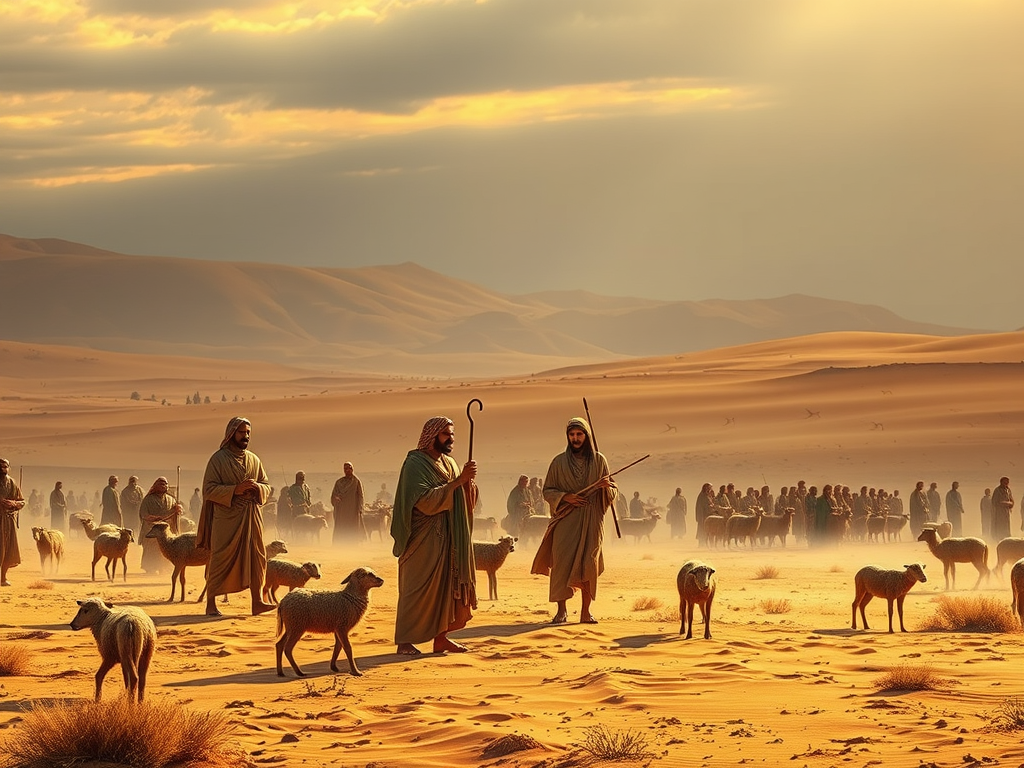
Imagine an entire nation of people wandering in the desert. Hundreds of thousands of men, women, and children; Perhaps millions with their flocks and herds. For four hundred years these people had been slaves in Egypt. They were told where to live, what to do each day, and they were given little or no choices in life. Their ancestor, Abraham, had made a covenant with God hundreds of years before, but they knew little about the God of Abraham. It had only been stories passed down through the generations.

Then, the God of Abraham showed up. He revealed Himself to Moses and miraculously delivered them out of their slavery in Egypt. Now they find themselves living in the wilderness. Everything has changed. This nation of people have an opportunity to begin a whole new way of living life together in community with their God, and with one another. It is, perhaps, the greatest social experiment in human history. It still resonates in our daily lives if we will but recognize it.

Today our chapter-a-day journey wades into perhaps the most ignored and misunderstood book in the entire Great Story. The book of Leviticus was a set of instructions for the newly appointed priests among this fledgling nation of newly freed slaves, the descendants of Abraham, Isaac, and Jacob. There were twelve tribes of them, and God through Moses appointed one tribe, the tribe of Levi, to handle priestly duties. Within the tribe of Levi, the descendants of Aaron (Moses right-hand man) would be the official priests who handled sacrifices. Keep in mind, just a month or so ago these Levite dudes were just slaves like everyone else doing what they were told to do in Pharaoh’s construction projects. Now they are priests of the God of Moses with no earthly idea what that means or what they are supposed to be doing. Leviticus is their guidebook.

The book opens by describing the five major types of offerings (burnt, grain, fellowship, sin, and guilt) that the people will bring to God, and how the priests are to handle them. Today’s opening chapter deals with burnt offerings. There were two things I noticed immediately as I read today’s chapter.

First, it says “when” people bring a burnt “offering” followed by “if” that offering is one of three potential types (a bull, a sheep, or a bird). This is not compulsory. The burnt offering is first and foremost a choice that is made by the person or family bringing it. The Hebrew word for “offering” means literally to “bring.” It is a choice. The entire act is one of willful devotion to God.

Next, there are three potential burnt offerings representing different economic realities. A bull could only be offered by a family with herds, which were objects of great wealth in their socio-economic system. A sheep or a goat were more common and represent a more “middle class” reality among the people. Birds were relatively cheap and plentiful for those who were on the poorer end of the economic spectrum of that day. In other words, God is allowing for people across the entire socio-economic spectrum to show their devotion at whatever level they can afford. Everyone is welcome.

As I meditated on these things in the quiet this morning, I was struck by the fact that God is amazingly consistent in His message and method. He initiated everything by appearing to Moses and freeing the Hebrew tribes from slavery. Now He is asking for them to make a free and willful choice to express their devotion and gratitude by coming to God with an offering, whatever they can personally afford.

“I chose you. I loved you. I saved you. Now, I want you to choose me and here is how you can do that.”

It is the same paradigm that God would display through Jesus a few thousand years later.

“For God so loved the world that he gave his one and only Son, that whoever believes in him shall not perish but have eternal life. For God did not send his Son into the world to condemn the world, but to save the world through him.
John 3:16-17 (NIV)

Or, as John would put it in one of his letters:

“We love because He first loved us.”
1 John 4:18

As I head out into a new and very busy work week, I’m reminded this morning that it is the same for me as it was for the former Hebrew slaves trying to figure out how now they should live. God has lovingly done everything for me. He has loved me, saved me, delivered me from my slavery to sin, guided me, provided for me, and blessed me. Now, I have the opportunity to choose to, in return, offer my love, gratitude, and devotion by living my life and relating to others with His love, joy, patience, kindness, goodness, gentleness, and self-control.

It’s my choice.

If you know anyone who might be encouraged by today’s post, please share.

These chapter-a-day blog posts are also available via podcast on all major podcast platforms including Apple, Google, and Spotify! Simply go to your podcast platform and search for “Wayfarer Tom Vander Well.” If it’s not on your platform, please let me know!

Stages of the Journey

“Here are the stages in the journey of the Israelites when they came out of Egypt by divisions under the leadership of Moses and Aaron. At the Lord’s command Moses recorded the stages in their journey. This is their journey by stages….”
Numbers 33:1-2 (NIV)

Yesterday our daughter Taylor was featured in a blog post by Ivory House photography. It was an artistic and poignant photo essay of our very pregnant daughter, and a tribute to all of the incredible qualities that emanate from her empowerment as a woman. Last night I read the essay and took time to appreciate how Whitney captured the beauty of Taylor and her pregnancy. I was struck at the new stage of life into which Taylor is ushering us as she gives birth to this little man we are so anxious to meet.

I woke up in the wee hours this morning. My heart was stirring. My brain wouldn’t shut down. I got up and started journaling. What came out was a stream of thoughts, fears, and hopes as I sense Wendy and me on the precipice of a new stage of our life journey. Unexpectedly becoming grandparents at the end of this year is a significant piece of it, but just one piece. This has been a year in which certain callings and responsibilities have been relinquished. There are new things coming for us at work that were unforeseen a year ago. We feel God pressing us forward in other areas of life. Again, things we didn’t see coming a short time ago.

This New Years Eve will be our 12th Anniversary. Twelve years. In my unending journey through God’s Message I’ve come to learn that twelve is a significant number. It’s a number of completion.

One stage coming to completion.
Another stage about to begin.

Old things pass away. New things come.”

Some days I’m amazed at God’s synchronicity. Finishing up my journaling, I opened up today’s chapter and what do I read?

Journey, stages, and God’s command to Moses record the stages.

Every life journey has its stages. In my experience, some stages are harder than others. Some stages feel like an endless trek through Death Valley, while others are an oasis. Some stages are an uphill grind, while others are a coast. Some are obstacle courses, and some stages are mountain top experiences so full of goodness and life that I don’t want to let them go or move on from them.

Moving from one stage to another may be a relief, or a sudden terrifying drop off the cliff, or an anxious unknowing. No matter the shift, I always find the transition comes with questions, trepidation, fear, and anxiety. Even transitioning from a difficult stage to an easier stage is still a step of faith. I rarely know what a new stage truly is until I’m well into it.

Moses and the Israelite tribes had stages of their journey from slavery in Egypt to Promised Land: Victories. Trials. Blessing. Conflict. Miracles. Struggle. And, God wanted them to record it.

Pay attention,” God says. “Record. Remember so you can look back and see in context….”

Where have we been?
Where are we right now?
Where are we going?

This morning I’m thinking back to the stages I’ve been through. Through all the ups and downs I can see God’s provision, God’s faithfulness, God’s goodness, God’s presence and leading. That’s helpful as I turn my gaze ahead and contemplate the next step.

I stand at the precipice  of a new stage of life like the Israelites standing at the River Jordan. What will this new stage be?

Only one way to find out.

“Leap, and the net will appear.”

Human Manipulation Present and Historical

While Israel was staying in Shittim, the men began to indulge in sexual immorality with Moabite women, who invited them to the sacrifices to their gods. The people ate the sacrificial meal and bowed down before these gods. So Israel yoked themselves to the Baal of Peor. And the Lord’s anger burned against them.
Numbers 25:1-3 (NIV)

One of the reasons that I enjoy being a student of history is that it so often affords me the wisdom to put current events into historical context. In the 24/7/365 world of network news and social media it is fascinating to watch people getting whipped into a frenzy by every trending story of the moment. In this past year the story about Russian interference in American elections has driven an incredible amount of airplay. The truth is that countries attempting to effect the outcome of foreign elections, or the opinions of a foreign people, has a very long and rich history around the globe and including my own government here in the United States. There are always slimy political agents willing to play both sides, or any side, for profit.

Today’s chapter is an ancient case in point.

Balaam the Seer may have appeared to be a faithful follower of God in the previous few chapters. Balaam knew God’s voice and he knew enough that it was not profitable for him to curse Israel if God was on their side. Balaam was also the prototypical double-agent. If military victory against the Israelites was out of the question, perhaps a campaign of religious and moral subversion would introduce chaos and disruption to weaken the Israelites.

So, women were sent to seduce Israelite men into joining them in the rather depraved sexual fertility rights of the local fertility god named Baal (Btw, men being easily seduced sexually for political or personal advantage is another well-documented historical pattern). It was not just a one night stand, but the narrative says the men “yoked” themselves to the Canaanite deity, which is a word picture of servitude. The disruption worked. The spiritual, moral, political, and religious struggle between God and Baal would continue for nearly a thousand years and eventually become part of the recipe that divided Israel into a long civil war.

What is fascinating is that the shadowy political operative manipulating things behind the scenes was none other than Balaam the Seer. In a few chapters (31:16) we discover that it was Balaam who instigated the Moabite women to seduce the Israelite men into Baal worship.

This morning I’m thinking about manipulation. I can be manipulated so easily. I live in a world in which the microphone on my cell phone can pick up my conversation and feed marketers the ads I’m likely to be interested in. I live in a world in which I may see only what the cameras of my news program of choice want me to see. I live in a world where relatively few inflammatory social media posts, strategically placed, can disrupt the collective thought of a nation. This isn’t new, it’s just old spiritual, commercial, political, and social paradigms discovering new and more powerful tools.

As I enter into a new work week, I’m reminded over Jesus excellent advice to His followers:

Be shrewd as a serpent; gentle as a dove.”

Have a good week, my friend.

Chapter-a-Day Leviticus 17

Moses with the tablets of the Ten Commandments...
Image via Wikipedia

This is so the Israelites will bring to God the sacrifices that they’re in the habit of sacrificing out in the open fields. Leviticus 17:5a (MSG)

We are creatures of habit. In fact, we’re selfish creatures of habit. We want things the way we want them, and in a largely consumer-driven economy, we’re used to getting what we want, when we want it, how we want it served. I found out recently that our local body of Jesus followers is eliminating the worship service which Wendy and I have faithfully attended the past several years. It’s become our worship home and an integral part of this leg of our faith journey. We’ve built community there. We’ve connected to God and others there. We’ve grown spiritually and matured there. We’ve served God and others there.  Now, our service is being eliminated and two services will be offered at two different times in its place.

The news creates a heady mixture of emotions in me. Frustration and anger are easily identified emotions on the surface, but as I trace the emotions to their roots I find grief and the pain that comes from feeling slighted. I don’t think that this is a bad decision. In fact, I can see that it’s likely to be a good decision long-term for our church as a whole. Nevertheless, like a child I tend to react negatively when decisions are made inconsiderate of how it affects me or makes me feel. We are selfish creatures of habit in a consumer driven society. I’m used to having my feelings and expectations considered in surveys, discussed in focus groups, and catered to in products and services. When something is taken away from us irregardless of our feelings, we tend to get annoyed. Just last night Wendy complained to me about her facial scrub which was recently removed from the market by the people at Neutrogena and replaced with something she doesn’t like. We like what we like and we don’t want someone taking it away.

Even as I process these feelings I am fully aware that a change of course, whether freely chosen or forced upon me, leads to a change in scenery, a new perspective of the landscape, and new vistas which open up on the horizon. I will grieve what I leave behind, but am grateful for the rich seeds of faith this stretch of the journey has planted in me. Those seeds will continue to germinate and bear fruit in the months and years to come. A new course creates new opportunities, new challenges, and offers new promise. That’s exciting.

I think about these things this morning as I imagine the people of Israel who’ve lived their entire lives with no religious structure but those they developed on their own. Their lives in Egypt offered them an open market of gods and idols, sacrifices and practices to choose from. They had gotten used to worshipping whichever god they chose to worship in their tents, in their fields, or among their flocks. They were used to worshipping whichever god they wanted whenever and however they wanted. Now, Moses had forcefully delivered God’s religious rule book and it demanded that they only offer sacrifices to the one true God, whose name was so holy it could not be uttered, at one specified place in the prescribed fashion. I’m sure there was a large and angry outcry from among the people. We are, after all, selfish creatures of habit.

Today, I am at once grieving the loss that change brings and excited for the opportunity which it promises.

Enhanced by Zemanta

Chapter-a-Day Leviticus 15

Person washing his hands
Image via Wikipedia

God spoke to Moses and Aaron: “Speak to the People of Israel. Tell them, When a man has a discharge from his genitals, the discharge is unclean. Whether it comes from a seepage or an obstruction he is unclean. He is unclean all the days his body has a seepage or an obstruction.” Leviticus 15:1 (MSG)

When my daughters were young, the word for “unclean” was “acky” (toddler-ese derivative of the word “yucky”). Kids need a clear understanding of what things are acceptable and which things are “acky” because they could maim you, burn you, give you intestinal problems (and let’s face it – the diapers are nasty enough without compounding the issue), spread a communicable disease (we’d like to abandon our “pink-stuff-of-the-month” subscription with the local pharmacy, thank you), or outright kill you (dad gets blamed for enough, he doesn’t need that hanging over his head, too). As a result, there is a period of development when “acky” was a hot topic of conversation.

As I read today’s chapter, I found myself returning to the metaphor of Leviticus being a heavenly Father’s rules for the nation of Israel who were just toddlers in their societal development. Wives have enough trouble with us men who were reared in an advanced civilization and the best educational system in human history. We still fart, belch, spit, scratch, pick and leave unhealthy residue of our bodily emissions on toilets with the seat up. Can you imagine how bad guys must have been living in a tent city in 2500 b.c. without showers, indoor plumbing, laundry facilities and disposable razors?

All of the description about what was “acky” in today’s chapter served layers of purposes. From a societal point-of-view, it helped protect the nation from communicable disease by prescribing ceremonial washing of things that could easily carry all sorts of nasty germs and viruses. From a spiritual point-of-view, it reminded the people that they served a holy (and clean) God.

Today, I’m reminded that [wait for it….] “cleanliness is next to godliness.”

Enhanced by Zemanta