Tag Archives: Iniquity

The Tension

 In all that has happened to us, you have remained righteous; you have acted faithfully, while we acted wickedly.
Nehemiah 9:33 (NIV)

Throughout my career I’ve had the opportunity to audit the Quality Assessment, or QA (e.g. “your call may be recorded for quality and training purposes”) programs of different companies. In these programs, there is typically a list of criteria that companies listen for in the phone calls so as to maintain a quality standard and hold team members accountable to that standard.

In auditing these programs over the decades I discovered that there is a spectrum for how criteria gets applied, or not applied. It can largely be based on the temperament of the individual who created the standard, or the individuals who apply the standard every day.

On one end of the spectrum is the QA Punisher wielding his red pen like a guillotine. The Punisher is quick to find every infraction real or perceived. Coaching sessions become employee beat-downs in which team members infractions are viewed under a microscope of criticism.

On the other end of the spectrum is the Rainbow Rater who doesn’t even have a red pen because pink is so much more affirming. When a team member fails to meet a certain service quality criteria, she is quick to give them credit for intending to do it, as she is sure that they were. Coaching sessions have not a hint of discussion about improvement or things that could have been done better. That’s too discouraging. Nothing but encouragement and affirmation in the Rainbow Raters world.

In my spiritual life, I find that religion mirrors my career in QA. Fundamentalists are the QA Punishers of religion. They police behavior like a perpetual witch hunt, condemn sin mercilessly, and shame individuals into corporate obedience. On the other end of the spectrum are the liberal universalists for whom sin is an unpleasant notion altogether. Everyone is okay doing whatever they want and credit is always given for good intentions.

Truth is always found at the point of tension between the two extremes. Whether in QA or in Life, the covenant relationship between God and humanity is constantly finding the tension. Today’s chapter is a great example.

In yesterday’s chapter, the Hebrews heard the Law of Moses read by Ezra the priest. For the first time, many in that Jewish community heard the Great Story in its entirety to that point in history. It had affected the community deeply, and in today’s chapter the entire community offers up a prayer to God. In fact, it’s one of the longest prayers recorded in all scripture.

There’s a number of fascinating things about this prayer.

First, it was led and recited by eight Levites. That’s seven-plus-one and there’s metaphorical significance in that. Seven is the number of creation, it’s a number of completion. With the walls rebuilt, the gates hung, and the covenant remembered this is a “new creation” moment for the Hebrew people.

The prayer is a recap of their entire history. They’ve just heard the Story read. Now they recite the entire Story back to God as a response. They praise Him for His lovingkindness and faithfulness. They confess their sins and the sins of their ancestors. They hit the covenant “reset” button and renew their covenant commitment.

Jewish rabbis view this prayer as a classic example of what they call teshuvah – a return to covenant faithfulness. The prayer finds the tension and balance between chesed, God’s loving kindness with confession of avon, or iniquity.

Paul told the believers in Rome that it’s God’s kindness that leads to repentance. Nehemiah and the Hebrew community are Exhibit A in this regard. They find in their reading and remembrance of the Great Story God’s promise, provision, blessing, and faithfulness. This doesn’t lead them to a free-for-all understanding that they can do whatever they want and are excused from whatever they’ve done. Rather, they recognize in God’s kindness that they have not been faithful or obedient. Time and again they have made commitment only to break that commitment. Their recognition of God’s kindness and faithfulness through the generations leads them to repentance for their own lack of faithfulness.

So, they come back to the tension. They hit the reset button. They repent and renew themselves to their covenant commitment.

Just like I have done so many times before.

This earthly journey is a marathon. I have wandered in my spiritual journey towards both sides of the spectrum. I am guilty of being a religious Punisher at times. Other times I have been quick to excuse my destructive thoughts and behaviors as if they aren’t detrimental to me, my loved ones, or anyone else. The further I get in the journey, I find myself simply trying to hold the point of tension for myself and with others.

If you know anyone who might be encouraged by today’s post, please share.

Promotional graphic for Tom Vander Well's Wayfarer blog and podcast, featuring icons of various podcast platforms with a photo of Tom Vander Well.
These chapter-a-day blog posts are also available via podcast on all major podcast platforms including Apple, Google, and Spotify! Simply go to your podcast platform and search for “Wayfarer Tom Vander Well.” If it’s not on your platform, please let me know!
Orange icon of an open book with text underneath, suggesting a biblical or educational theme.

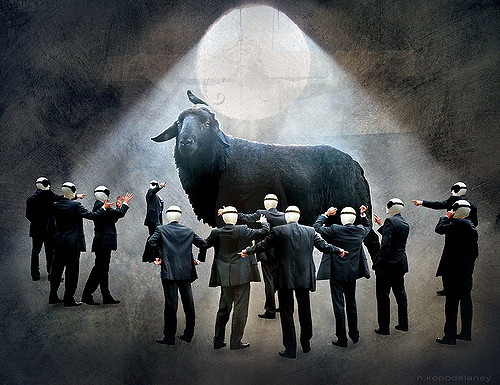
The Scapegoat

 Then Aaron shall lay both his hands on the head of the live goat, and confess over it all the iniquities of the people of Israel, and all their transgressions, all their sins, putting them on the head of the goat, and sending it away into the wilderness by means of someone designated for the task. The goat shall bear on itself all their iniquities to a barren region; and the goat shall be set free in the wilderness.
Leviticus 16:21-22

It was a gorgeous summer evening last night. Wendy and I headed to Des Moines as the guest of some fellow Cubs fans for a game between the Iowa Cubs and the Oklahoma City Dodgers. It was one of those nights for our boys of summer. They gave up five runs in the first and then couldn’t manage to get more than a couple of hits the rest of the evening.

As the evening wore on and our defeat became more certain, our section began to find raucous reasons to celebrate little victories. Our friends and ball park neighbors began swapping Cub stories. At some point the conversation turned to the tragic event for all Cubs fans in this generation: the Bartman ball. It was the National League Championship Series and our Cubs were just a few innings away from their first World Series since 1945. A fly ball to left might have been caught by the left fielder but a Cubs fan reached out to catch the ball and the fielder’s attempt at the put out was thwarted. The left fielder went ballistic and cussed out the fan. The crowd turned on the fan as the Florida Marlins scored several runs which turned into a run of victories and the Cubs hopes for a World Series were, once again, tragically thwarted.

The fan in question became the center of ridicule for a nation of Cubs fans. A life-long Cubs fan himself, he was blamed for the team’s tragic end. He had to be escorted from the game and eventually moved away from the region.

In 2011, an ESPN documentary entitle Catching Hell took a long hard look at the incident as a classic example of “scapegoating” in the world of sports. The word “scapegoating” and its legacy come from today’s chapter in Leviticus 16. In the ancient Hebrew sacrificial system, once a year the High Priest would metaphorically place all of the sins of the nation on one goat. That goat was then taken to a barren place in the wilderness and released. The word picture was that the sins, guilt and blame of many was placed on one to be carried away in banishment.

Scapegoating happens in every level of societal systems. There are plenty of examples in the world of sports, and it isn’t just about sports. Children become the scapegoats in families, ceaselessly blamed for everything bad that happens within the system A spouse can be scapegoated within marriage. An employer or employee can become a scapegoat for business woes. A political figure can be scapegoated for the woes of a city, a state, or the nation. It is at the core of fallen humanity. We seek to blame someone else for the ills we experience.

Over a decade later, our discussion of the Bartman ball took on a more civilized and objective tone last night. It wasn’t right. If the left fielder had been strong enough to shrug off the interference and casually return to his position, the game and the season may have ended differently. The discussion turned inward. One of our party admitted that, had they been present, they would very likely have been swept into the sentiment of the crowd. Truth is, we all would.

This morning I’m thinking about my own penchant for scapegoating. I’m pondering ways in which I focus blame on others for painful circumstances in my own life. It’s not fun to admit, but it is, universally, a very human thing to do. Perhaps that’s why God sought to make it part of the Hebrew sacrificial system. We need to be reminded regularly. We need more than a scapegoat. We need a savior. God would address that too…

The next day John [the Baptist] saw Jesus coming toward him and said, “Look, the Lamb of God, who takes away the sin of the world!

chapter a day banner 2015

featured image from Hartwig HKD via Flickr