These were the divisions of the descendants of Aaron: The sons of Aaron were Nadab, Abihu, Eleazar and Ithamar. 1 Chronicles 24:1 (NIV)
One of the most common criticisms I hear made regarding the Bible is that it doesn’t fit together. And, to a casual 21st-century reader who is expecting a simple, chronological story by a single author, I can totally understand how it’s easy to come to this conclusion. After over 40 years of reading and studying this Great Story, which does begin in the beginning and ends with the end (and a new beginning), I actually find the opposite. More and more, I’m blown away by the connections that tie the Great Story together. Like the one I found today.
Today’s chapter is a list of the descendants of Aaron who were appointed priests to offer sacrifices and offerings in the Temple according to the Law of Moses. Aaron was Moses’ brother, and the entire Hebrew worship system was instituted roughly 1400 years before Jesus. The Chronicler is writing his account roughly 400 years before Jesus. Among the lists of the “houses” or families of priests assigned regular sacrificial duties was the house of Abijah (vs. 10). If I put my finger in our 1 Chronicles chapter and flip forward to the first chapter of Luke, I find that Zechariah, the father of John the Baptist, was from the house of Abijah as he received an angelic visit regarding his son’s miraculous birth.
From Aaron in the book of Exodus to the Chronicler’s list of priests in 1 Chronicles to Jesus’ story in Luke, the descendants of Aaron and their role in the Hebrew worship system connect the history and the Great Story across eighteen hundred years. That’s like me being able to connect my family tree back to 500 A.D. I find that amazing.
As I meditate on these new connections I made in what is arguably one of the most boring and seemingly irrelevant chapters in the entirety of Scripture, I am reminded why I continue this chapter-a-day journey and why I continue to study it from beginning to end. It never ceases to reveal more and deeper lessons of Life and Spirit. It also continues to meet me where I find myself on life’s road, to reveal the lessons I need for the moment I am in.
If you know anyone who might be encouraged by today’s post, please share.
The Priesthood, Then and Now (CaD 1 Chr 6) –
Wayfarer
But Aaron and his descendants were the ones who presented offerings on the altar of burnt offering and on the altar of incense in connection with all that was done in the Most Holy Place, making atonement for Israel, in accordance with all that Moses the servant of God had commanded. 1 Chronicles 6:49 (NIV)
The Temple Mount in Jerusalem is arguably the most contested plot of ground on the earth. If you look at the featured photo you can see that the Al-Aqsa Mosque with its iconic golden dome and its walled courtyard sits perched on top. Many feet below is the uncovered Western wall of the Jewish temple, known as the Wailing Wall where thousands come daily to pray. You might also notice the constructed stairway from the top of the mount (under Muslim control) into the courtyard below (under Jewish control). The “mountain” is sacred to both Muslims and Jews, and the tension is ever-present.
I happened to visit the area during what is known as the 2nd Intifada in which Israel was regularly under terrorist attack. Our group was small. There were only five of us, and so we found ourselves slipping into a tour group of Jewish students to hear more about the Temple Mount, its excavation, and its future. Jerusalem is a popular tourist spot for Christians, Jews, and Muslims and you have to know that tour guides and hosts are well aware of the constituency of the groups when making their presentations. As five tag-along Christians at the back of a bunch of Jewish students, we were treated to the unabashedly Jewish presentation complete with a few jokes that disparaged Jesus and Christian beliefs.
I found it fascinating to learn that among certain Jewish groups, there are intricate plans already established for the rebuilding of a Jewish temple on the Temple Mount. The plans even allow for a return to the system of sacrifices and offerings laid out in the law of Moses. My first question was how this was even possible given the fact that only the sons of Aaron could be priests and offer sacrifices and only Levites could perform the other duties of the Temple. All of the genealogical records were destroyed with the Temple by the Romans in 70 A.D. I casually asked someone how a return to the sacrificial system could even happen since no one knew who were direct descendants of Aaron and Levi. The response was that geneticists are working on that through DNA.
Good to know.
Of course, all of those plans are predicated on the Muslims losing control of the Temple Mount and the destruction of their sacred mosque. And suddenly you have a microcosm of the conflict, rooted in thousands of years of history, that repeatedly spills over into violence to this day.
In today’s chapter, the Chronicler focuses on the tribe of Levi. In particular, he gives top billing to the descendants of Levi’s great-grandson, Aaron. They alone were the priests who could offer sacrifices according to the instructions given to Moses. As I meditated on this, I couldn’t help but consider that the Chronicler was sitting in exactly the same position our Temple Mount tour guide was hoping to be. The Temple had been destroyed by the Babylonians. The Chronicler’s generation had rebuilt it. The question I asked after our tour was extremely relevant to the Chronicler and his generation around 400 B.C. It was critical to establish the lines of Levi and Aaron so that the Temple could function properly according to the Law of Moses.
In the quiet this morning, my meditations led, as usual, to the teaching of Jesus. The week Jesus was to be executed He told His followers that the Temple would be destroyed. Exactly one generation later, the Romans fulfilled His prophetic prediction, and with the destruction of the genealogical records, the entire sacrificial system itself was dead and buried. The paradigm completely shifted. As the author of Hebrews wrote:
Unlike the other high priests, [Jesus] does not need to offer sacrifices day after day, first for his own sins, and then for the sins of the people. He sacrificed for their sins once for all when he offered himself. Hebrews 7:27 (NIV)
As a disciple of Jesus, it doesn’t end there. The shift of paradigm goes a step further. For those who are spiritually in Christ, we are adopted as children of God and thus are children of the King and High Priest, Jesus. This is why Peter referred to all of his fellow believers as “a royal priesthood.” As a member of that priesthood, I am called upon to make a sacrifice, the sacrifice of myself. As Paul wrote to the believers in Rome:
Therefore, I urge you, brothers and sisters, in view of God’s mercy, to offer your bodies as a living sacrifice, holy and pleasing to God—this is your true and proper worship.
And as Jesus said,
“Greater love has no one than this: to lay down one’s life for one’s friends.”
And so, I enter another day on the journey; A priest endeavoring to sacrificially give myself for the sake of others.
If you know anyone who might be encouraged by today’s post, please share.
[Job] replied, “You are talking like a foolish woman. Shall we accept good from God, and not trouble?” Job 2:10 (NIV)
I’m getting to a place on life’s road in which retirement sits on the horizon. I have friends who have already retired, and retirement thoughts and plans has suddenly become a more frequent topic of conversation.
I’ve observed that retirement seems to be a piece of “the American dream.” We’re told to plan for it, save for it, and get ready to “enjoy” life in our golden years. It’s easy to feel that I have a right to those promises of a “good life” in the retirement years like you see on every drug commercial. I put in all of those years of work, and the financial planner promised that my savings and investments will allow me to do the things I want to do.
Over the past decade, I’ve watched my mother suffer and die from Alzheimer’s. I’ve watched my father suffer from cancer as well as a viral infection that almost killed him and put him in nursing care for months. I know it’s not the life my parents envisioned in their seventies and eighties. It’s easy to feel a certain sense of injustice in it all.
The prologue of Job (chapters 1-2) sets up a divine relational triangle. God and Job have a good relationship going. Both are happy and content with one another. Job is grateful and faithful to God, ritually providing offerings even for his children that they would be pure in their relationship with the Almighty (Job 1:5). This is an important piece of the story for me to understand before embarking into the main text of the story.
In the ancient near east, the Hebrews had a very different understanding of God than the other cultures surrounding them had of their many gods and goddesses. The other religions of Job’s day viewed gods as higher beings, like super humans who were very human-like. The notion was that the gods got tired of providing for themselves, digging irrigation systems, raising crops, building homes for themselves, and et cetera. So, they believed that the gods created humans to serve them, provide them with a home and daily needs (a temple or shrine, with food (offerings and sacrifices), and to care for the gods in every way. Humans were essentially a slave labor force. The gods provided for humans in order that humans could provide for them. This is referred to as “The Great Symbiosis.”
In contrast, the God of Hebrews revealed Himself in a covenant relationship of His own prompting. He asked for ritual offerings and sacrifices like the other gods, but not because He needed humans for anything. God promised to provide and protect the Hebrews, but not because He desired anything other than relational fidelity from them. God simply wanted to be in a faithful covenant relationship with His creation, a covenant relationship very much like a marriage. Marriage is used as a metaphor for the relationship of God and humanity throughout the Great Story, especially by the prophets and later by Jesus.
The third member of this relational triangle revealed in the prologue of Job is Satan. The Hebrew word satan means “accuser” or “adversary.” Satan attempts to drive a relational wedge between God and Job (I can’t help but see a literary parallel to Iago driving a wedge between Othello and Desdemona in Shakespeare’s Othello). Satan’s accusation is that Job is faithful to God only because of a “Great Symbiosis” type relationship like the other gods of the near east. Satan contends that Job is only faithful because God has provided for him, protected him, and blessed him. Take away his wealth, the blessing of his children, and (in today’s chapter) his health, and Job will certainly lose his faith and curse God.
We’ll never know a certain diagnosis of what Job was afflicted with, but within the rest of the story he describes symptoms of festering sores from head-to-foot, nightmares, hallucinations, fever, weight loss. His physical appearance was frightening. The fact that his three friends put ashes on their heads (an ancient sign of grieving for the dead) when they saw him basically meant they considered Job as good as dead. Job’s wife certainly believed that Job would be better off dead, and urges him to essentially commit suicide by cursing God and prompting God to finish him off.
Despite his agony, Job refuses to do abandon God or curse him. He asks his wife another one of the big questions that resonate throughout the entire story, and that resonates with me in my own life: “Shall we accept good from God, and not trouble?”
In the quiet this morning, I focused on the fact that Satan exits the story upon his affliction of Job and Job’s refusal to curse God. We’ll neither see nor hear from the Accuser again in this story. Job will question God, plead with God, and complain to God, but never will he curse God. The accuser is proven wrong. Now the questions that remain for next 40 chapters are how on earth did Job endure? How does Job make sense of his circumstances? Why would God allow this suffering?
In the quiet, I’m also reminded that Jesus never promised His followers an easy life. Quite the opposite, He said: “I have told you these things, so that in me you may have peace. In this world you will have trouble. But take heart! I have overcome the world.” (John 16:33)
If you know anyone who might be encouraged by today’s post, please share.
Then the Lord said to me: “Even if Moses and Samuel were to stand before me, my heart would not go out to this people. Send them away from my presence! Let them go!” Jeremiah 15:1 (NIV)
I was really struggling with my current waypoint on this life journey. I knew where God had led me and was continuing to lead me but I didn’t want it. At least, I was afraid of it for all sorts of reasons. I wanted to run away.
One Sunday morning we were among our local gathering of Jesus’ followers. Every week there are people available to pray with and over those whoever needs it. I thought about going up for prayer, but was fighting with myself internally about doing so. Then, ironically, Wendy leaned over and whispered in my ear that she thought I should go up for prayer.
As my spiritual sister was praying over me, her hand on my heart, she suddenly just stopped praying. She was quiet and said nothing for a long moment. She then told me that, in her mind’s eye, she had been given an image of me as a little boy. “It’s like the first day of school and you know you need to go. You know it’s the right place for you to be, but you’re anxious and afraid and don’t want to be there. Father God just wants you to take His hand. He will walk with you where you need to go.”
I began to weep.
You see, what she didn’t know is that when I was a child, on the first day of school, my mom had to take me kicking and screaming into my kindergarten class. In fact, a few minutes into the class I got up, ran out the door and ran all the way home to plead with my mom not to make me go. My kindergarten teacher ran down the sidewalk after me. She was wearing heels. I got the “Walk” sign at the traffic light on the corner. Of course, mom drug me right back to school kicking, screaming, and crying. I recall her having to do so several times in those first weeks.
When I told my dear sister this, and why I was crying, we then shed a few tears together and a hug.
Here I am over 50 years later and I’m spiritually still having to learn the same lesson that I had to physically learn when I was five years old.
The story of God’s relationship with the Hebrew people is, in itself, a word picture of spiritual lessons like the one I just described.
God delivered the Hebrew people from being slaves in Egypt. Working through Moses, God pursued, delivered, provided for and then made a covenant with the Hebrew tribes to be in relationship with them just like a husband and wife make a covenant to be in relationship with one another.
Fast forward about 800 years and the marriage between God and the Hebrews is on the rocks. She’s a serial adulterer constantly breaking covenant and chasing after other gods.
In today’s chapter, God begins with the statement that even if Moses were to stand before Him to plead for the Hebrew people, it wouldn’t not change His mind. He then says “Let them go!”
What did God through Moses repeatedly tell Pharaoh?
“Let my people go!”
Later in the chapter, God says, “I will enslave you to your enemies in a land you do not know.”
The Hebrews had not spiritually learned the lesson that God was trying to physically teach them in their infancy as a nation. God physically freed them from slavery in Egypt only to have the Hebrews spiritually give themselves over to be slaves of sin and idolatry. The consequences? Back to physical slavery in Babylon to learn the lesson that wasn’t learned 800 years earlier.
In the quiet this morning, I’m reminded of an observation I’ve repeatedly made along my spiritual journey. God doesn’t work like the American educational system in which you keep moving up a grade whether or not you actually learned anything during the school year. In God’s Kingdom system, I have to actually learn the lesson before I get to move up to the next level of spiritual maturity. Jesus expressed frustration with His disciples regularly. “Where is your faith?” He would ask along with “Why are you so afraid?” When those same disciples couldn’t drive the demon out of a boy, Jesus responded, “You unbelieving and perverse generation. How long shall I stay with you? How long shall I put up with you?”
When Paul wrote the believers in Corinth he complained that they should have spiritually matured to eating solid food, but they were spiritually still bottle feeding on milk. It’s possible, he implies, for people to remain spiritual babes sucking on the bottle and never graduate to solid food.
It’s possible for the Hebrews to have never learned the spiritual lessons of God’s very real deliverance, protection, and provision during the Exodus.
It’s possible for me to have not learned the very real lesson of kindergarten and to be spiritually afraid and anxious of where I know I need to go and am being led by God’s hand.
In the quiet this morning, I enter this Good Friday mindful of Jesus going where He needed to go, led by the Father’s hand. I’m equally mindful of the reality that it is possible for me to be freed and delivered from my enslavement to sin, only to willingly allow myself to be enslaved once more. And God will let me enslave myself just as He let the Hebrews enslave themselves, if I fail to learn the lesson.
If you know anyone who might be encouraged by today’s post, please share.
“As for you, go your way till the end. You will rest, and then at the end of the days you will rise to receive your allotted inheritance.” Daniel 12:13 (NIV)
The spiritual journey is a faith journey. The author of Hebrews famously defined faith as “assurance of what we hope for, evidence of that which we do not see.” Jesus reminded Nicodemus that the word for spirit in Hebrew is the same word as wind:
“The wind blows wherever it pleases. You hear its sound, but you cannot tell where it comes from or where it is going. So it is with everyone born of the Spirit.” John 3:8 (NIV)
I’ve always loved that metaphor of wind as spirit. I can’t see the wind, I can only see the evidence of its presence and effect. Jesus provided a parallel metaphor regarding the effect of the Spirit in a person’s life being evidenced by the “fruit” of that person’s life. The evidence of the invisible Holy Spirit’s blowing in and through a person’s life is an increasing amount of love, joy, peace, patience, kindness, gentleness, goodness, faithfulness, and self-control.
I got to thinking about this as I read the final chapter of Daniel. It ends rather abruptly with the end of his prophetic vision regarding the end of days. Daniel himself is confused and perplexed. “I don’t understand,” he pleads to the angel who showed him the vision.
His humble acknowledgment of his ignorance resonated deeply within me. Like most people, I like facts, evidence, and certainty. The spiritual journey, however, is rife with mystery. There are a lot of moments along the way that I, like Daniel, shrug my shoulders and plead, “I don’t get it.”
What fascinated me in the quiet this morning was the angel’s twice-repeated response: “Go your way, Daniel.” Keep pressing on in the journey. Have faith. Stick to the Spirit’s path. Trust the evidence you feel like a soft breeze in your spirit even though you don’t see it. Be assured that the mystery is not something you can’t understand but that which you will endlessly understand. Press on to the journey’s end when you will fully know that which you always merely believed
If you know anyone who might be encouraged by today’s post, please share.
[King Josiah] stood by the pillar and renewed the covenant in the presence of the Lord—to follow the Lord and keep his commands, statutes and decrees with all his heart and all his soul, thus confirming the words of the covenant written in this book. Then all the people pledged themselves to the covenant. 2 Kings 23:3 (NIV)
One of the common themes of all great stories is when the hero loses his or her way. We see it in Luke Skywalker in Star Wars Episode VIII as he has chosen self-exile. Ron Weasley similarly chooses out in the Deathly Hallows. Edmund loses his way and follows the White Witch in The Lion, the Witch, and the Wardrobe. In The Hobbit, it is Bilbo who loses his way in the Misty Mountains where he happens to find a plain-looking golden ring in the darkness. Despite his insistence that he would never fall away, Peter denies that he knows Jesus three times.
Along my spiritual journey, I have come to embrace that losing one’s way is a common theme for a lot of us. As I look back on my own life journey, I can humbly point back to a period of time I call “the dark years,” in which I lost my way and made many regrettable choices.
In the Great Story told between Genesis and Revelation the theme of losing one’s way is recurring. From the Hebrew tribes “wandering in the wilderness” for 40 years to the exile of Israel and Judah in Assyria and Babylon to Jesus’ parable of the Prodigal Son, the tale of losing one’s way is a familiar one.
In today’s chapter, King Josiah reads the recently discovered Books of Moses to his people. We have no idea how long it had been since the story of Moses delivering the Hebrews from slavery in Egypt and God establishing a covenant with them had been read. It says in today’s chapter that the annual Passover Feast prescribed by God had not been celebrated “neither in the days of the judges who led Israel nor in the days of the kings of Israel and the kings of Judah.” That’s somewhere in the neighborhood of 800 years.
Today’s chapter is essentially about coming home, the Prodigal’s return, and the hero finding his or her way back to the path. Luke shows up to deliver the rebel forces in stunning form. Ron returns just in time to save Harry. Edmund is redeemed and restored by Aslan. Bilbo finds his way back to Thorin and Company with the ring that will help him facilitate the overthrow of Smaug. Jesus restores Peter on the shore of Galilee with three affirmations of his calling. Josiah leads the nation in renewing their covenant with the God who delivered and established them.
In the quiet this morning, I’m reminded that losing one’s way is a very common story. Jesus told stories about lost coins and lost sheep as well as a lost child. The stories are ultimately not about being lost, but about being found. The Shepherd risks the entire flock to search for the lost sheep until it’s found. The Prodigal’s father waits patiently and expectantly on the porch to catch sight of his child’s return. The found book helps Josiah and God’s people to find their way back to God.
I once was lost, but now I’m found.
For the spiritual pilgrim, there’s both encouragement and hope in the revelation that God expectantly desires that I find my way back to Him.
If you know anyone who might be encouraged by today’s post, please share.
Samson said to them, “Since you’ve acted like this, I swear that I won’t stop until I get my revenge on you.” Judges 15:7 (NIV)
Along my life journey, I have known certain individuals who became antithetical life examples for me. In other words, they were individuals whom I regarded as persons I never wanted to be like. It might have been their actions, their attitudes, or the way they treated others. Looking back, I’m grateful for them. I believe there have been waypoints on life’s journey where I was more motivated by who I didn’t want to be as much as I was who I did want to be. God has used both motivations in my story.
This explains the love-hate relationship I’ve always had with the person of Samson. The boy-child in me loves the stories of legendary heroes and superheroes and their save-the-day heroics. Samson’s legendary birth, size, and strength, along with his legendary feats, certainly fit into that category.
The problem is that Samson is a jerk. He’s selfish, impetuous, shallow, reactive, vengeful, and driven by his base appetites. He also makes continuously foolish choices.
It took me a long time to realize that this was the very point God is trying to make in Samson’s story.
Samson’s story is the story of the Hebrew people themselves.
Samson is divinely birthed and set apart from the beginning, just as the Hebrews were going all the way back to God’s promise to Abraham.
Samson was called by God to live differently than everyone else by taking a life-long Nazarite vow never to drink and never to cut his hair, just as the Hebrews were called by God to live differently than all the other people groups around them by keeping His law and commandments.
Samson lustfully desired and chased after Philistine women rather than women from his own tribes, just as the Hebrews lustfully chased after other gods rather than remaining faithful to God.
Samson’s impetuousness and foolish choices perpetually lead to violent and chaotic ends, just as the Hebrews’ foolish alliances and relationships with other nations lead to similar ends.
Samson’s story is the story of the Hebrew people. Samson is an antithetical example. He was special from the beginning. He is God’s man. He is divinely gifted. He has a calling and a purpose. Yet, all he does is act foolishly, get himself into trouble, and live selfishly.
And God continues to bless Samson, give him strength, deliver him, and miraculously provide for him.
“Remind you of anyone?” God is asking His people through the person of Samson.
He’s also asking me the same question as I read the story.
Looking back on my own life, my own story, how many times has God blessed me in ways I never deserved? How many times have I acted selfishly, impetuously, and foolishly? How many times have I allowed my own tragic flaws to get me into trouble even though I know I’m making the same mistake I’ve made before and I know where it leads? How many times have I been unfaithful to what God asks of me, only to have God remain steadfastly faithful to me?
I don’t want to be a Samson!
“Good,” God’s spirit whispers. “I don’t want that either. Remember that today as you live, speak, think, and make decisions. Don’t be a Samson.”
If you know anyone who might be encouraged by today’s post, please share.
“Now I am about to go the way of all the earth. You know with all your heart and soul that not one of all the good promises the Lord your God gave you has failed. Every promise has been fulfilled; not one has failed.” Joshua 23:14 (NIV)
When I was a young man, I was part of an organization that had enjoyed strong leadership for a number of years. In fact, it was one of the strong leaders who invited me to participate. It was obvious that over time the organization had grown, enjoyed repeated success, and became increasingly influential. I learned a tremendous amount in my first few years. Some of the lessons have helped me throughout my entire life.
Then the senior leadership left the organization.
It was one of the first experiences in my journey (there have been others) in which a change in leadership completely changed the system for the worse. In this case, the new leadership was tragically unprepared for the role they’d been given. Over the course of a few years, I watched the entire system implode.
In today’s chapter, we’re reaching the end of Joshua’s life. Since Moses showed up to lead the Hebrews out of slavery in Egypt, the tribes have benefitted from having a strong leader in charge. Moses led them out of Egypt to the Promised Land then Joshua led them to conquer the land and settle in it. Having finished the task, Joshua knows that his earthly journey is nearing its end. He calls the nation together to deliver a final message to them.
We’re on the verge of a massive change in leadership.
Joshua structures his message to the people as nations in that day structured treaties with one another. In presenting this treaty, Joshua assumes the role of God’s representative who is making a treaty with the nation. The people are reminded of all that God has done for them, reminded of God’s command to have no other gods, and warned that failure to keep those commands will have disastrous consequences. Just as God has kept his promises, Joshua explains, He will also make good on His warnings should they fail to keep their end of the covenant.
There is a major issue looming in the background as we approach the end of the Joshua administration. There’s no succession plan.
The fledgling Hebrew nation is made up of millions of people, scattered into twelve tribes, each made up of numerous family clans. Think of it as the 48 contiguous states in America with no central federal government. What’s going to keep them together? What happens to the small tribes when there are no checks and balances on the power and influence of the larger tribes? How do you keep tribal relationships from breaking down into feuds and civil wars?
Humanity is still in the toddler stage of development and relationship with God. Today’s chapter reads like a parent laying down the law with a three-year-old: “Do what I tell you because I know what’s good for you and have your best interests at heart. If you don’t do what I tell you, there will be consequences you’re not going to like.” Having parented a couple of three-year-olds, I can tell you confidently that eventually there will be willfulness, disobedience, attitude, stubbornness, and tantrums. There are always tantrums.
In the quiet this morning, I find myself recalling some of the best leaders I’ve worked with along my life journey and the things I learned from them. I’m whispering prayers of gratitude for all that I’ve learned through both relationship and example. As I have trekked along this life journey, I have learned that for the good of the group I’m leading, it’s important to try and have a succession plan, whenever I knew I would be leaving a leadership position. I’ve experienced both success and failure in that department.
And, I’m thinking about the Hebrew tribes, about to lose their central leadership with no succession plan. The next stage in their national development is not going to be pretty.
There will be tantrums.
If you know anyone who might be encouraged by today’s post, please share.
Judah became God’s sanctuary, Israel his dominion. Psalm 114:2 (NIV)
Along my journey, I have experienced discord and division among any number of groups to which I belonged. This includes family, churches, community organizations, and most recently, a nation.
When division happens, no matter the size or scope of that division, it creates so much relational mess in its wake. Suddenly, individuals who love one another find themselves on opposite sides of a topic or circumstance. Mental lines get drawn. Emotional trenches are dug. A relational no man’s land grows between, and neither party feels very much like being the one to crawl out of the trench and initiating the crossing of no man’s land.
It’s hard.
Today’s chapter, Psalm 114, is the second in a series of Ancient Hebrew songs known as the Hallel, which is sung each year at the Passover feast which celebrates God’s deliverance of the Hebrews from slavery in Egypt. Like yesterday’s psalm, it is sung before the Passover meal. In eight simple verses, the song overviews the major events of their exodus out of Egypt, through the wilderness, and into the promised land. As yesterday’s chapter was metaphorically the “call to praise” of the Passover feast, today’s chapter is, metaphorically, a prologue that overviews the journey participants will take through the feast.
What struck me the most as I read this morning was the second verse:
Judah became God’s sanctuary, Israel his dominion.
Casual readers are likely to miss the weight of this verse for the ancient Hebrews who sang it back in the day. Scholars say that the song was penned during a period in Hebrew history known as “the divided monarchy.” The twelve tribes of Israel were divided into two nations. Two tribes, led by Judah, became the southern nation of Judah with Jerusalem as its’ capital. The other ten tribes joined into the northern nation of Israel. There was perpetual discord, division, and civil war between the two.
As with any event of human discord and division, there was the drawing of mental lines, digging of emotional trenches, and the development of relational no-mans-lands.
The Passover feast, to which all good Hebrews were expected to attend and participate in was held in Jerusalem at Solomon’s temple in the capital city of Judah. This meant that the faithful who lived in the northern nation of Israel had to cross no-mans-land. I can only imagine the relational tension that existed in the city on that week each year. A festival that was meant to unite the people in remembrance of the unifying event of their national identity became a political and religious powder keg. I can’t help but feel an acute identification with that reality in light of my own nation’s recent events.
In the quiet this morning I find myself thinking back to those divisions which I have experienced and which dot the timeline of my life as painful waypoints on my journey. Given time, I’m glad to say that I’ve experienced relational healing and reconciliation in certain relationships. In others, the relational division led to separate paths that I don’t expect to converge on this side of eternity. In yet others, I have made attempts to cross the emotional no-mans-land only to be greeted with an emotional fence of barbed wire. I must also confess that there are yet other circumstances in which I would say that I desire there to be reconciliation, but that desire has not led to my willingness to initiate a crossing of no-mans-land. Those are the ones that lay heavy on my spirit this morning.
I find it ironic that my chapter-a-day journey happens upon the Passover Hallel on this week when followers of Jesus begin the annual spiritual pilgrimage with Jesus to Jerusalem, to crucifixion, and to resurrection. The final, climactic events of Jesus’ earthly life happened during the week of Passover. Followers of Jesus see the two events as spiritually akin. Moses led the Hebrews out of slavery in Egypt to the promised land. Jesus led any who will follow out of bondage to sin, through the wilderness of this earthly journey, to an eternal promised land.
It’s also ironic that today happens to be known as Ash Wednesday, which it the opening event of the season follower call Lent. It’s the day we are called to Spirit mode to embark on a spiritual journey of remembrance with Jesus to the cross. Just like yesterday’s chapter and today’s chapter called the Hebrews to the spiritual journey of remembrance with Moses to the promised land. (By the way, I didn’t plan this!)
I find myself answering the call to that annual journey this morning in the quiet of my office. I find myself thinking about those relationships on the other side of no-mans-land. Holy Spirit whispers the words of Jesus to my spirit:
“This is how I want you to conduct yourself in these matters. If you enter your place of worship and, about to make an offering, you suddenly remember a grudge a friend has against you, abandon your offering, leave immediately, go to this friend and make things right. Then and only then, come back and work things out with God.”
The Lord has sworn and will not change his mind: “You are a priest forever, in the order of Melchizedek.” Psalm 110:4 (NIV)
I confess. I am a Tolkien nerd. I have been most of my life. Before the advent of cell phones I would typically read The Lord of the Rings once a year. Now, I have it on audiobook and will often listen to it when I can’t sleep. Once I got a text from my daughter asking me, “Do you know the name of Theoden’s horse?”
I immediately replied. “Of course. Snowmane.”
She then texted. “Thanks. Playing pub trivia and I knew you’d know.”
But I couldn’t let it go at that. I then added:
“Gandalf’s horse is Shadowfax. Sam’s pony is Bill. Glorfindel’s horse is Asfaloth. Aragorn’s horse is Hasufel. Legolas’ horse is Arod.”
Okay. I was showing off and geeking out. Maybe I have a problem.
Geeking out came to mind as I read today’s chapter, Psalm 110, because it contains a geeky reference in the Great Story that I find even life-long followers of Jesus to be largely unaware. It is the mysterious character of Melchizedek.
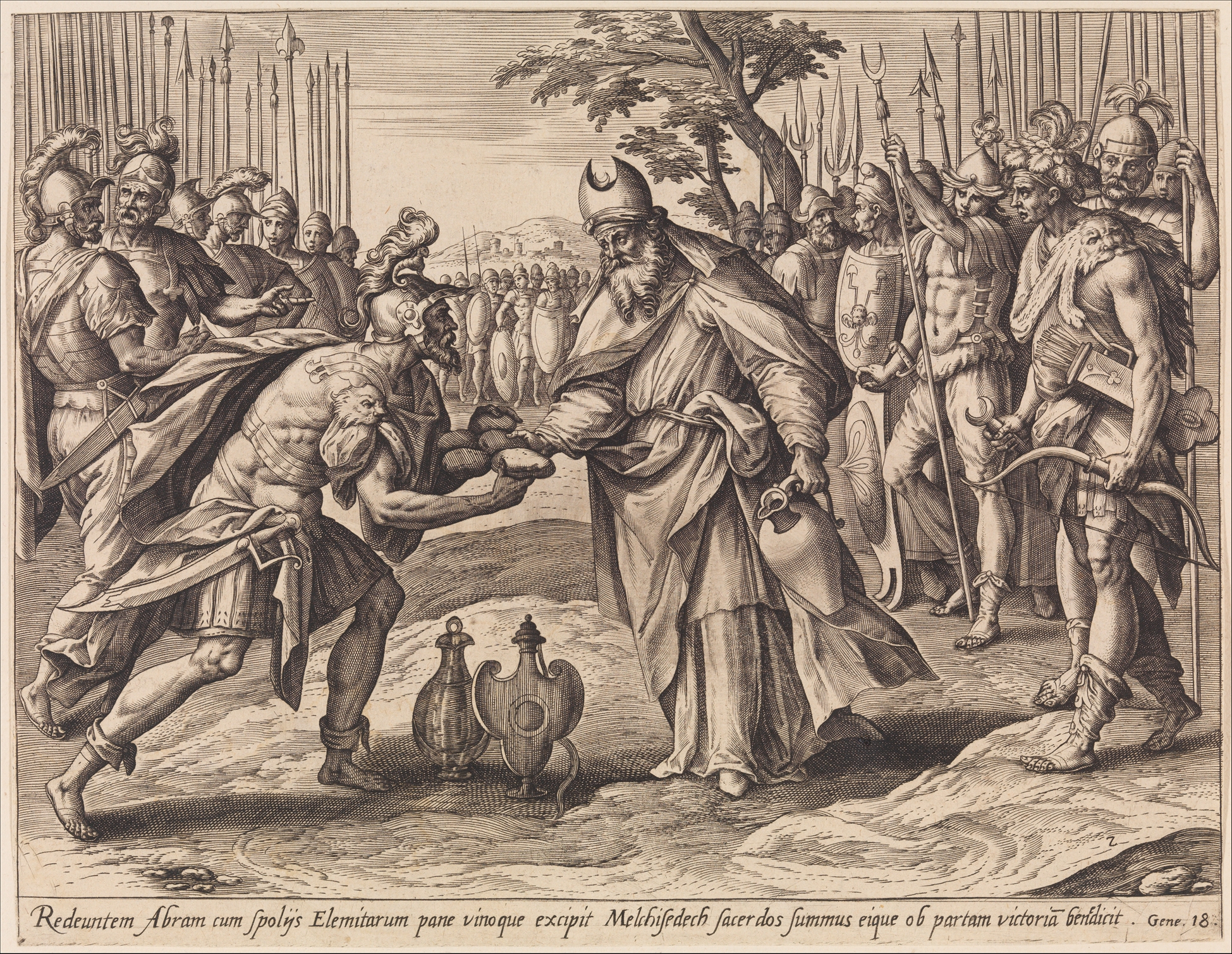
Melchizedek makes his appearance towards the very beginning of the Great Story when God calls Abraham:
Then Melchizedek king of Salem brought out bread and wine. He was priest of God Most High, and he blessed Abram, saying,
“Blessed be Abram by God Most High, Creator of heaven and earth. And praise be to God Most High, who delivered your enemies into your hand.”
Then Abram gave him a tenth of everything.
Genesis 14:17-20 (NIV)
That’s it. That’s the only reference to him and that’s all we know about him. And this is where the mystery begins. In the Great Story Abram is the first of the Hebrew “patriarchs.” At this point in the story, there are no Ten Commandments, no system of worship (which came through Moses centuries later), no record of any kind of formal “priesthood.” So, who is Melchizedek? Where did he come from? How did he become “priest of God Most High” and what exactly did that mean?
We. Don’t. Know.
So, why is he important?
In the Hebrew system of worship that God prescribed through Moses, the “priesthood” was relegated to Aaron and his descendants. If you weren’t in the line of Aaron then you couldn’t be a priest. When the law and sacrificial system was established through Moses the Hebrews had no “king.” It would be centuries before they established a monarchy. When they did, the line of King David was established as the royal line through which the Messiah would come. So, if the Messiah was to be both King of Kings (from the royal line of David) and eternal High Priest (and only descendants of Aaron could be priests) how is that possible?
David wrote the coronation song, Psalm 110, that prophetically provided the answer. Some scholars say that Psalm 110 is the most directly prophetic of all the psalms, but that isn’t easily understood by the casual reader. David references the mysterious priesthood before Moses and before Aaron. He connects the Messiah with the shadowy figure of Melchizedek, “priest of God Most High,” who “brought out bread and wine“ (sound familiar?). The early followers of Jesus saw it and the author of the New Testament book of Hebrews (also a mystery) fleshed it out. The priesthood and sacrificial system of Aaron was a temporary spiritual band-aid and living metaphor of what was to come. The ultimate, once-for-all sacrifice of Jesus was sourced in an eternal priesthood that was older, deeper, and (from a human perspective) infinitely mysterious.
The author of Hebrews writes:
“Melchizedek was king of Salem and priest of the Highest God. He met Abraham, who was returning from “the royal massacre,” and gave him his blessing. Abraham in turn gave him a tenth of the spoils. “Melchizedek” means “King of Righteousness.” “Salem” means “Peace.” So, he is also “King of Peace.” Melchizedek towers out of the past—without record of family ties, no account of beginning or end. In this way he is like the Son of God, one huge priestly presence dominating the landscape always.” Hebrews 7:1-3 (MSG)
In the quiet this morning I feel like I’m geeking out on the Great Story like I geek out on The Lord of the Rings so forgive me if this post leaves you rolling your eyes and/or scratching your head.
A faith journey isn’t about reason or it wouldn’t be faith. In the mystery of Melchizedek, I’m reminded that faith requires of me the humility to accept that there are truths that lie in mystery. They are deeper, older, and unfathomable this side of eternity. Once again, I am grateful to Richard Rohr for introducing me to the concept that mystery isn’t something that we can’t understand but something we endlessly understand. The further I get in my spiritual journey, the more I have come to embrace and enjoy the mystery.